Struggling with WASSCE Maths? Stop guessing. Let’s fix the gap step by step.
10 Diagnostic Questions to Find Your Weak Area in Mathematics

Diagnostic questions to find your weak area in mathematics should do more than give you a score. They should show you the exact small skill that is blocking your progress in Core Maths.
Many Ghanaian SHS learners say, ‘Sir, I am weak in Maths, because the whole subject feels heavy. But that statement is too broad to guide proper revision. A learner may be able to calculate well but fail to translate a word problem. Another may understand percentages but repeatedly choose the wrong base. Another may know the correct method but lose marks through signs, units, or poor checking.
The particular learner gap addressed in this post is the inability to trace repeated Core Maths mistakes to their real cause. When that gap is not corrected, the learner keeps revising whole topics, copying more examples and answering more questions without knowing what must change.
The Maths Clinic philosophy is simple: a wrong answer is not the final judgment on a learner. It is evidence. When the learner studies where the thinking broke down, the mistake becomes a map to the weak area that needs treatment.
This approach also fits Ghana’s standards-based secondary mathematics curriculum. Learners are expected to make sense of problems, explain their reasoning, apply knowledge, communicate mathematical ideas, and use suitable representations—not merely copy procedures. It is equally important for WASSCE, where questions may combine reading, interpretation, method selection, accurate working, and clear presentation.
| Maths Clinic diagnosis Do not ask only, “Did I pass or fail?” Ask, “Which exact skill caused the mark loss, and what evidence in my working proves it?” |
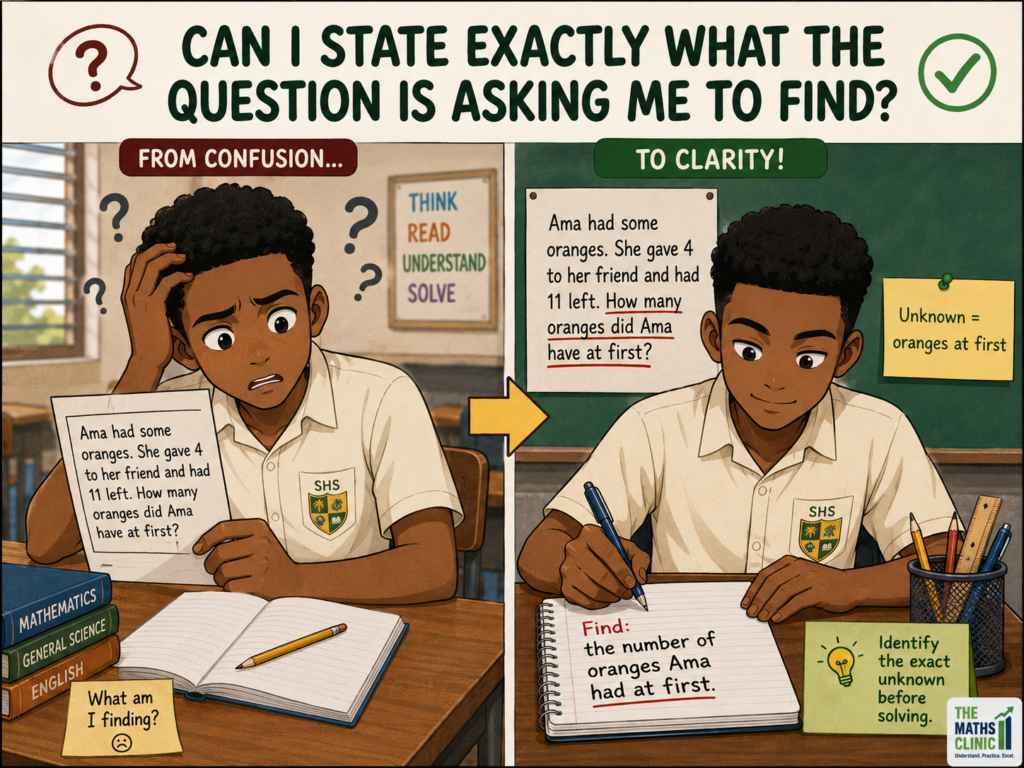
1. Can I state exactly what the question is asking me to find?
What this diagnostic question checks: reading, interpretation, and mathematical communication.
Why the weakness develops: Some learners see numbers and immediately begin calculating. They have not separated the information given from the quantity required. The learner may therefore solve a different problem from the one WAEC asked.
How it affects WASSCE Core Maths: A candidate may calculate simple interest when the question asks for amount, find area when perimeter is required, or give the probability of an event instead of its complement.
Learner action: Before touching the calculator, complete this sentence: ‘I am required to find ______.’ Then list what is given, including units and conditions.
| Likely weak area revealed: interpretation gap. You can perform operations, but you have not yet learned to translate the demand of a question into a clear mathematical target. |
2. Can I identify the topic when nobody names it for me?
What this diagnostic question checks: This checks topic recognition and transfer of learning.
Why the weakness develops: In class, the heading on the board tells you the topic. In WASSCE, the question may hide percentages inside profit, algebra inside an age problem, or geometry inside a scale drawing.
How it affects WASSCE Core Maths: When the topic is not recognized, the wrong method may begin from the first line. Neat working cannot rescue a method chosen for the wrong concept.
Learner action: Underline clue words, symbols, and visual features. Ask whether the question is mainly about change, comparison, relationship, shape, data, chance, or an unknown quantity.
| Likely weak area revealed: transfer gap—you know a method in a familiar lesson, but you struggle to recognize the same idea in a new context. |
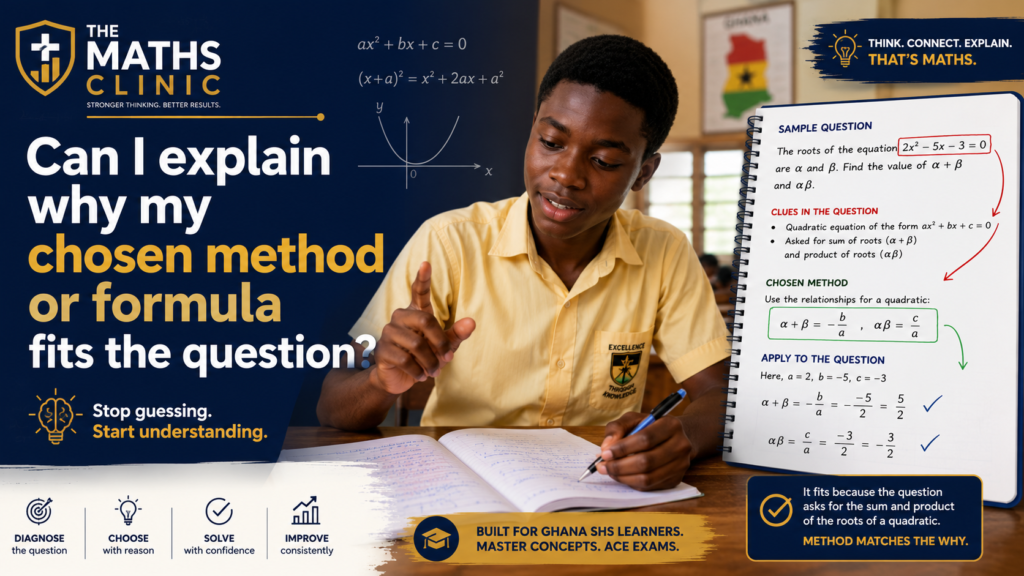
3. Can I explain why my chosen method or formula fits the question?
What this diagnostic question checks: This checks conceptual understanding rather than formula memorization.
Why the weakness develops: A formula can be remembered without being understood. The learner knows the letters but does not know the conditions, units, or relationship represented by the formula.
How it affects WASSCE Core Maths: This appears when time in months is entered directly into a per-annum formula, diameter is used where radius is required, or the gradient formula is applied with inconsistent coordinate order.
Learner action: Say what every symbol means, check the units, and explain in one sentence why the formula matches the information given.
| Likely weak area revealed Meaning gap: the formula is stored in memory, but its mathematical meaning has not become part of your understanding. |
4. Can I begin and complete a fresh question without looking at a worked example?
What this diagnostic question checks: This checks independent problem-solving and learner ownership.
Why the weakness develops: A learner can follow the teacher’s steps and still be unable to select the first step alone. Familiarity with a solution is not the same as mastery.
How it affects WASSCE Core Maths: WASSCE questions will not sit beside a matching classroom example. The candidate must decide what to do, arrange the steps, and check the result independently.
Learner action: After a lesson, close the notebook and solve two questions with changed numbers and wording. Explain each step aloud or in writing.
| Likely weak area revealed Dependency gap: the teacher or example is carrying the thinking that the learner must learn to own. |
5. Can I handle negative numbers, signs, and inverse operations correctly?
What this diagnostic question checks: This checks a foundation skill that supports algebra, graphs, and equations.
Why the weakness develops: Many learners use the phrase ‘move it to the other side’ without understanding balance and inverse operations. This encourages unexplained sign changes.
How it affects WASSCE Core Maths: One sign error can spoil linear equations, simultaneous equations, inequalities, substitution, gradients, and later steps that depend on the wrong value.
Learner action: Name the operation affecting the unknown and use the opposite operation on both sides. Write the balancing step when signs are troubling you.
| Likely weak area revealed Integer and inverse-operation gap: the visible error appears in algebra, but the root may be earlier number work. |
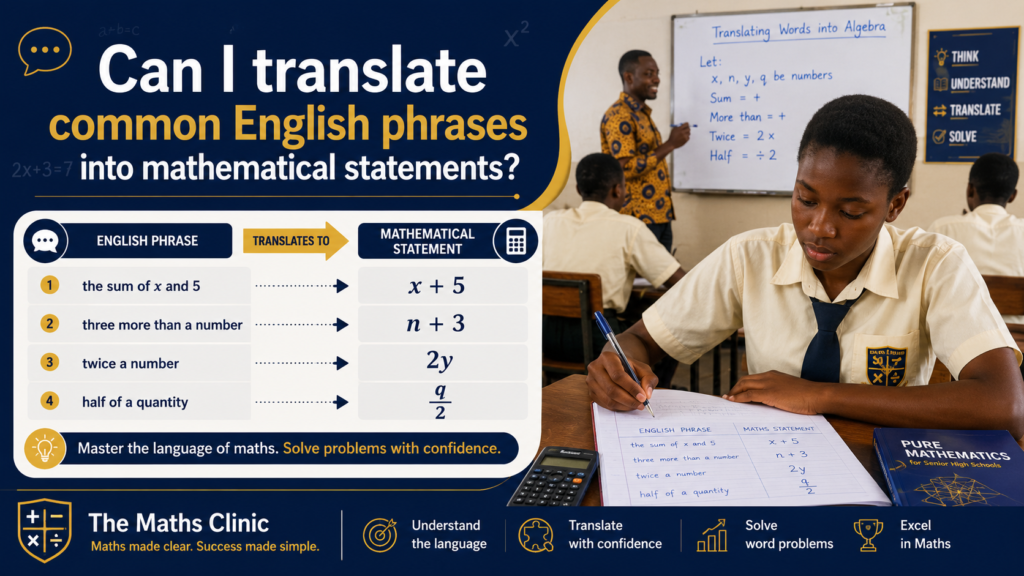
6. Can I translate common English phrases into mathematical statements?
What this diagnostic question checks: This checks the bridge between language and calculation.
Why the weakness develops: Some learners can calculate 20% of a number but cannot form an equation from ‘20% less than the original price.’ The obstacle is translation, not arithmetic.
How it affects WASSCE Core Maths: WAEC word problems often require candidates to identify an unknown, represent relationships, and form an equation before calculating.
Learner action: Translate one phrase at a time. For example, ‘six more than x’ becomes x + 6, ‘six less than x’ becomes x – 6, and ‘three times a number’ becomes 3x.
| A likely weak area revealed: Mathematical-language gap: you understand some calculations, but the words have not yet become symbols and relationships in your mind. |
7. Can I identify the correct base or whole in percentage and financial questions?
What this diagnostic question checks: proportional reasoning.
Why the weakness develops: Learners often treat every number mentioned as the base. But percentage change, profit, discount, and depreciation depend on the quantity to which the percentage is applied.
How it affects WASSCE Core Maths: A wrong base produces a believable but incorrect answer. This is common when the selling price is mistaken for the cost price or the discounted price is mistaken for the original price.
Learner action: Ask: ‘What is the original whole?’ ‘What percentage of that whole remains?’ and ‘Which quantity is being compared with which?’
| Likely weak area revealed Comparison gap: you can calculate a percentage, but you do not yet understand the relationship between the part and the correct whole. |
8. Can I read a table, graph, or diagram accurately before calculating?
What this diagnostic question checks: This checks visual interpretation and use of mathematical representations.
Why the weakness develops: Some learners focus only on written sentences and ignore scales, labels, axes, direction, angle marks, and units. The visual information then becomes a source of panic.
How it affects WASSCE Core Maths: WASSCE may present essential information in statistical graphs, geometry diagrams, bearings, transformations, construction, or scale drawings. One misread scale can affect every later answer.
Learner action: Read the title, labels, scale, and units first. Mark the known values and the required value. Make a small sketch where the question has no diagram.
| Likely weak area revealed: Representation gap: the learner has not learned to extract and organize mathematical meaning from visual forms. |
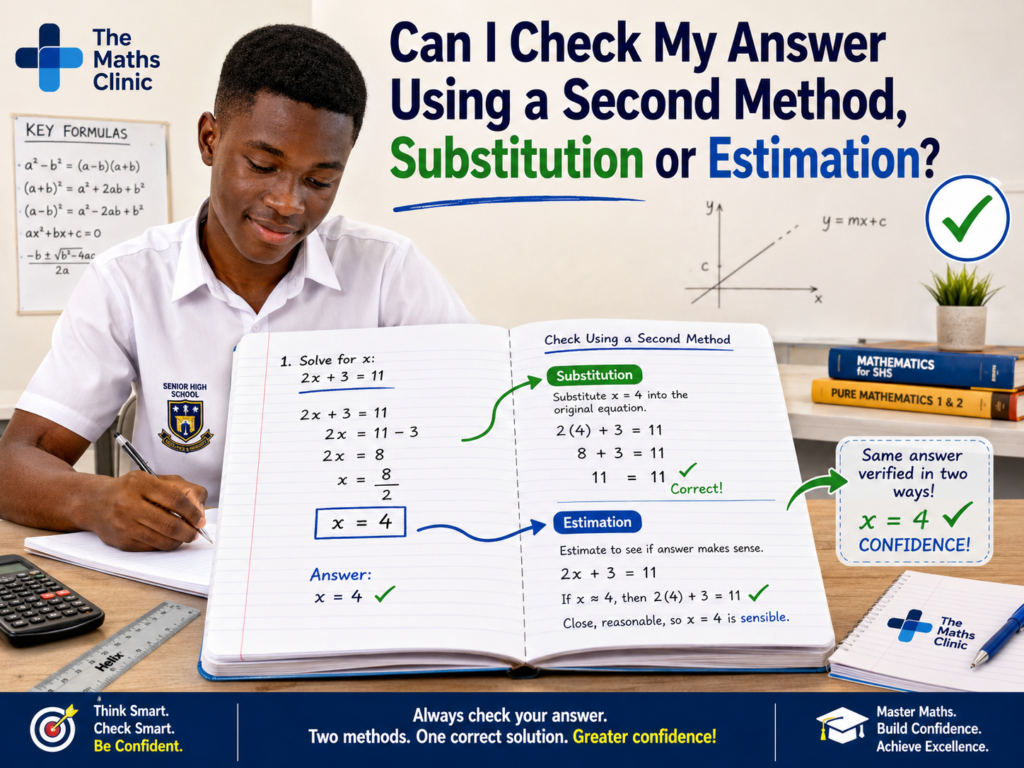
9. Can I check my answer using a second method, substitution or estimation?
What this diagnostic question checks: metacognition and self-correction.
Why the weakness develops: Many learners finish the final line and immediately move on. They treat checking as something to do only when extra time remains.
How it affects WASSCE Core Maths: Candidates lose avoidable marks through copied values, wrong units, unreasonable answers, incorrect rounding, and answers that do not satisfy the original equation.
Learner action: Use a suitable check: substitute the answer, estimate its size, reverse the operation, inspect the unit, or compare it with the conditions of the question.
| Likely weak area revealed Checking gap: the learner can produce working but has not developed a reliable habit for judging whether the result makes sense. |
10. Can I describe the exact cause of a wrong answer?
What this diagnostic question checks: This checks whether practice is producing learning rather than repeated exposure.
Why the weakness develops: Some learners erase a wrong answer, copy the correction, and move on. The page becomes correct, but the thinking that produced the error remains unchanged.
How it affects WASSCE Core Maths: The same Core Maths mistake returns when WAEC changes the numbers, context, or appearance because the learner corrected the answer without correcting the cause.
Learner action: Keep a mistake record with four headings: question/topic, exact error, reason for the error, and the new rule or habit that will prevent it.
| Likely weak area revealed Diagnostic gap: you can see that the answer is wrong, but you cannot yet use the error as evidence for targeted revision. |
Worked Diagnostic Example: Do Not Blame the Whole Topic
Question: A school bag is sold for GH₵144 after a discount of 20%. Find the original marked price.
A Common Wrong Approach
The learner calculates 20% of GH₵144 and adds or subtracts it without first deciding what GH₵144 represents. For example:
20% of 144 = GH₵28.80
144 + 28.80 = GH₵172.80
The learner may conclude, “I am weak in percentages.” That diagnosis is too broad. The calculation of 20% may be correct, but the base and relationship are wrong.
Use the Diagnostic Questions
- What am I finding? The original marked price.
- What topic is hidden here? Percentage discount and reverse percentage.
- What does a 20% discount mean? The selling price is 80% of the original price.
- What is the correct base? The original marked price, not GH₵144.
- Can I check the answer? Twenty percent of the original should be removed to give GH₵144.
Correct Method
80% of original price = GH₵144
0.80 × original price = 144
Original price = 144 ÷ 0.80
Original price = GH₵180
| Precise diagnosis: The weak area is not the whole of percentages. It is identifying the correct percentage base and reversing a percentage change. |
How This Supports the New Curriculum Standards
The new standards-based curriculum expects learners to take an active role in making sense of mathematics. These diagnostic questions support that goal in practical ways:
- Problem-solving: the learner first understands the situation and plans a method instead of rushing into operations.
- Critical thinking and reasoning: the learner explains why a method works and examines the cause of an error.
- Communication: the learner states what is required, defines symbols, and presents logical steps.
- Application and transfer: the learner recognizes familiar concepts when they appear in new WASSCE contexts.
- Use of representations: the learner reads and creates tables, diagrams, graphs, and equations.
- Personal responsibility for learning: the learner checks, reflects, and chooses the next skill to repair.
This is learner-centered mathematics because the learner is not waiting only for the teacher to announce the mistake. The learner develops the ability to observe personal thinking, ask useful questions, and take the next corrective step.
Why This Method Is WAEC-Oriented
WAEC Core Mathematics does not reward a memorized formula alone. A candidate must interpret the question, select an appropriate method, work accurately, and communicate the answer clearly. Chief Examiners’ Reports are useful because they draw attention to recurring candidate weaknesses. A Maths Clinic learner should use such weaknesses as revision signals, not as labels of failure.
- Difficulty translating word problems should lead to deliberate practice in forming expressions and equations.
- Weakness in financial applications should lead to work on percentage base, time conversion, and formula meaning.
- Errors in graphs and data should lead to scale reading, coordinate order, and interpretation practice.
- Poor presentation and unexplained steps should lead to clearer mathematical communication.
- Repeated arithmetic or sign errors should lead to foundation repair before harder topic practice.
The Maths Clinic Weak-Area Diagnostic Checklist
Choose one recent class exercise, mock question, or WASSCE past question. Score yourself honestly: 2 = I can do this independently; 1 = I can do it with help; 0 = I cannot yet do it.
| Diagnostic statement | Score (0–2) | Evidence/next action |
| I can state exactly what the question requires. | ||
| I can identify the main topic or relationship. | ||
| I can explain why my method or formula is suitable. | ||
| I can solve it without copying a worked example. | ||
| I can control signs and inverse operations. | ||
| I can translate words into mathematical statements. | ||
| I can identify the correct base in percentage questions. | ||
| I can read tables, graphs, and diagrams accurately. | ||
| I can check whether my answer is reasonable. | ||
| I can explain the exact cause of my mistake. |
How to read your result:
- 16–20: your diagnostic habits are developing. Use your lowest scores to guide revision.
- 10–15: you have some useful skills, but several hidden gaps are still controlling your marks.
- 0–9: do not rush into more difficult questions. Work with a teacher, study partner, or intervention guide to repair one foundation skill at a time.
Practice Task: Find the Weak Area, Not Only the Answer
Algebra
Question: Solve 5x – 7 = 28.
Diagnostic focus: Did the mistake come from inverse operations, a sign, or division?
Percentages
Question: A trader sold an item for GH₵150 after making a profit of 25%. Find the cost price.
Diagnostic focus: Did you use the selling price as the base instead of recognizing it as 125% of the cost price?
Simple interest
Question: Find the simple interest on GH₵900 at 12% per annum for 10 months.
Diagnostic focus: Did you understand the formula and convert months to years?
Graphs
Question: Find the gradient of the line joining (2, 5) and (6, 13).
Diagnostic focus: Did you keep the coordinate order consistent and subtract accurately?
Word problems
Question: The sum of two numbers is 42. One number is 6 more than the other. Find the numbers.
Diagnostic focus: Could you define the unknown and translate the relationship into an equation?
Correct Method: Turn the Diagnosis into a Repair Plan
- Choose one weak area, not the whole of mathematics.
- Return to the smallest missing prerequisite skill.
- Study one clear explanation and one worked example.
- Explain the rule or relationship in your own words.
- Solve three direct questions without help.
- Solve two mixed or WASSCE-style questions where the skill is hidden.
- Check your work and record any repeated mistakes.
- Retest the skill after a short interval before moving to a harder level.
| Important warning: Doing more questions will not repair a gap when you keep using the same wrong thinking. The purpose of practice is to change the thinking that produced the error. |
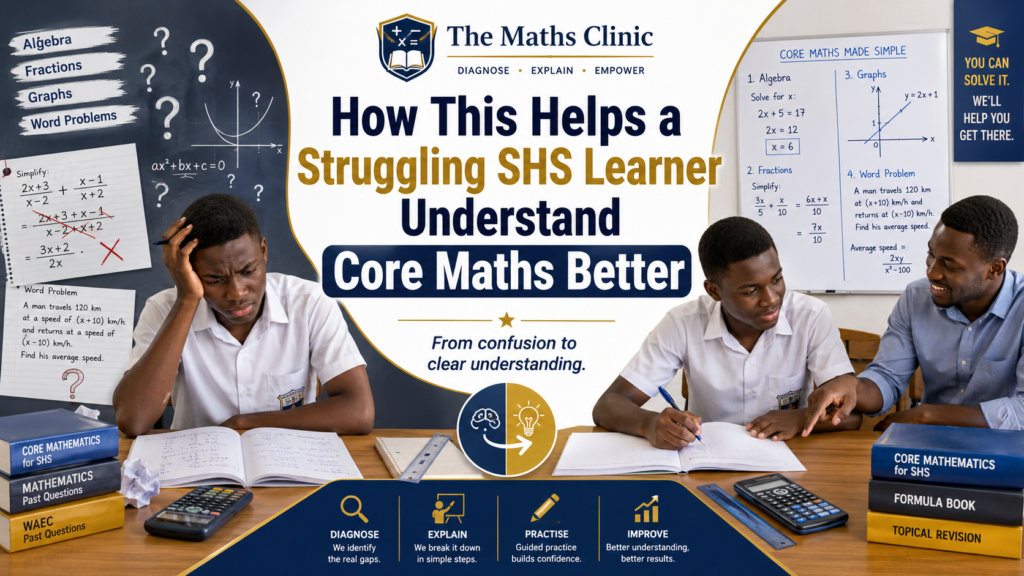
How This Helps a Struggling SHS Learner Understand Core Maths Better
These diagnostic questions to find your weak area in mathematics reduce a large, frightening problem into smaller skills that can be repaired. Instead of saying, ‘I do not understand Core Maths,’ the learner can say, ‘I misread what the question required,’ ‘I do not understand the percentage base,’ or ‘I depend on worked examples.’
That new statement matters because it gives direction. The learner knows what to practice, what to ask the teacher, which earlier skill to revise, and what to check in the next WASSCE-style question.
The approach also builds confidence without giving false praise. Confidence grows from evidence: the learner identifies a gap, repairs it, solves it independently, and sees improvement. This is the Maths Clinic meaning of Stop Guessing. Start Understanding.
A weak area does not mean the learner is weak in every part of mathematics. It means one part of the foundation needs diagnosis, explanation, focused practice, and retesting.
Final Advice Before WASSCE
Do not wait until the final weeks before WASSCE to search for your mathematics weaknesses. Take one question today and study the thinking behind every line.
When an answer is wrong, do not stop at the red mark. Ask whether the problem came from reading, topic recognition, formula meaning, signs, translation, percentage base, visual interpretation, or checking. Then repair that particular learner gap before attempting a harder version.
At The Maths Clinic, weak does not mean finished. It means the present method has exposed a part of the foundation that needs attention. Once the learner can name the gap, the learner can begin to fix it.
You do not need to guess your way through WASSCE Core Maths. Find the weak area, correct the hidden skill, practice with purpose, and test yourself again.