Struggling with WASSCE Maths? Stop guessing. Let’s fix the gap step by step.

WAEC Maths Traps
Every WAEC Maths Mistake Points to a Hidden Gap.
WAEC Maths Traps are common mistakes learners make in WAEC-organized exams such as WASSCE and NOVDEC. Behind many lost marks in WASSCE Core Mathematics is a learning gap that has not been fixed yet. At The Maths Clinic, we help students find the hidden gap behind the mistake, understand why it happens, and fix it step by step.
A trap is not always a hard question. Sometimes, it is a familiar question exposing weak understanding.
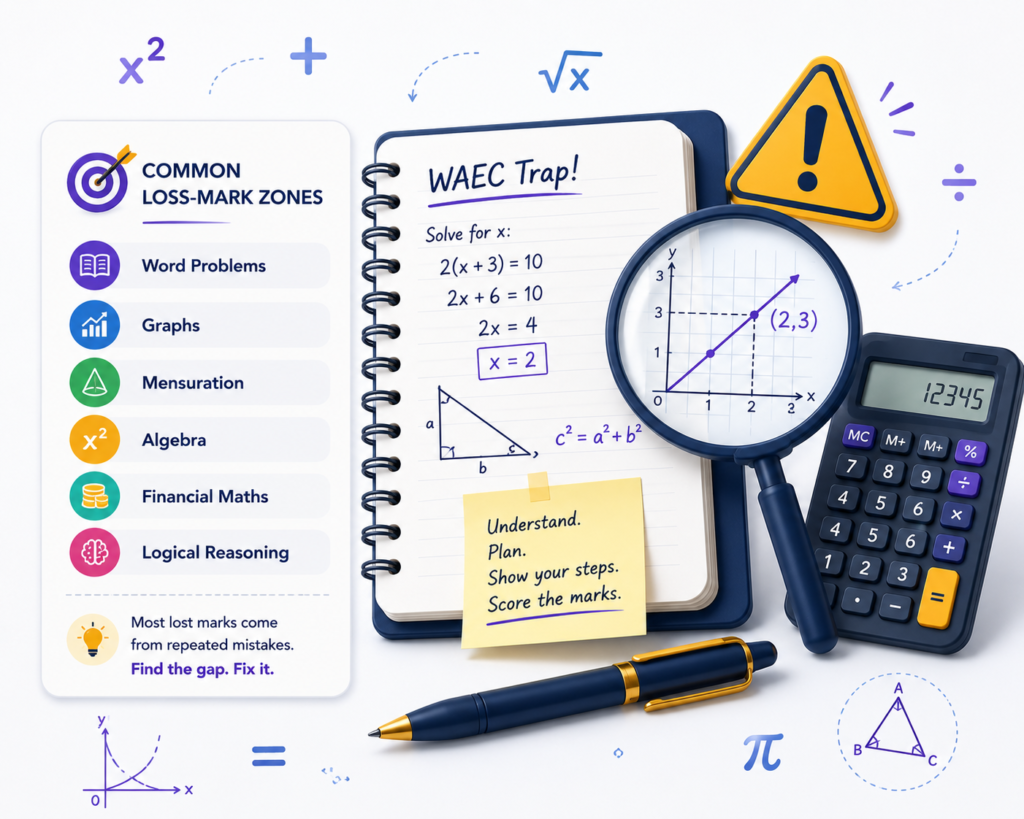
THE MEANING
What Is a WAEC Maths Trap?
A WAEC Maths Trap is a common mistake that causes learners to lose marks in WAEC-organized exams such as WASSCE and NOVDEC. These WAEC Maths Traps are not always difficult questions; sometimes, they are simple ideas presented in ways that expose weak understanding.
Reading Trap.
The learner may understand the topic but misread what the question is asking.
Method Trap.
The learner may know a formula but use it in the wrong situation.
Presentation Trap.
The learner may know part of the answer but lose marks because the working is not clear.
Every WAEC Maths mistake is telling you something. The real work is to find the gap behind the mistake and fix it.
THE CAUSE
Why Students Fall Into These Traps.
Many learners fall into WAEC Maths Traps because they prepare by memorizing steps instead of understanding the idea behind the method. A student may know a formula but may not know when to use it. Another student may solve classroom examples well, but struggle when WAEC changes the wording, diagram, graph, or real-life situation. This is why understanding the cause of WAEC Maths Traps is more useful than only memorizing more past questions.
MEMORY TRAP
Memorizing Without Understanding
Some learners remember steps only when the question looks familiar. But when WAEC changes the wording, values, diagram, or order of the question, they become confused because the method was memorized, not fully understood. This becomes a WAEC Maths trap because the learner may think the topic is mastered, but cannot handle a different version of the same idea.
Example: A student may memorize the simple interest formula but struggle when asked to find the rate or time instead of the interest.
FOUNDATION GAP
Weak Foundations
A WAEC Maths trap does not always start from the main topic. Sometimes, the real problem is a weak foundation in fractions, algebra, percentages, signs, or basic operations. That is why The Maths Clinic uses reverse foundation questions to trace the mistake backwards and find the missing skill before the student practices the main topic again.
Example: A simple interest mistake may come from weak percentages, poor multiplication, or wrong substitution — not simple interest itself.
READING GAP
Poor Question Reading
Some learners rush into solving before fully understanding the question. They may miss important words, units, values, or instructions such as “not,” “nearest,” “increase,” “decrease,” “hence,” “estimate,” or “show that.” This becomes a WAEC Maths trap because the student may know the topic, but still answer a different question from the one WAEC asked.
Example: A student may calculate the area correctly but lose marks because the question asked for the answer in square meters, not square centimeters.
CONFIDENCE GAP
Fear of Unfamiliar Questions
When a question looks different from what the learner practiced, fear can lead to guessing. This often happens when a student depends too much on familiar question patterns. If WAEC changes the wording, combines two ideas, or presents the question differently, the learner may panic and forget the basic steps.
Example: A student may know how to solve simultaneous equations but feel lost when the same idea is written as a word problem.
If you only memorize the method, WAEC can confuse you by changing the question. But if you understand the idea, you can reason your way through.
WHO NEEDS THIS
Who Should Pay Attention to WAEC Maths Traps?
This page is for learners who keep losing marks even after studying. It is also for students who understand topics in class but struggle when the same idea appears in a WASSCE or NOVDEC question. Sometimes, the problem is not lack of effort. The real issue may be a hidden gap that keeps showing up through repeated mistakes.
WASSCE LEARNER
SHS Students Preparing for WASSCE
You need to know the common traps before the final exam so you can practice with better awareness.
REWRITE CANDIDATE
NOVDEC Candidates
If you are rewriting Core Maths, you must not repeat the same mistakes that affected your previous attempt.
REPEATED ERRORS
Students Who Keep Making the Same Mistakes
If the same error keeps appearing in your work, it may be pointing to a weak area that needs attention.
QUIET STRUGGLER
Learners Who Understand in Class but Struggle in Exams
You may understand the lesson but still need help applying the idea when the question is changed.
If you often say, “I knew this question, but I still got it wrong,” then this page is for you.
WHERE THEY APPEAR
Where Do WAEC Maths Traps Usually Appear?
WAEC Maths Traps usually appear in topics where learners must read carefully, reason clearly, interpret information, and show proper working. These areas often include word problems, algebra, graphs, geometry, mensuration, financial mathematics, and logical reasoning. Most WAEC Maths Traps appear when a question looks familiar, but the hidden demand is deeper than simple calculation. That is why learners must pay attention to how the question is worded, drawn, or presented.
WORD PROBLEM TRAP
Word Problems.
The learner understands the story but struggles to change it into an equation or mathematical statement.
SIGN TRAP
Algebra
The learner loses marks through wrong signs, brackets, expansion, substitution, or simplification.
GRAPH TRAP
Graphs and Data
The learner draws the graph but fails to read, interpret, compare, or explain what the graph shows.
DIAGRAM TRAP
Geometry and Mensuration
The learner uses the wrong formula, ignores the diagram, or fails to label the shape correctly.
MONEY TRAP
Financial Mathematics
The learner confuses cost price, selling price, profit, loss, discount, interest, and percentages.
REASONING TRAP
Logical Reasoning
The learner guesses conclusions instead of following what the statement or given information supports.
A topic may look familiar, but the trap is often hidden in how the question is worded, drawn, or presented.
Add Your Heading Text Here
When Should Students Notice a WAEC Maths Trap?
Many students notice the trap too late — after a class test, mock exam, WASSCE, or NOVDEC result. But the best time to notice a WAEC Maths Trap is during practice. When a mistake keeps appearing, it is a signal that a hidden gap needs attention.
REPEATED MISTAKE
When the Same Error Keeps Appearing
If you keep making the same mistake in similar questions, do not ignore it. That mistake may be pointing to a weak concept.
CONFUSING STEPS
When the Method Looks Familiar but Still Breaks Down
You may know the topic, but if your solution gets confusing halfway, the method may not be fully understood yet.
FORMULA DOUBT
When You Cannot Explain Why a Formula Was Used
If you only remember the formula but cannot explain why it fits the question, WAEC can easily change the wording and expose the gap.
GUESSING SIGN
When You Start Guessing Instead of Reasoning
Guessing is often a sign that the learner has not understood what the question is really asking.
Do not wait until the final exam to discover your weak area. Find it during practice and fix it early.
NEW CURRICULUM ALERT
New Curriculum Pitfalls Learners Must Watch.
Under Ghana’s new SHS curriculum direction, learners must do more than remember formulas and repeat old methods. They need to understand ideas, explain their thinking, interpret information, solve unfamiliar problems, and apply Mathematics to real-life situations. Under the new curriculum direction, WAEC Maths Traps may become more visible when learners rely only on memorized steps instead of understanding. This means students must prepare differently by focusing on reasoning, application, and step-by-step correction.
FORMULA TRAP
Memorizing Formulas Without Understanding
You may know the formula, but struggle when the question is written in a new or real-life way.
APPLICATION GAP
Weak Real-Life Application
A question may not look like the exact example you practiced. You must understand how to apply the idea.
EXPLANATION GAP
Poor Explanation of Steps
pooGetting the final answer is not enough. Your work must show clear thinking and correct procedure.
DATA GAP
Weak Graph and Data Interpretation
Learners must read, compare, interpret, and explain information from graphs, tables, charts, and diagrams.
MODELLING GAP
Poor Mathematical Modelling
Some questions require you to form an equation, draw a diagram, or represent the situation before solving.
TOPIC CONNECTION
Studying Topics in Isolation
WAEC may combine algebra, percentages, graphs, mensuration, and reasoning in one question.
The new curriculum makes understanding more important than memorization. That is why The Maths Clinic focuses on gaps, reasoning, correction, and confidence.
COMMON TRAPS
Common WAEC Maths Traps Students Must Watch.
These are some repeated WAEC maths traps that cause learners to lose marks in WASSCE and NOVDEC core mathematics. Each trap points to a hidden gap. The goal is not to fear WAEC maths traps but to understand them and correct the thinking behind them.
TRAP 1
What happens: The learner reads the story but struggles to form the mathematical statement.
Hidden gap: Changing words into equations.
How to fix it: Underline the important information, identify the unknown, assign a variable, and form the equation step by step.
TRAP 2
What happens: The learner loses marks through wrong signs, brackets, expansion, substitution, or simplification.
Hidden gap: Weak understanding of algebraic rules.
How to fix it: Work slowly, write each step clearly, and check signs before moving to the next line.
TRAP 3
What happens: The learner draws the graph but fails to show readings, scale, intercepts, or interpretation clearly.
Hidden gap: Poor graph-reading and presentation skills.
How to fix it: Choose a clear scale, label the axes, plot carefully, and show evidence when reading values from the graph.
TRAP 4
What happens: The learner solves geometry or mensuration without a correct diagram or clear labels.
Hidden gap: Weak visual representation.
How to fix it: Draw the diagram first, label all given information, and connect the diagram to the formula.
TRAP 5
What happens: The learner confuses profit, loss, discount, interest, cost price, and selling price.
Hidden gap: Weak understanding of money-related maths language.
How to fix it: Identify what each value represents before calculating. Do not rush to use a formula.
TRAP 6
What happens: The learner knows the method but loses marks because the working is incomplete.
Hidden gap: Poor exam presentation.
How to fix it: Show the formula, substitution, working, units, and final answer clearly.
A WAEC Maths Trap becomes less dangerous when you know what happens, why it happens, and how to correct it.
THE CLINIC METHOD
How The Maths Clinic Fixes WAEC Maths Traps.
At The Maths Clinic, we do not stop at telling learners what they got wrong. We help them slow down, look at the mistake carefully, and understand the weak area behind it. The Maths Clinic method is designed to help learners move from repeated WAEC Maths Traps to clearer thinking, better practice, and stronger confidence in Core Maths.
STEP 1
Identify the Trap
We look at the exact mistake the learner keeps making and where it appears in the solution.
STEP 2
Find the Hidden Gap
We ask what weak concept, skill, or habit caused the mistake.
STEP 3
Explain the Correct Thinking
We break the idea down in simple language so the learner understands what should have been done.
STEP 4
Practice the fix
The learner practices similar questions until the correct method becomes familiar.
STEP 5
Build Confidence
The learner begins to approach similar questions with less fear and more understanding.
If you keep losing marks through WAEC maths traps, do not only practice more questions. First, find the mistake. Then find the gap behind it. After that, practice the correction properly.
START FIXING THE GAP
Do Not Repeat the Same Mistake Again.
Choose your next step: find the learning gap behind your mistakes or practice with correction.