Struggling with WASSCE Maths? Stop guessing. Let’s fix the gap step by step.

Word Problems in Core Maths: 7 Hidden Clues

Word problems in Core Maths become difficult for many Ghanaian SHS learners, not because the calculations are always hard, but because the numbers are hidden inside sentences.
In many classrooms, the moment a word problem appears on the board, some learners become quiet. The question may contain simple numbers, but the learner does not know where to start, what information matters, or which operation to use.
One learner may understand percentages. Another may know linear equations. Another may know simple interest. However, when the same idea is presented as a word problem, the learner begins to guess.
This is why word problems can be dangerous before WASSCE. They do not only test whether you can calculate. They also test whether you can read carefully, identify important clues, translate words into mathematical statements, and choose the correct method.
At The Maths Clinic, we do not want a struggling learner to conclude, “I am bad at word problems.” That statement is too broad and does not show the real problem.
A better question is “Which clue did I ignore in the question?”
Sometimes the learner misses the unknown quantity. Sometimes the learner ignores a word that suggests addition, subtraction, multiplication, division, percentages, ratios, or equations. In other cases, the learner picks numbers from the question and starts calculating without first understanding what is being asked.
This post will help you identify 7 hidden clues in Core Maths word problems that students often overlook. Once you learn to notice these clues, core maths word problems become less confusing because the question itself begins to guide you towards the correct method.
The aim is not to memorize more formulas. The aim is to train your eyes to notice the mathematical instructions hiding inside the English sentences.
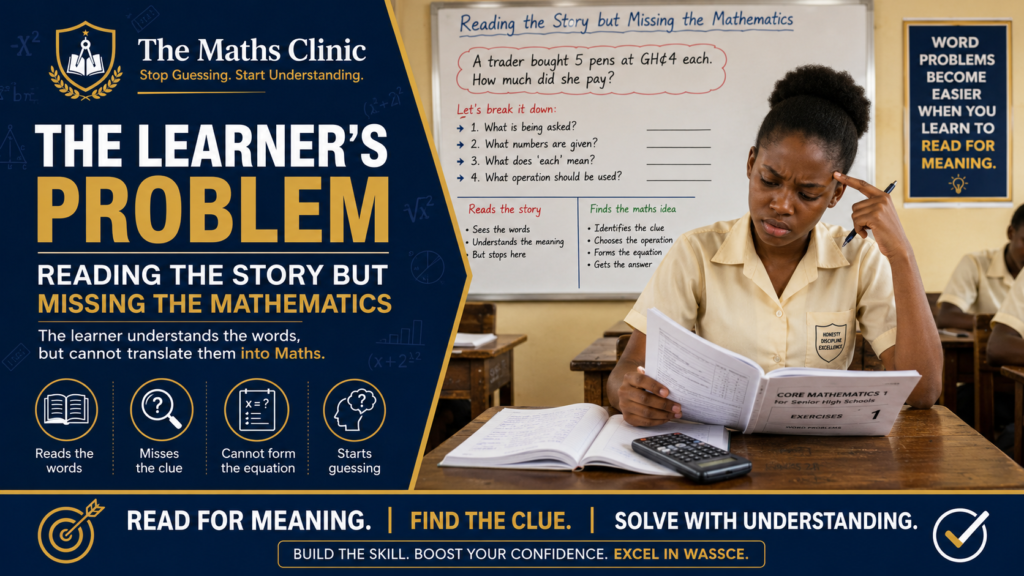
The Learner’s Problem: Reading the Story but Missing the Mathematics
The common problem is this: the learner reads the words, sees the numbers, but misses the mathematical instruction hidden in the sentence.
For example, a question may say, ‘A number is 5 more than another number.’ Some learners see 5 and start adding, but they do not form the relationship correctly. Another question may say, ‘after a discount,’ and the learner treats the discounted price as the original price.
So the real weakness is not only calculation. The hidden weakness is interpretation. The learner is not yet trained to pick clues from the language of the question.
Maths Clinic diagnosis: A word problem is not just a story. It is a coded instruction. Your job is to decode the clue before calculating.
Why This Mistake Happens
This mistake happens because many learners treat mathematics as only numbers and formulas. They forget that in word problems, the words are part of the mathematics.
Words like ‘more than,’ ‘less than,’ ‘total,’ ‘remaining,’ ‘per annum,’ ‘original price,’ ‘discount,’ ‘difference,’ ‘altogether,’ and ‘increased by’ are not decoration. They are signs on the road.
When a learner ignores these signs, the learner may use the right formula in the wrong way. That is why some solutions look neat but still produce wrong answers.
What WAEC or the Curriculum Reveals
In WASSCE Core Mathematics, word problems appear across many areas: algebra, percentages, ratios, simple interest, profit and loss, mensuration, statistics, variation, probability, and graphs.
This means a learner who cannot interpret word problems may lose marks in several topics, not only one topic. The weakness can spread across the paper like a small crack spreading through a wall.
The curriculum also expects learners to reason, communicate mathematically, and apply concepts. So it is not enough to know a formula. The learner must know when the formula is needed and what the question is truly asking.
Simple Explanation: What a Word Problem Is Really Asking You to Do
A word problem is a mathematics question written in everyday language. The numbers are not the only important part. The relationship between the numbers is also important.
When you read a word problem, you must do three things before solving: identify what is given, identify what is required, and identify the clue words that show the operation or relationship.
If you skip these three things, you may calculate quickly but wrongly. If you do them well, the question begins to open itself.
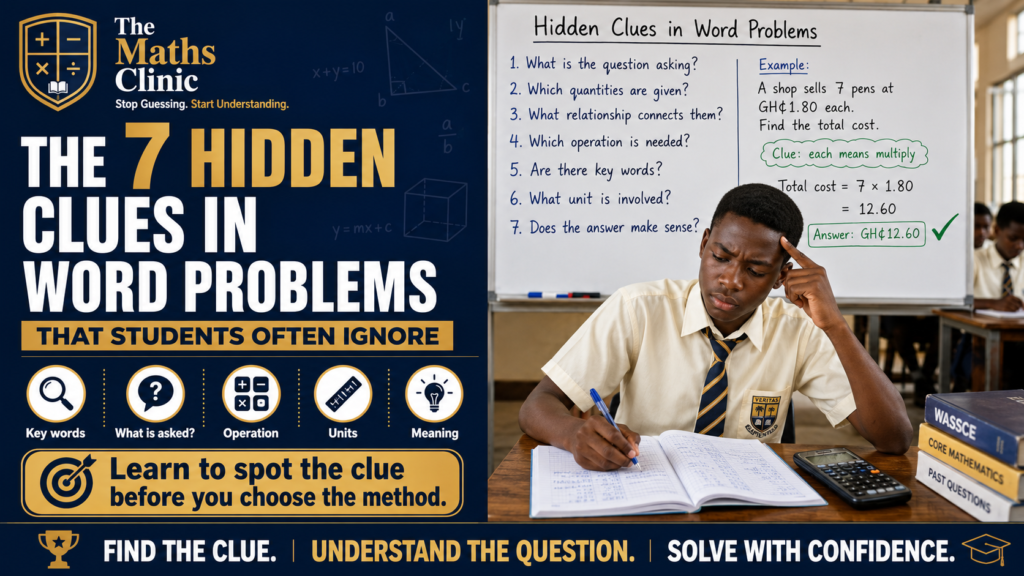
Why Word Problems in Core Maths Confuse Many SHS Students.
Word problems in Core Maths confuse many SHS students because the maths is not always shown as numbers at first. The information is hidden inside sentences. A learner may know how to add, subtract, multiply, divide, calculate percentages, or solve simple equations but still struggle when the same idea is written as a story.
The problem is usually not that the learner knows nothing. The real gap is that the learner has not yet learnt how to read the question for clues. Before solving, the learner must first identify what is being asked, what information is given, which words point to an operation, and whether the answer makes sense.
That is why guessing is dangerous in word problems. If you miss one clue, you may choose the wrong method even when your calculation is correct. The 7 clues below will help you slow down, read properly, and know where the maths problem really starts before WASSCE.
7 Hidden Clues in Word Problems in Core Maths
1. The Clue That Shows What the Question Is Asking You to Find
What the clue looks like: This clue often appears at the end of the question. It may say, ‘find the original price,’ ‘calculate the simple interest,’ ‘Determine the value of x,’ ‘Find the total amount, ‘ or ‘how many are left?’
Why students ignore it: Many learners start solving before identifying the required answer. So they may find the discount when the question asks for the original price or find the interest when the question asks for the amount.
How it helps a struggling learner understand Core Maths better: This clue helps because it gives your work a target. Before you calculate, ask: What exactly must my final answer be? Once the target is clear, you are less likely to use the wrong method.
What the learner should do next: Underline the command part of the question. Write ‘Required:’ before solving. For example: Required: original price.
2. The Clue That Shows the Correct Base in Percentages
What the clue looks like: This clue appears in words like ‘original price,’ ‘cost price,’ ‘marked price, ‘ ‘selling price,’ ‘discount,’ ‘increase, ‘ and ‘decrease.’
Why students ignore it: Many learners make percentage errors because they compare the percentage to the wrong amount. In percentages, the base is the whole you are comparing with. If you choose the wrong base, the whole solution becomes wrong.
How it helps a struggling learner understand Core Maths better: This clue helps the learner understand that percentage is not just about multiplying by 100. It is about knowing what the percentage is taken from.
What the learner should do next: When you see a percentage word problem, ask: Percentage of what? What is the whole? What is the new amount?
3. The Clue That Shows Time Must Be Converted
What the clue looks like: This clue appears in simple interest and rate questions. The question may give time in months, weeks, days, or years.
Why students ignore it: Many learners know the formula SI = PRT/100, but they forget that the rate is usually per annum. If the time is 8 months, it should be changed to 8/12 years. If the learner uses 8 as years, the answer becomes too large.
How it helps a struggling learner understand Core Maths better: This clue helps because it teaches the learner to check units before substitution. Core Maths is not only formula work; it is also unit awareness.
What the learner should do next: Before using any formula, ask: Are all the units in the correct form?
4. The Clue That Shows Addition or Subtraction Is Hidden in Words
What the clue looks like: Words like ‘more than,’ ‘increased by,’ ‘altogether,’ ‘sum,’ ‘total,’ ‘less than,’ ‘reduced by,’ ‘difference,’ and ‘remaining’ are operation clues.
Why students ignore it: Learners often see these words but do not translate them correctly. For example, ‘6 less than a number’ is not the same as ‘6 minus the number. ‘The order matters.
How it helps a struggling learner understand Core Maths better: This clue helps because it trains the learner to convert English into mathematics carefully instead of rushing to add or subtract any number seen in the question.
What the learner should do next: Write the phrase in mathematical form before solving the full problem.
5. The Clue That Shows Multiplication or Division Is Needed
What the clue looks like: Words like ‘twice,’ ‘three times,’ ‘half,’ ‘shared equally,’ ‘per,’ ‘ratio,’ ‘each,’ and ‘rate’ often point to multiplication or division.
Why students ignore it: Some learners miss these clues because they focus only on the numbers. For example, ‘twice a number’ means 2x. ‘Shared equally among 5 students’ points to division by 5.
How it helps a struggling learner understand Core Maths better: This clue helps because it shows the relationship between the quantities. Once the relationship is clear, the equation becomes easier to form.
What the learner should do next: Circle words that show grouping, sharing, or repeated quantity.
6. The Clue That Shows a Relationship Between Two Unknowns
What the clue looks like: This clue appears in questions like ‘one number is 4 more than another,’ ‘one side is twice the other, ‘ or ‘Ama is 3 years older than Kofi.’
Why students ignore it: Many learners fail these questions because they choose two unknowns without connecting them properly. They may write x and y, but they do not know how x and y relate.
How it helps a struggling learner understand Core Maths better: This clue helps the learner understand that word problems are built on relationships. If the relationship is written well, the equation becomes easier.
What the learner should do next: Let one unknown be x, then express the other unknown in terms of x.
7. The Clue That Shows Whether the Answer Must Be Reasonable
What the clue looks like: This clue is not always written directly. It comes from the meaning of the situation. For example, a person’s age cannot be negative. Many students cannot be 3.5. A discount should usually reduce the price, not increase it.
Why students ignore it: Many learners finish the calculation and accept any answer without checking whether it makes sense. That is how careless errors escape.
How it helps a struggling learner understand Core Maths better: This clue helps because it builds self-checking. The learner learns to ask whether the answer fits the real-life situation described in the question.
What the learner should do next: After solving, ask, “Does my answer make sense in the story?”
Worked Example: Finding the Hidden Clues Before Solving
Question
A bag is sold for GH₵240 after a discount of 20%. Find the original price.
Step 1: Identify what is required
The question asks for the original price. That means GH₵240 is not the original price. It is the price after the discount.
Step 2: Identify the percentage clue
A discount of 20% means the buyer paid 80% of the original price.
Step 3: Form the mathematical statement
80% of original price = GH₵240
Let the original price be x.
80/100 × x = 240
0.8x = 240
x = 240 ÷ 0.8
x = 300
So the original price is GH₵300.
Common Wrong Approach
A common wrong approach is to calculate 20% of GH₵240 and add or subtract it wrongly.
Some learners write, “20% of 240 = 48, so original price = 240 + 48 = GH₵288.”
This is wrong because the 20% discount was not taken from GH₵240. It was taken from the original price. The GH₵240 is already the discounted price.
Correct Method
The correct method is to identify the base. Since the discount is 20%, the selling price represents 80% of the original price.
So we write: 80% of original price = 240.
Then solve to get the original price as GH₵300.
This shows why hidden clues matter. The number GH₵240 was not the base. It was the result after the discount.
Practice Task: Diagnose the Clue Before Solving
Try these WASSCE-style questions. Do not rush. After each question, write the clue you noticed before solving.
1. Percentages
A laptop is sold for GH₵1,800 after a 10% discount. Find the original price.
Diagnostic question: Which amount is the base for the percentage?
2. Simple Interest
Find the simple interest on GH₵1,500 at 12% per annum for 9 months.
Diagnostic question: What time conversion is needed before using the formula?
3. Algebraic Word Problem
The sum of two numbers is 45. One number is 7 more than the other. Find the two numbers.
Diagnostic question: What relationship connects the two unknowns?
4. Ratio
A sum of GH₵360 is shared among Ama and Kofi in the ratio 2:3. Find Kofi’s share.
Diagnostic question: What does each part of the ratio represent?
5. Mensuration
The length of a rectangle is twice its breadth. If its perimeter is 54 cm, find its length.
Diagnostic question: Which phrase shows the relationship between length and breadth?
6. Probability
A bag contains 5 red balls, 3 blue balls, and 2 green balls. Find the probability of picking a blue ball.
Diagnostic question: What is the total number of possible outcomes?
7. Graphs
A line passes through the points (2, 5) and (6, 13). Find its gradient.
Diagnostic question: What order should you use when subtracting the coordinates?
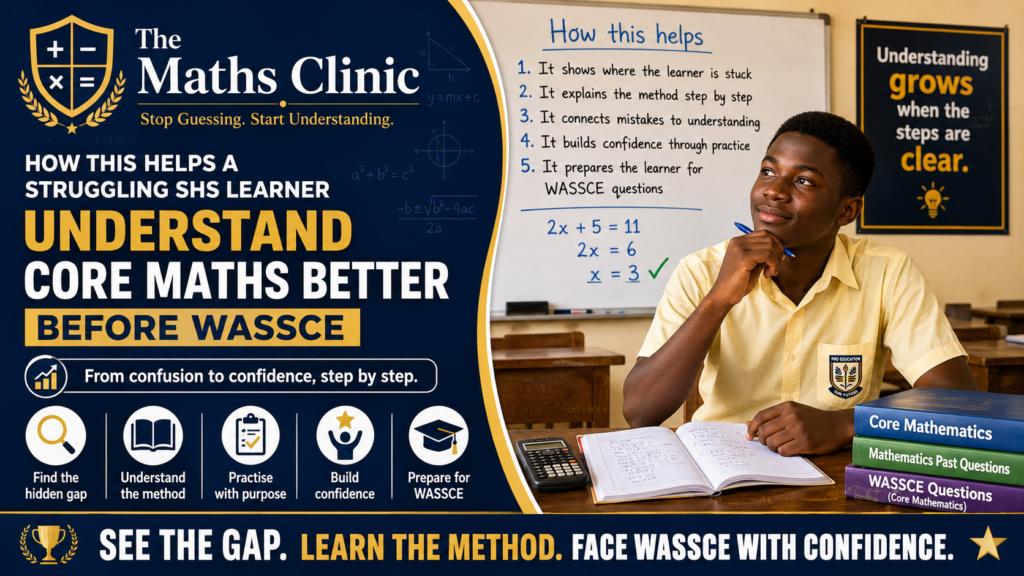
How This Helps a Struggling SHS Learner Understand Core Maths Better Before WASSCE
This lesson helps a struggling learner because it changes the way the learner reads a question. Instead of seeing a word problem as a long, confusing story, the learner begins to search for clues.
The learner learns that every word problem has a direction. Some words point to the required answer. Some words show the operation. Some words show the base, time, relationship, or unit. Some clues help the learner check whether the answer makes sense.
This reduces guessing. It also helps the learner understand that the mistake is not always because the topic is impossible. Sometimes the learner only missed one hidden clue.
Once the clue is found, the method becomes clearer. That is how word problems become easier: not by rushing, but by reading with mathematical eyes.
Final Advice Before WASSCE
If word problems have been worrying you, do not conclude that you are finished. Start by changing your reading habit.
Before you solve, pause. Underline what is required. Circle the clue words. Check the units. Identify the relationship. Ask whether your answer will make sense in the story.
A struggling learner does not need to guess through word problems. The learner needs to learn how to read the hidden clues.
At The Maths Clinic, we believe that weakness is not the end. It is a signal. Once you find the clue you usually ignore, you can fix the gap and practice with better understanding before WASSCE.