Struggling with WASSCE Maths? Stop guessing. Let’s fix the gap step by step.

7 WASSCE Algebra Traps That Look Easy but Cost Marks

7 WASSCE algebra traps that look easy but cost marks are the kinds of questions that make students say, “Sir, I knew it, but I made a small mistake.” In WASSCE Core Maths, those small mistakes can remove method marks, accuracy marks, and confidence. The question may look simple, but the trap lies in signs, brackets, fractions, indices, or wording.
Many Ghana SHS learners do not fail algebra because they know nothing. They lose marks because they enter the question too quickly. Algebra rewards careful thinking. It punishes careless copying.
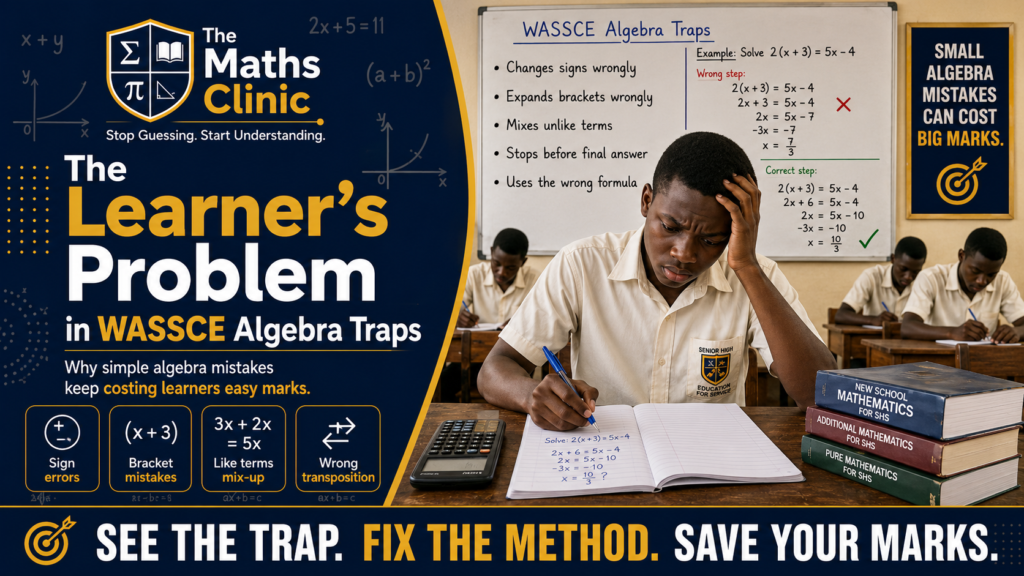
The Learner’s Problem in WASSCE Algebra traps
The learner sees an algebra question and assumes it is easy, so the mind relaxes. Then a minus sign disappears. A bracket is opened wrongly. A denominator is ignored. A term is moved without the inverse operation. By the time the final answer comes, the learner is confident but wrong.
This kind of error is painful because the student may understand the topic, but the working does not show controlled mathematical thinking. WASSCE marking does not reward what the learner intended. It rewards what is written clearly and correctly.
Why Did the Mistake Happen?
The mistake occurs when learners treat algebra as speed work rather than structured work. They rush because the question looks familiar. But familiar questions are sometimes the most dangerous because they tempt the learner to use memory instead of reading.
Another cause is weak checking habits. Some learners finish an algebra question and move on immediately. They do not substitute back, check signs, or ask whether the answer makes sense. That is where easy marks escape.
What WAEC or the Curriculum Reveals about WASSCE Algebra Traps
WASSCE algebra questions often test more than one skill in the same line. A question may involve brackets, fractions, equations, factorization, and substitution together. The curriculum expects learners to connect these skills, not treat them as separate islands.
This means the learner must practice algebra with attention to traps. It is not enough to know the formula or rule. The learner must know where students normally lose marks and how to avoid those places.
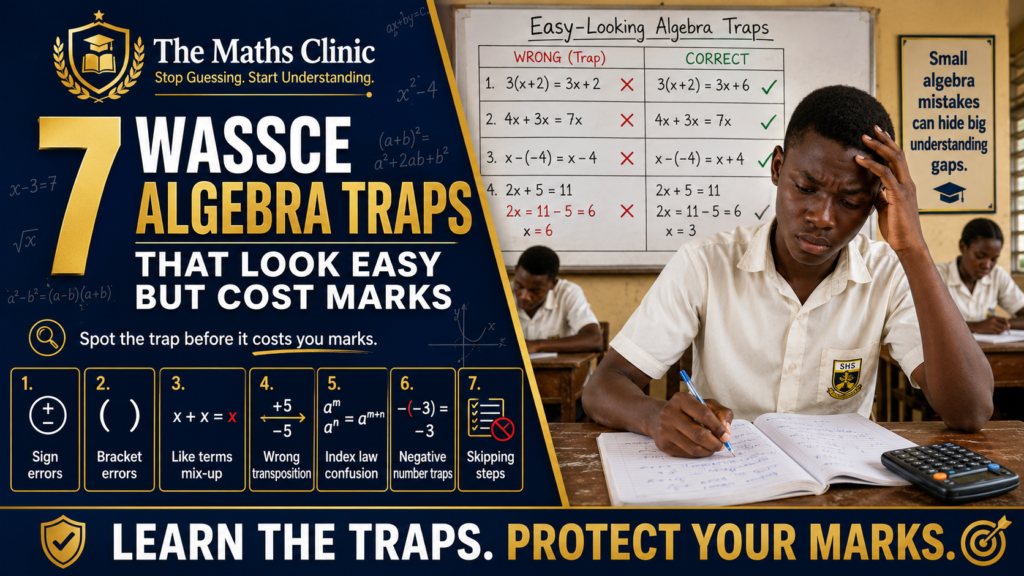
7 WASSCE Algebra Traps That Look Easy but Cost Marks
These 7 WASSCE algebra traps look easy because they often appear in simple questions. A learner may see brackets, signs, like terms, indices, or transpositions and quickly think, “I know this one.” But that quick confidence can become dangerous when the learner starts solving without checking the rule behind the step.
In WASSCE, many marks are not lost because the whole question is difficult. Marks are often lost because of one small algebra mistake at the beginning. A wrong sign, a missed bracket, a poor transposition, or mixing unlike terms can change the whole answer. The work may look busy, but the thinking behind it may be weak.
That is why these traps matter. They help the learner slow down and ask, “Which rule am I using here?” When a student can notice the trap before solving, algebra becomes less about guessing and more about understanding each step.
Trap 1: Losing the minus sign before a bracket
Example: Simplify 5 – (2x – 3). A common wrong answer is 5 – 2x – 3 = 2 – 2x. The error is that the minus sign outside the bracket must affect every term inside the bracket.
Correct method: 5 – (2x – 3) = 5 – 2x + 3 = 8 – 2x.
Trap 2: Changing signs without inverse operations
In solving x + 7 = 15, the correct idea is to subtract 7 from both sides, not to throw 7 across the equal sign. The answer is x = 8. When learners depend only on “change side, change sign,” they may change signs even where no movement is needed.
Trap 3: Forgetting to multiply every term when clearing fractions
Example: Solve x/3 + 2 = 5. If we multiply by 3, every term must be affected: x + 6 = 15. So x = 9. A wrong approach is x + 2 = 15, because the 2 was not multiplied by 3.
Trap 4: Expanding only the first term in a bracket
Example: 4(x + 5) must become 4x + 20, not 4x + 5. The 4 multiplies everything inside the bracket. This error is common because students see x first and forget the constant.
Trap 5: Treating unlike terms as like terms
A learner may write 3x + 4 = 7x. That is wrong. Only like terms can be combined. 3x and 4 are not like terms. The expression 3x + 4 cannot be simplified further unless more information is given.
Trap 6: Mishandling powers and coefficients
2x + 3x = 5x, but 2x times 3x = 6x^2. Addition and multiplication do not behave the same way. Also, x times x gives x^2, not 2x. Weak learners need to separate coefficients from powers.
Trap 7: Not checking the final answer in the original question
Substitution is one of the best ways to catch algebra mistakes. If the question is 2x + 5 = 17 and you get x = 6, substitute: 2(6) + 5 = 17. Since 12 + 5 = 17, the answer works. This small check can save a learner from a costly mistake.
Worked Example
Solve: 3(x – 2) + 4 = 16.
Step 1: Open the bracket carefully. 3x – 6 + 4 = 16.
Step 2: Simplify the left side. 3x – 2 = 16.
Step 3: Add 2 to both sides. 3x = 18.
Step 4: Divide both sides by 3. x = 6.
Step 5: Check in the original question. 3(6 – 2) + 4 = 3(4) + 4 = 16. The answer is correct.
Common Wrong Approach
| WAEC Trap Box: Writing 3(x – 2) as 3x – 2 instead of 3x – 6. Simplifying -6 + 4 as -10 instead of -2. Dividing only one term by 3 when the whole equation must be balanced. Failing to check the answer in the original equation. |
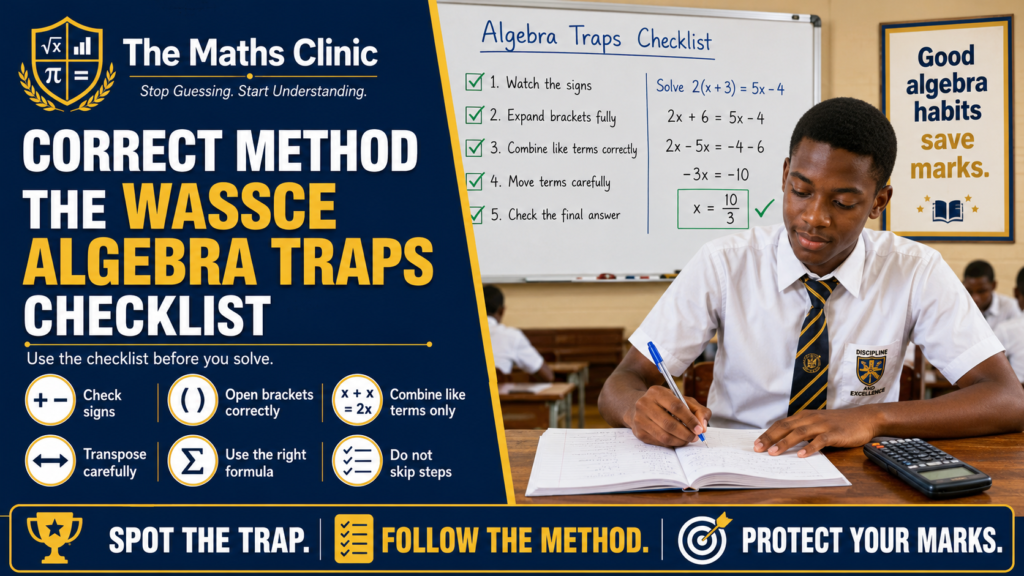
Correct Method: The WASSCE Algebra Traps Checklist
- Circle any minus sign before a bracket.
- Underline the equal sign if it is an equation.
- Check whether all terms are multiplied when clearing fractions.
- Combine only like terms.
- Keep coefficients and powers separate.
- Write one clear step per line.
- Substitute your answer back when solving equations.
Practice Task for WASSCE Algebra Traps
Try these WASSCE-style algebra trap questions. Work slowly and check each answer.
- Simplify 6 – (3x – 4).
- Expand 5(2a – 3).
- Solve x/4 + 3 = 8.
- Simplify 4x + 7 – 2x + 5.
- Solve 2(y + 3) = 18.
- Simplify 3p x 2p.
- Solve 5m – 4 = 21.
Answers
- 10 – 3x
- 10a – 15
- x = 20
- 2x + 12
- y = 6
- 6p^2
- m = 5
How This Helps a Struggling SHS Learner Before WASSCE
This post helps the learner see algebra traps before entering them. A weak learner does not need more pressure. The learner needs a checklist that exposes the exact place where marks usually disappear. When students practice this way, they stop saying “I always make careless mistakes” and start saying “I know where to check.”
Conclusion
WASSCE Algebra traps are not always difficult. Some are small and quiet. But in WASSCE, small errors can cost big marks. The solution is not panic. The solution is careful diagnosis, steady practice, and a habit of checking signs, brackets, fractions, and final answers. That is how The Maths Clinic helps struggling learners turn easy-looking traps into secure marks.