Struggling with WASSCE Maths? Stop guessing. Let’s fix the gap step by step.

10 Powerful Algebra Rules Every Weak SHS Learner Must Master

Algebra rules for SHS students are not meant to frighten learners. They are meant to bring order to the confusion.
Many learners fear algebra because letters, signs, brackets, and equations appear together, and they do not know which part to control first.
In a typical Ghanaian SHS classroom, this problem is easy to notice. One learner begins an equation correctly but changes a sign wrongly. Another opens a bracket but multiplies only the first term. Another combines unlike terms simply because both terms contain letters.
These are not random mistakes. They point to gaps in the learner’s foundation in algebra.
This Maths Clinic lesson explains ten important algebra rules for SHS students who want to reduce avoidable mistakes and prepare confidently for WASSCE Core Mathematics.
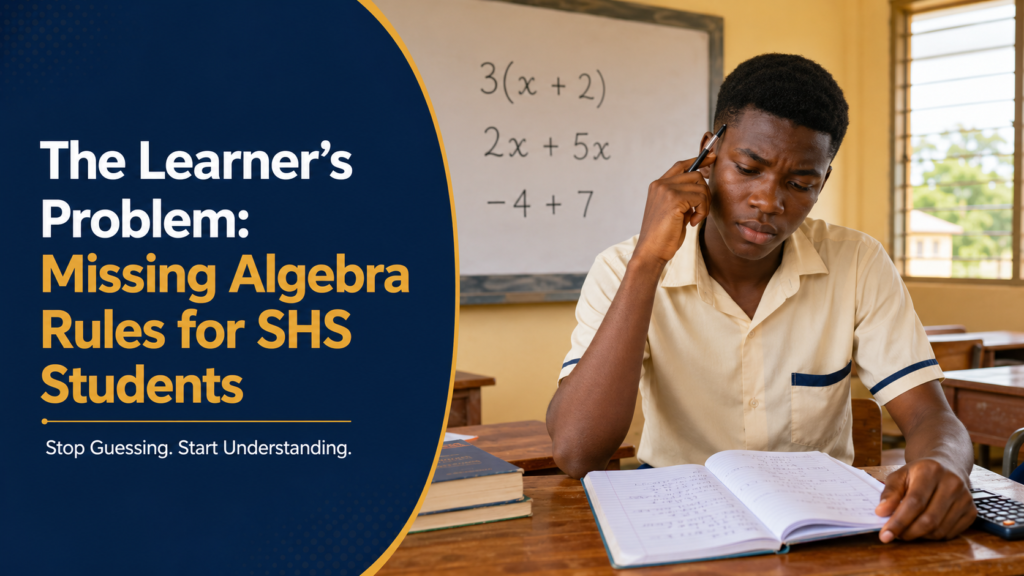
The Learner’s Problem: Missing Algebra Rules for SHS Students
Many struggling SHS learners do not have only one algebra problem. They have a chain of small gaps. One gap may involve signs. Another may involve like terms. Another may involve brackets, substitution, or the meaning of equality.
When these gaps combine, the learner begins to feel that algebra is impossible. The good news is that algebra becomes manageable when the learner follows a few clear rules carefully.
These rules do not replace understanding. They guide the learner until correct algebraic thinking becomes a habit.
Why Learners Forget Algebra Rules for SHS Students
Many algebra mistakes begin when learners memorize procedures without understanding the meaning behind them.
A learner may know the statement “change side, change sign” but may not understand that solving an equation involves performing inverse operations on both sides.
Another learner may know the instruction “open the bracket” but may not understand that the number outside the bracket must multiply every term inside it.
Rushing also causes serious mistakes. Algebra punishes careless copying. One missing minus sign, one forgotten bracket, or one wrongly collected term can affect the entire solution.
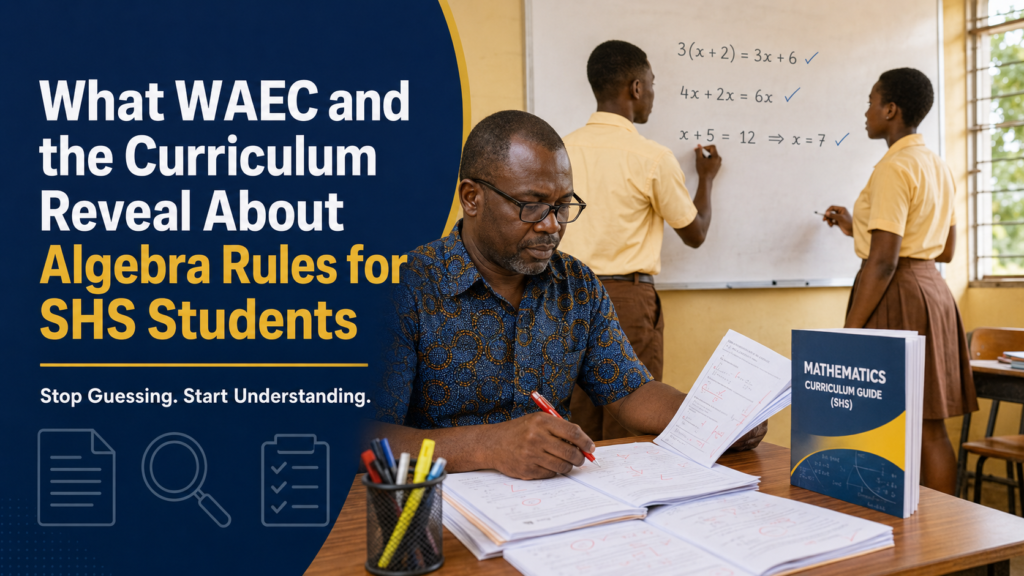
What WAEC and the Curriculum Reveal About Algebra Rules for SHS Students
WASSCE Core Mathematics uses algebra as a language in many topics. Learners meet algebra in:
- equations
- graphs
- word problems
- variation
- functions
- menstruation
- financial mathematics
- statistics
This means that a weak algebra foundation can affect performance in several examination questions, not only questions labeled “Algebra.”
The standards-based SHS curriculum also encourages reasoning, problem-solving, and clear mathematical communication. Learners are therefore expected to understand why a method works instead of repeating steps without meaning.
10 Powerful Algebra Rules for SHS Students to Master
1. The Sign Belongs to the Term
Read −4x as one complete term. Do not treat the minus sign as something separate from 4x.
Consider 5x − 3 + 2x + 8. The terms are 5x, −3, 2x, and 8. Notice that the minus sign belongs to 3.
−4x. The term is −4x, not 4x with a loose minus sign.
2. Like Terms Must Have the Same Variable Part
Terms are like terms only when their variable parts are the same.
3x and 5x are like terms, but 3x and 5x² are not like terms because x and x² are different variable parts.
3x + 5x = 8x
3x + 5x² = 5x² + 3x
3. Do the Same Thing to Both Sides of an Equation
An equation is like a balanced scale. Whatever operation you perform on one side must also be performed on the other side.
x + 5 = 12
x + 5 − 5 = 12 − 5
x = 7
4. Use Inverse Operations to Solve Equations
Inverse operations undo each other: addition and subtraction; multiplication and division.
Do not say, “The 3 crossed the equal sign and changed.” The correct explanation is that both sides were divided by 3.
3x = 15
3x ÷ 3 = 15 ÷ 3
x = 5
5. A Number Outside a Bracket Affects Every Term Inside
When expanding a bracket, multiply every term inside the bracket.
3(x + 4)
3(x) + 3(4)
3x + 12
Do not write 3x + 4.
6. A Minus Sign Before a Bracket Changes Every Sign Inside
A minus sign before a bracket can be treated as multiplication by −1. Every term inside the bracket is affected.
−(x + 5) = −x − 5
−(x − 5) = −x + 5
7. Collect Terms Together With Their Signs
Do not move or group a term and leave its sign behind.
5x − 3 + 2x + 8
5x + 2x − 3 + 8
7x + 5
8. Use Brackets When Substituting Negative Values
Brackets protect the negative sign during substitution.
x = −2
3x² − 4x
3(−2)² − 4(−2)
3(4) + 8
20
(−2)² = 4, but −2² = −4
9. Follow the Correct Order of Operations
Use this order: brackets, powers, multiplication and division, and then addition and subtraction.
3 + 2 × 4
3 + 8
11
10. Check the Answer in the Original Question
When possible, substitute the answer back into the original equation.
2x + 3 = 11
x = 4
2(4) + 3 = 11
11 = 11, so x = 4 is correct.
Simple Explanation: Algebra Is a Language With Rules
Algebra is like English grammar. You cannot arrange words anyhow and expect a sentence to make sense.
In the same way, you cannot move terms, change signs, or remove brackets carelessly and expect the answer to remain correct.
The algebra rules for SHS students in this lesson help learners read algebra properly before solving. When the reading improves, the working also improves.
Worked Example 1: Signs and Like Terms Together
Simplify:
5x − 3 + 2x + 8
Step 1: Group the like terms
5x + 2x − 3 + 8
Step 2: Combine the x-terms
5x + 2x = 7x
Step 3: Combine the constants
−3 + 8 = 5
Final answer
7x + 5
Worked Example 2: Brackets and Equation Balance
Solve:
2(x + 3) = 14
Step 1: Expand the bracket
2x + 6 = 14
Step 2: Subtract 6 from both sides
2x = 8
Step 3: Divide both sides by 2
x = 4
Step 4: Check the answer
2(4 + 3) = 14 → 14 = 14
x = 4
Worked Example 3: Negative Substitution
If x = −2, find 3x² − 4x.
Step 1: Substitute using brackets
3(−2)² − 4(−2)
Step 2: Evaluate the power
3(4) − 4(−2)
Step 3: Multiply and simplify
12 + 8
20
The common trap is forgetting the brackets around the negative value. Whenever you substitute a negative number, place it inside brackets.
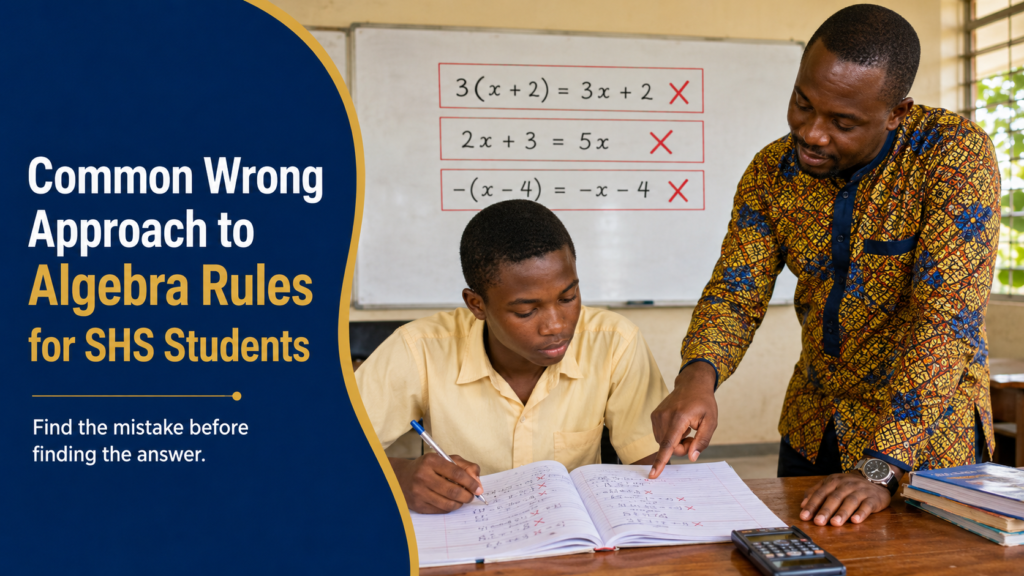
Common Wrong Approach to Algebra Rules for SHS Students
Consider:
2(x + 3) = 14
A learner may wrongly write:
2x + 3 = 14
This is incorrect because the learner multiplied only x by 2 and ignored the 3. The correct expansion is:
2(x + 3) = 2x + 6
Correct Method Learners Should Practise
- Write one clear mathematical line at a time.
- Do not skip the expansion stage.
- Carry each sign with its term.
- Use inverse operations instead of guesswork.
- Put negative substituted values inside brackets.
- Check answers in the original question where possible.
- Avoid doing too many operations in one line.
- Read the completed work before moving to the next question.
These habits may appear simple, but they protect valuable marks in WASSCE Core Mathematics.
Practice Task: Apply the Algebra Rules for SHS Students
Question 1
3x + 4x − 2
Question 2
5a − 2b + 3a
Question 3
3(y − 4)
Question 4
4x − 5 = 15
Question 5
If p = −3, find 2p² + p.
Practice Task Answers
Answer 1
3x + 4x − 2
7x − 2
Answer 2
5a − 2b + 3a
8a − 2b
Answer 3
3(y − 4)
3y − 12
Answer 4
4x − 5 = 15
4x = 20
x = 5
Answer 5
2(−3)² + (−3)
18 − 3
15

How Algebra Rules for SHS Students Help Before WASSCE
These rules help struggling learners identify the exact point where their algebra work begins to fail.
A learner may discover that the real problem is not the whole topic. It may be only one missing habit.
- forgetting signs
- combining unlike terms
- expanding brackets wrongly
- substituting negative numbers without brackets
- failing to balance equations
- ignoring the order of operations
Once the learner identifies the hidden gap, practice becomes more focused.
“Which algebra rule did I break?”
That question makes improvement possible.
Conclusion: Algebra Improves When the Rules Become Habits
Struggling SHS learners can improve in algebra when they stop rushing and begin following clear rules.
The aim is not to memorize blindly. The aim is to train the eye, hand, and mind to treat signs, brackets, terms, and equality correctly.
When these algebra rules for SHS students become habits, learners stop guessing. They begin to understand the question, control their work, and protect their marks in WASSCE Core Mathematics.