Struggling with WASSCE Maths? Stop guessing. Let’s fix the gap step by step.

10 Costly Algebra Mistakes SHS Students Must Fix Before WASSCE

Algebra mistakes are one of the quiet reasons many Ghanaian SHS students lose marks in WASSCE Core Maths. The painful part is that some learners do not even know that algebra is the real problem. They only say, “Sir, Maths is hard.”
But when you check their work carefully, the breakdown is not always the big topic. It is often a small algebra habit that has been repeated for years. A wrong sign. A bracket was ignored. A letter treated like a number. A formula copied wrongly. A simple equation was rushed.
That is why this lesson is not here to shame any learner. At The Maths Clinic, we do not start by saying, “You are weak.” We start by asking, “Where exactly is the mistake entering?” Once we find that point, we can treat it properly.
Before WASSCE, every SHS learner must take algebra seriously because algebra enters many topics: linear equations, simultaneous equations, indices, variation, functions, graphs, mensuration, business mathematics, statistics, and word problems. If your algebra foundation is weak, even questions that look simple can become confusing.
This post will show you 10 costly algebra mistakes, why they happen, how WAEC-style questions expose them, and how to correct them step by step.
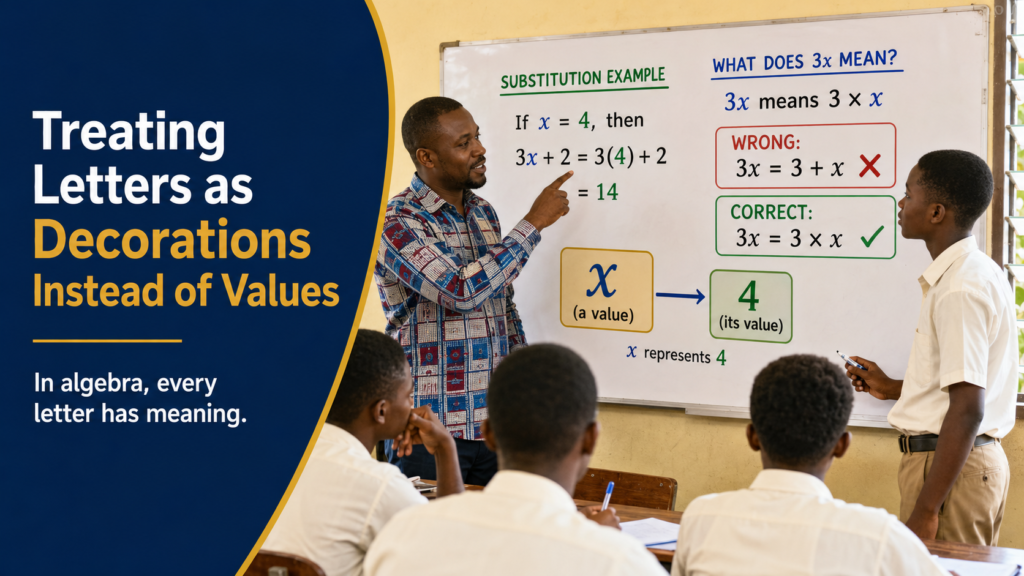
1. Treating Letters as Decorations Instead of Values
The learner’s problem
Some learners see x, y, a, or b in a question and immediately become afraid. They forget that a letter in algebra is not decoration. It stands for a number, an unknown value, or a changing value.
Why the mistake happened
The learner may have copied algebra steps for years without understanding what the letters represent. So when WAEC changes the question slightly, the learner cannot reason through it.
Simple explanation
In algebra, a letter is a placeholder. If x = 4, then every x in the expression must be replaced by 4. If y = -2, then every y must be replaced by -2. The letter is carrying value.
Worked example
Simplify 3x + 2x.
Since both terms have the same letter x, add only the coefficients: 3x + 2x = 5x.
Common wrong approach
3x + 2x = 5x². This is wrong because adding like terms does not change the power of the letter.
Correct method
Think of 3x as 3 groups of x and 2x as 2 groups of x. Altogether, you have 5 groups of x. So the answer is 5x.
| Clinic diagnosis |
| The hidden gap is not “algebra is hard.” The hidden gap is that the learner has not yet understood what a letter is doing in an expression. |
2. Adding Unlike Terms as If They Are the Same
The learner’s problem
A common algebra mistake is writing 2x + 3y = 5xy or 5x. This mistake looks small, but it can destroy a whole solution.
Why the mistake happened
The learner sees numbers and wants to combine them quickly. But in algebra, you cannot combine terms just because numbers are present. The letter part must also match.
Simple explanation
Like terms have the same letter part and the same powers. For example, 4x and 7x are like terms. But 4x and 7y are not like terms. Also, 5x and 5x² are not like terms.
Worked example
Simplify 6a + 3b – 2a + 5b.
Group like terms: 6a – 2a + 3b + 5b = 4a + 8b.
Common wrong approach
6a + 3b – 2a + 5b = 12ab. This is wrong because a-terms and b-terms cannot be joined into ab.
Correct method
Underline the same letter parts before adding. Add a-terms to a-terms. Add b-terms with b-terms.
| WASSCE warning |
| WAEC questions often test this inside expansion, factorization, substitution, and equations. If you cannot separate like and unlike terms, your final answer may look neat but still be wrong. |
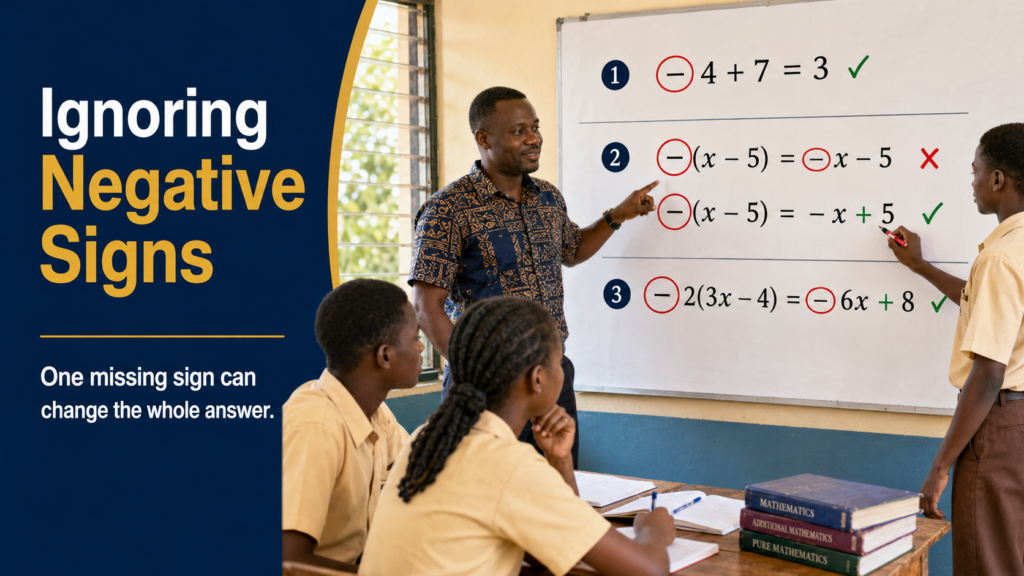
3. Ignoring Negative Signs
The learner’s problem
Many SHS learners know the method but lose marks because of negative signs. The sign in front of a term is part of the term. If you leave it behind, the answer changes.
Why the mistake happened
The learner may be rushing or may not understand that subtraction affects the term that follows it. This becomes worse when brackets are involved.
Simple explanation
In algebra, do not move a term without its sign. In the expression 7x – 4x + 2, the term is -4x, not 4x.
Worked example
Simplify 8x – 3x – 2x.
Keep the signs: 8x – 3x – 2x = 3x.
Common wrong approach
8x – 3x – 2x = 7x. This often happens when the learner subtracts only one term and forgets the second negative term.
Correct method
Say it slowly: positive 8x, negative 3x, negative 2x. Then combine: 8x – 5x = 3x.
| Practice task |
| Simplify: 12m – 5m – 3m + 2m. Answer: 6m. |
4. Removing Brackets Carelessly
The learner’s problem
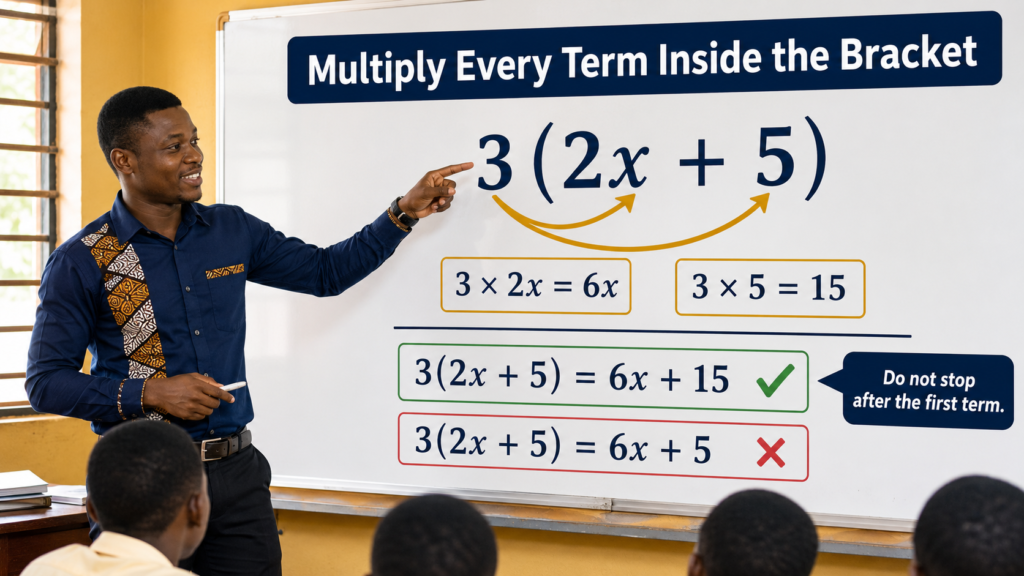
Brackets are one of the biggest algebra traps before WASSCE. A learner may write 3(x + 4) as 3x + 4 instead of 3x + 12. Another learner may write -(x – 5) as -x – 5 instead of -x + 5.
Why the mistake happened
The learner treats the bracket as if it affects only the first term. But a number outside a bracket must multiply every term inside the bracket. Also, a negative sign outside a bracket changes every sign inside.
Simple explanation
When removing brackets, distribute what is outside to all terms inside. Do not stop halfway.
Worked example
Expand 4(2x – 3).
4 multiplies 2x and also -3. So 4(2x – 3) = 8x – 12.
Common wrong approach
4(2x – 3) = 8x – 3. This is wrong because the -3 was not multiplied by 4.
Correct method
Use arrows mentally. The outside number must touch each term in the bracket.
5. Expanding Squares Wrongly
The learner’s problem
Many learners write (x + 3)² = x² + 9. This is a very common algebra mistake. It looks fast, but it is wrong.
Why the mistake happened
The learner sees the square and applies it to only x and 3 separately. The learner forgets that (x + 3)² means (x + 3)(x + 3).
Simple explanation
A squared bracket means the whole bracket is multiplied by itself.
Worked example
(x + 3)² = (x + 3)(x + 3).
Now expand: x² + 3x + 3x + 9 = x² + 6x + 9.
Common wrong approach
(x + 3)² = x² + 9. The middle term 6x is missing.
Correct method
Always write the bracket twice first if you are not confident. It may take a few extra seconds, but it saves marks.
| WASSCE warning |
| This mistake affects quadratic equations, completing the square, graphs, mensuration, and algebraic simplification. |
6. Substituting Values Without Brackets
The learner’s problem
Substitution looks simple, but many students lose marks when the value is negative. For example, if x = -2, some learners write x² = -2² and get -4 instead of 4.
Why the mistake happened
The learner does not protect the substituted value with brackets. This makes the sign behave wrongly.
Simple explanation
Whenever you substitute a negative value into an algebraic expression, put the value in brackets.
Worked example
If x = -2, find 3x² – 4x.
3(-2)² – 4(-2) = 3(4) + 8 = 12 + 8 = 20.
Common wrong approach
3(-2²) – 4(-2) = -12 + 8 = -4. This is wrong because the square was not applied to the whole negative value.
Correct method
Use brackets first. Then apply powers. Then multiply. Then add or subtract.
| Practice task |
| If a = -3, find 2a² + 5a. Answer: 3. |
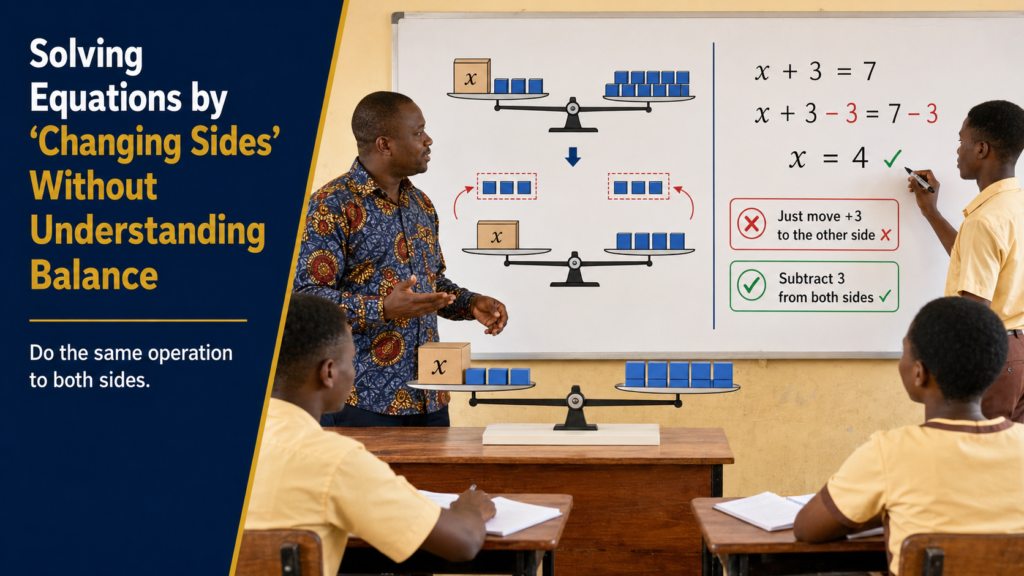
7. Solving Equations by “Changing Sides” Without Understanding Balance
The learner’s problem
Many learners say, “When it crosses the equal sign, it changes sign.” Sometimes they get the answer, but when the equation becomes tricky, they get confused.
Why the mistake happened
The learner memorized a shortcut but did not understand that an equation is like a balance. Whatever you do to one side, you must do to the other side.
Simple explanation
Solving an equation means keeping both sides equal while finding the value of the unknown.
Worked example
Solve 3x + 5 = 20.
Subtract 5 from both sides: 3x = 15. Divide both sides by 3: x = 5.
Common wrong approach
3x + 5 = 20, so 3x = 20 + 5. This is wrong because +5 was not removed by subtracting 5.
Correct method
Ask: What operation is disturbing x? Then use the opposite operation on both sides.
| Clinic diagnosis |
| The hidden gap is balance. Once a learner understands balance, equations stop feeling like magic rules. |
8. Dividing Only One Term in an Equation
The learner’s problem
When solving equations, some learners divide only one term instead of dividing the whole side. This causes wrong answers, especially in fractions and simultaneous equations.
Why the mistake happened
The learner sees a coefficient and wants to remove it quickly. But if a whole expression is being divided, every term in that expression must be handled correctly.
Worked example
Solve 2x + 6 = 18.
Subtract 6 first: 2x = 12. Divide by 2: x = 6.
Common wrong approach
A learner may divide 2x by 2 and leave the other terms unchanged. That is not balanced.
Correct method
First isolate the x-term. Then divide. Do not divide in a hurry while other terms are still attached.
| Practice task |
| Solve 5y – 10 = 30. Answer: y = 8. |
9. Mishandling Fractions in Algebra
The learner’s problem
Fractions make many algebra questions look more difficult than they are. A learner may know the algebra but fail because of poor fraction handling.
Why the mistake happened
The foundation gap may be in LCM, equivalent fractions, or clearing fractions. The learner thinks the problem is algebra, but the real weakness is fractions inside algebra.
Simple explanation
When an equation contains fractions, one helpful method is to multiply every term by the LCM of the denominators. This removes the fractions and makes the equation easier.
Worked example
Solve x/3 + 2 = 5.
Subtract 2 from both sides: x/3 = 3. Multiply both sides by 3: x = 9.
Common wrong approach
Some learners multiply only x/3 by 3 and forget the other side. The equation then loses balance.
Correct method
If you multiply one side by a number, multiply the other side too. If you clear fractions, clear them across the whole equation, not one small part only.
10. Translating Word Problems into Wrong Algebra
The learner’s problem
Many WASSCE candidates can solve an equation after it is formed, but they cannot form the equation from the word problem. That is why word problems expose algebra weakness quickly.
Why the mistake happened
The learner rushes to calculate before identifying the unknown. The learner may not know how to translate phrases such as “twice a number,” “5 more than,” “difference between,” or “shared equally.”
Simple explanation
In word problems, first decide what the unknown is. Then let it be x. After that, translate each phrase carefully into algebra.
Worked example
A number is increased by 7. The result is 20. Find the number.
Let the number be x. Increased by 7 means x + 7. So x + 7 = 20. Therefore, x = 13.
Common wrong approach
Some learners write 7x = 20 because they see a number and want to multiply. But “increased by 7” means add 7, not multiply by 7.
Correct method
Underline the action words: increased, decreased, twice, shared, total, difference, product, more than, less than. These words tell you the operation.
| WAEC warning |
| Word problems do not only test calculation. They test reading, translation, and algebraic reasoning. A learner who skips translation will keep guessing. |

What WAEC or the Curriculum Reveals About Algebra
WASSCE Core Maths does not treat algebra as one small isolated topic. Algebra is a language used across the paper. That is why a learner can meet algebra in equations, graphs, functions, variation, indices, surds, mensuration, and financial mathematics.
The new SHS Mathematics curriculum also expects learners to reason, represent situations, communicate mathematically, and solve problems. Algebra supports all these skills. It is not enough to memorize steps. A learner must understand what the symbols mean and why each operation is done.
So when a learner keeps losing marks in algebra, the teacher or learner must not only ask, “Can you solve for x?” The better question is, “Which algebra action is breaking down?”
- Is the learner combining unlike terms?
- Is the learner losing negative signs?
- Is the learner expanding brackets wrongly?
- Is the learner substituting negative values without brackets?
- Is the learner forming equations wrongly from word problems?
- Is the learner treating equations as magic instead of balance?
The Maths Clinic Algebra Fix: A Simple Diagnostic Checklist
Before you say, “I do not understand algebra,” use this checklist. Tick the area where your mistake usually enters.
| Algebra action | Common mistake | What to practise |
| Like terms | Adding unlike terms | Grouping terms by same letter and power |
| Signs | Dropping negative signs | Carrying each term with its sign |
| Brackets | Multiplying only the first term | Distributive property |
| Squares | Missing the middle term | Writing the bracket twice |
| Substitution | Ignoring brackets for negative values | Substitute with brackets first |
| Equations | Changing sides blindly | Balance method |
| Fractions | Clearing only one part | LCM and equal operations |
| Word problems | Forming the wrong equation | Underline action words |
Worked Example: Fixing Three Mistakes in One Question
Question: Simplify 2(x – 3) + 4x – (x + 5).
Step 1: Expand the first bracket
2(x – 3) = 2x – 6.
Step 2: Remove the negative bracket carefully
-(x + 5) = -x – 5.
Step 3: Rewrite the expression
2x – 6 + 4x – x – 5.
Step 4: Combine like terms
2x + 4x – x = 5x.
-6 – 5 = -11.
Final answer: 5x – 11.
| Common wrong answer |
| A learner may write 2x – 6 + 4x – x + 5 = 5x – 1. The mistake was made when the negative sign outside the bracket failed to change +5 to -5. |
Practice Zone: Try These Before WASSCE
Do not only read the corrections. Practice them. Algebra improves when your hand learns the correct steps repeatedly.
- Simplify 7x + 3y – 2x + 5y.
- Expand 5(2a – 3).
- Simplify 3p – 7p + 2p.
- Expand (x + 4)².
- If x = -3, find 2x² – x.
- Solve 4x + 6 = 22.
- Solve y/5 + 3 = 9.
- Simplify 3(a + 2) – 2(a – 5).
- A number is doubled, and 6 is added. The result is 24. Find the number.
- Simplify 4m – (2m – 7) + 3.
Answers
- 5x + 8y
- 10a – 15
- -2p
- x² + 8x + 16
- 21
- x = 4
- y = 30
- a + 16
- 9
- 2m + 10
Try more WASSCE algebra practice questions.
Common Wrong Beliefs About Algebra
Wrong belief 1: “Algebra is only about x.”
No. Algebra is about representing numbers and relationships using symbols. The letter may be x, y, a, n, t, or any other symbol.
Wrong belief 2: “If my final answer looks simple, it must be correct.”
No. A wrong method can still produce a neat-looking answer. Always check the signs, brackets, and like terms.
Wrong belief 3: “I only need to memorize steps.”
Memorising can help for basic questions, but WASSCE often changes the arrangement. Understanding helps you survive unfamiliar questions.
Wrong belief 4: “I am bad at Maths.”
That statement is too broad. A better statement is, “I am losing marks in signs, brackets, substitution, or word-problem translation.” Once you name the exact weakness, you can fix it.

How This Helps a Struggling SHS Learner Before WASSCE
This lesson helps because it moves the learner from fear to diagnosis. Instead of seeing algebra as one big confusing topic, the learner can now separate the problem into smaller parts.
A learner who fixes signs will gain marks in equations. A learner who fixes brackets will improve in expansion and simplification. A learner who fixes substitution will do better in formulas, functions, and graphs. A learner who fixes word-problem translation will stop guessing when WAEC gives a story question.
That is the real work before WASSCE: not pretending everything is fine but finding the exact gap and correcting it early.
Conclusion: Algebra Becomes Easier When the Hidden Mistake Is Found
Dear SHS learner, if algebra has been worrying you, do not conclude that you are hopeless in mathematics. That is not the correct diagnosis. The real issue may be one or two hidden algebra mistakes that have followed you from JHS into SHS.
Start with the basics. Respect signs. Respect brackets. Combine only like terms. Substitute with brackets. Solve equations by balancing. Translate word problems slowly. These small habits can protect many marks in WASSCE Core Maths.
At The Maths Clinic, the aim is simple: stop guessing, find the exact breakdown, and rebuild your Core Maths foundation step by step.
Need help finding your exact algebra weakness? Visit the Intervention Hub or practice in the WASSCE Maths Practice Zone. Start with the mistake you make most often, then fix it one step at a time.