Struggling with WASSCE Maths? Stop guessing. Let’s fix the gap step by step.

10 Powerful Steps to Solve Linear Equations Without Guessing

Solve linear equations without guessing. That is the simple skill many Ghana SHS students need before they enter serious algebra, word problems, graphs, simultaneous equations, and WASSCE Core Maths questions.
In many classrooms, the learner can copy the example from the board, but when the numbers change slightly, confusion starts. One learner moves 5 from the left side to the right side and changes it to -5. Another learner moves -3x and forgets whether it should become +3x. Another one divides only one term by 2 and leaves the other term untouched. The answer may look close, but the method is shaky.
That is why this lesson is not just about getting x. It is about learning a safe method that works even when the equation has brackets, negative signs, fractions, decimals, or variables on both sides.
Editorial note: Internal link note: Link the phrase “algebra foundation” to your Maths Clinic algebra foundation post or Intervention Hub. Link “Practice Zone” near the end to your interactive practice page.
The Learner’s Problem: Why You Still Guess When Solving Linear Equations
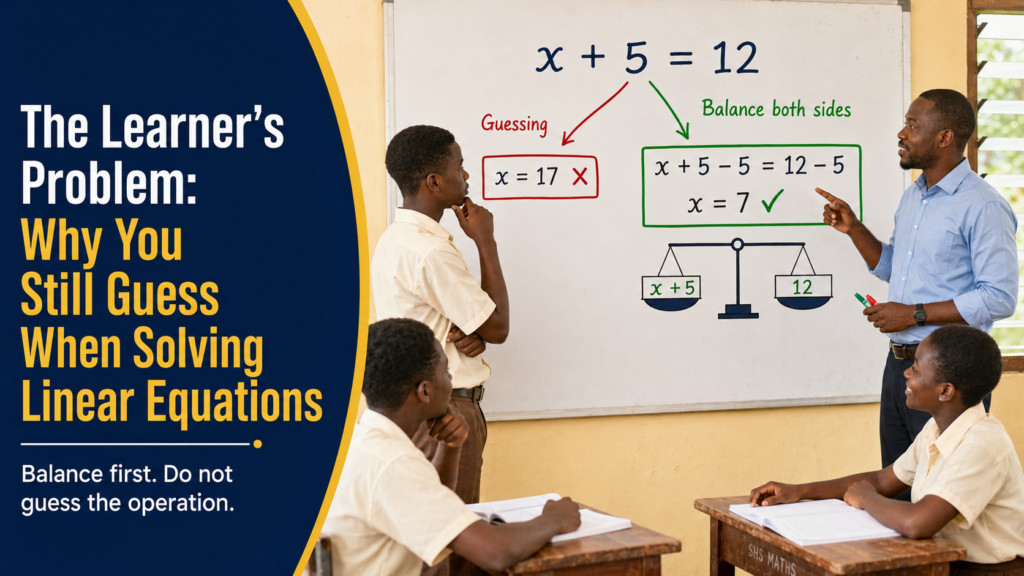
A linear equation is not supposed to be a guessing game. Yet many SHS learners solve equations by memory tricks. They say things like “when it crosses the equal sign, it changes sign” without understanding what is happening.
That sentence is not always the main problem. The real problem is that the learner has not understood the equal sign as a balance. The left side and the right side must remain equal. Whatever operation you do on one side, you must do the same operation on the other side.
For example, consider this equation:
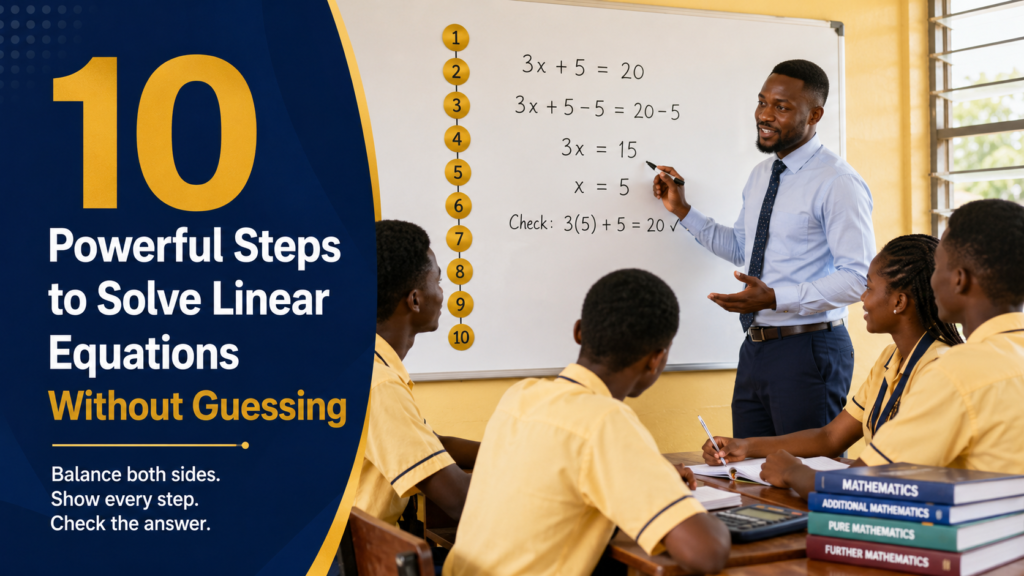
3x + 5 = 20
A learner who is guessing may write:
3x = 20 + 5
This gives 3x = 25, so x = 25/3. The learner may feel the work is complete, but the first movement was wrong. Since +5 is on the left side, we remove it by subtracting 5 from both sides, not by adding 5 to the right side. The correct step is
3x + 5 – 5 = 20 – 5
3x = 15
x = 5
The hidden gap is not laziness. The hidden gap is poor control of inverse operations.
Why Learners Struggle to Solve Linear Equations Without Guessing
Most wrong solutions in linear equations come from one of five gaps.
- The learner sees the equal sign as a “move across” symbol instead of a balance sign.
- The learner memorizes sign-changing rules without understanding inverse operations.
- The learner is weak in directed numbers, especially negative signs.
- The learner expands brackets too quickly and loses signs.
- The learner does not check the answer by substituting it back into the original equation.
So when the learner meets a question like 2(3x – 4) = 16, the problem is not only the bracket. The bracket exposes whether the learner understands multiplication, subtraction, and equality together.
What WAEC Reports and the Curriculum Reveal About Linear Equations
Linear equations sit quietly inside many Core Maths topics. A student may think equations are only one small algebra topic, but WASSCE questions use equations in mensuration, financial mathematics, coordinate geometry, word problems, variation, sequences, and graph work.
The curriculum expects learners to reason with algebraic statements, not only copy procedures. This means a learner must be able to translate a statement into an equation, simplify both sides correctly, solve step by step, and interpret the answer in context.
This is why a small sign error in a linear equation can cost marks in a bigger question. The learner may know the formula, but once the equation formed from the formula is handled wrongly, the final answer becomes wrong.
Simple Explanation: What You Need to Solve Linear Equations Without Guessing
A linear equation is an equation where the highest power of the unknown is 1. The unknown may be x, y, a, b, or any letter. Examples include:
2x + 7 = 15
5y – 3 = 2y + 12
x/3 + 4 = 10
The aim is to find the value of the unknown that makes the statement true. If the answer is x = 4, it means when you put 4 into the original equation, the left side and right side must agree.
So our rule is simple: do not chase signs. Protect the balance.
10 Powerful Steps to Solve Linear Equations Without Guessing
Step 1: Read the equation before touching the numbers
Many learners start solving before they understand the structure of the question. First, look at the equation. Ask yourself: Are there brackets? Are there fractions? Are there variables on both sides? Are there negative signs? This small check prevents careless work.
Step 2: Clear brackets carefully
If the equation has brackets, expand them first. Multiply every term inside the bracket. Do not multiply only the first term. For example:
2(3x – 4) = 6x – 8
The 2 multiplies both 3x and -4. If you write 6x – 4, you have ignored part of the bracket.
Step 3: Clear fractions by multiplying through
Fractions make many learners panic. The safe method is to multiply every term by the lowest common multiple of the denominators. For example:
x/3 + 2 = 5
Multiply every term by 3:
x + 6 = 15
Now the equation is easier to solve.
Step 4: Collect like terms
Put the terms with the unknown together and the numbers together. But do it by using inverse operations, not by guessing sign changes.
For example:
5x – 7 = 2x + 8
Subtract 2x from both sides:
3x – 7 = 8
Add 7 to both sides:
3x = 15
x = 5
Step 5: Undo addition or subtraction first
In a simple equation like 4x + 9 = 25, the x is first multiplied by 4, and then 9 is added. To solve, undo the last operation first. Remove +9 by subtracting 9 from both sides.
4x + 9 = 25
4x = 16
x = 4
Step 6: Undo multiplication or division last
When the unknown is multiplied by a number, divide both sides by that number. When the unknown is divided by a number, multiply both sides by that number. Do not divide only the term you like.
7x = 42
x = 6
Step 7: Be extra careful with negative coefficients
Negative signs disturb many students. If -3x = 18, divide both sides by -3.
-3x = 18
x = -6
Do not cancel the negative sign as if it were not part of the number. It belongs to the coefficient of x.
Step 8: Keep your working arranged line by line
Scattered working causes copied signs to change by accident. Put one equation on each line. Align the equal signs if possible. This helps you see whether the balance is still correct.
Step 9: Substitute your answer back
After solving, put the answer into the original equation. This is the strongest way to catch your own mistake. For example, if x = 5 in 3x + 5 = 20:
3(5) + 5 = 20
15 + 5 = 20
20 = 20
Since both sides agree, the answer is correct.
Step 10: Write the final answer clearly
Do not leave your answer as a half-solved statement. If the question asks for x, end with x = something. If the question is in a word problem, write the answer with the correct unit or meaning.
Worked Example 1: Simple Linear Equation
Solve:
4x + 7 = 31
Subtract 7 from both sides:
4x = 24
Divide both sides by 4:
x = 6
Check:
4(6) + 7 = 24 + 7 = 31
So the answer is x = 6.
Worked Example 2: Variables on Both Sides
Solve:
6x – 5 = 2x + 11
Subtract 2x from both sides:
4x – 5 = 11
Add 5 to both sides:
4x = 16
Divide both sides by 4:
x = 4
Check:
6(4) – 5 = 24 – 5 = 19
2(4) + 11 = 8 + 11 = 19
Both sides give 19, so x = 4 is correct.
Worked Example 3: Equation with Brackets
Solve:
3(2x – 1) = 21
Expand the bracket:
6x – 3 = 21
Add 3 to both sides:
6x = 24
Divide both sides by 6:
x = 4
Check:
3(2(4) – 1) = 3(8 – 1) = 3(7) = 21
The answer is x = 4.
Worked Example 4: Equation with Fractions
Solve:
x/2 + 3 = 9
Subtract 3 from both sides:
x/2 = 6
Multiply both sides by 2:
x = 12
Check:
12/2 + 3 = 6 + 3 = 9
So x = 12.
Common Wrong Approach
Let us diagnose this common wrong solution.
5x – 4 = 21
Wrong working:
5x = 21 – 4
5x = 17
x = 17/5
The mistake is that -4 was removed wrongly. To remove -4, add 4 to both sides. The correct working is
5x – 4 = 21
5x = 25
x = 5
This is why learners must stop saying “change side, change sign” without thinking. The safer language is “What operation will undo this term, and must I do it to both sides?”
Correct Method: Use Balance to Solve Linear Equations Without Guessing
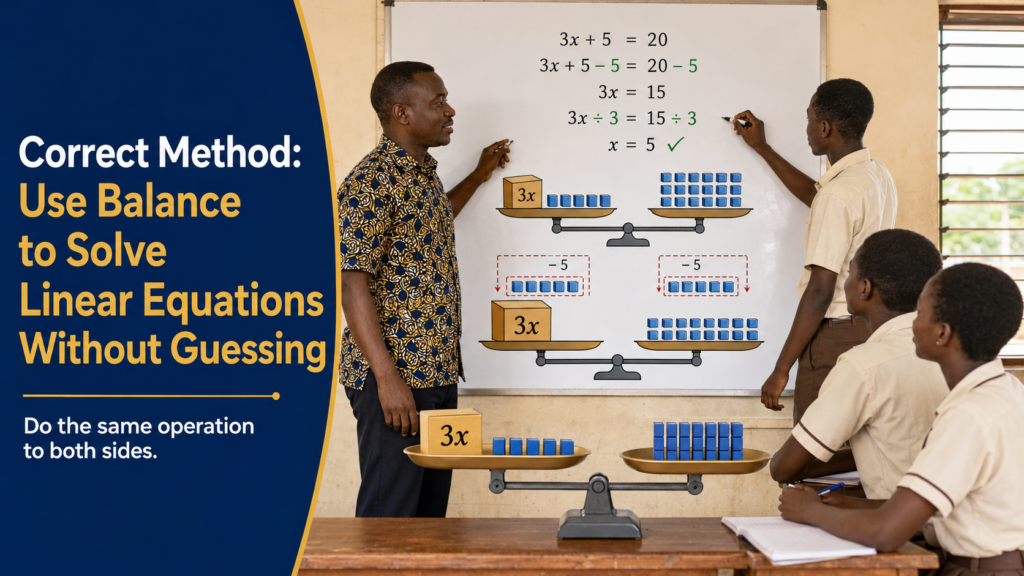
The balance method is the most reliable method for weak and struggling learners because it shows why each step is allowed.
Example:
2x + 9 = 17
Subtract 9 from both sides:
2x + 9 – 9 = 17 – 9
2x = 8
Divide both sides by 2:
2x/2 = 8/2
x = 4
This method may look longer at first, but it trains the learner to respect equality. After enough practice, the learner can shorten the steps without losing the logic.
WAEC Trap Box: Where Learners Lose Marks in Linear Equations
- Changing +7 to +7 again instead of -7 when moving it from one side.
- Removing -5 by subtracting 5 instead of adding 5.
- Dividing only one term when the whole side must be divided.
- Expanding 4(x – 2) as 4x – 2 instead of 4x – 8.
- Forgetting to multiply every term when clearing fractions.
- Dropping the negative sign in -2x = 10.
- Getting the correct value of x but failing to check whether it satisfies the original equation.
Practice Task: Can You Solve Linear Equations Without Guessing?
Try these without guessing. Show one clear step per line and check at least two of your answers.
1. 3x + 4 = 19
2. 5x – 6 = 24
3. 7 – 2x = 15
4. 4x + 3 = 2x + 17
5. 3(2x – 5) = 21
6. x/4 + 2 = 9
7. 5(y + 2) = 35
8. 8a – 3 = 5a + 12
9. 2(3m + 1) = 4m + 10
10. (p/3) – 5 = 2
Answers
1. x = 5
2. x = 6
3. x = -4
4. x = 7
5. x = 6
6. x = 28
7. y = 5
8. a = 5
9. m = 4
10. p = 21
If you got many of the practice questions wrong, do not conclude that you are bad at mathematics. Your problem may be one small algebra gap: signs, brackets, inverse operations, or checking. Go to the Maths Clinic Practice Zone and practice linear equations step by step. Then visit the Intervention Hub if you notice that the same mistake keeps appearing.
Conclusion: Understand Balance and Stop Guessing in Linear Equations
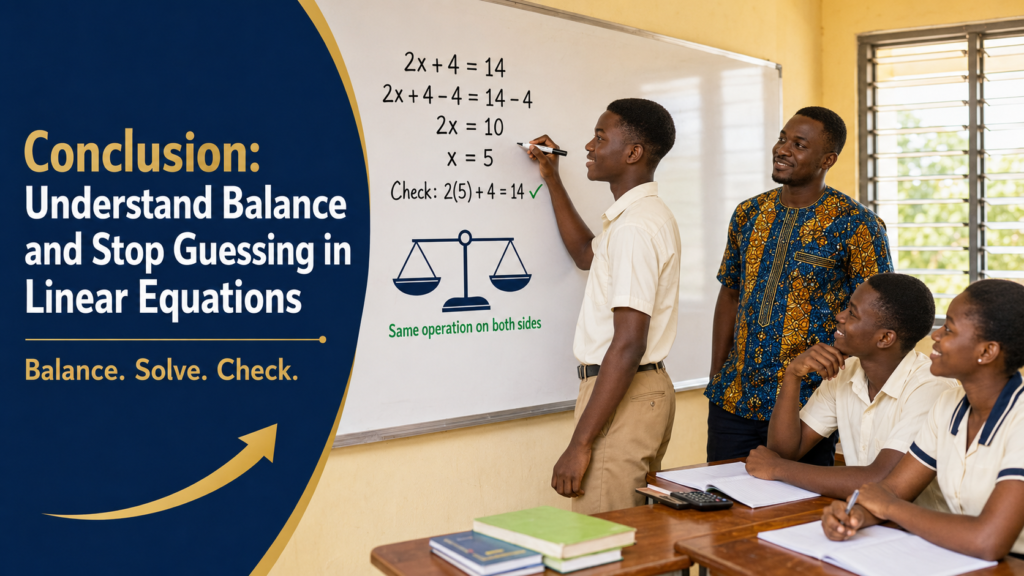
Linear equations are not solved by luck. They are solved by balance, inverse operations, careful signs, and checking. Once a learner understands this, algebra becomes less frightening.
So the next time you see an equation, do not rush to move terms anyhow. Read the equation, clear brackets, clear fractions, collect like terms, undo operations carefully, and check your answer. That is how you solve linear equations without guessing.
At The Maths Clinic, we do not shame learners for making mistakes. We diagnose the gap, explain the cause, and fix it step by step.