Struggling with WASSCE Maths? Stop guessing. Let’s fix the gap step by step.

Is Nov/Dec Harder Than WASSCE? The Shocking Truth Revealed

“Sir, is Nov/Dec harder than WASSCE?” A learner normally asks this question for a reason.
Perhaps the learner did not obtain the core mathematics grade expected in the school-candidate WASSCE. Now, Nov/Dec looks like a second chance—but stories from friends have created fear.
One person says, “Nov/Dec questions are always harder.” Another says, “WAEC does not favor private candidates.”
Someone else warns, “If you could not pass mathematics in school, you cannot pass it in Nov/Dec.”
After hearing these statements repeatedly, the learner may enter the next preparation period already feeling defeated.
But is Nov/Dec harder than WASSCE Core Mathematics?
Here is the honest answer:
Nov/Dec Core Mathematics is not automatically harder than the school-candidate WASSCE. It often feels harder because many private candidates prepare with less support, unresolved learning gaps, and greater personal pressure.
The examination must be taken seriously, but it should not be treated as an impossible paper designed to punish private candidates.
This Maths Clinic lesson focuses only on core mathematics. We will examine why Nov/Dec feels harder to some learners, expose the learning gaps behind that experience, and build a practical preparation plan without making false grade promises.
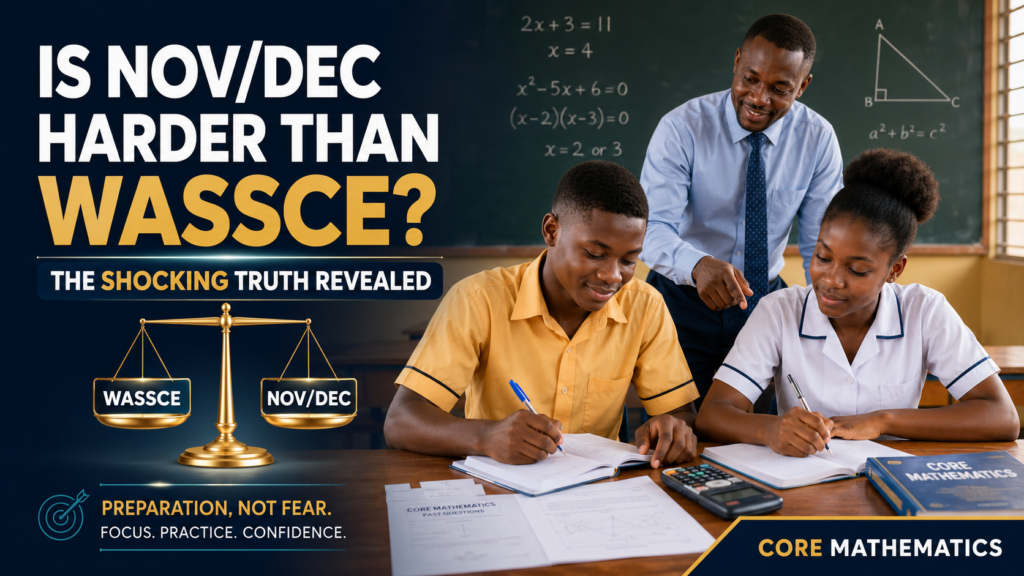
Is Nov/Dec Harder Than WASSCE? The Direct Answer
There is no sound reason to claim that every Nov/Dec Core Mathematics paper is harder than every school-candidate WASSCE paper.
The difficulty of individual questions may vary from one examination year to another. A particular paper may contain unfamiliar-looking questions or require deeper application of familiar concepts. That can also happen in the school-candidate WASSCE.
More importantly, difficulty is partly connected to preparation.
A question on percentages may look simple to a learner who understands fractions, decimals, and ratios. The same question may look very difficult to another learner whose foundation is weak.
Therefore:
A more realistic picture is
WAEC Ghana describes the private-candidate examination as an individual-based examination. It is a recognized form of WASSCE, not an examination officially described as a punishment for candidates who want to improve their results. WAEC Ghana: WASSCE for Private Candidates
The false claim is therefore not that Nov/Dec can feel difficult. It certainly can.
The false claim is that it is always deliberately harder simply because private candidates are writing it.
Why Nov/Dec Core Mathematics Feels Harder to Some Learners
Consider two learners.
Akosua is preparing for the school-candidate WASSCE. She attends mathematics lessons regularly. Her teacher gives exercises, marks them, and explains her mistakes. She writes class tests and mock examinations. She also has classmates preparing for the same paper.
Yaw completed SHS two years ago. He works during the day and studies when he is tired. He has forgotten some algebra rules. He downloads past questions, but nobody checks his working. He begins serious preparation two months before Nov/Dec.
If Yaw finds the paper harder, the examination itself may not be the only reason. His preparation conditions were more difficult.
Many private candidates face similar problems:
- They are no longer receiving daily classroom instruction
- They may be combining work with study
- They have forgotten some foundational concepts
- They may be preparing alone
- They have fewer marked exercises
- They may start serious preparation late
- They carry fear from a previous result
- They practice past questions without correcting their real weaknesses.
These conditions can make a manageable examination feel overwhelming.
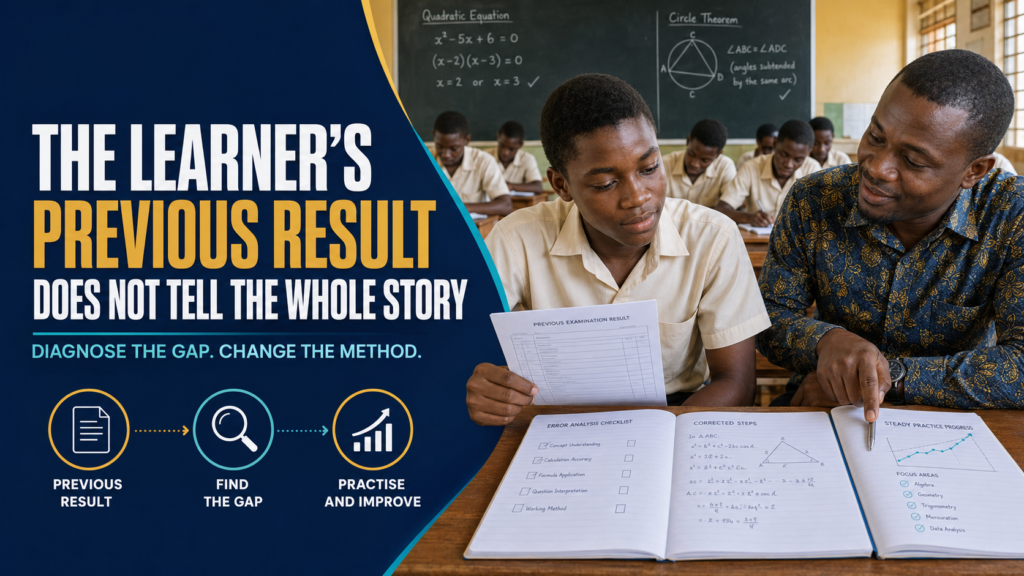
The Learner’s Previous Result Does Not Tell the Whole Story
A poor core mathematics result does not automatically mean that the learner understands nothing.
Sometimes, the learner has a small number of serious gaps that affect many topics.
For example, a learner who struggles with fractions may also struggle with:
- ratio;
- percentages;
- probability;
- algebraic fractions;
- rates;
- mensuration;
- Business Mathematics.
Another learner may understand the concepts but repeatedly lose marks through:
- sign errors;
- wrong substitution;
- incomplete working;
- careless calculator entries;
- poor interpretation of questions;
- weak time management.
These learners do not need the same intervention.
That is why saying, “I am weak in mathematics,” is too broad to be useful.
A better question is
Which exact mathematical gaps are causing me to lose marks?
Once the problem becomes specific, the repair can also become specific.
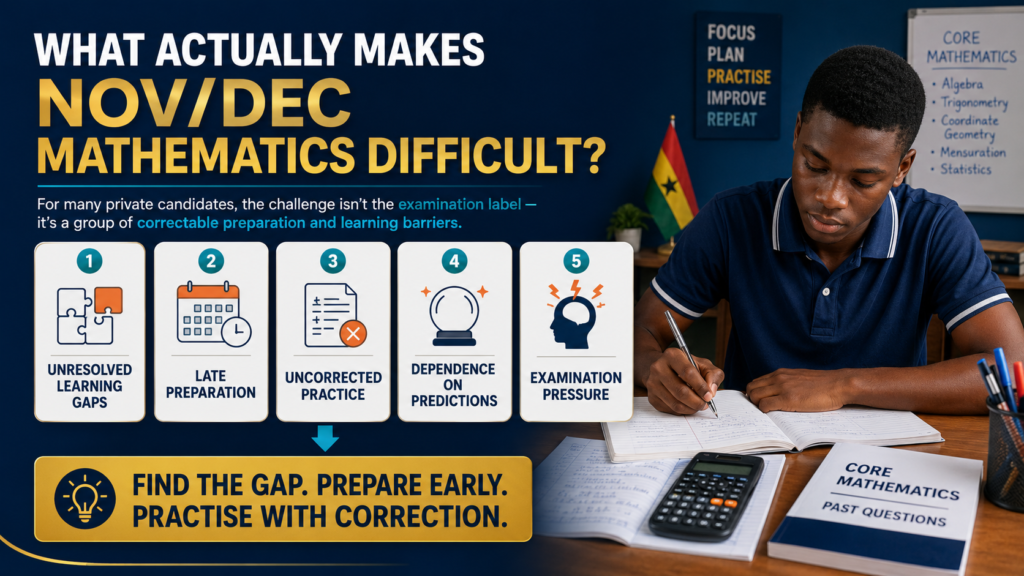
What Actually Makes Nov/Dec Mathematics Difficult?
1. Repeating the examination without changing the preparation method
Registering for Nov/Dec creates another opportunity, but registration alone does not correct a learning gap.
Some candidates prepare exactly as they did before:
- They memorize procedures without understanding them
- They avoid difficult topics
- They copy worked solutions
- They depend on predicted questions
- They begin serious revision late
- They never practice under time;
- They do not analyze their previous mistakes.
If the preparation method remains the same, the same difficulties may return.
Before beginning, ask yourself:
- Which topics gave me the greatest difficulty?
- Did I understand the methods or memorize steps?
- Could I solve questions when the wording changed?
- Did I complete the paper?
- Did I show enough working?
- Were my mistakes caused by knowledge, interpretation, or carelessness?
- Who checked my practice?
These questions help you prepare differently.
2. Studying without proper correction
Mathematics practice becomes useful when mistakes are corrected. Suppose a learner believes that 4(x+3) = 4x+3. The learner may practise several equations using that wrong expansion. More practice will not solve the problem because the practice is strengthening an incorrect rule.
The correct expansion is 4(x+3) = 4x+12. The hidden gap is that the learner does not yet understand that the term outside the bracket must multiply every term inside the bracket.
A private candidate therefore needs a reliable correction system. This may include:
- support from a qualified mathematics teacher;
- a structured remedial class;
- accurate worked solutions;
- a serious study group;
- an error notebook;
- trusted mathematics learning resources.
Do not only ask, “Did I get the answer wrong?”
Ask, “At which exact step did my thinking go wrong?”
3. Starting serious preparation too late
Core Mathematics contains connected learning areas. A learner may need time to repair number work before algebra becomes easier.
Trying to cover everything within a few weeks can lead to rushed learning:
- Formulas are memorized but quickly forgotten
- Past questions are copied instead of solved;
- Weak topics are avoided;
- Sleep is reduced;
- Examination fear increases;
- Little time remains for timed practice.
Early preparation gives you time to learn, practice, forget, revisit, and improve. That cycle is normal. It is how understanding becomes stable.
4. Practicing only comfortable topics
Learners naturally prefer topics they can already solve.
A candidate may answer several questions on sets because sets feel familiar but continue avoiding geometry, probability, or word problems.
This creates false confidence.
A good preparation plan must include:
- strong areas that need maintenance;
- average areas that need more practice;
- weak areas that need direct intervention.
Do not spend every study session proving that you can solve what you already understand.
5. Reading solutions instead of solving questions
A worked solution often looks easy after somebody else has completed it. You may read it and say, “I understand everything.” Then a similar question appears, and you cannot decide how to begin. Recognizing another person’s method is not the same as producing your own.
Use this learning cycle:
- Study the concept.
- Follow one clear worked example.
- Close the example.
- Attempt a similar question independently.
- Check your method.
- Identify the exact mistake.
- Correct it.
- Attempt another question without help.
You are moving towards mastery when you can solve the problem and explain why the method works.
6. Depending on question predictions
Predictions can encourage selective learning.
A candidate may be told that probability, construction, or graphs will not appear. The learner then ignores those areas and enters the examination with incomplete preparation.
Past questions should help you understand:
- how concepts are tested;
- how questions are worded;
- where candidates commonly make mistakes;
- How to manage examination time.
They should not be treated as a list of questions that WAEC must repeat.
Prepare according to the correct syllabus and current examination requirements, not rumors.
7. Carrying examination fear into every question
Fear can interfere with a learner’s reading and decision-making.
A worried learner may:
- rush through instructions;
- misread a figure;
- forget a familiar formula;
- abandon a manageable question;
- spend too long on one difficult part;
- change a correct answer without good reason;
- Assume an unfamiliar-looking question is impossible.
Confidence does not mean expecting every question to be easy.
It means knowing how to read carefully, identify what is given, select a suitable method, show your working, and move on when one part becomes difficult.
Core Mathematics Learning Areas to Diagnose Before Nov/Dec
Do not treat core mathematics as one large problem. Break it into smaller learning areas and examine your level in each one.
1. Numbers and Operations
This foundation includes:
- fractions;
- decimals;
- percentages;
- ratio and proportion;
- directed numbers;
- approximation;
- standard form;
- indices;
- order of operations.
Weak number work affects almost every other topic.
For example, a learner may select the correct mensuration formula but lose the final answer when simplifying a fraction or converting units.
Quick diagnosis
Can you confidently:
- Add and subtract fractions?
- Change a percentage into a decimal or fraction?
- Simplify expressions involving negative numbers?
- Apply the correct order of operations?
- Write large and small numbers in standard form?
- Solve ratio and proportion problems?
If not, repair this area early. It supports much of core mathematics.
2. Algebra
Important algebra skills include:
- identifying like terms;
- simplifying expressions;
- substitution;
- expansion;
- factorization;
- changing the subject of a formula;
- solving linear equations;
- solving simultaneous equations;
- inequalities;
- algebraic fractions;
- functions.
Many learners think algebra is difficult because letters are involved. The real problem is often poor control of signs, brackets, and operations.
For example: 5-2(x-3). The (-2) must multiply both terms inside the bracket: 5-2(x-3) = 5-2x+6
Therefore: 5-2(x-3) = 11-2x
A learner who writes (5-2x-6) does not need to memorize more algebra. The learner needs to repair the rule for multiplying a negative term across a bracket.
3. Word Problems and Mathematical Interpretation
Some learners can calculate but cannot decide what a word problem requires.
Before calculating, ask:
- What information has been given?
- What must I find?
- Which quantities are connected?
- Can I represent the information using a table, diagram, or equation?
- Which operation or formula matches that relationship?
- Does my final answer make sense?
Do not begin pressing the calculator simply because you have seen numbers. The greatest challenge in many word problems is not calculation. It is translation.
4. Geometry and Mensuration
Candidates should prepare in areas such as
- angle properties;
- polygons;
- circles;
- perimeter and area;
- surface area and volume;
- coordinate geometry;
- bearings;
- scale drawing;
- geometric construction, where applicable.
A common mistake is selecting a formula before understanding the diagram.
For every question:
- Identify the shape.
- Label the known measurements.
- Mark what must be found.
- Check whether unit conversion is needed.
- Select the correct rule or formula.
- Include the correct unit in the answer.
For example:
Circumference of a circle, but Area of a circle =
Knowing both formulas is not enough. You must know which quantity the question requires.
5. Trigonometry
Learners commonly struggle with:
- identifying the opposite, adjacent, and hypotenuse sides;
- selecting sine, cosine, or tangent;
- angles of elevation and depression;
- bearings;
- interpreting diagrams;
- using the calculator correctly.
Draw or label the diagram before choosing a ratio.
The correct ratio becomes easier to recognize when you know the angle involved, the side given, and the side required.
Also check the calculator mode before solving angle questions. A correct method can produce a wrong answer when the calculator is in the wrong mode.
6. Statistics and Probability
Important skills include:
- reading tables and graphs;
- calculating mean, median, and mode;
- completing frequency tables;
- finding range;
- organizing outcomes;
- finding simple probabilities;
- interpreting results.
In probability, list or organize the possible outcomes before calculating. In statistics, do not stop at obtaining a number. Be ready to explain what that number means in the situation presented.
7. Graphs and Functions
Candidates should know how to:
- complete a table of values;
- Choose a suitable scale;
- plot points accurately;
- Draw a straight line or smooth curve;
- read values from a graph;
- identify intercepts;
- calculate or interpret gradient;
- Understand basic function notation.
A correct table of values does not guarantee a correct graph.
Marks can be lost through:
- unsuitable scale;
- inaccurate plotting;
- unlabelled axes;
- missing units;
- joining points carelessly;
- reading from the wrong axis.
Graph work requires patience and accuracy.
8. Business Mathematics
This area may include:
- profit and loss;
- discount;
- commission;
- simple interest;
- compound interest;
- depreciation;
- hire-purchase;
- rates and bills.
The main difficulty is often interpreting the quantities.
For example:
and
Do not substitute numbers until you know what each number represents.
What WAEC Reports Teach About Mathematics Preparation
WAEC Ghana publishes Chief Examiners’ Reports showing candidates’ strengths and weaknesses. These reports are more useful than examination rumors because they are based on what examiners observe in candidates’ scripts. WAEC Ghana: Chief Examiners’ Reports
The reports help teachers and learners pay attention to problems such as
- weak interpretation of questions;
- inadequate preparation;
- poor foundational knowledge;
- careless computation;
- incomplete working;
- incorrect use of formulas;
- failure to follow instructions;
- poor mathematical presentation;
- difficulty applying familiar concepts in unfamiliar situations.
The useful question is therefore not only:
“Will Nov/Dec Mathematics be difficult?”
Ask instead:
“Which weaknesses normally cost candidates marks, and how am I correcting them before the examination?”
The second question leads to action.
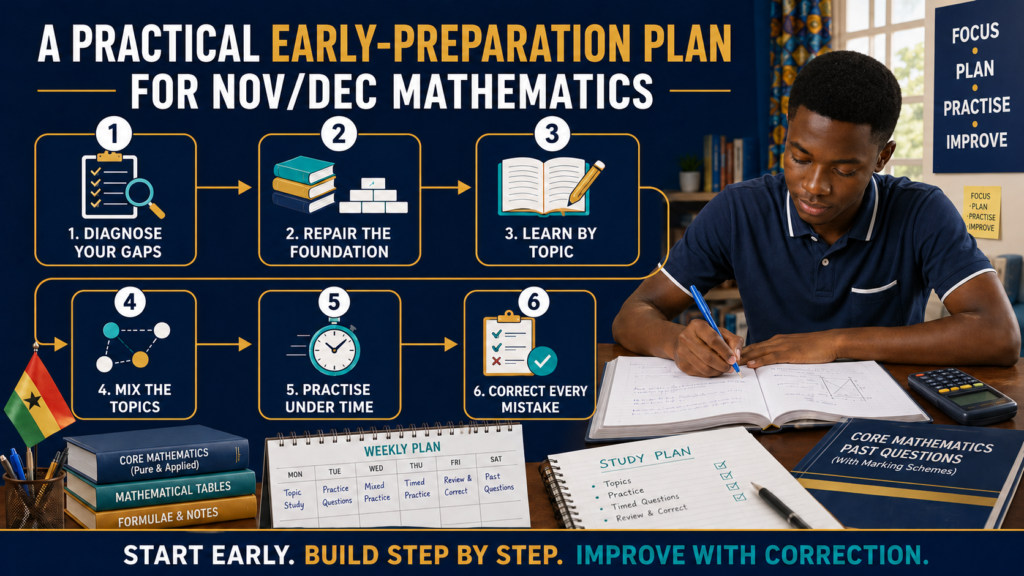
A Practical Early-Preparation Plan for Nov/Dec Mathematics
Stage 1: Diagnose before studying everything again
Attempt a complete core mathematics past paper without using notes or worked solutions.
Mark it honestly. Place each mistake under one of these headings:
- concept not understood;
- basic skill missing;
- formula forgotten;
- question misread;
- wrong method selected;
- calculation error;
- sign or bracket error;
- incomplete working;
- poor time management;
- topic not studied.
This diagnosis shows where your marks are being lost.
Stage 2: Repair your foundation
Begin with the basic skills affecting several topics.
These may include:
- fractions;
- directed numbers;
- order of operations;
- percentages;
- ratio;
- basic algebra;
- substitution;
- equations;
- interpretation of word problems.
Do not feel embarrassed about returning to a basic skill.
Repairing one foundation gap may improve your performance in several topics.
Stage 3: Learn one topic properly.
Use this cycle:
- Understand the main concept.
- Learn the necessary rule or formula.
- Study a worked example.
- Attempt simple questions.
- Correct your mistakes.
- Attempt WASSCE-style questions.
- Record repeated errors.
- Return to the topic after a few days.
Do not leave a topic after getting one question correct.
Stage 4: Mix the topics
Topic-by-topic practice teaches the method. Mixed practice teaches you when to use the method.
Combine questions from different learning areas. This forces you to read, interpret, and decide independently.
Stage 5: Practice under examination time.
Begin with short-timed exercises. Gradually move to complete papers.
Timed practice will show whether you can:
- maintain accuracy under pressure;
- Decide when to move to another question
- complete the required number of questions;
- reserve time for checking;
- control examination anxiety.
Do not wait until the final week before attempting your first timed paper.
Stage 6: Correct the paper properly.
After marking, do not focus only on the score.
For every serious mistake, write:
- what I did;
- why it was wrong;
- the correct method;
- What should warn me next time?
- One similar question to attempt again.
A score tells you how you performed. A proper correction teaches you how to improve.
Create a Mathematics Error Book
An error book helps you identify patterns in your mistakes.
| Topic | My mistake. | Correct idea | Warning for next time |
|---|---|---|---|
| Expansion | Multiplied only the first term in the bracket | Multiply every term inside the bracket. | Check the whole bracket. |
| Percentage | Used 15 instead of (15/100) | “Percentage” means “out of 100.” | Convert before multiplying |
| Circle | Used to find area | Area is | Check whether the question asks for area or circumference. |
| Equation | Changed a sign without explaining the operation | Perform the same operation on both sides. | Think about balance. |
| Graph | Used an unsuitable scale | Choose a scale that uses the graph space well. | Plan the axes before plotting. |
Review the book every week.
You may discover that many wrong answers come from only three or four repeated habits. Correcting those habits can protect marks across several topics.
A Realistic Weekly Preparation Plan
A private candidate may be working or managing other responsibilities. The study plan should therefore be realistic enough to follow.
| Day | Main Mathematics Task |
|---|---|
| Monday | Learn one weak concept. |
| Tuesday | Study examples and complete guided practice. |
| Wednesday | Solve questions without notes. |
| Thursday | Correct mistakes and relearn weak steps. |
| Friday | Attempt mixed questions. |
| Saturday | Complete timed practice |
| Sunday | Review the error book and plan the next week. |
A simple timetable followed consistently is better than a crowded timetable abandoned after a few days.
Decide what you will complete before each study session begins.
“Study Mathematics” is too broad.
A clearer target is
“Solve ten simultaneous-equation questions, mark them, and correct every elimination error.”
How to Build Real Confidence Before Nov/Dec
Confidence should come from evidence, not empty promises.
You build confidence when:
- You can solve a question without copying
- You can explain why a method works
- A previously difficult topic becomes clearer;
- Your repeated mistakes reduce
- You complete a paper within the official time;
- You know how to approach an unfamiliar-looking problem
- You can find and correct your own error.
Do not wait until you feel confident before studying.
Study properly, observe your improvement, and allow confidence to grow from the work you have completed.
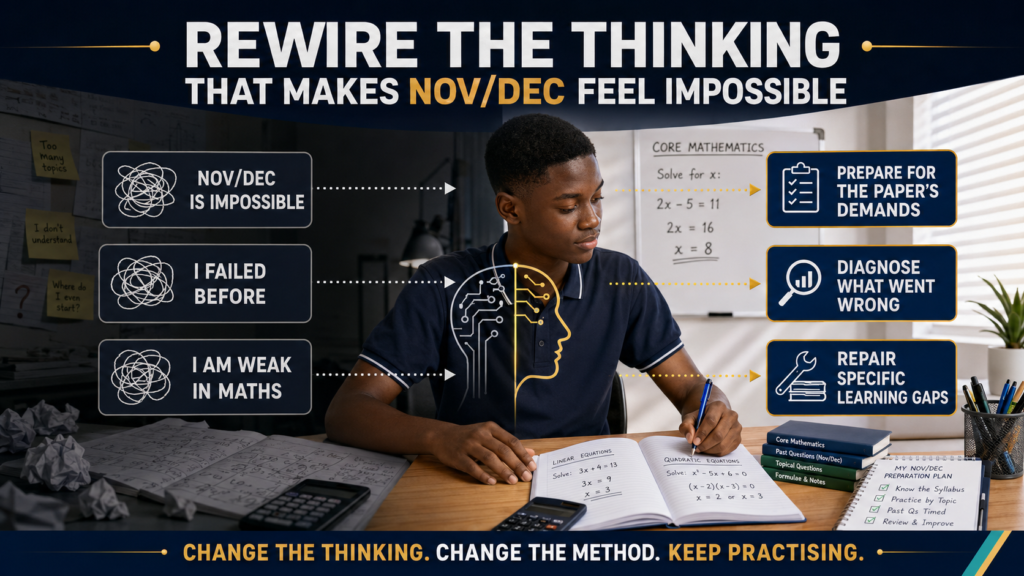
Rewire the Thinking That Makes Nov/Dec Feel Impossible
“Nov/Dec Mathematics is designed to fail private candidates.”
Replace it with:
“Nov/Dec Mathematics is a serious examination. I must prepare for its demands instead of preparing through rumors.”
“I did not obtain the grade I wanted before, so I cannot improve.”
Replace it with:
“My previous result shows that my old preparation was not enough. I can diagnose the problem and use a better method.”
“I am naturally weak in mathematics.”
Replace it with:
“I have specific mathematical gaps. Specific gaps can be identified, taught, and practiced.”
“The paper may contain a difficult question, so I will fail.”
Replace it with:
“I do not need every question to look easy. I need to secure the marks I can, think carefully, and manage my time.”
“I understand when the teacher solves it, so I have mastered it.”
Replace it with:
“I have mastered the method when I can solve and explain it independently.”
This is not pretending that Nov/Dec will be easy. It is replacing unhelpful fear with accurate thinking and useful action.
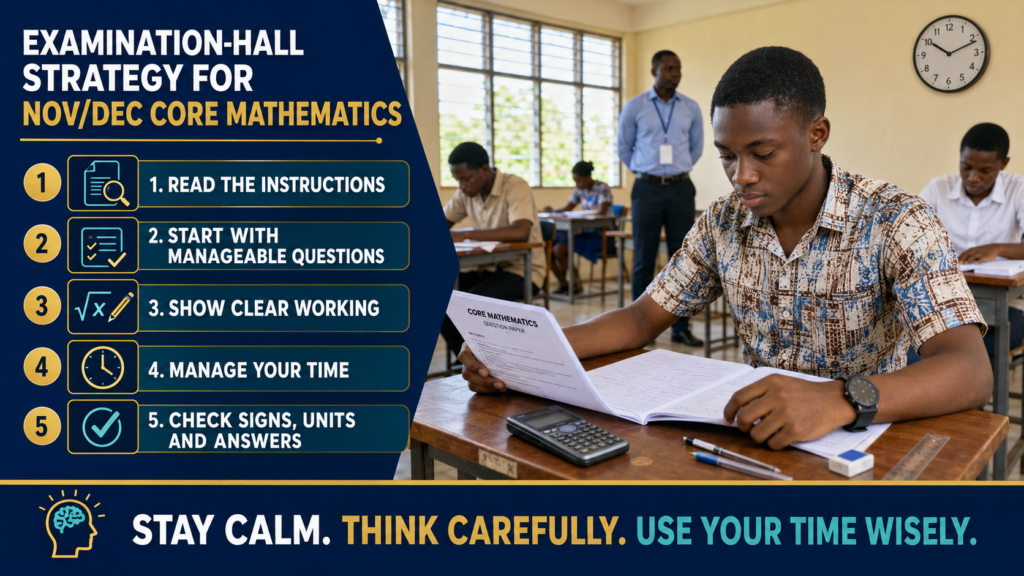
Examination-Hall Strategy for Nov/Dec Core Mathematics
Read the instructions.
Check:
- the number of questions required;
- compulsory sections;
- the time allowed;
- where answers should be written;
- any special instruction on the paper.
Start with questions you understand.
A calm beginning helps you settle into the paper and secure marks. However, do not ignore compulsory questions.
Show clear working.
Do not jump from the question to an unsupported answer.
Clear working helps you organize your thoughts, detect mistakes, and communicate your method.
Use the correct units.
An answer such as (36) may be incomplete if the required answer is
Do not allow one question to trap you.
If you become stuck, leave space and continue. Return after answering other manageable questions.
Check strategically.
Look for:
- wrong signs;
- copied figures;
- calculator errors;
- missing units;
- unreasonable answers;
- skipped parts;
- incorrect question numbers;
- answers that do not address what was asked.
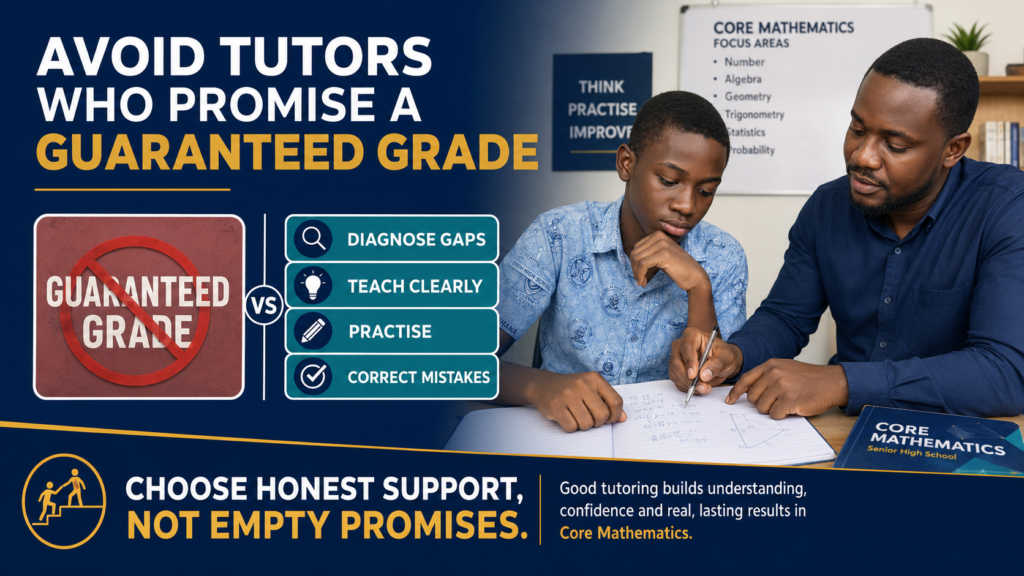
Avoid Tutors Who Promise a Guaranteed Grade
Encouragement is important, but a responsible teacher should not guarantee that every learner will obtain A1, B2, or any other specific grade.
A result depends on several factors:
- the learner’s starting point;
- quality of preparation;
- consistency;
- understanding;
- examination-day performance;
- accuracy;
- time management;
- adherence to instructions;
- the official marking and grading process.
A good teacher can provide:
- clear explanations;
- diagnostic support;
- targeted practice;
- honest correction;
- examination guidance;
- a structured preparation plan.
These can improve the learner’s readiness, but they should not be turned into a guaranteed grade.
A more honest statement is
Improvement is achievable when the learner receives the right support and consistently does the required work. The final grade cannot be promised before the examination is written and officially assessed.
Frequently Asked Questions About Nov/Dec Mathematics
Is Nov/Dec harder than WASSCE Core Mathematics?
Not automatically. Individual papers may vary, but it is misleading to claim that Nov/Dec Mathematics is always deliberately harder. It often feels harder because many private candidates prepare with less support and unresolved learning gaps.
Does WAEC deliberately fail private candidates?
There is no useful basis for preparing around that belief. Concentrate on the correct syllabus, current examination requirements, accurate methods, and answers that earn marks.
Can I improve after a poor core mathematics result?
Improvement is achievable, but it is not automatic. You must identify what produced the previous result and change the preparation method.
Are past questions enough for Nov/Dec Mathematics?
No. Past questions are important, but they cannot replace understanding.
Use them to:
- study question styles;
- Practice applying concepts;
- improve speed;
- diagnose weak areas;
- Test your readiness.
Do not memorize worked answers and expect the questions to return unchanged.
How early should I begin preparing?
Begin as early as possible. Early preparation gives you time to diagnose, learn, practise, correct, revisit, and complete timed papers without panic.
Must I attend remedial classes?
Not every learner needs the same arrangement. However, every learner needs access to accurate teaching and correction. If you study independently, use trusted materials and seek help when a method remains unclear.
What if I am rewriting only core mathematics?
Preparing for one subject gives you more focus, but it does not justify starting late. Use the opportunity to diagnose every major mathematics learning area and prepare thoroughly.
What if mathematics has always been difficult for me?
Do not label the whole subject as your weakness. Find the exact gaps.
Your struggle may come mainly from:
- fractions;
- signs;
- brackets;
- weak arithmetic;
- formula selection;
- word-problem interpretation;
- poor time management.
Repairing a few foundation gaps can improve several topics.
Conclusion: Is Nov/Dec Harder Than WASSCE?
So, is Nov/Dec harder than WASSCE Core Mathematics?
Not automatically.
It can feel harder when a learner enters the examination with:
- unresolved mathematical gaps;
- limited teacher support;
- poor study habits;
- late preparation;
- little timed practice;
- fear from a previous result;
- dependence on predictions;
- repeated errors that have never been corrected.
These problems are serious, but they can be addressed. Do not allow somebody’s frightening story to become your preparation plan. Do not register again and repeat the same learning mistakes.
Begin early. Diagnose your gaps. Repair your foundation. Practice by topic. Move to mixed questions. Complete timed papers. Record your errors. Seek correction. Follow current WAEC requirements.
Some questions may still be demanding. That is normal in a serious examination. Demanding does not mean impossible.
You do not need a false grade promise. You need accurate teaching, consistent practice, honest correction, and a preparation method that responds to your real learning gaps.
Nov/Dec Core Mathematics is not an examination to be approached carelessly. It is also not an examination to fear hopelessly. Prepare for it with understanding.
Stop Guessing. Start Understanding.