Struggling with WASSCE Maths? Stop guessing. Let’s fix the gap step by step.

Formula Errors in Area and Volume: 10 Powerful Fixes

Formula Errors in Area and Volume is meant for a struggling Ghanaian SHS learner who remembers mensuration formulas but misidentifies the dimensions, radius, height, or unit required.
A learner may be close to the correct answer but lose the whole method because of one small mistake:
- Diameter is used as radius.
- A sloping side is used as perpendicular height.
- The factor is omitted from a triangle formula.
- The factor ( is omitted from a cone formula.
- Surface area is calculated when volume is required.
- Square units are used for a volume.
- Measurements in centimetres and metres are mixed.
- The correct formula is copied, but the values enter the wrong positions.
These errors can make mensuration look more difficult than it really is.
This Mensuration Formulas Clinic identifies the dimension-and-formula gap, corrects it visibly, and prepares the learner for WASSCE and other WAEC-organized examinations.
The main correction is:
Do not substitute a measurement until you can name what it represents.
Maths Clinic Diagnosis: The First Formula May Already Be Wrong
The hidden gap is:
The learner remembers formulas as arrangements of letters but cannot connect each letter to the correct dimension in the diagram.
For example, a learner may remember:
V=
but still make one of these errors:
- Use diameter as
- Use slant height as
- Omit the square on
- Use instead
- Write the final answer in
The formula has not been understood as a measurement relationship.
The learner must know:
- (r) means radius.
- (h) means perpendicular height.
- is the area of the circular base.
- Multiplying the base area by height gives cylinder volume.
- Volume requires cubic units.
Current Curriculum Connection
A learner studying area and volume should be able to:
- Observe or sketch a figure
- Name the shape or solid
- Identify what must be measured
- Label the dimensions
- Explain why a formula fits
- Substitute accurately
- Convert units where necessary
- Check whether the final unit is squared or cubed
- Communicate the reasoning in clear steps
Where suitable, learners may use:
- A ruler
- A grid
- Paper cut-outs
- Cardboard models
- Cylindrical containers
- Cubes and boxes
- Dynamic geometry tools
The purpose of these materials is to connect each formula to an actual length, region, or space.
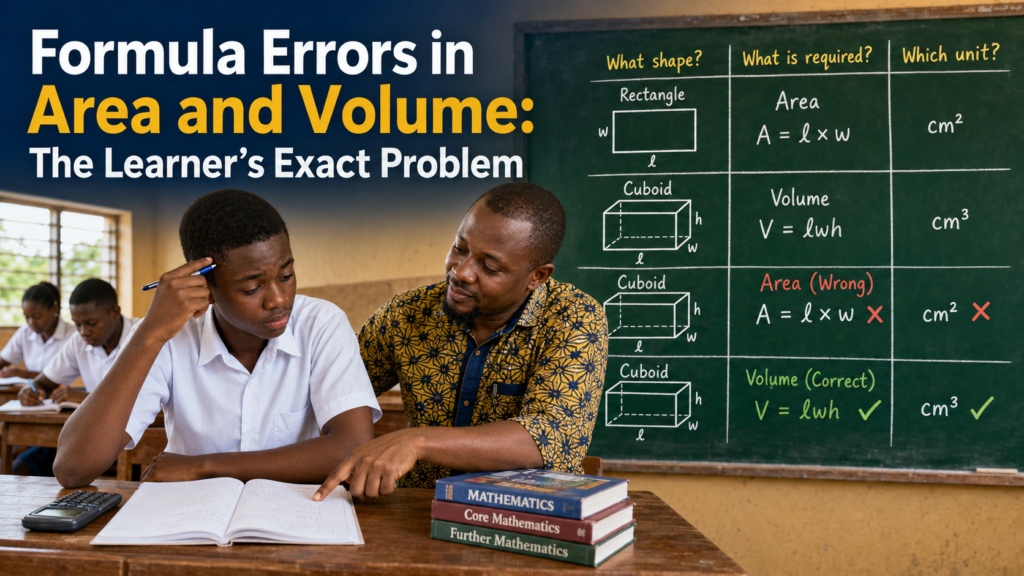
Formula Errors in Area and Volume: The Learner’s Exact Problem
The learner is not completely lost. The learner may even write a familiar formula.
The breakdown occurs when the learner cannot answer:
- Is the figure flat or solid?
- Is the question asking for area, surface area, or volume?
- Which value is the radius?
- Is the given measurement a diameter?
- Which line is perpendicular to the base?
- Is the given height vertical or slanting?
- Are all measurements in the same unit?
- Does the formula need (\frac12) or (\frac13)?
- Should the final unit be squared or cubed?
The learner may therefore produce serious-looking working from a wrong first decision.
Three Questions Before Every Formula
Before writing a formula, ask:
1. What shape or solid is involved?
Examples:
- Rectangle
- Triangle
- Circle
- Trapezium
- Cuboid
- Prism
- Cylinder
- Cone
- Sphere
2. What measurement is required?
Examples:
- Area
- Surface area
- Volume
3. Which dimensions are given?
Examples:
- Length
- Breadth
- Radius
- Diameter
- Perpendicular height
- Slant height
- Cross-sectional area
If these three answers are clear, formula selection becomes safer.
Area and Volume Are Not the Same
Area
An area measures a flat two-dimensional region.
Examples include:
- A field
- A floor
- A wall
- A circle
- A triangular face
Area uses square units:
Surface area
Surface area measures the outside covering of a solid.
It also uses square units.
Volume
Volume measures three-dimensional space.
It may be:
- Space occupied by a solid
- Space inside a container
Volume uses cubic units:
Dimension Check: Why the Units Change
Rectangle area
If both measurements are in centimeters:
Cuboid volume
V=
Therefore:
Cylinder volume
V=
The circular base area is:
, which is measured in square units.
Multiplying by height gives:
.
This unit reasoning can help the learner detect an incomplete formula.
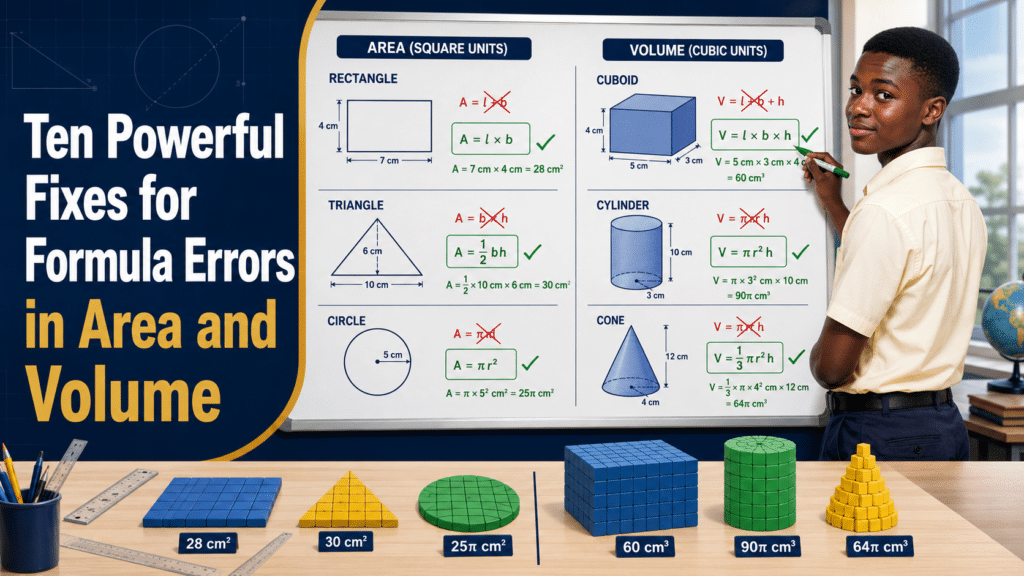
Ten Powerful Fixes for Formula Errors in Area and Volume
Fix 1: Separate flat figures from solids.
A flat figure may require area.
A solid may require:
- Surface area
- Volume
A circle is flat. A cylinder is solid.
Do not use a circle-area formula as the final answer when the question asks for cylinder volume.
Fix 2: Name the measurement before choosing the formula
Write:
Required measurement = area.
or:
Required measurement = volume.
This prevents the learner from selecting a formula only because the shape looks familiar.
Fix 3: Label every dimension.
Write:
r=
h=
Do not substitute unnamed numbers.
Fix 4: Change diameter to radius.
Circle, cylinder, cone, and sphere formulas usually use radius.
Remember:
Therefore:
If the diameter is
Fix 5: Use perpendicular height.
For triangles, parallelograms, trapezia, prisms, cones, and pyramids, height normally means perpendicular distance.
A perpendicular line meets the base at (90^\circ).
Do not use any sloping side as the height.
Fix 6: Separate vertical height and slant height.
For a right circular cone:
- (h) is the perpendicular height.
- (l) is the slant height.
Use:
for volume.
Use:
for curved surface area.
Fix 7: Protect important numerical factors
The area of a triangle is:
The volume of a cone or pyramid is:
Omitting doubles a triangle’s area.
Omitting triples a cone’s volume.
Fix 8: Make all units consistent
Do not substitute meters and centimeters into the same formula.
Convert before calculating.
For example:
Area and volume conversions must also respect the power:
Fix 9: Distinguish base area from complete volume
For a cylinder:
finds the area of one circular base.
The volume is:
The height must be included.
Fix 10: Predict the final unit
Before calculating, write the expected unit.
For example:
Expected unit =
If the calculation ends in something is incomplete, or the wrong measurement was found.
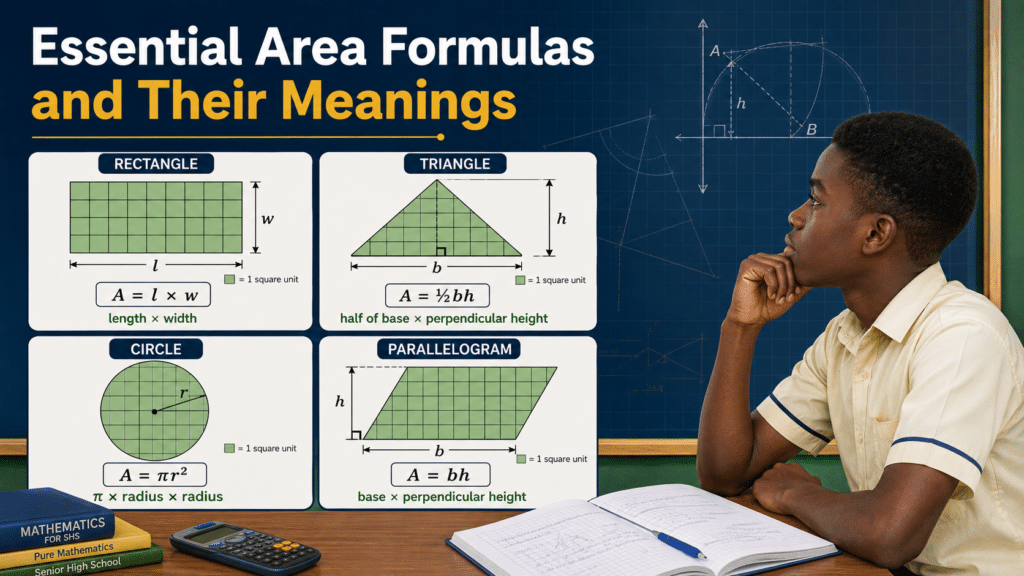
Essential Area Formulas and Their Meanings
| Shape | Formula | Meaning of dimensions |
|---|---|---|
| Rectangle | Length × breadth | |
| Square | Side × side | |
| Triangle | Base × perpendicular height ÷ 2 | |
| Parallelogram | Base × perpendicular height | |
| Trapezium | Average of parallel sides × perpendicular height | |
| Circle | × radius squared | |
| Sector | Fraction of complete circle area |
Essential Volume Formulas and Their Meanings
| Solid | Formula | Formula meaning |
|---|---|---|
| Cube | Side × side × side | |
| Cuboid | Length × breadth × height | |
| Prism | Base or cross-section extended through a length | |
| Cylinder | Circular base area × height | |
| Cone | One-third of the matching cylinder volume | |
| Pyramid | One-third × base area × perpendicular height | |
| Sphere | Volume determined by radius cubed | |
| Hemisphere | Half of the sphere’s volume |
In the pyramid formula, (B) represents the area of the base, not a single base length.
Error 1: Circumference Used Instead of Circle Area
For a circle:
Circumference:
Area:
Circumference measures distance around.
Area measures the flat region inside.
Diagnostic clue
If the question asks for area and the answer is in centimeters rather than square centimeters, circumference may have been calculated.
Error 2: Diameter Used as Radius
Suppose a circle has a diameter
Wrong:
Correct:
Area:
Using 14 as the radius makes the area four times the correct value.
Error 3: Any Side Used as Triangle Height
The formula is:
The base and height must be perpendicular.
If a triangle has:
- Base
- Sloping side
- Perpendicular height
use:
Do not use the sloping (10\text{ cm}) side as the height.
Error 4: Triangle Factor Omitted
Wrong:
Correct:
The triangle is half of a parallelogram or rectangle with the same base and perpendicular height.
Error 5: Cylinder Base Area Given as Volume
Wrong final formula:
This finds only the area of the circular base.
Correct:
The base area must be extended through the cylinder’s height.
Error 6: Curved Surface Area Used as Volume
For a cylinder:
finds curved surface area.
It does not find volume.
Volume is:
A learner may recognise the cylinder correctly but still choose the wrong measurement.
Error 7: Cone Factor Omitted
Wrong:
This is the volume of a cylinder.
Correct cone volume:
A cone with the same circular base and height as a cylinder has one-third of the cylinder’s volume.
Error 8: Slant Height Used for Cone Volume
Cone volume uses perpendicular height:
Curved surface area uses slant height:
If (r) and (h) are given, the slant height of a right circular cone may be found using:
Do not interchange (h) and (l).
Error 9: Length Units Mixed
Suppose a cuboid has:
- Length
- Breadth
- Height
Do not write:
The units are mixed.
Convert (1.5\text{ m}) to centimetres:
Then:
Error 10: Wrong Power on the Final Unit
Area:
Volume:
Writing a wrong unit is not merely a writing error. It may show that the learner does not understand what was measured.
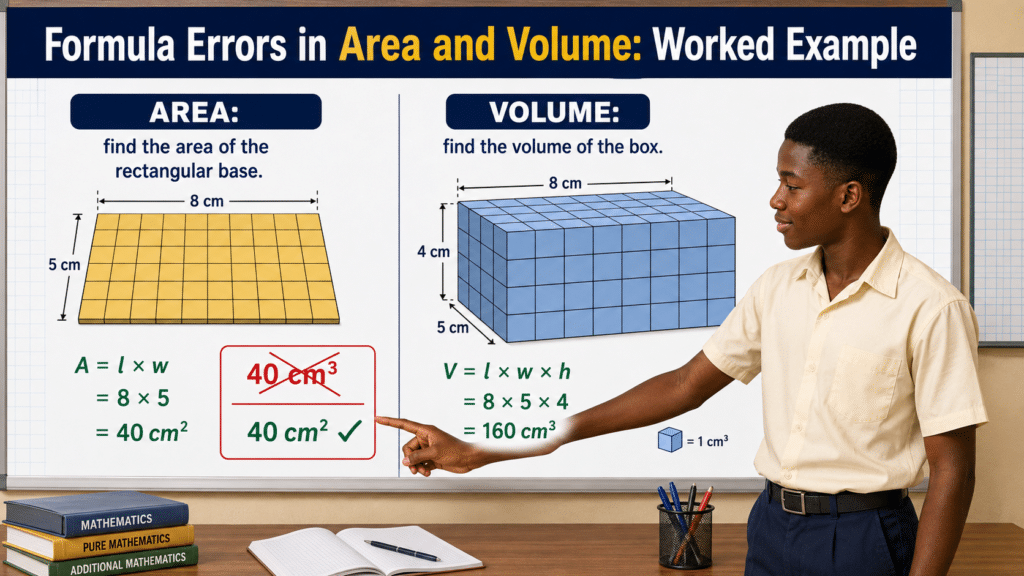
Formula Errors in Area and Volume Worked Example
Find the volume of a cylinder of radius (7\text{ cm}) and height (10\text{ cm}). Use:
Step 1: Identify the solid
The solid is a cylinder.
Step 2: Identify the measurement
The question requires volume.
Step 3: Label the dimensions
Step 4: Select the formula
Step 5: Substitute
Step 6: State the unit
Answer: Volume =.
Reasonableness check
The base area is:
]
The cylinder extends through a height of (10\text{ cm}):
Why the Common Wrong Approaches Fail
Wrong approach A
This finds the curved surface area of the cylinder. The answer would use square units.
Wrong approach B
This finds only the area of the circular base. It does not include the cylinder’s height.
Wrong approach C
This is neither the standard cylinder-volume formula nor its curved surface area formula.
Hidden gap
The learner identified the solid but did not connect the required measurement to the correct formula.
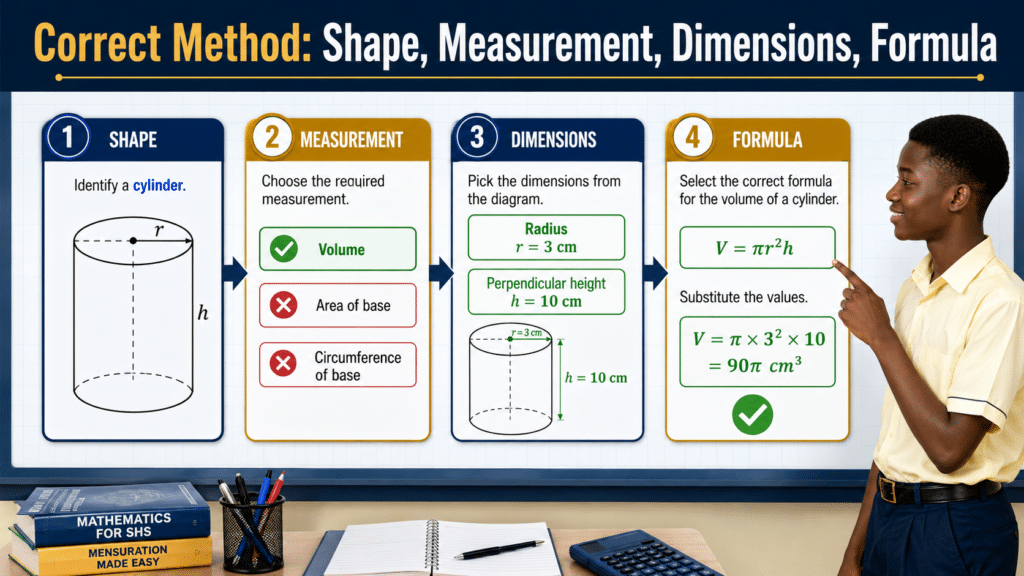
Correct Method: Shape, Measurement, Dimensions, Formula
Use this order:
Step 1: Name the shape or solid
For example:
Cylinder
Step 2: Name the measurement
For example:
Volume
Step 3: Label the dimensions
For example:
Step 4: Predict the final unit
For example:
Step 5: Select the formula
Step 6: Substitute
Place each labelled value in its correct position.
Step 7: Calculate
Follow the stated instruction for rounding.
Step 8: Check
Confirm that the result matches the required measurement and unit.
Formula-Selection Checklist
Before substituting, ask:
- Is the figure flat or solid?
- Is the question asking for area, surface area, or volume?
- What does each letter in the formula mean?
- Is the given measurement a radius or diameter?
- Which line is perpendicular to the base?
- Is the given height perpendicular or slanting?
- Does the formula require or?
- Are all dimensions in the same unit?
- Should the final answer be squared or cubed?
- Is another practical step required?
Formula Errors in Area and Volume Practice and Retest
For each question:
- Name the shape or solid.
- State the measurement required.
- Label the dimensions.
- Predict the answer unit.
- Write the formula.
- Solve.
- Check the result.
Questions
- A circle has diameter . Find its area using .
- A cube has side . Find its volume.
- A triangle has base and perpendicular height (9\text{ cm}). Find its area.
- A cylinder has radius and height. Find its volume in terms of.
- A rectangular field measures by . Find its area.
- A trapezium has parallel sides and , and perpendicular height (5\text{ cm}). Find its area.
- A cone has radius ( and perpendicular height Find its volume and curved surface area in terms of.
- A cylinder has diameter and height . Find its volume using .
- A triangular prism has a triangular cross-section of base and perpendicular height (5 cm). The prism is long. Find its volume.
- A cuboid measures by by . Find its volume in cubic centimeters and cubic meters.
- A sphere has a diameter . Find its volume in terms of .
- A triangle has a base, a perpendicular height , and a sloping side. A learner uses the height. Explain the mistake and calculate the correct area.
Answers and Gap Diagnosis
1. Area =
Diameter:
Radius:
Area:
If you used, you confused diameter with radius.
2. Volume =
If you wrote (25\text{ cm}^2): You found the area of one square face.
3. Area =
[
A=\frac12 bh
]
If you wrote (108\text{ cm}^2): You omitted the factor (\frac12).
4. Volume =
If you wrote : You used curved surface area.
5. Area =
6. Area =
If you used : You treated the trapezium as a rectangle.
7. Volume = ; curved surface area =
Volume:
Find the slant height:
Curved surface area:
This question deliberately separates (h) from (l).
8. Volume =
9. Volume =
Area of triangular cross-section:
Prism volume:
If you stopped at: You found only the cross-sectional area.
10. Volume =
Convert:
Then:
Since:
then:
If you multiplied : You mixed meters and centimeters.
11. Volume =
Diameter:
Radius:
Sphere volume:
12. Correct area =
The side is sloping. It is not the perpendicular distance from the base.
Use:
Therefore:
Gap identified: Perpendicular-height recognition.

Use the Results to Locate the Gap
| Error pattern | Likely gap | Repair action |
|---|---|---|
| Circumference found instead of area | Measurement-selection gap | Name the requested measurement first. |
| Diameter used as radius | Dimension-identification gap | Write |
| Sloping side used as height | Perpendicular-height gap | Mark the relationship |
| omitted | Formula-structure gap | Connect the triangle to half a parallelogram. |
| omitted | Solid-comparison gap | Compare a cone or pyramid with a prism or cylinder. |
| Base area given as final volume | Missing-dimension gap | Multiply by the solid’s height or length. |
| Surface area formula used for volume | Formula-meaning gap | Separate outside covering from inside space. |
| Metres and centimetres mixed | Unit-consistency gap | Convert before substitution. |
| Square unit used for volume | Dimension-unit gap | Predict the unit before calculating. |
| Cross-sectional area not extended | Prism-structure gap | Multiply by prism length. |
Score Guide
| Score | What it suggests | Next action |
|---|---|---|
| 10–12 correct | Dimension and formula meanings are becoming secure. | Attempt unfamiliar mixed-mensuration questions. |
| 7–9 correct | One or two dimension traps remain. | Correct the specific error pattern and retest. |
| 4–6 correct | Formula letters are not consistently linked to dimensions. | Return to labelled diagrams. |
| 0–3 correct | Formula substitution begins before the shape is understood | Rebuild shape, measurement, and dimensions first. |
Formula Error-Correction Record
Complete one row for every wrong answer.
| Question | Shape | Measurement | Dimension confused | First wrong line | Retest |
|---|---|---|---|---|---|
Use this correction cycle:
- Name the shape.
- Name the measurement.
- Label every dimension.
- Locate the first wrong line.
- Name the gap.
- Correct that exact skill.
- Solve the original question again.
- Attempt a similar question without help.
Learner-Centered Clinic Activity
Activity 1: Label before calculating
Give the learner diagrams without formulas.
Ask the learner to label:
- Radius
- Diameter
- Base
- Perpendicular height
- Slant height
- Length
- Breadth
Do not allow calculation until the labels are correct.
Activity 2: Formula sorting
Write area and volume formulas on separate cards.
Ask the learner to sort them into:
- Flat-shape area
- Surface area
- Solid volume
The learner must explain what every letter represents.
Activity 3: Formula repair
Present incomplete formulas:
for a triangle
for a cylinder
for a cone
Ask the learner to identify and repair the missing factor or dimension.
Activity 4: Unit prediction
Before solving, ask the learner to write:
- for area
- for volume
The learner then checks whether the working produces the predicted dimension.
Activity 5: Fresh retest
After correcting one formula error, change the figures and let the learner solve a similar problem without help.
Depth of Knowledge Progression
| Depth of Knowledge | Main demand | Questions or activity |
|---|---|---|
| DoK 1 | Recall and apply a familiar formula. | Questions 1–5 |
| DoK 2 | Identify dimensions, convert units and coordinate formula steps | Questions 6–11 |
| DoK 3 | Diagnose a wrong dimension and justify the correction. | Question 12 and formula-repair activity |
The depth comes from the reasoning required, not merely the number of calculations.
Learner Reflection
Tick each statement only when you can do it without copying.
- I identify the shape before selecting a formula.
- I state whether the question requires area, surface area or volume.
- I label every given dimension.
- I can separate radius from diameter.
- I can identify perpendicular height.
- I can separate perpendicular height from slant height.
- I remember the in-triangle area.
- I remember the cone and pyramid volume.
- I know that is a circular base area.
- I know why cylinder volume includes height.
- I convert measurements to a common unit before substitution.
- I can distinguish square and cubic units.
- I can explain what each letter in my formula means.
- I check the formula before using the calculator.
- I can diagnose the first wrong line in a solution.
How This Helps Before WASSCE
This lesson helps the learner to:
- Connect formulas to measurement meanings
- Identify dimensions from diagrams
- Separate radius from diameter
- Use perpendicular height correctly
- Distinguish vertical and slant heights
- Protect important factors such as (\frac12) and (\frac13)
- Separate base area from volume
- Distinguish surface area from volume
- Convert units before substitution
- State square and cubic units correctly
- Diagnose where a formula solution became wrong
- Explain why a formula fits the figure
The official WAEC Ghana Chief Examiner’s Reports may be consulted when studying reported examination performance and weaknesses.
Continue the Mensuration Intervention
If the learner still cannot decide whether a question requires area, surface area or volume, visit the Maths Intervention Hub to repair the measurement-type gap.
When the dimensions and formulas are becoming clear, attempt targeted questions in the WASSCE Maths Practice Zone.
For examination errors involving diagrams, formulas, and units, explore WAEC Maths Traps.
Conclusion: Understand the Dimensions Before Substituting
Formula errors in area and volume reduce when the learner understands what each measurement represents.
Before using a formula, ask:
- What shape or solid is involved?
- What measurement is required?
- Which value is the radius?
- Was I given the diameter?
- Which line is perpendicular to the base?
- Is the height vertical or slanting?
- Does the formula need (\frac12) or (\frac13)?
- Are all measurements in the same unit?
- Should the final answer be squared or cubed?
A wrong formula can make a learner who is close to understanding appear completely weak.
The solution is not to copy more formulas without meaning. The learner must attach each formula to:
- A shape
- A measurement
- A labelled diagram
- A correct unit
Use this safe order:
Shape first. Measurement second. Dimensions third. Formula fourth.
Once these four decisions are correct, substitution becomes ordinary arithmetic.
Stop Guessing. Start Understanding.
Ready to Find and Fix Your Formula Gap?
Do not practice blindly. Enter the Maths Clinic Practice Zone, answer the questions, and use your results to locate the exact gap—shape identification, measurement choice, dimensions, formula selection, or units.
Study every correction, retry the weak area, and practice until the method becomes clear.
Start Practising: Find the Gap. Fix the error. Build Confidence.
Visit the WASSCE Maths Practice Zone and attempt more area and volume questions with purpose.
For every wrong answer, identify whether the mistake came from:
- Measurement selection
- Formula selection
- Radius–diameter confusion
- Perpendicular-height recognition
- Slant-height confusion
- A missing factor
- Unit conversion
- Substitution
- Square or cubic units
- Final interpretation
Correct that exact gap before attempting a fresh question.