Struggling with WASSCE Maths? Stop guessing. Let’s fix the gap step by step.
What WAEC Examiners Report: 12 Years of Mathematics (2011–2025)
Twelve years of WAEC Chief Examiner reports for Core Mathematics in one table: where candidates lose marks, what the examiners recommend, and what changes under the 2023 curriculum.
Every year, WAEC’s Chief Examiners write a report on how candidates answered the Mathematics paper: what they did well, where they lost marks, and what teachers and learners should do about it. Most learners never read these reports. We did.
This page brings together the reports for Mathematics (Core) from 2011 to 2025: twelve years in one table. It is the evidence behind every lesson, diagnostic and repair pack on The Maths Clinic.
How we read the reports
- Years covered: 2011, 2012, 2013, 2016, 2017, 2018, 2019, 2020, 2021, 2023, 2024 and 2025. We do not have the reports for 2014, 2015 and 2022.
- Core Mathematics only. Elective Mathematics findings are left out.
- Weak or Strong means the report’s own summary named the area as a weakness or a strength that year.
- Poor or Good means the summary did not mention the area, but the comment on a question in that area said most candidates answered it poorly or well.
- A blank cell means the report did not comment on the area. It does not mean candidates were strong.
Twelve years in one table
| Area | 2011 | 2012 | 2013 | 2016 | 2017 | 2018 | 2019 | 2020 | 2021 | 2023 | 2024 | 2025 |
|---|---|---|---|---|---|---|---|---|---|---|---|---|
| Word problems into equations | Weak | Weak | Poor | Weak | Weak | Weak | Weak | Weak | Weak | Poor | Weak | |
| Illustrating information in a diagram | Poor | Poor | Poor | Poor | Poor | Poor | Poor | Weak | Weak | Weak | ||
| Plane geometry and circle theorems | Weak | Weak | Weak | Weak | Weak | Weak | Weak | Weak | Poor | Poor | ||
| Mensuration | Weak | Poor | Weak | Weak | Weak | Poor | Weak | Strong | ||||
| Trigonometry: ratios and graphs | Weak | Strong | Weak | Strong | Poor | Strong | Strong | Strong | Strong | |||
| Elevation and depression | Poor | Poor | Poor | Poor | Poor | Weak | Poor | Poor | ||||
| Bearings: drawing the diagram | Poor | Poor | Poor | Poor | Strong* | Strong* | ||||||
| Global maths (latitude, longitude) | Weak | Weak | Weak | |||||||||
| Business and financial maths | Poor | Weak | Weak | Poor | Poor | Weak | Weak | |||||
| Ratio, proportion, variation | Poor | Poor | Strong | Poor | Poor | Weak | Poor | |||||
| Number: surds, indices, logs, no calculator | Weak | Weak | Weak | Strong | Weak | Weak | Weak | |||||
| Graph reading and evidence | Poor | Poor | Weak | Weak | Weak | Poor | ||||||
| Statistics: tables, cumulative frequency | Weak | Weak | Strong | Strong | Strong | Strong | Strong | Weak | ||||
| Probability | Poor | Weak | Strong | Weak | Weak | Strong | Strong | Strong | Strong | |||
| Sets and Venn diagrams | Strong | Weak | Poor | Strong | Strong | Strong | Good | |||||
| Logical reasoning | Weak | Weak | Weak | Poor | ||||||||
| Vectors and transformations | Strong | Strong | Strong | Weak | Strong | Strong | Strong | Strong | Strong | Strong | Strong |
Strong*: the summary lists bearings as a strength in 2023 and 2024, yet in the same reports most candidates could not draw the bearings diagram. We trust the question comments more, because they describe real scripts.
What the pattern says
- The biggest leak is translation, not whole topics. Turning a word problem into an equation is named as a weakness in 9 of the 12 reports. The 2024 report names a close relative: translating diagrams into mathematical statements.
- A wrong or missing diagram ends many answers early. Illustrating information in a diagram is a named weakness in 2023, 2024 and 2025, and question comments describe the same failure in most earlier years: bearings, angles of elevation and depression, and geometry.
- Drawing a graph is a strength; reading it is not. Completing a table of values and drawing the graph is a strength in at least eight years, but showing evidence of reading from the graph is a weakness in 2019, 2020 and 2021.
- Trigonometry is split. The ratios are mostly a strength. Questions that need a sketch first, such as elevation, depression and two-leg bearings, are where marks go.
- Probability, sets, vectors and transformations are usually strengths. They are good places to secure easy marks.
Six gaps, with examples
These are the gaps the reports point to most often. Each comes with a small example and the fix.
1. You can solve equations, but word problems freeze
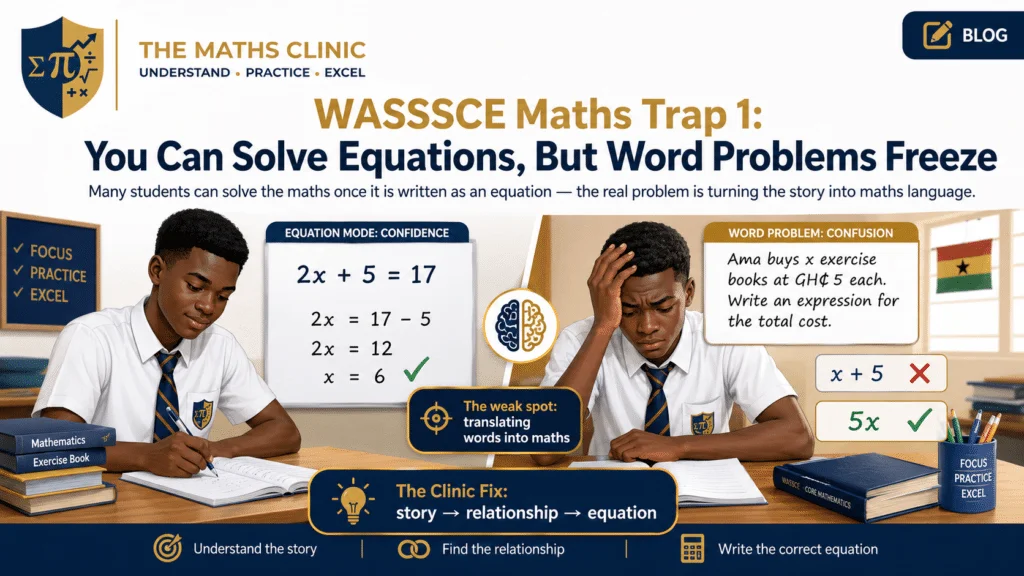
This is one of the most common WASSCE Maths traps. A student may solve this:
2x+5=17. But when the same idea is written as a story, the student freezes.
Ama goes to a bookshop in Adum. One exercise book costs GH₵5. She buys 4 exercise books.
Ama buys x exercise books at GH₵5 each. Write an expression for the total cost.
Some students write x + 5 or even 5. That is where the weakness shows itself.
The student understands buying and selling in real life but cannot change the story into mathematical language. That is not just an algebra problem. It is a translation problem.
The fix: before solving, ask what you are looking for, what is given, and how they are related. One book costs GH₵5 and Ama buys x books, so the total cost is 5x.
- What am I looking for?
- What has been given?
- What is the relationship?
- Should I add, subtract, multiply, or divide?
- Can I write the situation as an expression or equation?
2. You read the graph, but you don’t show evidence
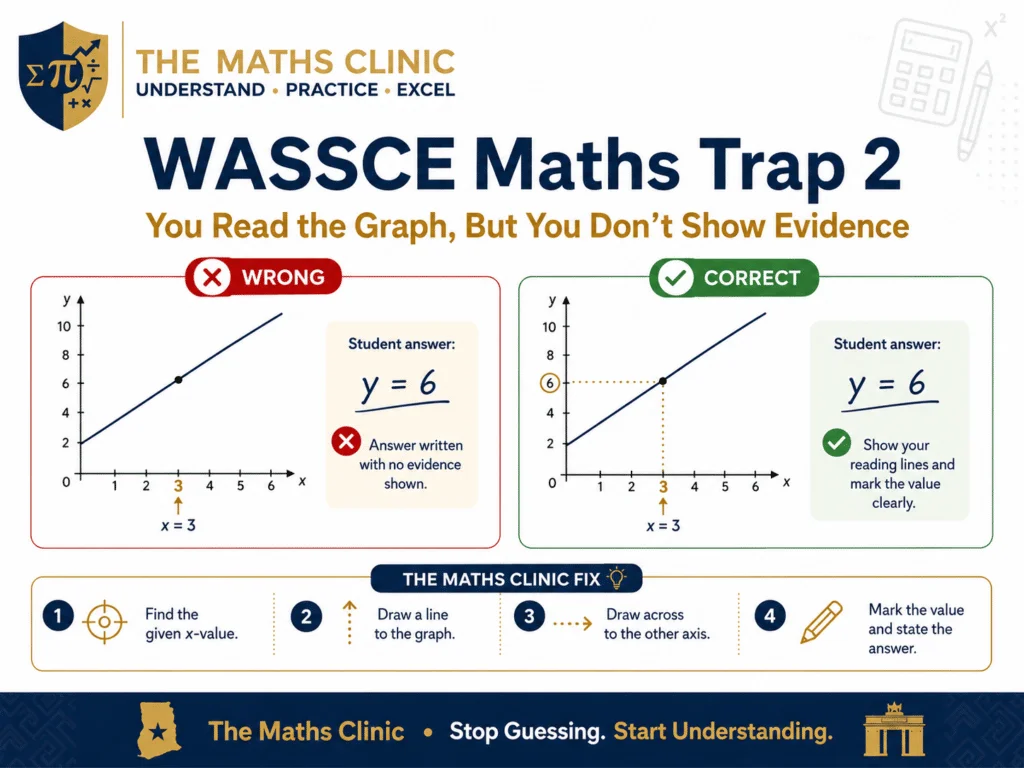
Many students can read the correct value from a graph, but still lose marks because they do not show the reading lines and clear evidence.
Showing evidence of reading from a graph is a named weakness in the 2019, 2020 and 2021 reports. A question may ask: use your graph to find y when x = 3. Writing “y = 6” with no lines drawn gives the examiner no evidence of how you got it.
- Find the given value on the axis.
- Draw a neat line on the graph.
- Draw another line to the other axis.
- Mark the value clearly.
- Write the answer.
3. You know the formula, but use it in the wrong place
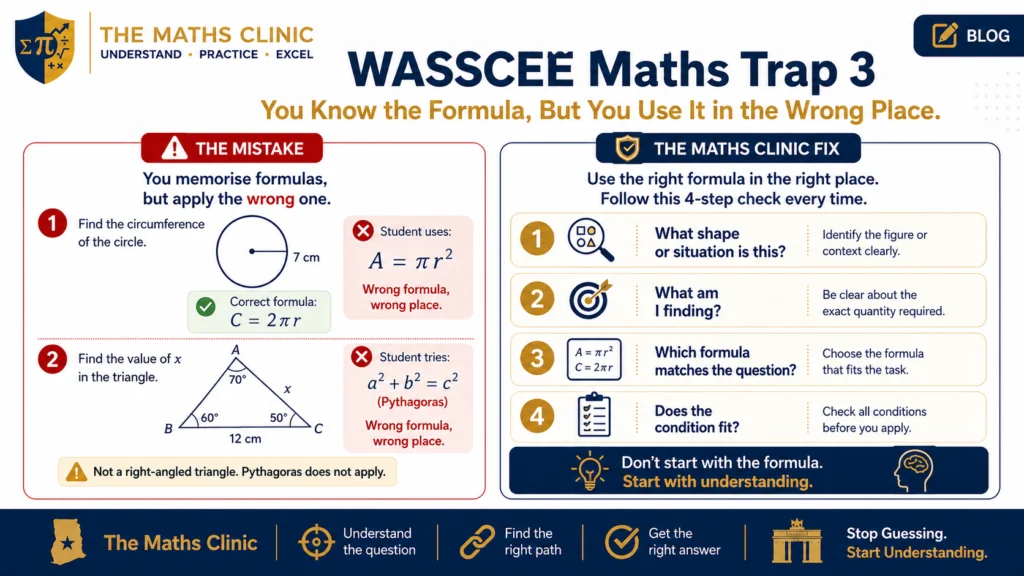
Many students know the formula, but still lose marks because they apply it to the wrong shape, question, or condition.
Because knowing a formula is not the same as knowing when to use it.
- A student may apply Pythagoras’ theorem to a triangle that is not right-angled.
- Another may use the area of a circle when the question is asking for the circumference.
- Another may use simple interest wrongly because they do not know which amount is the principal.
- What shape or situation is this?
- What information has been given?
- What exactly am I finding?
- Does this formula fit the question?
- What unit should my answer carry?
4. You handle money in real life, but percentage questions go wrong
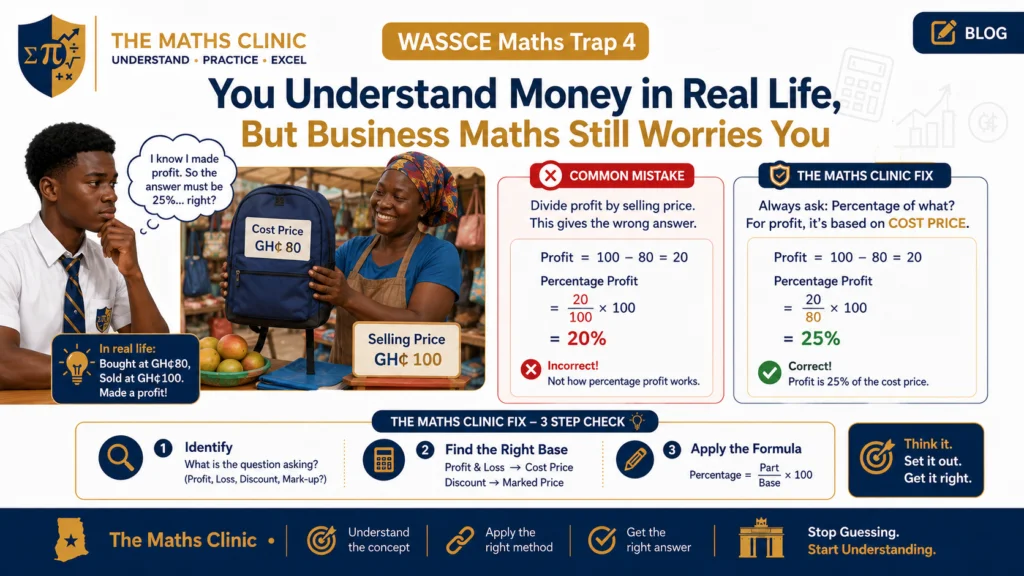
The 2025 report lists simple interest applications and translating word problems among the weaknesses; the 2024 report lists business mathematics.
Let us use a market example. A trader buys a school bag for GH₵80 and sells it for GH₵100. How much profit did the trader make?
Profit = Selling Price (SP) – Cost Price (CP)
Profit = \text{GH₵}100 – \text{GH₵}80 = \text{GH₵}20.
So the profit is GH₵20.
Now the percentage profit is \frac{20}{80}\times 100\% = 25\%. Note: Some students divide by the selling price (SP), which in this example is GH₵100, instead of the cost price of GH₵80 in this example, i.e., \frac{20}{100}\times 100\% = 20\%. This answer is wrong because the base is wrong. For percentage profit, the base is the cost price.
Percentage of what?
Profit percentage → cost price
Discount percentage → marked price
Simple interest → principal
Commission → amount sold or the stated base
5. You start calculating before drawing the situation
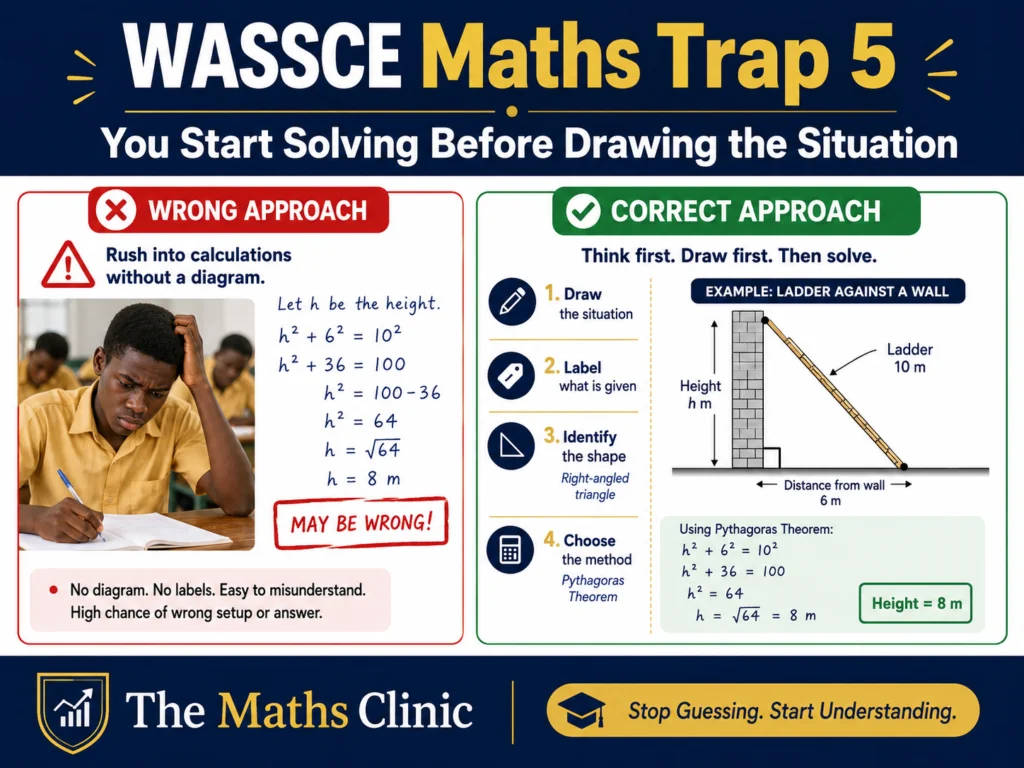
Representing information in a diagram is a named weakness in the 2023, 2024 and 2025 reports.
A ladder leans against a wall. The foot of the ladder is 6 m from the wall. The ladder is 10 m long. Find the height of the wall.
Now you can see a right-angled triangle. That simple drawing can show you that Pythagoras’ theorem is needed.
- Draw the situation.
- Label what is given.
- Mark what you are finding.
- Identify the shape.
- Choose the method that makes sense after the diagram.
6. You guess the conclusion instead of following the statement
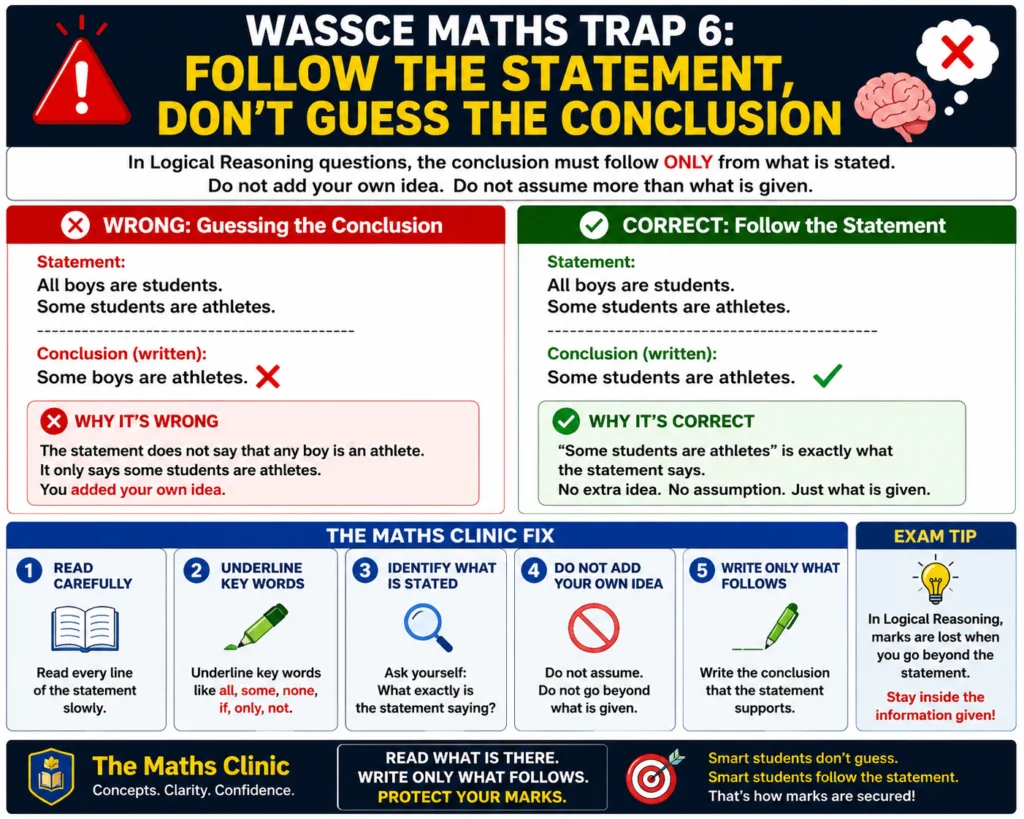
Logical reasoning is a named weakness in the 2013, 2021 and 2023 reports.
All students in Form 3 Gold study Mathematics.
Akua is in Form 3 Gold.
Correct: Akua studies Mathematics. Not supported: Akua is good at Mathematics. The statement does not say that, so you must not add it.
- Read only what is given.
- Do not add your own idea.
- Ask: What must be true?
- Use a simple diagram if needed.
- Write only the conclusion that the statement supports.
What the examiners keep recommending
The remedies hardly change from year to year:
- Read carefully and understand the demands of each question before answering.
- Give candidates more exercises and encourage them to practise on their own.
- Give weak students time and teach them the basic principles of the topics they struggle with.
- Work with at least four decimal places and round only at the end (2019).
- Teachers should stop teaching only the topics they are comfortable with.
Old syllabus, new curriculum
These reports were written for candidates on the older syllabus. Ghana’s SHS Mathematics curriculum (NaCCA, September 2023) is organised into four strands: Numbers for Everyday Life, Algebraic Reasoning, Geometry Around Us, and Making Sense of and Using Data. Most of the weak areas above are still in it, often with more emphasis on real-life modelling.
We could not find these examined topics in the 2023 curriculum: global maths (latitude and longitude), the sine and cosine rules, matrices, binary operations, histograms, frequency polygons, percentiles, hire purchase and frustums. Lessons on these topics carry a syllabus note. Whether WAEC will still set them for new-curriculum candidates is not yet confirmed, so ask your teacher.
Quick check: five questions
Try these five questions. They are simple, but each one checks something important.
1. Word Problem Check
A student buys 6 pens at GH₵2 each. Find the total cost.
2. Algebra Check
Simplify: x+x+x
3. Business Maths Check
A shirt was bought for GH₵50 and sold for GH₵65. Find the profit.
4. Percentage Check
Using the same shirt question, find the percentage profit.
5. Graph Evidence Check
If a graph asks you to find y when x = 4, what must you show on the graph?
Clinic Answers
1. Total Cost: 6×2=12, Total cost = GH₵ 12. Do not add 6 and 2. The 6 is the quantity. 2 is the price per pen.
2. Algebra: x+x+x=3x. Do not write x^3. That would mean: x×x×x
3. Profit: 65−50=15. Profit = GH₵15.
4. Percentage profit = \frac{15}{50}\times 100\% = 30\%. Use the cost price as the base.
5. Graph Evidence
Show the reading. Draw from x = 4the graph, then from the graph to the axis. Mark the value and write the answer.
How The Maths Clinic uses this
- The free 18-question check screens all six recovery areas.
- Every lesson includes a box on what the Chief Examiner reported for that topic and how to win the marks back.
- Our first repair pack targets the most frequent weakness: turning word problems into equations.
- Stuck on a question? Ask Dickson and send the step where you got lost.
Sources
- WAEC Chief Examiners’ Reports, WASSCE (School Candidates), Mathematics (Core): 2011, 2012, 2013, 2016, 2017, 2018, 2019, 2020, 2021, 2023 and 2024.
- WAEC Chief Examiners’ Reports, WASSCE (SC) 2025, Ghana, Mathematics (Core), pp. 349–368.
- NaCCA, Mathematics Curriculum for Secondary Education (SHS 1–3), September 2023.