Struggling with WASSCE Maths? Stop guessing. Let’s fix the gap step by step.
WAEC Maths Mistakes: 6 Hidden Gaps Costing Students Marks

WAEC Maths mistakes are not always signs that a student is lazy or careless. Sometimes, they are signals pointing to a weak spot that has not been found and fixed.
At The Maths Clinic, we do not treat a wrong answer as the end of the matter. We ask a better question:
What caused the mistake?
Many Ghana SHS students say:
“I study, but I still fail Core Maths.”
And sometimes, they are telling the truth.
They attend class. They copy notes. They join extra classes. They solve past questions. They may even understand the teacher during lessons.
But when the WASSCE Core Mathematics paper comes, the same mistakes return.
They misread the question.
They use the right formula in the wrong place.
They read the graph but fail to show evidence.
They understand the story but cannot turn it into an equation.
They draw the diagram incorrectly.
They skip steps and lose marks.
That is why we say:
Every WAEC Maths mistake points to a hidden gap.
The answer on the paper is only the symptom. The real work is finding what caused it — and fixing it step by step.
What Chief Examiner’s Reports Reveal About WAEC Maths Mistakes.
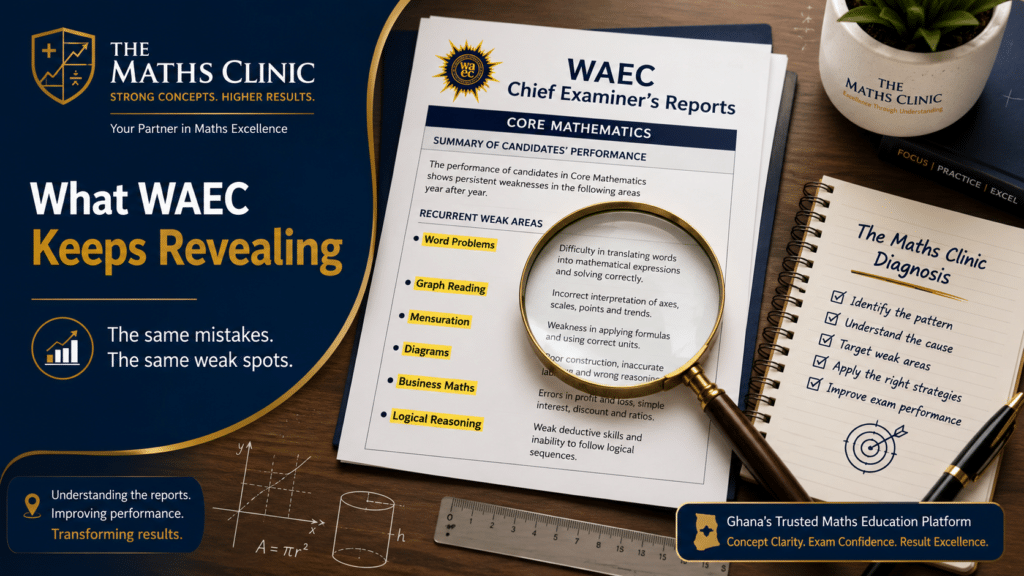
The WAEC Chief Examiner’s Reports are not just documents for teachers. They are a serious warning to every WASSCE and NOVDEC candidate. For years, the reports have been showing the same pattern in WASSCE Core Mathematics.
- translating word problems into mathematical equations
- showing evidence when reading values from graphs
- solving mensuration and geometry problems
- drawing correct conclusions from logical statements
- Understanding the demand of the question before solving
The 2021 report clearly listed these as weaknesses in Core Mathematics and advised candidates to read carefully, understand what questions are demanding, practise more, work independently, and receive support in the basic principles of weak topics.
Another report (2020) repeated similar Core Maths learning gaps: word problems, circle theorems, angles of elevation and depression, ratio and proportion, and graph-reading evidence. It also recommended that students should be taught how to translate word problems, understand circle theorems, read questions carefully, and show evidence when reading values from graphs.
So the problem is not hidden. WAEC has been pointing out the weak areas for us.
The problem is that many struggling maths students are still treating the whole syllabus as the enemy. But often, it is not the whole syllabus. It may be one or two Core Maths learning gaps disturbing many topics at the same time.
WASSCE Maths Trap 1: You Can Solve Equations, But Word Problems Freeze.
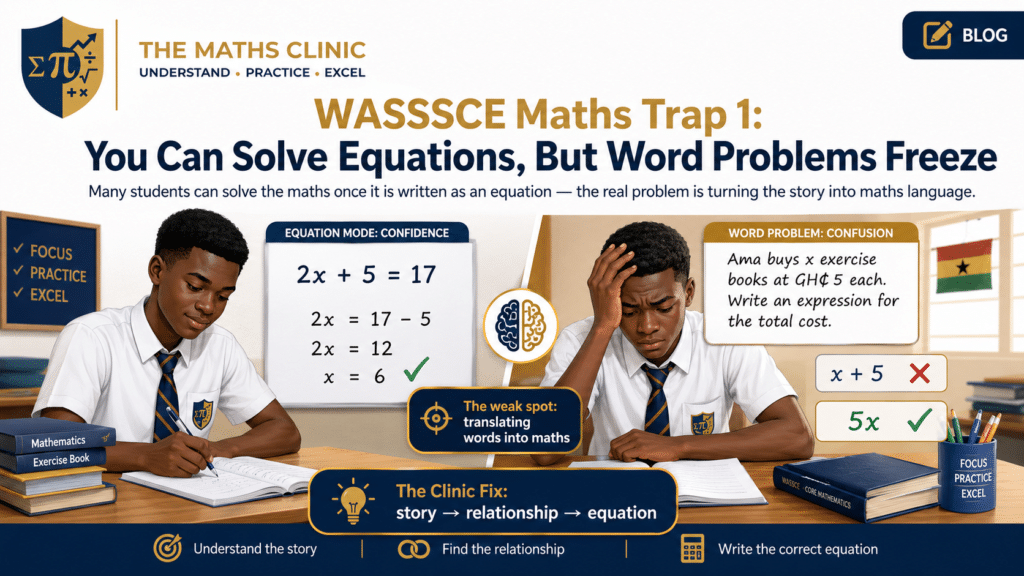
This is one of the most common WASSCE Maths traps. A student may solve this:
. But when the same idea is written as a story, the student freezes.
Let us use a simple Ghanaian example.
Ama goes to a bookshop in Adum. One exercise book costs GH₵5. She buys 4 exercise books.
Most students know the total cost:
No wahala.
But when WAEC writes:
Ama buys exercise books at GH₵5 each. Write an expression for the total cost.
Some students write: That is where the weakness shows itself.
The student understands buying and selling in real life but cannot change the story into mathematical language. That is not just an algebra problem. It is a translation problem.
The Clinic Fix
Before solving a word problem, slow down.
Ask:
- What am I looking for?
- What has been given?
- What is the relationship?
- Should I add, subtract, multiply, or divide?
- Can I write the situation as an expression or equation?
For the exercise book example:
- Cost of one book = GH₵5
- Number of books =
- Total cost =
So: . That is the intervention.
Not guessing. Not cramming. Just translating the story properly.
This is why maths intervention for SHS students must not only mean “more questions.” It must mean finding the exact point where understanding breaks down.
WASSCE Maths Trap 2: You Read the Graph, But You Don’t Show Evidence.
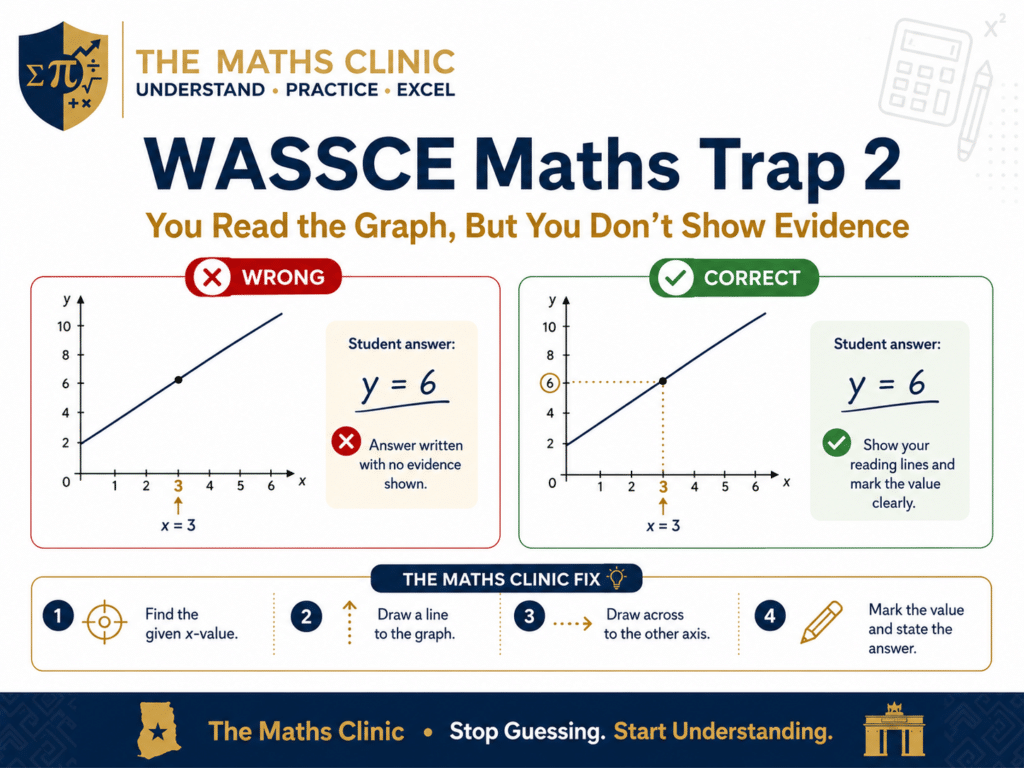
Many students can read the correct value from a graph, but still lose marks because they do not show the reading lines and clear evidence.
This is another painful WAEC Maths mistake. A student may say:
“Sir, I got the answer.”
But the examiner is asking:
“Where is your evidence?”
The 2020 reports keep mentioning that candidates struggle to show evidence when reading values from graphs. In one report, the suggested remedy was direct: teaching should emphasize showing evidence when reading from graphs.
A question may ask: Use your graph to find when .
The student looks at the graph and writes: y = 6
But there is no line from to the graph. No line from the graph to the -axis.
No mark. No evidence. That is how easy marks disappear.
In class, the student may feel cheated.
But in WASSCE Core Mathematics, the examiner does not sit inside your mind. You must show how you got the value. Think of it like giving directions from Kejetia to KNUST.
If you only say, “Go straight,” the person may get confused. But if you mention Asafo, Amakom, and Tech Junction, then the route becomes clearer.
Graph work is like that. Show your route.
What Students Should Do
When reading from a graph:
- Find the given value on the axis.
- Draw a neat line on the graph.
- Draw another line to the other axis.
- Mark the value clearly.
- Write the answer.
Do not only write the value. Show evidence. That small habit can protect marks in WASSCE Core Mathematics and even help NOVDEC candidates who are trying to correct old mistakes.
WASSCE Maths Trap 3: You Know the Formula, But You Use It in the Wrong Place.
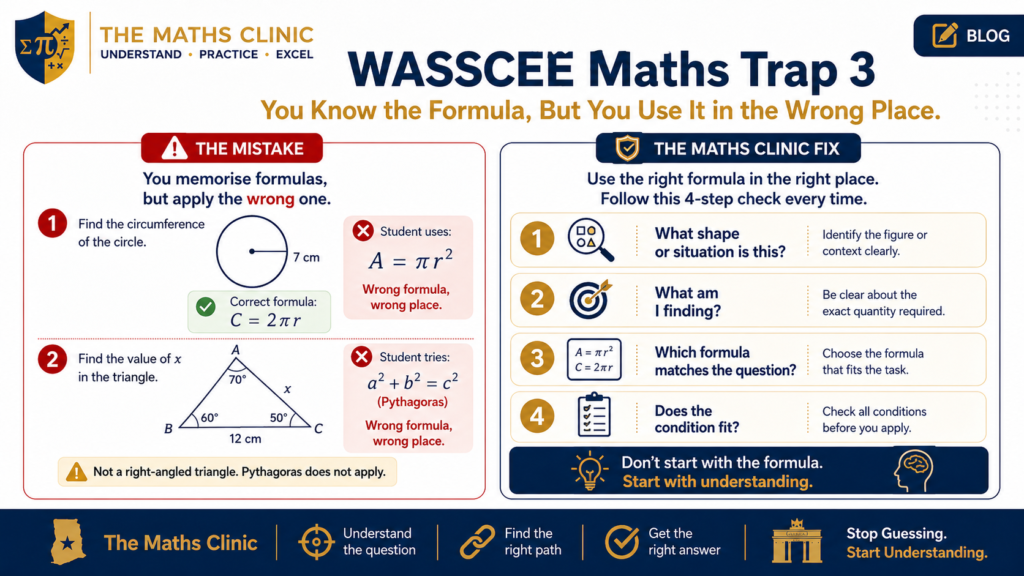
Many students know the formula, but still lose marks because they apply it to the wrong shape, question, or condition.
Some students can recite formulas very well.
Area of a circle:Pythagoras’ theorem: Simple interest:
But when the question comes, confusion starts.
Why?
Because knowing a formula is not the same as knowing when to use it.
- A student may apply Pythagoras’ theorem to a triangle that is not right-angled.
- Another may use the area of a circle when the question is asking for the circumference.
- Another may use simple interest wrongly because they do not know which amount is the principal.
This is one of the Core Maths learning gaps that affects many topics. It shows up in mensuration, geometry, trigonometry, business maths, and real-life problems.
Ghanaian Classroom Example
You cannot use a trotro fare from Asafo to Kejetia to pay for Kumasi to Accra. Both are transport fares, but the journey is not the same.
Formulas are also like that. Before you use a formula, check whether it fits the question.
The Correct Approach.
Before using any formula, ask:
- What shape or situation is this?
- What information has been given?
- What exactly am I finding?
- Does this formula fit the question?
- What unit should my answer carry?
Do not start with a formula. Start with understanding.
This is the heart of stopping guessing in maths. You do not pick formulas because they look familiar. You choose them because the question demands them.
WASSCE Maths Trap 4: You Understand Money in Real Life, But Business Maths Still Worries You.
This one is common in Ghana SHS Mathematics.
A student can buy waakye and calculate change.
A student can buy a data bundle and compare prices.
A student can send mobile money and check the remaining balance.
However, when WAEC asks for profit, loss, discount, simple interest, or percentage, the same student gets confused.
The 2024 Chief Examiners’ Report listed core mathematics weaknesses, such as making deductions from real-life problems, solving simple interest application problems, and translating word problems into mathematical expressions. It also recommended careful reading, more practice in difficult areas, and more exercises on sketches and diagram representation.
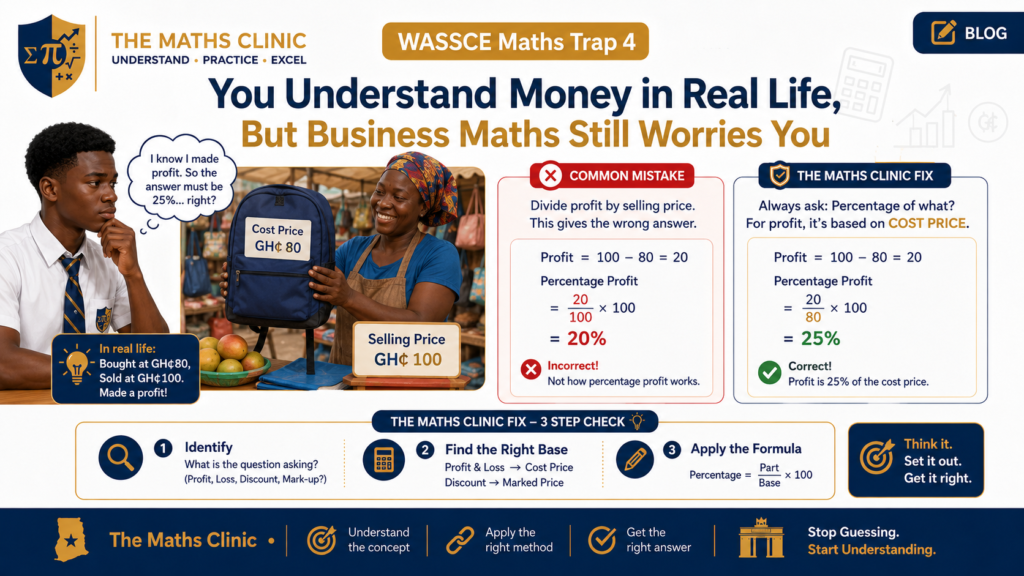
Let us use a market example. A trader buys a school bag for GH₵80 and sells it for GH₵100. How much profit did the trader make?
Profit = Selling Price (SP) – Cost Price (CP)
Profit = GH₵100 – GH₵80 = GH₵20.
So the profit is GH₵20.
Now the percentage profit is % = 25%. Note: Some students divide by the selling price (SP), which in this example is GH₵100, instead of the cost price of GH₵80 in this example, i.e., (GH₵20 / GH₵100) x 100% = 20%. This answer is wrong because the base is wrong. For percentage profit, the base is the cost price.
How to Avoid This Mistake.
Before solving any percentage question, ask:
Percentage of what?
Profit percentage → cost price
Discount percentage → marked price
Simple interest → principal
Commission → amount sold or the stated base
Find the base first. Then calculate.
This is the kind of simple correction that gives real NOVDEC Core Maths help because many resit candidates are not failing everything. Sometimes, one untreated misunderstanding keeps spoiling many marks.
WASSCE Maths Trap 5: You Start Solving Before Drawing the Situation.
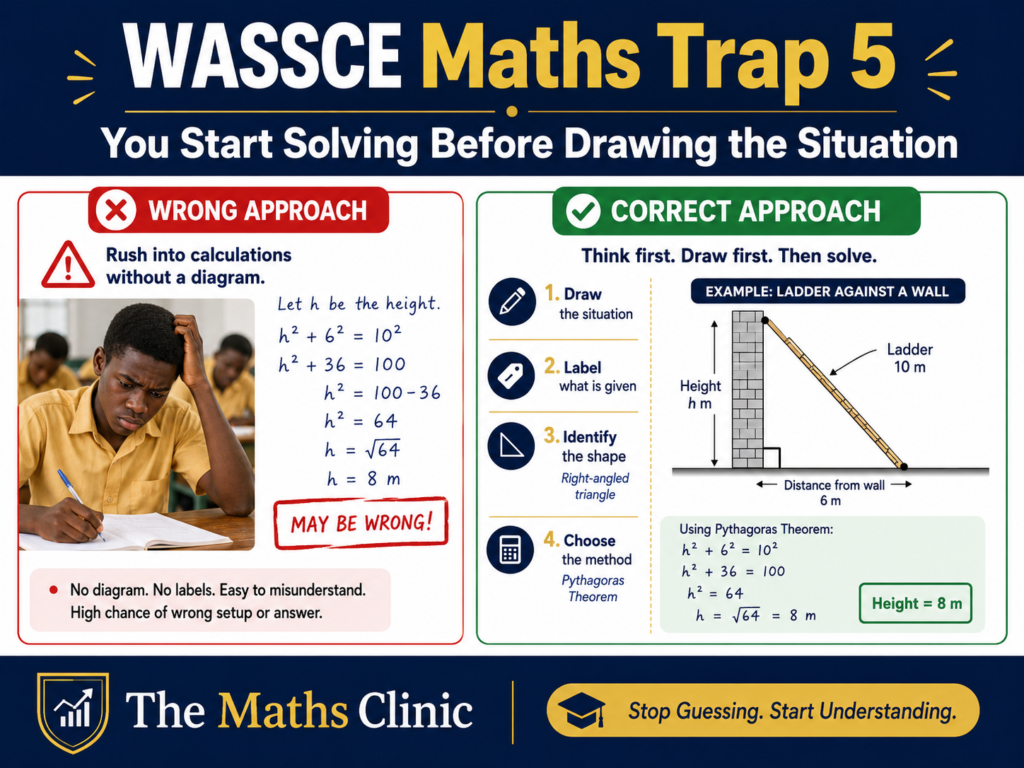
Many students rush into calculation before drawing or studying the diagram properly.
But in Core Maths, a diagram is not decoration. It can show you what method to use.
The Chief Examiner’s Reports have pointed to weaknesses in representing mathematical information in diagrams and illustrating given information correctly. The 2024 report also advised more sketching and diagramming exercises.
Take this example:
A ladder leans against a wall. The foot of the ladder is 6 m from the wall. The ladder is 10 m long. Find the height of the wall.
Some students will start asking:
“Which formula should I use?”
But first, draw it.
Wall.
Ground.
Ladder.
Now you can see a right-angled triangle. That simple drawing can show you that Pythagoras’ theorem is needed.
Practice the Fix.
Before solving any diagram question:
- Draw the situation.
- Label what is given.
- Mark what you are finding.
- Identify the shape.
- Choose the method that makes sense after the diagram.
Do not solve before you represent.
This is not about drawing fine art. It is about helping your brain see the mathematics clearly.
WASSCE Maths Trap 6: You Guess the Conclusion Instead of Following the Statement.
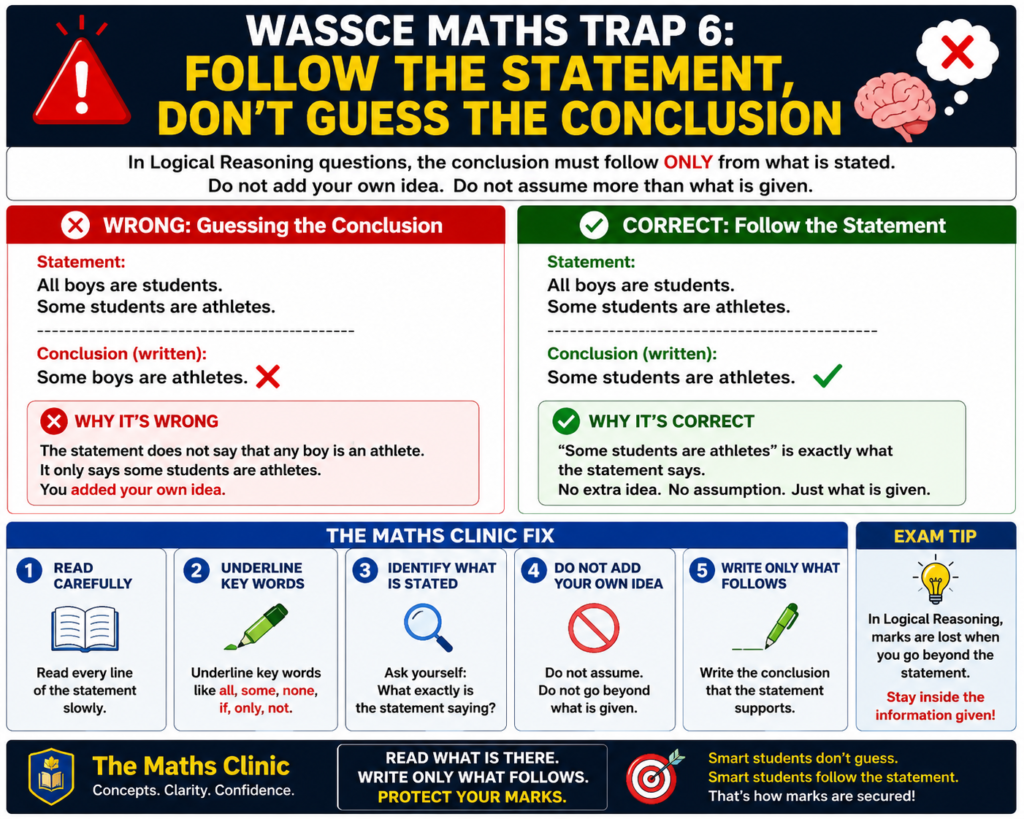
Core Maths is not only about calculation. Sometimes, WAEC tests whether you can reason.
The 2021 report mentions weakness in concluding logical statements, and the 2023 report also lists logical reasoning as one of the challenging areas for Core Mathematics candidates.
Example:
All students in Form 3 Gold study Core Mathematics.
Akua is in Form 3 Gold.
What can you conclude?
Correct answer:
Akua studies core mathematics.
But if a student writes:
Akua is good at core mathematics.
That is not supported by the statement. You have added your own idea.
That is how logic questions punish guessing.
How The Maths Clinic Fixes WAEC Maths Mistakes.
For logical reasoning:
- Read only what is given.
- Do not add your own idea.
- Ask: What must be true?
- Use a simple diagram if needed.
- Write only the conclusion that the statement supports.
In logic, do not assume. Follow the information.
Why More Lessons Alone May Not Fix WAEC Maths Mistakes.
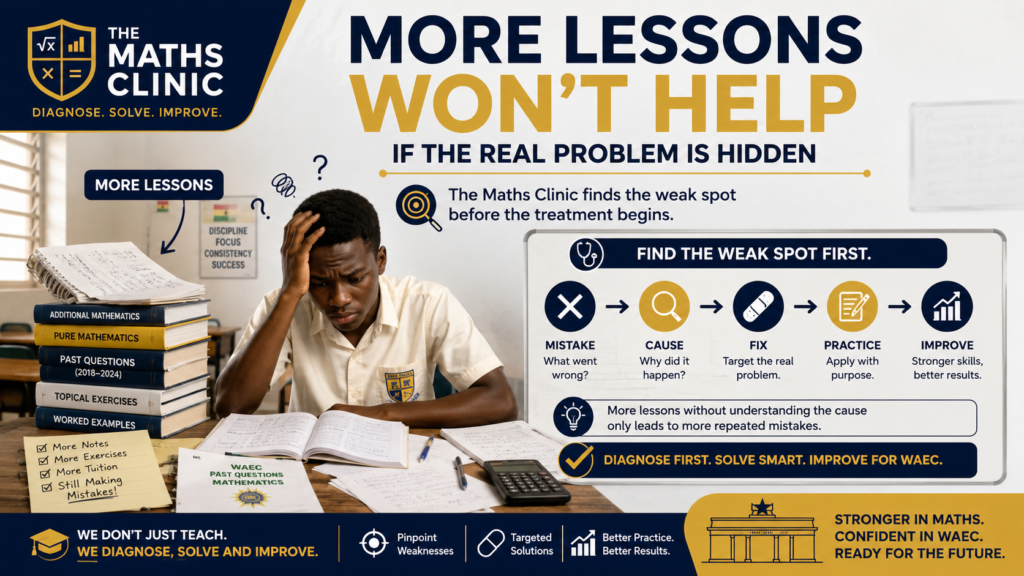
This is where many parents and students become tired.
- The student attends extra classes.
- The student buys past questions.
- The student watches videos.
- The student still fails.
That does not always mean the student is lazy.
It may mean the real weak spot has not been treated. If the problem is word-problem translation, more formulas alone will not fix it.
If the problem is graph evidence, drawing more graphs without showing the readings properly will not fix it.
If the problem is percentage-based, solving more business maths questions without correcting the base confusion will not fix it.
If the problem is poor diagrams, more calculations will not fix it. This is why maths intervention for SHS students must be targeted. The student does not always need the whole syllabus repeated.
Sometimes, the student needs one weak area to be found and treated properly. That is the difference between ordinary revision and true intervention.
How to avoid these weak spots.
At The Maths Clinic, we do not stop at:
“Your answer is wrong.”
We ask:
“What made you write that answer?”
That question changes everything.
Step 1: Spot the mistake
Example: The student wrote instead of
Step 2: Find the weak spot
The student does not understand quantity multiplied by unit price.
Step 3: Explain it with a familiar Ghanaian example
If one pen costs GH₵5, four pens cost: not 4 + 5
Step 4: Practise similar questions
Use pens, exercise books, trotro fares, waakye packs, data bundles, provisions, and school items.
Step 5: Build confidence
The student begins to see that maths is not magic. It is structured. Once the structure is clear, confidence grows. That is how struggling maths students begin to move from fear to understanding.
Quick Maths Clinic Check for WASSCE Core Mathematics.
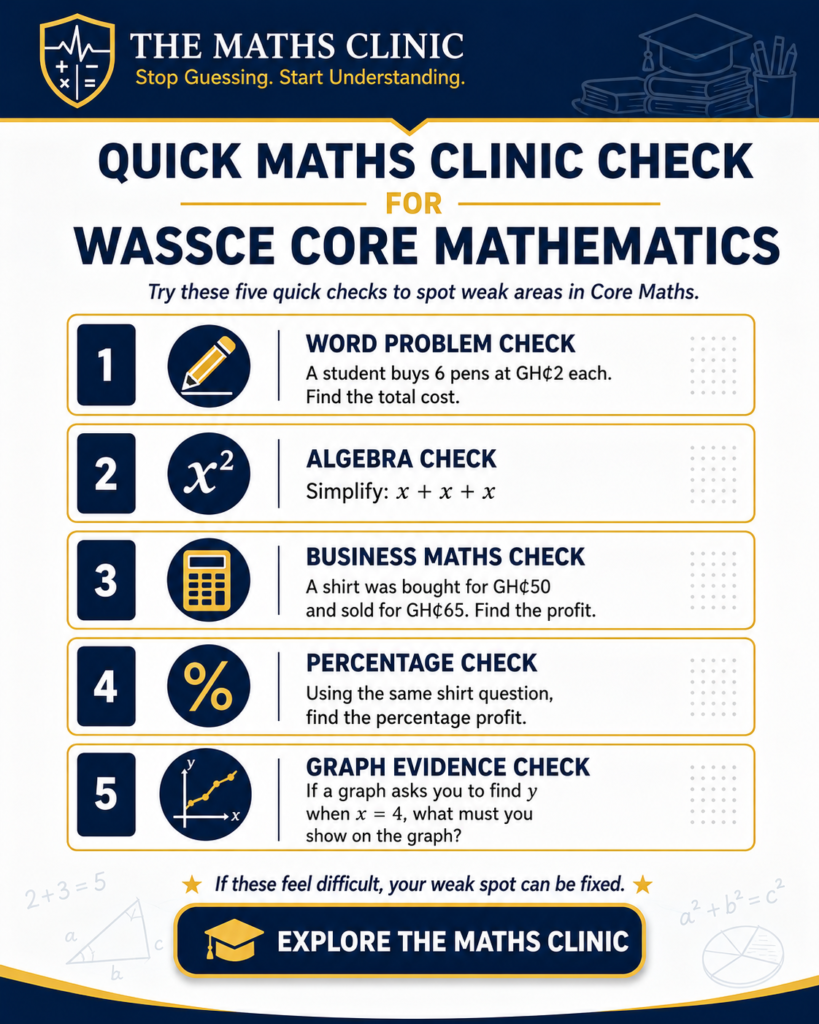
Try these five questions. They are simple, but each one checks something important.
1. Word Problem Check
A student buys 6 pens at GH₵2 each. Find the total cost.
2. Algebra Check
Simplify:
3. Business Maths Check
A shirt was bought for GH₵50 and sold for GH₵65. Find the profit.
4. Percentage Check
Using the same shirt question, find the percentage profit.
5. Graph Evidence Check
If a graph asks you to find when , what must you show on the graph?
Clinic Answers
1. Total Cost: , Total cost = GH₵ 12. Do not add 6 and 2. The 6 is the quantity. 2 is the price per pen.
2, Algebra: . Do not write . That would mean:
3. Profit: . Profit = GH₵15.
4. Percentage Profit = %. Use the cost price as the base.
5. 5. Graph Evidence
Show the reading. Draw from the graph, then from the graph to the axis. Mark the value and write the answer.
Final Word for Struggling Maths Students
If you keep making mistakes in WASSCE Core Mathematics, do not only ask
“What is the correct answer?”
Ask:
“What made me get it wrong?”
That question is important.
- A wrong equation may show that you cannot translate words into maths.
- A wrong percentage may show that you do not understand the base.
- A missing graph line may show that you do not know how to show evidence.
- A wrong formula may show that you memorized without knowing the condition.
- A poor diagram may show that you solved it before representing the situation.
So no, you may not be beyond help. You may only have a weak spot that has not been properly found. That is what The Maths Clinic is built for.
We do not reteach the whole syllabus blindly.
- We find the weak spot.
- We fix the misunderstanding.
- We practice the correction.
- We improve step-by-step
Stop Guessing. Start Understanding.