Struggling with WASSCE Maths? Stop guessing. Let’s fix the gap step by step.

Maths Confidence: 7 Ways to Start Again After Failing Core Maths

Maths confidence is one of the first things many Ghana SHS students lose after core maths failure. The learner may still have the brain to improve, but once fear enters, even a simple question can look like a mountain. This is why rebuilding confidence must begin from the first line of preparation, not only when WASSCE is near.
In many Ghanaian classrooms, when Core Maths results are released, some learners become very quiet. Others smile because they passed. A few sit with their heads down because the grade they feared has finally appeared. You may hear a learner say, “Sir, I knew I would fail.” That statement is painful because it means the learner failed the paper in their mind before entering the examination hall.
At The Maths Clinic, we do not treat a failed WASSCE Core Maths result as a final judgment on a learner. We treat it as a diagnosis. The result may be disappointing, but it also gives useful information. It can show whether the learner has maths learning gaps in fractions, signs, algebra, percentages, graphs, word problems, or exam reading.
This article is for the SHS student who fears mathematics, the Nov/Dec candidate who wants WASSCE Maths help, and the learner who has failed Core Maths before but wants to start again properly. The message is simple: you can rebuild maths confidence, but you must rebuild it with the right method, not by guessing.
| Teacher’s Note A weak result does not always mean a weak brain. In many cases, it means the learner has been practicing without diagnosing the real gap. |
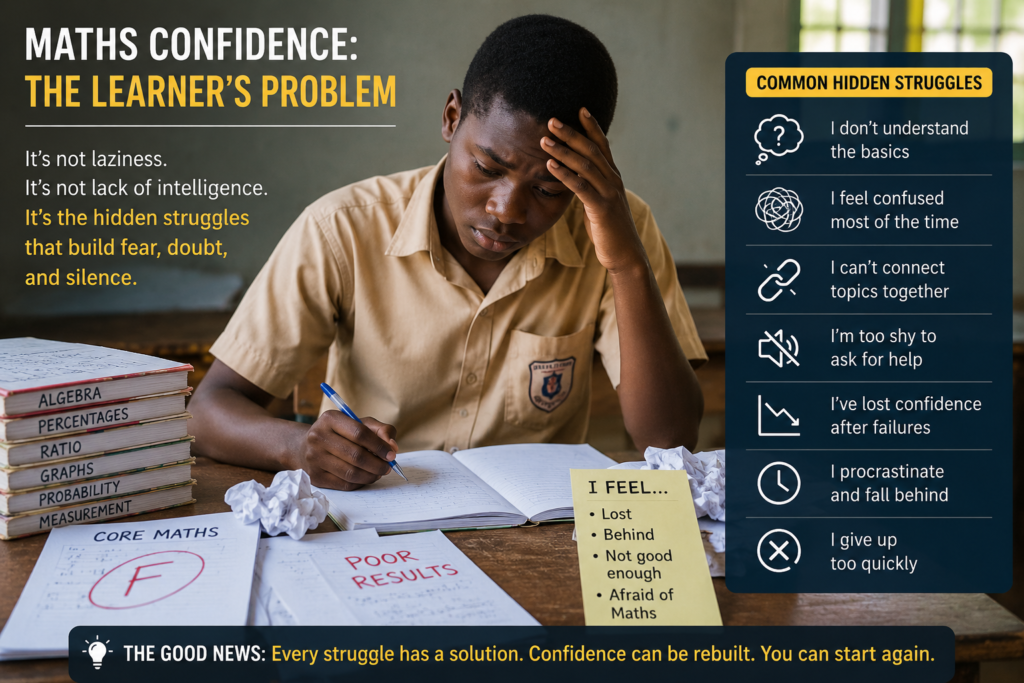
1. The Learner’s Problem
The main problem is not only that the learner failed Core Maths. The deeper problem is that the learner now believes mathematics is not for him or her. Once that belief enters the mind, the learner begins to avoid questions, skip practice, copy without understanding, and guess answers when pressure starts.
In class, such a learner may understand while the teacher is solving on the board. But when the same learner sits alone with an exercise book, the hand becomes heavy. The question is there, the pen is there, but the starting point is missing.
This is how loss of maths confidence looks in a real Ghanaian classroom:
- The learner says, “I am not a maths person,” before even trying the question.
- The learner copies solutions from the board but cannot explain the steps later.
- The learner avoids word problems because they look too long.
- The learner panics when fractions, signs, brackets, graphs, or formulas appear.
- The learner guesses multiple-choice answers without proper working.
- The learner practices many questions but repeats the same mistakes.
So the first issue to fix is not just the syllabus. The first issue is the learner’s relationship with mathematics. A learner who feels defeated will not attack the topic with a clear mind.
2. Why Did the Mistake Happen?
Many students lose maths confidence because nobody showed them where the mistake started. They only saw the final wrong answer. That is like treating a fever without checking the cause. The visible mark may be low, but the hidden cause may be somewhere deeper.
For example, a learner may fail simultaneous equations, but the real problem may be signs. Another learner may fail percentages, but the real problem may be fractions. Another may have failed bearings, but the real problem may be direction, language, and angle measurement. In Ghana SHS mathematics, one small, untreated gap can disturb many big topics.
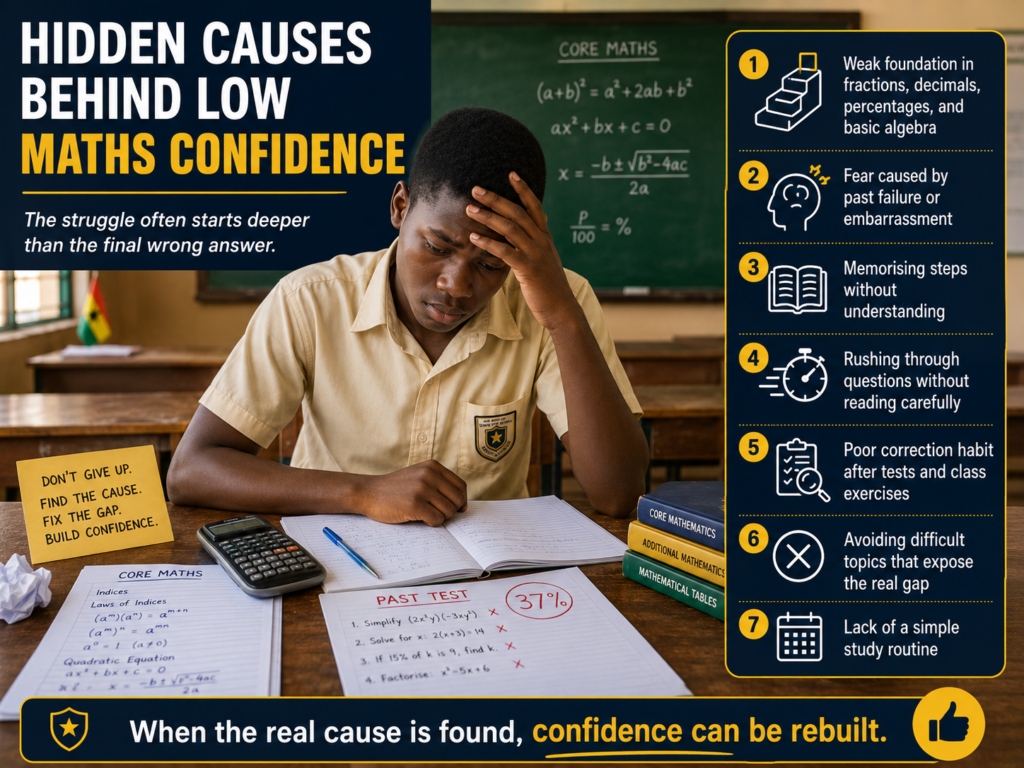
Hidden Causes Behind Low Maths Confidence
- Weak foundation in fractions, decimals, percentages, directed numbers, and basic algebra.
- Fear caused by past failure, embarrassment, or constant comparison with stronger students.
- Memorizing steps without understanding why the steps work.
- Rushing through questions without underlining key information.
- Poor correction habits after tests, class exercises, and mock examinations.
- Practicing only easy questions and avoiding the topics that expose the gap.
- Lack of a simple study routine that builds confidence gradually.
| The Hidden Gap The learner may think, “I failed Core Math because I am not intelligent.” But the real diagnosis may be this: the learner has never been guided to identify and correct the exact mistake pattern. |
3. What WAEC or the Curriculum Reveals
WASSCE Core Mathematics does not reward guessing. It rewards understanding, correct method, clear working, careful substitution, accurate calculation, and proper interpretation of the question. A learner can know a formula and still lose marks if the formula is used carelessly.
The current curriculum direction also expects learners to reason, solve problems, connect ideas, and apply mathematics to real situations. That means a student cannot rely only on memorized formulas. The learner must know how to read the question, choose the correct method, and explain the steps through working.
This is why maths confidence matters. Confidence does not mean shouting, “I know maths.” Real confidence means the learner can start a question calmly, identify what is given, decide what is required, and follow a method without guessing.
What WASSCE Preparation Should Build
- Reading skill: understanding what the question is asking before calculating.
- Foundation skill: handling signs, fractions, percentages, and algebra accurately.
- Method skill: knowing the correct steps and why they are used.
- Presentation skill: showing work clearly enough to earn marks.
- Correction skill: learning from mistakes instead of repeating them.
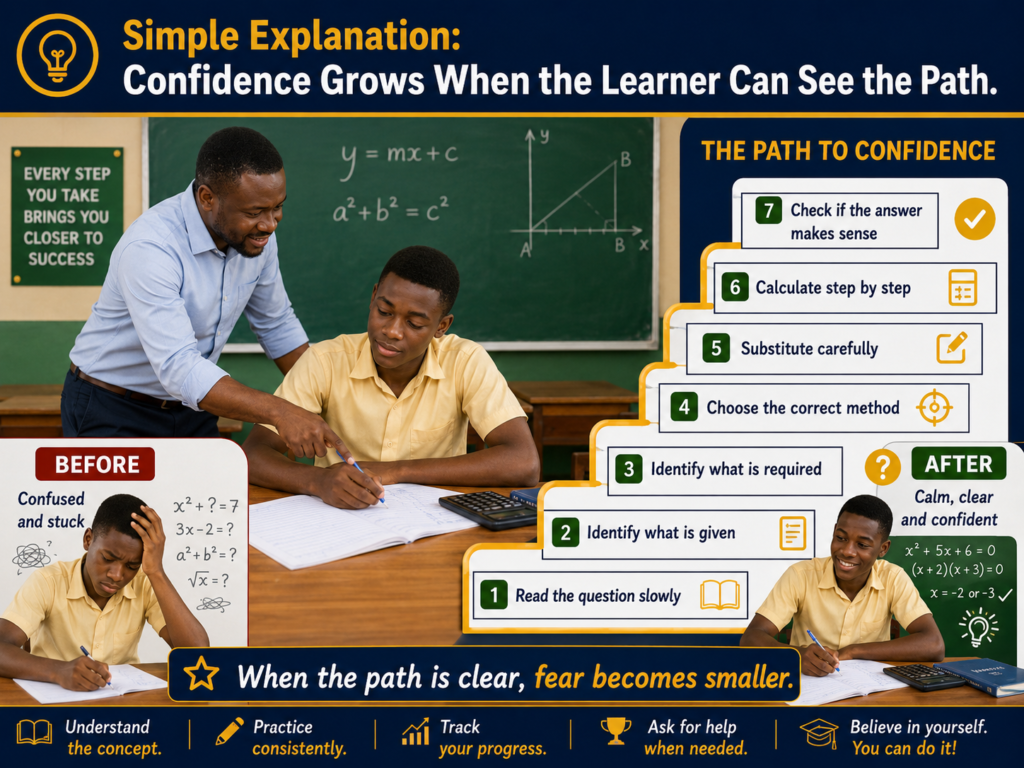
4. Simple Explanation: Confidence Grows When the Learner Can See the Path
Mathematics becomes frightening when the learner cannot see the next step. The question may not even be very hard, but because the learner does not know where to begin, fear takes over.
Think of an SHS student moving from the classroom block to the dining hall. The student walks freely because the path is known. But if the same student is dropped in a new town at night and told, “Go to the lorry station,” fear can come because the path is not clear. Core Maths feels the same way when the learner does not know the next step.
Maths confidence grows when the learner sees the path clearly and follows it many times.
The Maths Clinic Confidence Path
- Read the question slowly.
- Identify what is given.
- Identify what is required.
- Choose the correct formula or method.
- Substitute carefully.
- Calculate step by step.
- Check whether the answer makes sense.
Once the learner repeats this path many times, the fear reduces. Confidence is not magic. Confidence is built through correct practice.
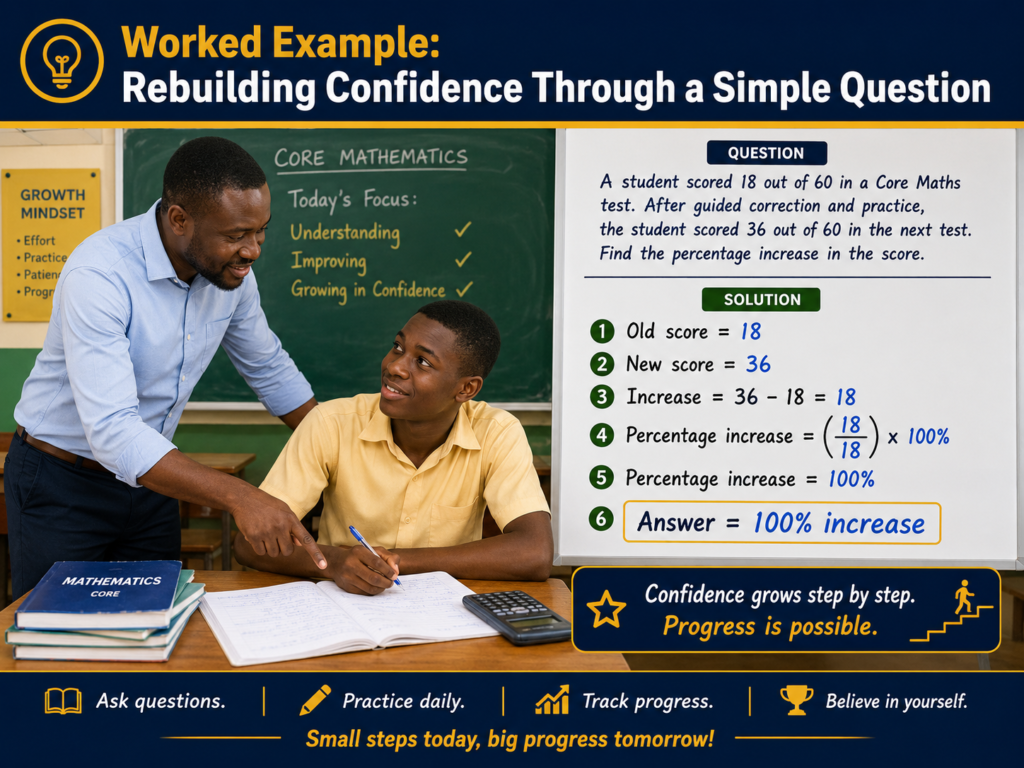
5. Worked Example: Rebuilding Confidence Through a Simple Question
Example
A student scored 18 marks out of 60 in a core maths test. After guided correction and practice, the student scored 36 marks out of 60 in the next test. Find the percentage increase in the score.
Step-by-Step Solution
Step 1: Identify the old score
Old score = 18
Step 2: Identify the new score
New score = 36
Step 3: Find the increase
Increase = New score – Old score
Increase = 36 – 18
Increase = 18
Step 4: Use the percentage increase formula
Percentage increase = (Increase / Old score) x 100%
Percentage increase = (18 / 18) x 100%
Percentage increase = 100%
Final Answer
Percentage increase = 100%
The student’s score increased by 100%. This does not mean the student is now perfect. It means the student improved from the original score by the same amount as the original score.
| Confidence Lesson from the Example A learner who moves from 18/60 to 36/60 has not completed the journey, but the progress is real. Improvement should be measured, not mocked. |
6. Common Wrong Approach
A common wrong approach is to say the following:
Percentage increase = (Increase / New score) x 100%
Percentage increase = (18 / 36) x 100% = 50%
This answer is wrong because the learner used the new score as the denominator.
Why This Is Wrong
For the percentage increase, we compare the increase to the old value, not the new value. The old score is the starting point. That is why the old score must be used as the denominator.
| WAEC Trap Many learners lose marks not because they cannot calculate, but because they choose the wrong denominator. In percentage increase and decrease, always ask, “What was the original value?” |
7. Correct Method
Correct Formula
Percentage increase = (Increase / Original value) x 100%
Correct Thinking
- The original value is the starting point.
- The increase is the difference between the new value and the original value.
- The percentage increase compares the increase to the original value.
- The final answer must carry the percentage sign.
Correct Confidence Habit
When solving, do not rush. Write what each number means. This one habit helps weak learners stop guessing and start thinking. In WASSCE Maths help sessions, this is often the first habit that changes a learner’s confidence.
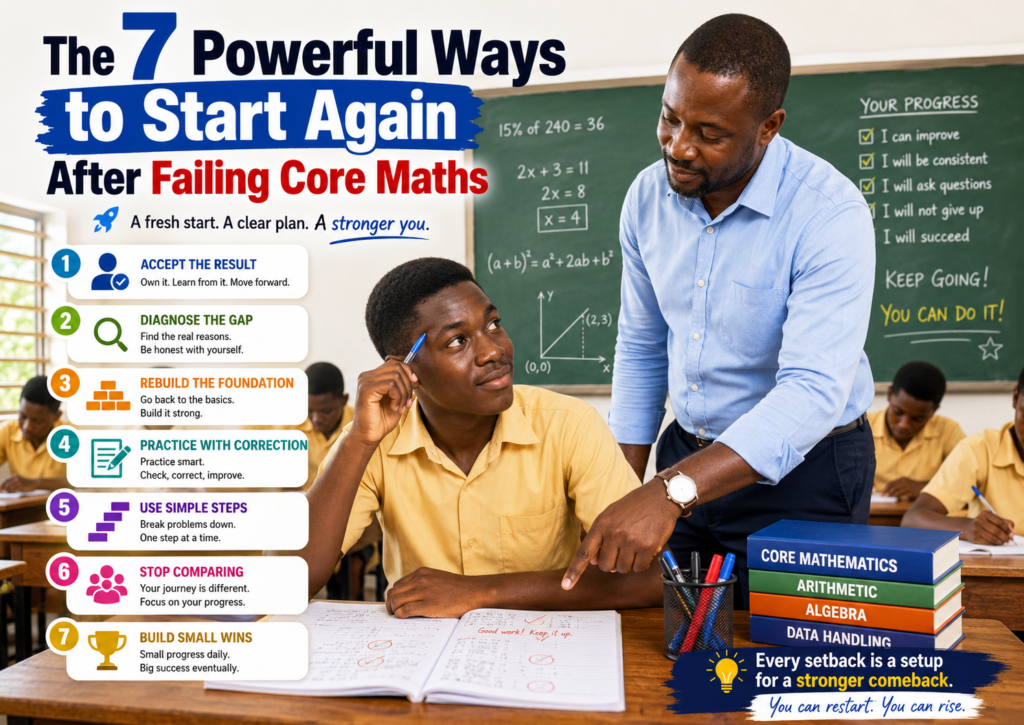
8. The 7 Powerful Ways to Start Again After Failing Core Maths
1. Accept the Result, But Do Not Accept a Permanent Label
Failing Core Maths is a result, not your identity. Do not call yourself useless, dull, or finished. A result tells you what happened in one exam. It does not tell you what you can become after proper correction.
2. Diagnose the Real Maths Gap First
Do not begin by solving random past questions. First, find the weak areas. Are you struggling with fractions, algebra, word problems, graphs, percentages, mensuration, or signs? A correct diagnosis saves time and reduces confusion.
3. Rebuild the Foundation Before Attacking Big Topics
A learner who cannot handle directed numbers will struggle with algebra. A learner who fears fractions will struggle with probability and percentages. Start from the small gaps that are disturbing the bigger topics.
4. Practice With Correction, Not Just Repetition
Doing many questions is good, but repeating the same mistake many times is dangerous. After every wrong answer, write down what caused the mistake and how to avoid it next time.
5. Use Simple Steps Until the Method Becomes Clear
Do not jump steps just because someone else is fast. Write the given values, formula, substitution, calculation, and final answer. Speed can come later. Clarity must come first.
6. Stop Comparing Your Speed With Stronger Students
Some students are faster because their foundation is stronger. Your job is not to pretend. Your job is to improve. A slow, correct method is better than a fast, wrong guess.
7. Build Small Wins Every Week
Confidence grows when the learner sees progress. Set small weekly targets. For example, master percentage increase this week, linear equations next week, and word problems after that. Small wins create strong confidence.
9. Practice Task
Try these questions. Do not guess. Use the steps shown in the worked example. Write the old value, new value, increase or decrease, formula, substitution, and final answer.
Question 1
A student scored 20 out of 50 on a test. After correction, the student scored 35 out of 50. Find the percentage increase in the score.
Question 2
Ama scored 24 marks in a Core Maths test. In the next test, she scored 30 marks. Find the percentage increase in her score.
Question 3
Kojo scored 45 marks in a mock exam. In the next mock exam, he scored 36 marks. Find the percentage decrease in his score.
Question 4
A learner improved from 15 correct answers to 24 correct answers in a practice test. Find the percentage increase.
Practice Task Solutions
Solution to Question 1
Old score = 20
New score = 35
Increase = 35 – 20 = 15
Percentage increase = (15 / 20) x 100% = 75%
Answer = 75%
Solution to Question 2
Old score = 24
New score = 30
Increase = 30 – 24 = 6
Percentage increase = (6 / 24) x 100% = 25%
Answer = 25%
Solution to Question 3
Old score = 45
New score = 36
Decrease = 45 – 36 = 9
Percentage decrease = (9 / 45) x 100% = 20%
Answer = 20% decrease
Solution to Question 4
Old value = 15
New value = 24
Increase = 24 – 15 = 9
Percentage increase = (9 / 15) x 100% = 60%
Answer = 60%
10. Link to Practice Zone or Intervention Hub
If you failed Core Maths before, do not start again by rushing into everything at once. Start by finding the topics that cost you marks, then rebuild them one by one. That is how The Maths Clinic turns Core Maths failure into a guided correction plan.
| Page | Suggested Anchor Text |
| Practice Zone | Start WASSCE Maths Practice Without Guessing |
| Intervention Hub | Find and Fix My Core Maths Learning Gaps |
| WAEC Trap Page | Learn Common WAEC Maths Mistakes and How to Avoid Them |
| Ask Dickson Page | Ask a Core Maths Question and Get Guided Help |
FAQ: Maths Confidence After Failing Core Maths
Can I pass Core Maths after failing it before?
Yes. Many learners improve when they stop guessing and start correcting the exact gaps that caused the failure. The key is diagnosis, guided practice, and steady correction.
Should I start with past questions immediately?
Past questions are useful, but do not start blindly. If your foundation is weak, past questions will expose you but may not fix you. First identify the weak topics, then use past questions to test progress.
How many hours should I study Core Maths?
A consistent one hour with proper correction is better than three hours of confused guessing. Focus on quality practice, not just long study time.
Why do I understand in class but fail alone?
This often happens when you understand the teacher’s explanation but have not mastered the independent steps. You need to practice writing the steps yourself until the method becomes familiar.
What is the fastest way to rebuild maths confidence?
Start with small topics you can improve quickly, such as percentages, linear equations, directed numbers, and basic algebra. Small wins reduce fear and prepare you for harder topics.
Conclusion: Start Again, But Start Correctly
Failing Core Maths can hurt. It can make a learner feel embarrassed, tired, or afraid to try again. But one result should not become a permanent name on a student’s forehead.
The important question is not only, “Why did I fail?” The better question is, “Which gap caused the failure, and how do I correct it?” Once that question is answered, the learner has a path forward.
At The Maths Clinic, we believe struggling students are not hopeless students. Many are simply carrying untreated maths learning gaps. When those gaps are diagnosed and corrected step by step, maths confidence begins to return.
So if you failed Core Maths before, breathe. Start again. But this time, do not start with fear. Start with diagnosis, correction, guided practice, and small wins. That is how maths confidence is rebuilt for WASSCE Core Mathematics and beyond.
| Final Message to the Learner You are not starting from zero. You are starting with experience. Use the old mistake as information, not as a prison. |