Struggling with WASSCE Maths? Stop guessing. Let’s fix the gap step by step.

Word Problems in WASSCE Maths: 7 Ways to Understand the Question

In many Ghanaian classrooms, you can hear this statement almost every term:
| Student Complaint “Sir, I know the formula, but when the question comes as a word problem, I do not know where to start.” |
That statement tells us something important. The learner is not always blank. Sometimes, the formula is in the head, but the question has not entered the mind properly.
This is why many students struggle with word problems in WASSCE Maths. They do not fail because they cannot press calculator buttons. They fail because they cannot translate the English sentence into mathematics.
At The Maths Clinic, we treat word problems like a reading-and-reasoning issue before we treat them as a calculation issue. A learner must first understand what is happening in the question before choosing any formula.
This post will help you learn seven practical ways to read, understand, and solve word problems in WASSCE Core Mathematics without panic.
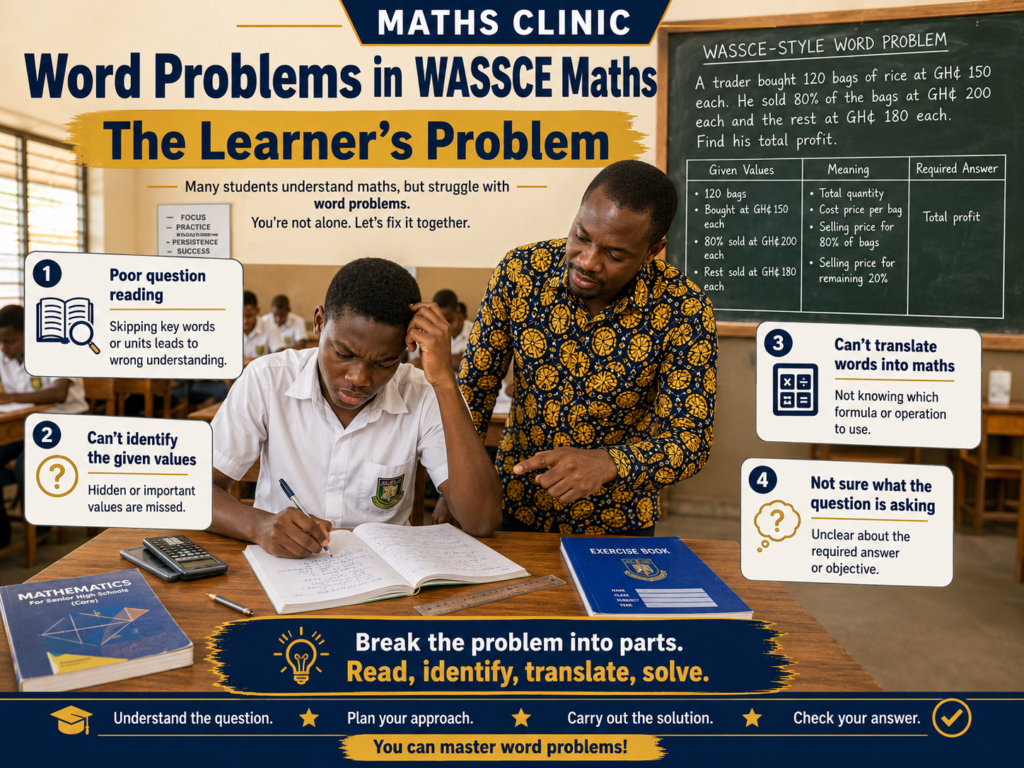
1. The Learner’s Problem
The main learner’s problem is this:
| Diagnosis The student sees a word problem, picks numbers quickly, remembers a formula, and starts calculating before understanding the situation. |
This is where the marks begin to leak. In WASSCE Maths, word problems are not only testing formulas. They are also testing reading, interpretation, translation, reasoning, and clear presentation.
A learner may know the formula for simple interest:
I = (P × R × T) / 100
But when the question says, “Ama invested GH₵2,400 at 8% per annum for 3 years,” the learner must know that
- GH₵2,400 is the principal, P.
- 8% is the rate, R.
- 3 years is the time, T.
- “Per annum” means per year.
- The question may ask for interest only or the total amount. These are not the same.
So the real challenge is not only the formula. The real challenge is knowing what each part of the sentence means mathematically.
2. Why Did the Mistake Happen?
The mistake usually happens because the learner has one or more hidden gaps. These gaps are small, but they can destroy a whole solution.
Hidden Gap 1: Poor Question Reading
Some learners read the first line and stop thinking. They do not read the full question. In WASSCE, one word can change the whole method. Words like “total,” “difference,” “remaining,” “per annum,” “at least,” “more than,” “less than,” and “nearest whole number” must not be ignored.
Hidden Gap 2: Weak Translation from English to Mathematics
A word problem is like a story. The learner must convert the story into mathematical statements. If the learner cannot translate the words, the formula alone will not save the answer.
Hidden Gap 3: Picking Numbers Without Understanding Their Roles
Many students see numbers and start using them anyhow. But every number in a word problem has a job. One number may be the cost price, another may be the selling price, and another may be the profit. If the roles are mixed up, the answer will also be wrong.
Hidden Gap 4: Memorizing Formulas Without Meaning
A learner may memorize ten formulas and still fail if he or she does not know when each formula should be used. WAEC questions often test whether the learner understands the condition behind the formula.
Hidden Gap 5: Fear When the Question Looks Unfamiliar
Some learners panic immediately when a question looks longer than usual. Once fear enters, they stop thinking carefully. They guess the method, copy numbers wrongly, or leave the question blank.
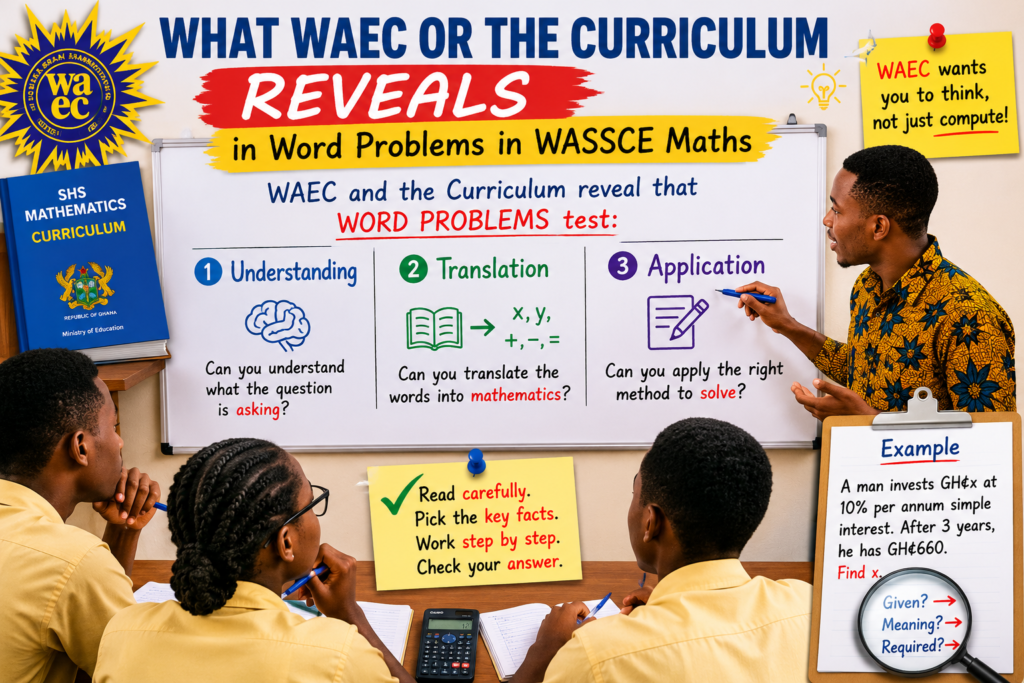
3. What WAEC or the Curriculum Reveals
WAEC-style Core Mathematics questions often require more than direct substitution. A learner must read carefully, identify the known values, decide what is being asked, and present the solution in a clear order.
The curriculum direction also supports problem-solving, application, reasoning, and communication. This means students must not only know how to calculate; they must be able to explain mathematical ideas through real-life situations.
Word problems appear in many Core Maths areas, including:
- Percentages, profit, loss, and discount
- Simple interest and compound interest
- Ratio and proportion
- Linear equations and simultaneous equations
- Mensuration and geometry
- Statistics and probability
- Variation
- Rates, speed, distance, and time
- Bearings and scale drawing
This means word problems are not a small topic. They are a skill that runs through many WASSCE Core Mathematics topics.
4. Simple Explanation
A word problem is a mathematical question written in normal language. Your work is to change the normal language into mathematical language.
Think of it this way:
| Simple Meaning Words tell the story. Numbers give the values. The question tells you the target. Your method connects the values to the target. |
Before solving any word problem, ask three simple questions:
- What is happening in the question?
- What values have I been given?
- What exactly am I being asked to find?
If you cannot answer these three questions, do not start calculating yet. You may be walking into a WAEC trap.
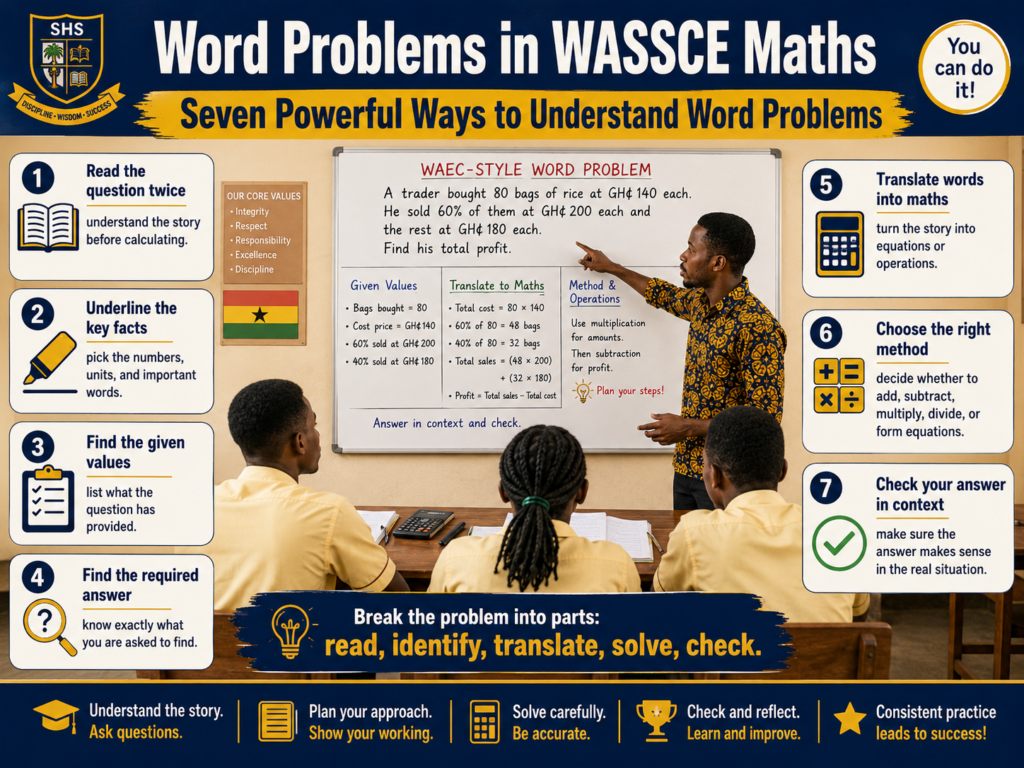
5. Seven Powerful Ways to Understand Word Problems in WASSCE Maths
Way 1: Read the Question Twice Before Touching the Calculator
The first reading gives you the story. The second reading gives you the mathematics. Many learners lose marks because they start calculating after reading only half of the question.
Classroom fix: After the first reading, ask: “What is the question talking about?” After the second reading, underline the important values and instruction words.
Way 2: Circle the Values and Write Their Meaning
Do not just copy numbers. Write what each number represents. A number without meaning can mislead you.
Classroom fix: For example, in profit and loss, GH₵80 may be the cost price while GH₵100 may be the selling price. If you confuse them, the percentage profit will be wrong.
Way 3: Identify the Topic Hidden Inside the Story
A word problem may not mention the topic directly. It may not say “use percentages” or “use simultaneous equations.” You must detect the topic from the situation.
Classroom fix: If two unknown items are being compared, it may lead to simultaneous equations. If money grows with time at a rate, it may be simple interest or compound interest.
Way 4: Write Down What the Question Is Asking For
Many learners solve for the wrong thing. The question may ask for profit, but the learner finds the selling price. It may ask for the total amount, but the learner finds interest only in it.
Classroom fix: Before calculation, write: Required = ________. This small habit keeps your mind focused.
Way 5: Change Key Words into Mathematical Operations
Word problems use language. You must know how to translate common words into operations.
Classroom fix: Words like “total” may suggest addition. “Difference” may suggest subtraction. “Of” in percentage problems may suggest multiplication. “Shared equally” may suggest division.
Way 6: Draw a Small Table, Diagram, or List
Some word problems become easier when you organize the information. A table is helpful for age problems, mixture problems, simple interest problems, and comparison questions.
Classroom fix: Do not be ashamed to draw. In mathematics, a simple diagram can rescue a confused mind.
Way 7: Check Whether Your Answer Makes Sense
After solving, compare your answer to the story. If a discount is bigger than the original price, something is wrong. If a time answer is negative in a normal real-life question, something is wrong.
Classroom fix: A sensible check can help you catch errors before you lose marks.
6. Worked Example
Example: Turning a Story into Mathematics
A trader bought 15 exercise books at GH₵8 each. He sold all the books for GH₵150. Find his percentage profit.
Step 1: Read and Identify the Story
The question is about buying and selling exercise books. So this is a profit and percentage profit problem.
Step 2: Write the Given Values with Their Meaning
- Number of exercise books = 15
- Cost of one exercise book = GH₵8
- Total selling price = GH₵150
Step 3: Find the Total Cost Price
Total Cost Price = Number of books × Cost of one book
Total Cost Price = 15 × 8
Total Cost Price = GH₵120
Step 4: Find the Profit
Profit = Selling Price – Cost Price
Profit = 150 – 120
Profit = GH₵30
Step 5: Find the Percentage Profit
Percentage Profit = (Profit / Cost Price) × 100%
Percentage Profit = (30 / 120) × 100%
Percentage Profit = 25%
Final Answer:
Percentage Profit = 25%
7. Common Wrong Approach
A common wrong approach is to use GH₵150 as the cost price because it is the bigger amount in the question.
Wrong Percentage Profit = (30 / 150) × 100% = 20%
This is wrong because the percentage profit must be based on the cost price, not the selling price.
Another wrong approach is to ignore the 15 books and treat GH₵8 as the total cost price. That also gives a wrong solution because GH₵8 is the cost of only one book, not the total cost of all the books.
| WAEC Trap Do not use a number just because it appears in the question. First ask: What does this number represent? |
8. Correct Method
The correct method is to slow down and translate the question before calculating.
Correct Word Problem Method
- Read the question twice.
- Identify the topic hidden in the story.
- List the given values with their meanings.
- Write what the question is asking for.
- Choose the correct formula or operation.
- Substitute the values carefully.
- Check whether the answer makes sense.
For the worked example, the important translation is this:
| Sentence in the Question | Mathematical Meaning | What to Do |
| 15 exercise books at GH₵8 each | Each book costs GH₵8 | Multiply 15 by 8 |
| Sold all the books for GH₵150 | The total selling price is GH₵150 | Use as selling price |
| Find percentage profit | Compare profit to cost price | Use profit over cost price times 100% |
9. Practice Task
Try these questions first. Do not rush. For each one, write the meaning of the values before solving.
Question 1
A bag was bought for GH₵180 and sold for GH₵225. Find the percentage profit.
Question 2
A student bought 6 pens at GH₵3 each and sold all of them for GH₵24. Find the percentage profit.
Question 3
A man borrowed GH₵2,000 at 12% simple interest per annum for 2 years. Find the simple interest.
Question 4
The sum of two numbers is 45. One number is 9 more than the other. Find the two numbers.
Question 5
A car travels 180 km in 3 hours. Find its average speed in km/h.
Question 6
A rectangular classroom is 12 m long and 8 m wide. Find its perimeter.
Question 7
A trader gives a discount of 15% on an item marked GH₵400. Find the discount and the selling price after the discount.
Practice Task Solutions
Solution 1
Cost Price = GH₵180. Selling Price = GH₵225. Profit = 225 – 180 = GH₵45. Percentage Profit = (45 / 180) × 100% = 25%. Answer: 25%.
Solution 2
Cost of 6 pens = 6 × 3 = GH₵18. Selling Price = GH₵24. Profit = 24 – 18 = GH₵6. 6. Percentage Profit = (6 / 18) × 100% = 33⅓%. Answer: 33⅓%.
Solution 3
Principal = GH₵2,000. Rate = 12%. Time = 2 years. Simple Interest = (P × R × T) / 100 = (2000 × 12 × 2) / 100 = GH₵480. Answer: GH₵480.
Solution 4
Let the smaller number be x. Then the bigger number is x + 9. So x + x + 9 = 45. Therefore, 2x + 9 = 45. 2x = 36. x = 18. Bigger number = 18 + 9 = 27. Answer: 18 and 27.
Solution 5
Distance = 180 km. Time = 3 hours. Speed = Distance / Time = 180 / 3 = 60 km/h. Answer: 60 km/h.
Solution 6
Length = 12 m. Width = 8 m. Perimeter = 2(length + width) = 2(12 + 8) = 2(20) = 40 m. Answer: 40 m.
Solution 7
Marked Price = GH₵400. Discount = 15% of 400 = (15 / 100) × 400 = GH₵60. Selling Price = 400 – 60 = GH₵340. Answer: Discount = GH₵60, Selling Price = GH₵340.
Common WAEC Word Problem Traps to Watch
- Using all the numbers in the question, even when one number is not needed.
- Finding the interest when the question asks for the total amount.
- Finding the discount but forgetting to subtract it from the marked price.
- Using the selling price as the denominator for percentage profit.
- Ignoring units such as cm, m, km, hours, minutes, years, and Ghana cedis.
- Writing the final answer without checking whether it matches the question.
- Leaving the answer in an unfinished form when the question needs a final value.
FAQ: Word Problems in WASSCE Maths
Why do students fail word problems even when they know the formula?
Because knowing a formula is not the same as understanding the question. Many students fail because they cannot identify the values, translate the English sentence into mathematics, or decide what the question is asking for.
How can I improve in WASSCE word problems?
Start by reading the question twice, listing the given values with their meanings, identifying the topic, and writing what you are required to find before solving.
Are word problems a separate topic in Core Maths?
Not exactly. Word problems appear in many topics such as percentages, algebra, financial maths, mensuration, speed, ratio, probability, and statistics.
Should I memorize keywords for word problems?
Keywords can help, but do not depend on them alone. Always understand the full sentence because some words can change meaning depending on the question.
What should I do when I do not understand a word problem?
Break it into smaller parts. Write the known values, draw a simple diagram or table, and ask what the question wants you to find. Then choose the method.
Conclusion: Do Not Fight the Formula Before You Understand the Story
In WASSCE Maths, word problems are not meant to punish students. They are meant to test whether the learner can connect mathematics to real situations.
So when you see a word problem, do not rush. Read the story. Identify the topic. Give each number a meaning. Write what you are looking for. Then solve step by step.
The learner who understands the question has already solved half of the problem. The calculation only completes the work.
At The Maths Clinic, we believe many students can improve in core mathematics when the hidden gap is properly diagnosed and corrected. Word problems become easier when you stop guessing and start understanding.