Struggling with WASSCE Maths? Stop guessing. Let’s fix the gap step by step.

Mathematics Struggler: 10 Powerful Types and Fixes

In many Ghanaian SHS classrooms, two students can both score low marks in core mathematics, but their real problems may not be the same. One learner may be afraid of every unfamiliar question. Another learner may be weak in fractions and signs. Another may understand the lesson but lose marks because of poor exam presentation. Another may know the formula but cannot read the question properly.
That is why The Maths Clinic does not treat every wrong answer the same way. A wrong answer is not only a mistake. It is a signal. It points to a hidden gap that needs proper diagnosis.
This post is for every mathematics struggler who has ever said, “Sir, I am weak in maths,” “Madam, I understand in class, but I fail the test,” or “I know the formula, but I do not know how to start.” The aim is not to label you forever. The aim is to help you identify the type of struggle you are facing so that you can fix the right problem.
Under the new SHS mathematics curriculum direction, learners are expected to understand concepts, reason, communicate ideas, model real-life situations, and apply mathematics beyond copied examples. This means a student cannot depend on memorising steps alone. You must know your struggle type and work on it carefully.
So, which type of mathematics struggler are you? Read slowly. You may find yourself in one group, or you may see yourself in two or three groups. That is not a reason to panic. It only means your gap has been found. Once the gap is found, it can be fixed.
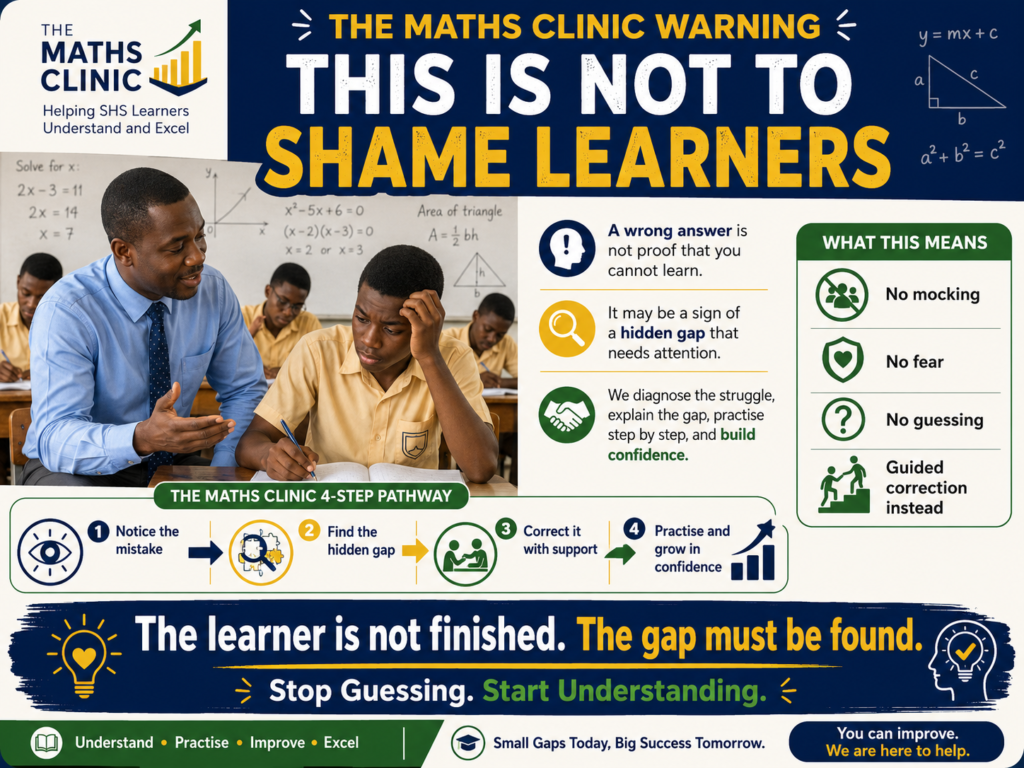
The Maths Clinic Warning: This Is Not to Shame Learners
Before we continue, one thing must be clear. Calling someone a mathematics struggler is not an insult. It is a diagnosis point. In the same way a clinic identifies fever, headache, or infection before treatment, The Maths Clinic identifies maths habits, hidden gaps, confidence issues, and exam mistakes before intervention.
Some struggling SHS maths students are hardworking. Some attend class regularly. Some copy notes neatly. Some even teach their friends in other subjects. Their problem is not that they are useless. Their problem is that the exact maths gap has not been treated well.
Quick Self-Check: Which Statements Sound Like You?
Tick the ones that describe you honestly. Do not think what you wish were true. Tick what usually happens when you meet Core Maths questions.
- I understand when the teacher solves, but I cannot solve it alone.
- I fear long word problems before I even read them properly.
- I make many sign mistakes in algebra.
- I know formulas, but I do not know when to use them.
- I lose marks because I forget units, round wrongly, or scatter my work.
- I copy from the board neatly, but similar questions confuse me.
- I avoid answering questions in class because I fear being wrong.
- I do past questions, but I keep repeating the same mistakes.
- I panic when a question looks different from the examples I have seen.
- I am weak in fractions, percentages, directed numbers, and basic operations.
If you ticked many of them, do not conclude that you are finished. It means you need diagnosis, correction, and targeted WASSCE Maths practice.
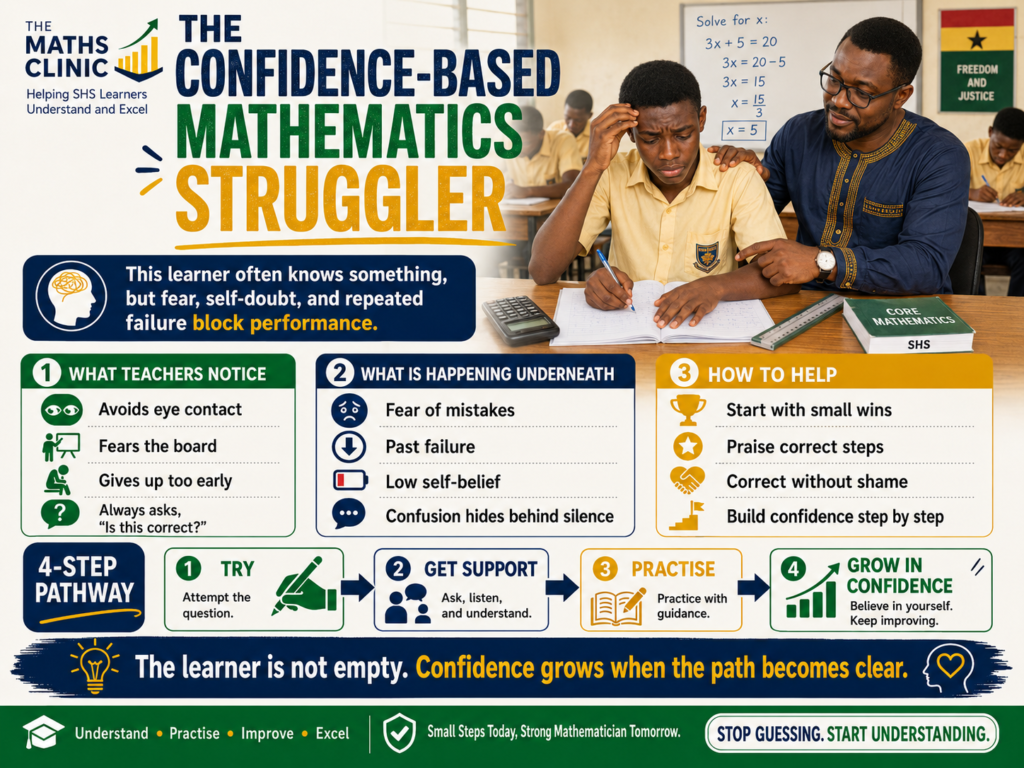
1. The Confidence-Based Mathematics Struggler
The learner’s problem
This mathematics struggler may know something, but fear blocks the thinking. The learner sees a question, and the mind goes blank. Even when the first step is known, the learner doubts it. In class, this student may avoid eye contact, keep quiet during oral questions, fear the board, and say, “Sir, I cannot do it,” before trying.
This struggle is common among learners who have failed mathematics before, learners who were laughed at, learners who have been called weak for a long time, and learners who compare themselves too much with stronger classmates.
Ghanaian classroom example
A learner is asked, “A number is multiplied by 3, and then 4 is added. The result is 25. Find the number.” The learner panics because the question looks unfamiliar. But when broken down, it is simply 3x + 4 = 25.
What may be hiding under the mistake
- Low maths confidence
- Fear of embarrassment
- Not enough guided practice
- Poor experience with past failure
- Believing maths is only for naturally brilliant students
How to start fixing it
- Start with small questions you can complete.
- Read unfamiliar questions twice before deciding they are hard.
- Write what is given and what is required.
- Attempt the first step, even if you are not sure.
- Let your teacher see your wrong attempt so the real gap can be corrected.
Build Maths Confidence Step by Step.
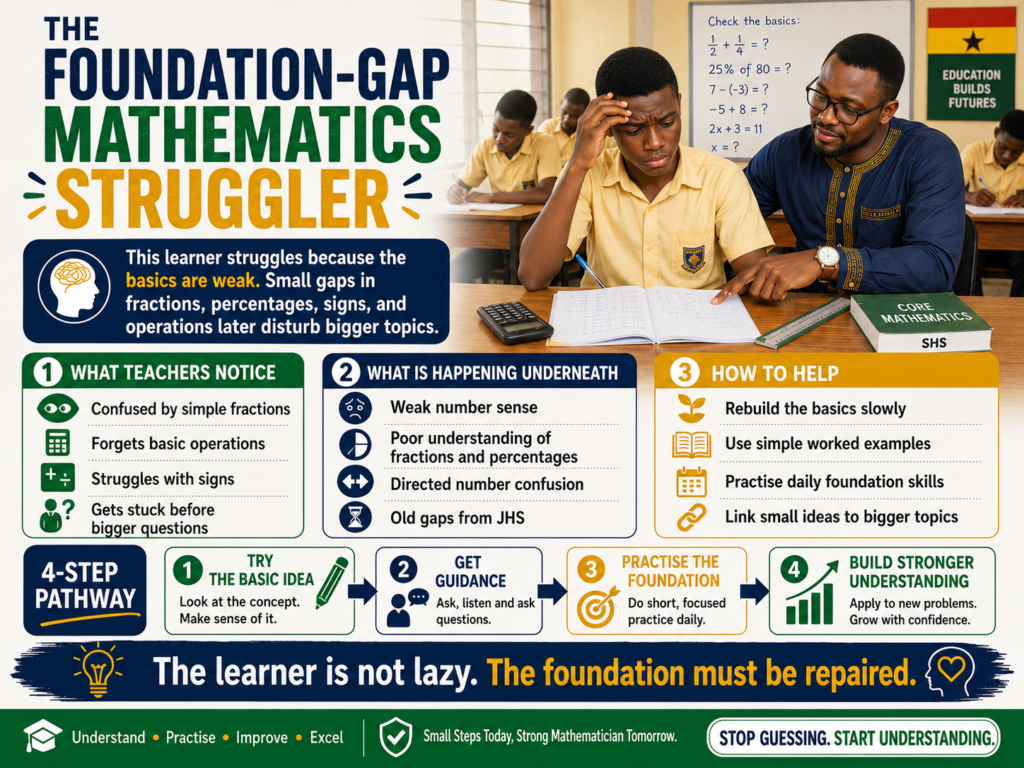
2. The Foundation-Gap Mathematics Struggler
The learner’s problem
This learner struggles because the basics are weak. The problem may not begin with the SHS topic being taught. It may come from JHS fractions, percentages, multiplication, division, directed numbers, decimals, ratios, or basic algebra.
A foundation-gap mathematics struggler may suffer in many topics at once because the same weak basics keep appearing in different forms. Fractions disturb percentages. Sign errors disturb algebra. Poor multiplication affects indices, graphs, statistics, and mensuration.
Ghanaian classroom example
A student cannot simplify 1/2 + 1/3 correctly. Later, the same student struggles with probability, algebraic fractions, percentage profit, simple interest, and statistics because fractions are hiding inside all those topics.
What may be hiding under the mistake
- Weak number sense
- Poor understanding of fractions and percentages
- Difficulty with negative signs
- Rushing into bigger topics before basic skills are stable
- Memorising rules without knowing the meaning
How to start fixing it
- Practice fractions, percentages, directed numbers, and basic operations daily.
- Do not feel too big to revise JHS basics.
- Connect each basic skill to SHS topics.
- Ask: “Which small skill is hiding inside this big topic?”
- Use short daily drills before past questions.
Fix Basic Number Skills Before WASSCE.
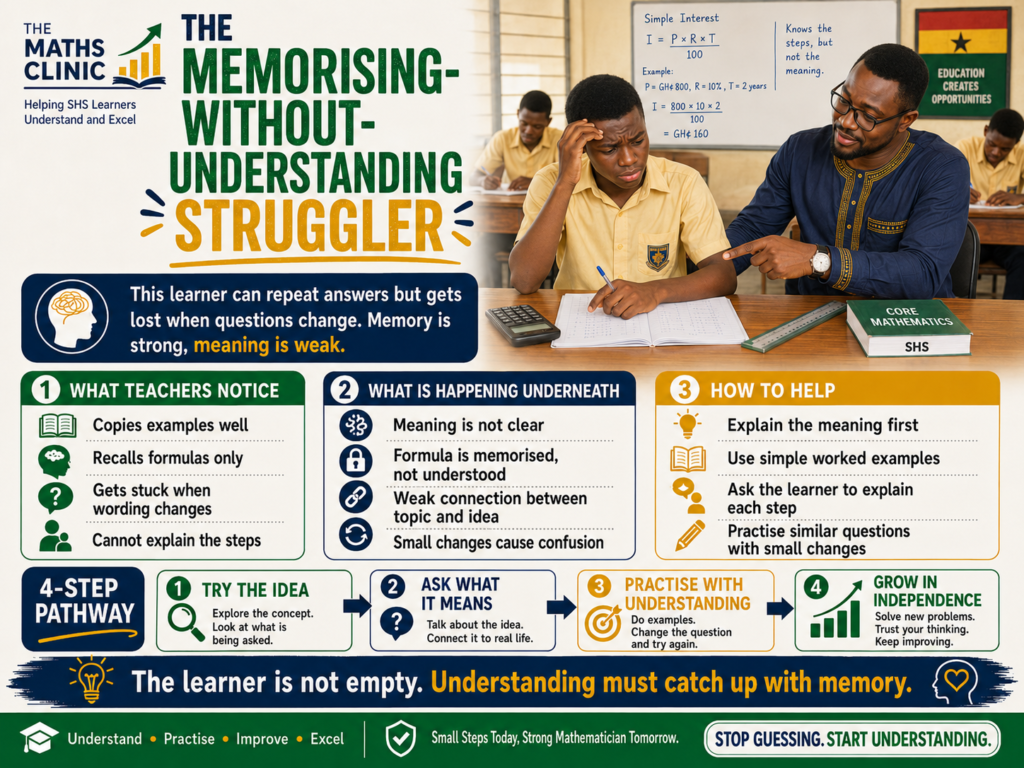
3. The Memorising-Without-Understanding Struggler
The learner’s problem
This learner can recite formulas and copy procedures, but the meaning is missing. Once the question changes a little, confusion starts. The learner may say, “I know the formula, but I do not know how to start.”
This type of mathematics struggler is common because many students study Core Maths by copying worked examples and memorizing past question patterns. But the new curriculum and WASSCE-style questions expect learners to understand, apply, reason, and explain.
Ghanaian classroom example
A learner writes Simple Interest = (P x R x T) / 100 but substitutes it as (P + R + T) / 100. The learner remembers the formula topic but does not understand what each letter means or why multiplication is used.
What may be hiding under the mistake
- Learning steps like a song
- Not asking why a formula works
- Depending on repeated examples only
- Weak connection between the formula and the real meaning
How to start fixing it
- Before using a formula, write what each letter means.
- Explain the formula in your own simple words.
- Solve one question slowly and say why each step is needed.
- Compare two similar questions and identify what changed.
- Stop saying “that is how we do it” and start asking “why does this work?”
Stop Memorizing and Start Understanding Core Maths.
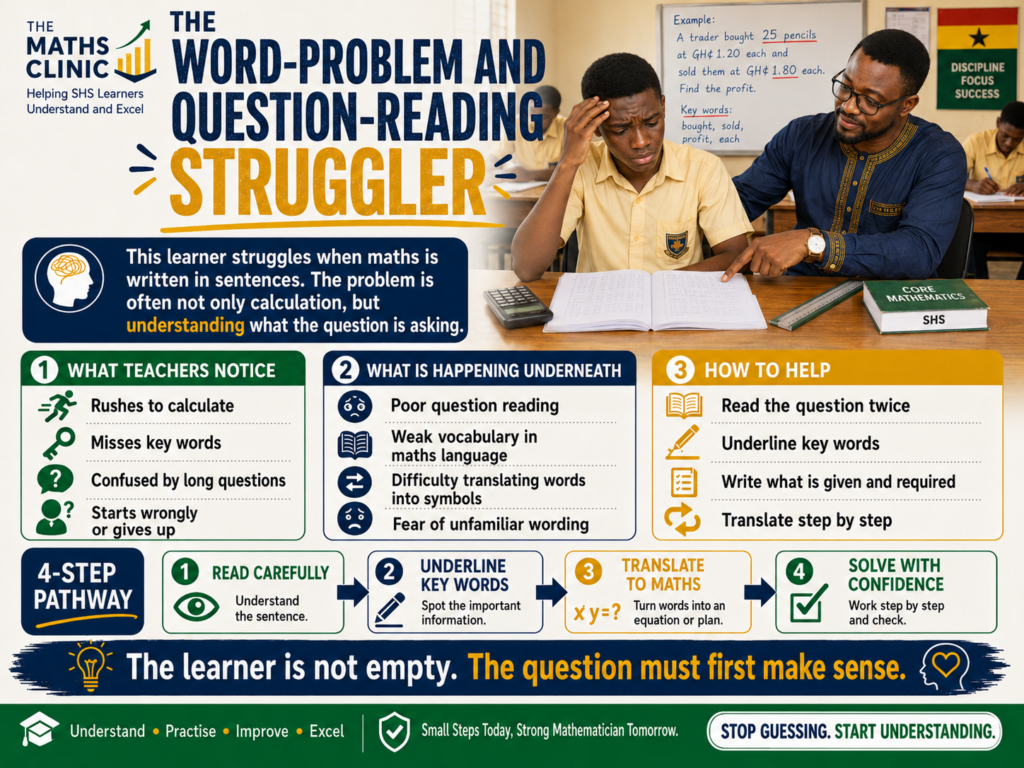
4. The Word-Problem and Question-Reading Struggler
The learner’s problem
This learner may know calculations but loses marks because the question is not understood properly. The learner sees numbers and starts calculating before translating the sentence into mathematics.
In WASSCE Core Mathematics, poor reading can spoil a good topic. Words such as sum, difference, product, quotient, total, at least, not more than, perimeter, area, profit, loss, nearest, hence, and estimate must be read carefully.
Ghanaian classroom example
The question says: “The sum of a number and 7 is 19.” Some learners write 7x = 19. But “sum” means addition, so the correct translation is x + 7 = 19.
What may be hiding under the mistake
- Rushing through questions
- Poor mathematical vocabulary
- Seeing numbers before seeing meaning
- Weak translation from English to mathematics
- Fear of long sentences
How to start fixing it
- Read the question twice.
- Underline key action words.
- Write what is given and what is required.
- Translate the statement into mathematical form before calculating.
- Check whether your answer fits the original question.
Practice WASSCE word problems step by step.
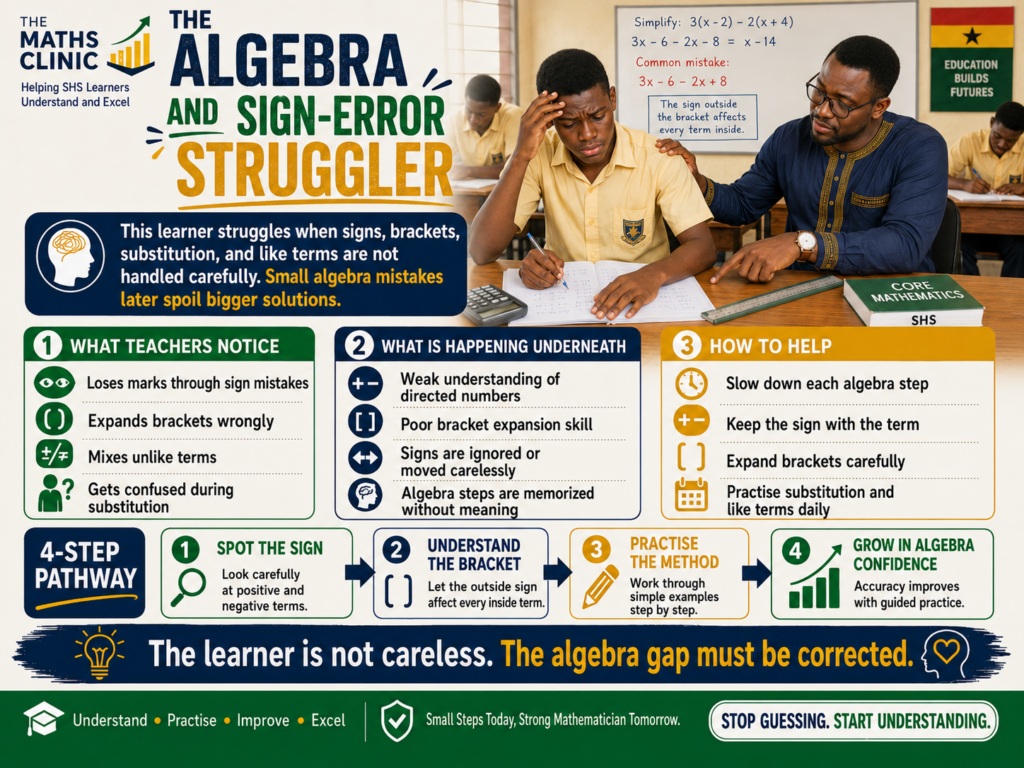
5. The Algebra and Sign-Error Struggler
The learner’s problem
This mathematics struggler can start algebra questions but loses marks through signs, brackets, transposition, like terms, substitution, and expansion. The learner may understand the topic generally, but small algebra mistakes destroy the final answer.
Algebra is not one small topic in SHS mathematics in Ghana. It enters equations, functions, graphs, variation, mensuration, trigonometry, coordinate geometry, and word problems. So an algebra gap can affect many WASSCE Core Mathematics questions.
Ghanaian classroom example
Simplify 3(x – 2) – 2(x + 4). A common wrong answer is x + 2 because the learner changes -2(x + 4) into -2x + 8. The correct expansion is 3x – 6 – 2x – 8 = x – 14.
What may be hiding under the mistake
- Not treating signs as part of terms
- Forgetting that a negative sign affects every term in a bracket
- Moving terms across the equal sign carelessly
- Poor substitution habits
How to start fixing it
- Expand brackets slowly.
- Keep the sign attached to each term.
- Collect like terms carefully.
- Check negative signs before moving to the next line.
- Practice short algebra questions daily.
Fix Algebra and Sign Errors Before WASSCE.
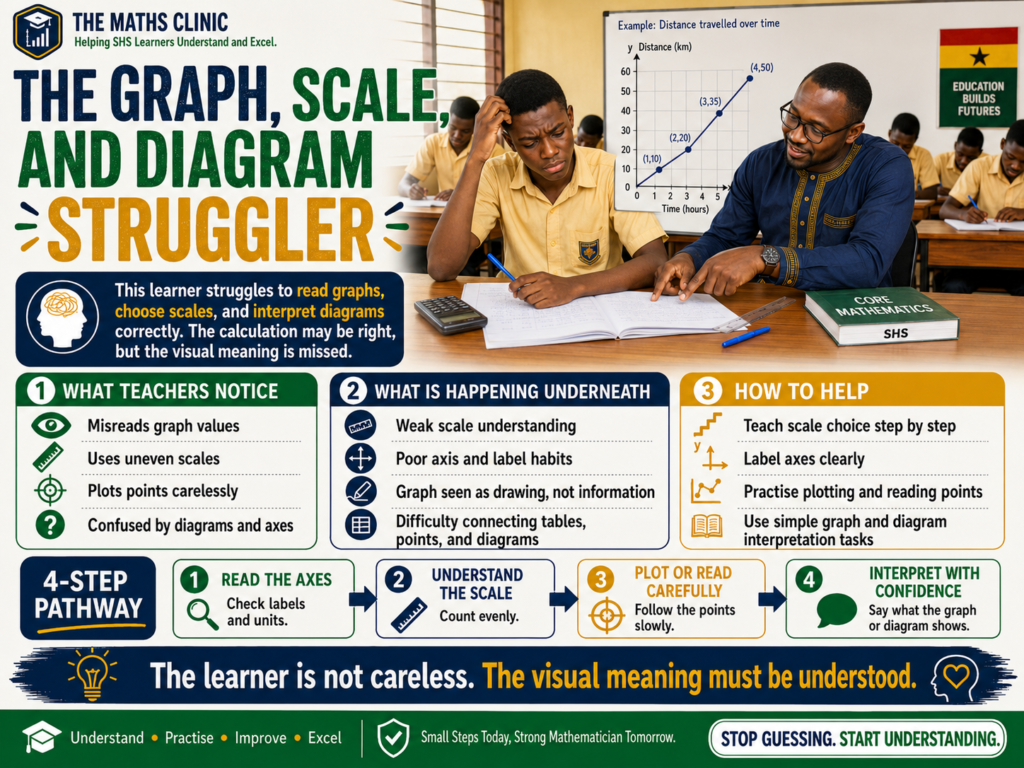
6. The Graph, Scale, and Diagram Struggler
The learner’s problem
This learner may calculate values correctly but loses marks when drawing, reading, or interpreting graphs and diagrams. The learner may choose a poor scale, forget labels, plot points carelessly, or treat diagrams as decoration.
This struggle affects linear graphs, cumulative frequency curves, histograms, bearings, transformations, constructions, circle theorems, trigonometry, and geometry.
Ghanaian classroom example
For y = 2x + 1, a learner may calculate the table correctly but plot the points using unequal spacing on the axis. The graph becomes wrong even though the table is correct.
What may be hiding under the mistake
- Poor scale choice
- Not labelling axes
- Careless plotting
- Misreading diagrams
- Not using a ruler and a pencil properly
How to start fixing it
- Choose a clear and even scale.
- Label both axes.
- Plot points accurately.
- Use a ruler for straight lines.
- Read values from graphs carefully before writing final answers.
Practice WASSCE Graph Questions with Feedback.
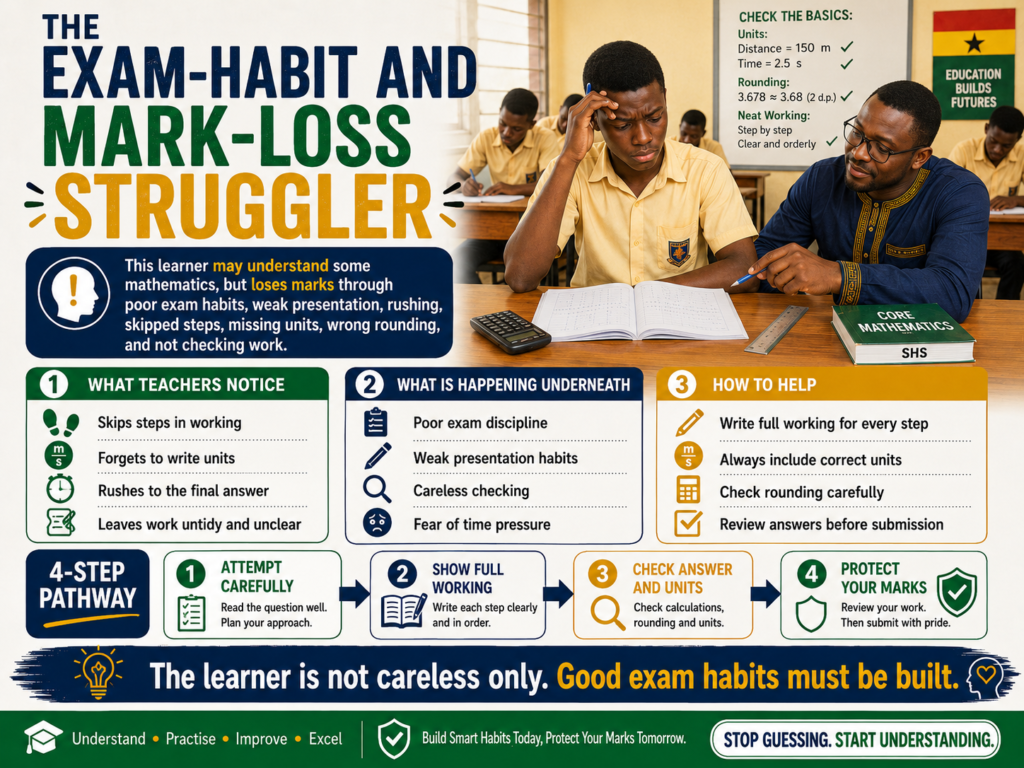
7. The Exam-Habit and Mark-Loss Struggler
The learner’s problem
This student may know the topic, but loses marks through poor exam habits. The work may be untidy. Units may be missing. Rounding may be wrong. The final answer may not be stated clearly. Sometimes the learner leaves questions blank too early.
This type of mathematics struggler is painful because the learner may understand more than the marks show. The problem is not only knowledge. It is a presentation and exam discipline.
Ghanaian classroom example
A learner finds the area of a rectangle as 96 but writes only “96” instead of “96 cm².” In some questions, missing units can cost marks or make the final answer incomplete.
What may be hiding under the mistake
- Thinking that only final answers matter
- Skipping formulas and important steps
- Poor arrangement of work
- Wrong rounding instruction
- Leaving units out
How to start fixing it
- Write the formula where necessary.
- Substitute values clearly.
- Show important steps.
- Attach correct units.
- Round according to the question.
- Box or state final answers clearly.
Avoid Common Core Maths Exam Mistakes.
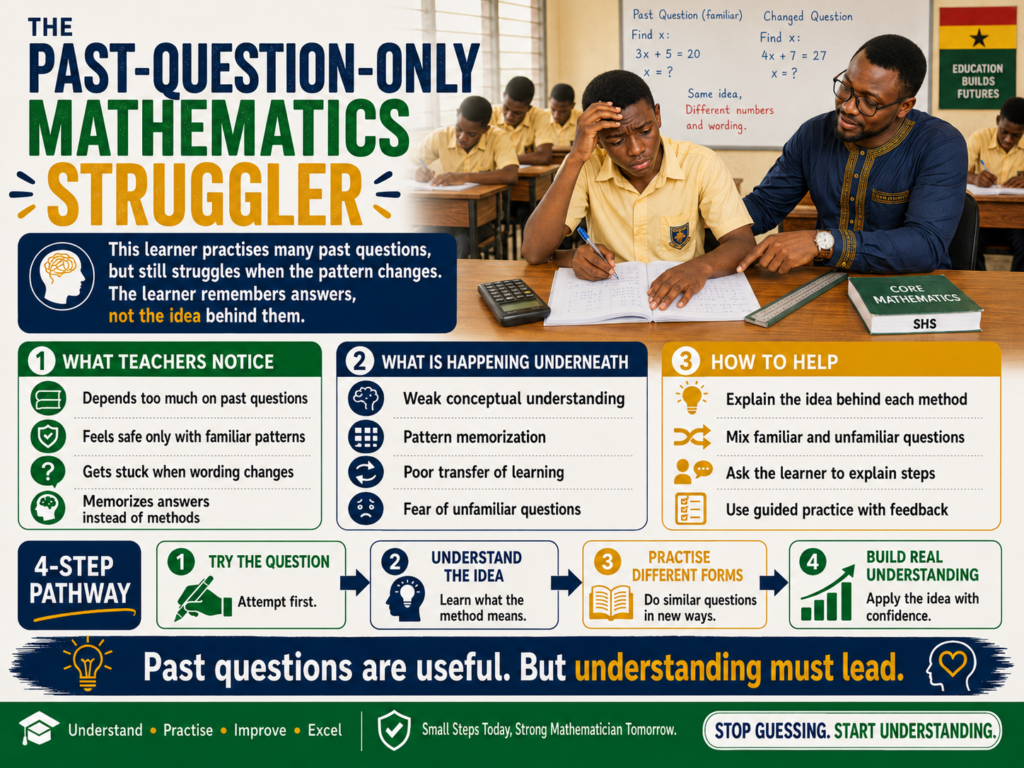
8. The Past-Question-Only Struggler
The learner’s problem
This learner believes that doing many past questions alone will solve everything. Past questions are useful, but they are not medicine by themselves. If the hidden gap is not corrected, the learner may repeat the same wrong method across many papers.
A student may solve twenty percentage questions and still fail the next one because the real gap is not percentage. The real gap may be fractions, base value, or a poor interpretation of profit and loss.
Ghanaian classroom example
A learner keeps failing the percentage profit because he divides profit by the selling price instead of the cost price. Doing more past questions will not fix the problem until the learner understands the correct base.
What may be hiding under the mistake
- Repeating questions without feedback
- Memorising final answers
- Not reviewing mistakes
- Avoiding corrections
- Practicing more but not practicing smarter
How to start fixing it
- After each wrong answer, ask: “What gap produced this mistake?”
- Group mistakes by topic and habit.
- Correct the simple idea before doing more questions.
- Redo similar questions after correction.
- Use Practice Zone and Intervention Hub together.
Diagnose the Gap Before Doing More Past Questions.
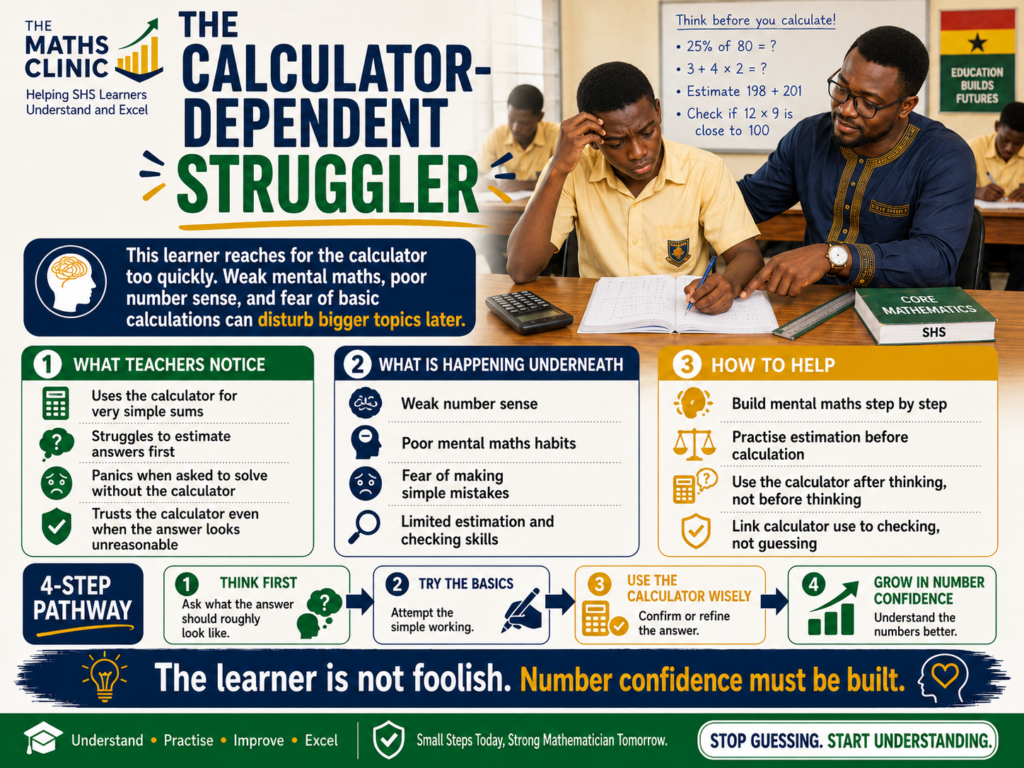
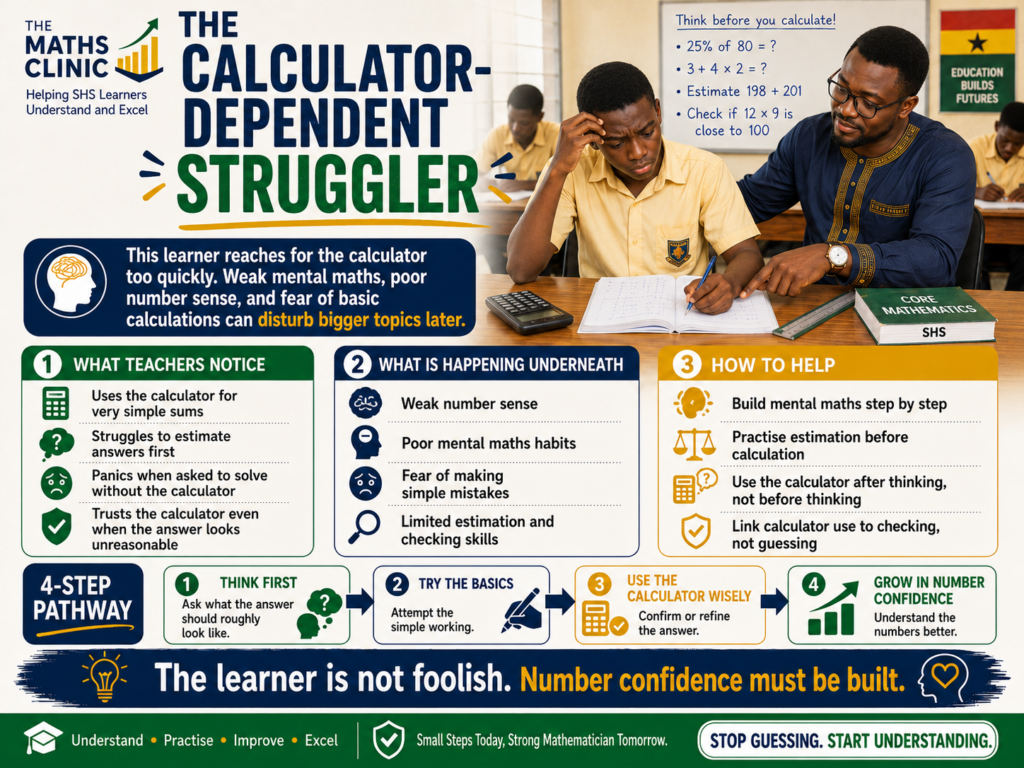
9. The Calculator-Dependent Struggler
The learner’s problem
This learner depends on the calculator before understanding mathematics. The calculator gives answers, but it does not read the question, choose the formula, select the unit, or explain the reasoning.
In SHS Core Maths, calculators are useful, but they cannot replace thinking. A learner who uses a calculator without understanding may still lose marks in word problems, algebra, graphs, statistics, and geometry.
Ghanaian classroom example
A learner enters numbers into the calculator for simple interest but does not know which number is the principal, which one is the rate, and which one is the time. The calculator becomes fast, but the thinking remains weak.
What may be hiding under the mistake
- Using a calculator as the first step instead of a support tool
- Not estimating answers
- Poor formula selection
- Not checking whether the answer makes sense
How to start fixing it
- Understand the question before pressing the calculator.
- Write the formula first.
- Substitute values before calculating.
- Estimate roughly to check if the answer is reasonable.
- Use the calculator to confirm, not to replace thinking.
Use Your Calculator Without Losing the Maths.
10. The Silent Classroom Struggler
The learner’s problem
This learner sits quietly, copies notes, behaves well, and rarely disturbs. But the learner does not fully understand. Because the student is quiet, the teacher may not notice the struggle early unless classwork is checked carefully.
Many weak mathematics students in Ghanaian classrooms are not noisy. They are silent. They hide confusion because they do not want attention. This makes their gaps grow quietly.
Ghanaian classroom example
During a lesson on equations, the learner copies all the examples. But when the teacher gives an independent exercise, the learner leaves the page blank and waits for correction.
What may be hiding under the mistake
- Fear of asking questions
- Low confidence
- Not knowing how to explain the confusion
- Good behaviour hides a poor understanding
How to start fixing it
- Ask one small question after class.
- Show the teacher where you got stuck.
- Attempt classwork before correction begins.
- Join a serious study partner who explains instead of only giving answers.
- Use wrong attempts as clues, not shame.
Ask a Core Maths Question Without Fear.
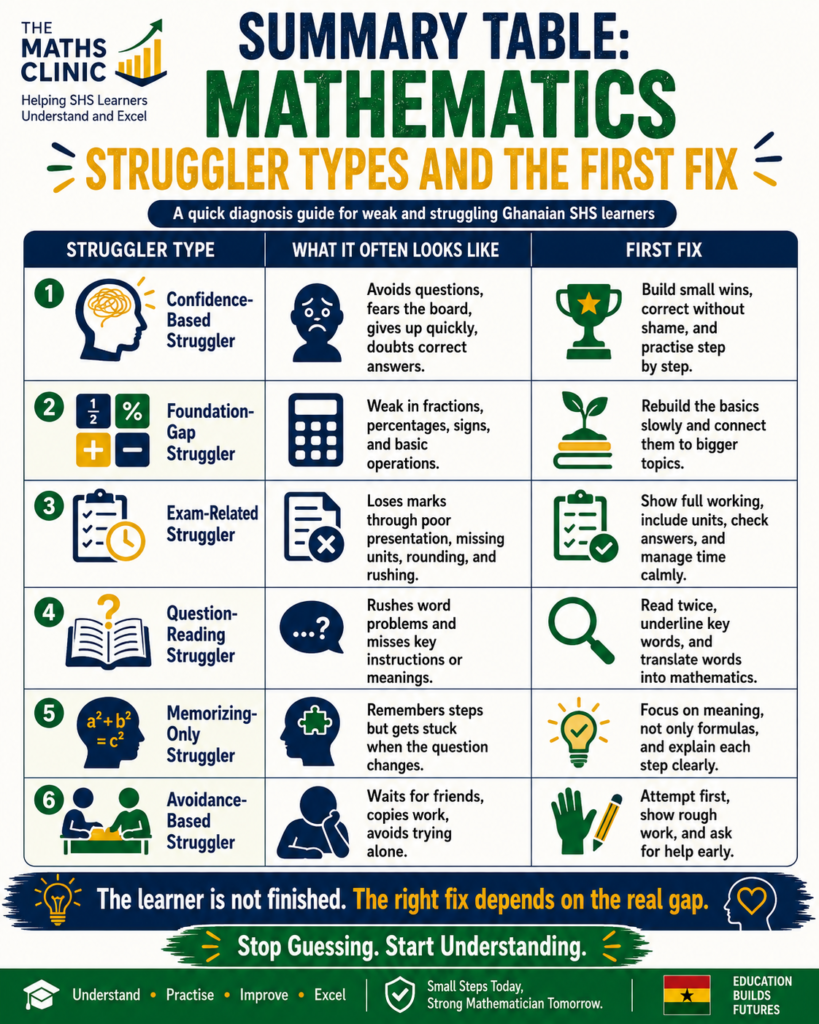
Summary Table: Mathematics Struggler Types and the First Fix
| Struggler type | What it looks like | First fix |
| Confidence-based struggler | Panics, avoids questions, fears the board | Start with small wins and guided practice |
| Foundation-gap struggler | Weak in fractions, signs, percentages, and basics | Rebuild number sense before bigger topics |
| Memory-based struggler | Knows formulas but cannot apply them | Explain the meaning behind each formula |
| Word-problem struggler | Misreads questions and rushes to calculate | Underline keywords and translate sentences |
| Algebra/sign struggler | Loses marks through signs, brackets, and like terms | Practise slow expansion and careful sign control |
| Graph/diagram struggler | Uses poor scales and misreads diagrams | Label axes, plot carefully, read diagrams as information |
| Exam-habit struggler | Omits units, rounds wrongly, and scatters work | Show clear working and final answers |
| Past-question-only struggler | Practises many questions but repeats mistakes | Diagnose the hidden gap before more practice |
| Calculator-dependent struggler | Presses calculator before understanding | Write formula and substitute before calculating |
| Silent classroom struggler | Copies quietly but cannot solve alone | Ask small questions and attempt first |
How to Use This Diagnosis Without Labelling Yourself Forever
You may see yourself in more than one type. That is normal. A learner can have a foundation gap and also lack confidence. Another learner can read questions poorly and also lose marks due to exam habits. The purpose is not to put yourself in a box. The purpose is to know where to begin.
Start with the struggle that costs you the most marks. If your basics are weak, begin there. If fear stops you from attempting questions, begin with confidence and small wins. If you understand lessons but fail exams, work on presentation, timing, units, rounding, and careful reading.
Do not try to fix everything in one week. Mathematics improves when the right small gaps are treated repeatedly.
A Simple 7-Day Restart Plan for a Mathematics Struggler
- Day 1: Write the topics that worry you most, such as fractions, algebra, graphs, word problems, or mensuration.
- Day 2: Solve five very simple questions from your weakest foundation area.
- Day 3: Take one wrong answer and identify the exact mistake behind it.
- Day 4: Practice one-word problems slowly by underlining key words before solving.
- Day 5: Redo a question you got wrong earlier and explain the correction in your own words.
- Day 6: Practice one WASSCE-style question and show full working, units, and final answer.
- Day 7: Review your progress and choose the next gap to fix.
This plan looks simple, but it teaches the learner one important habit: do not run away from the gap. Find it and treat it.
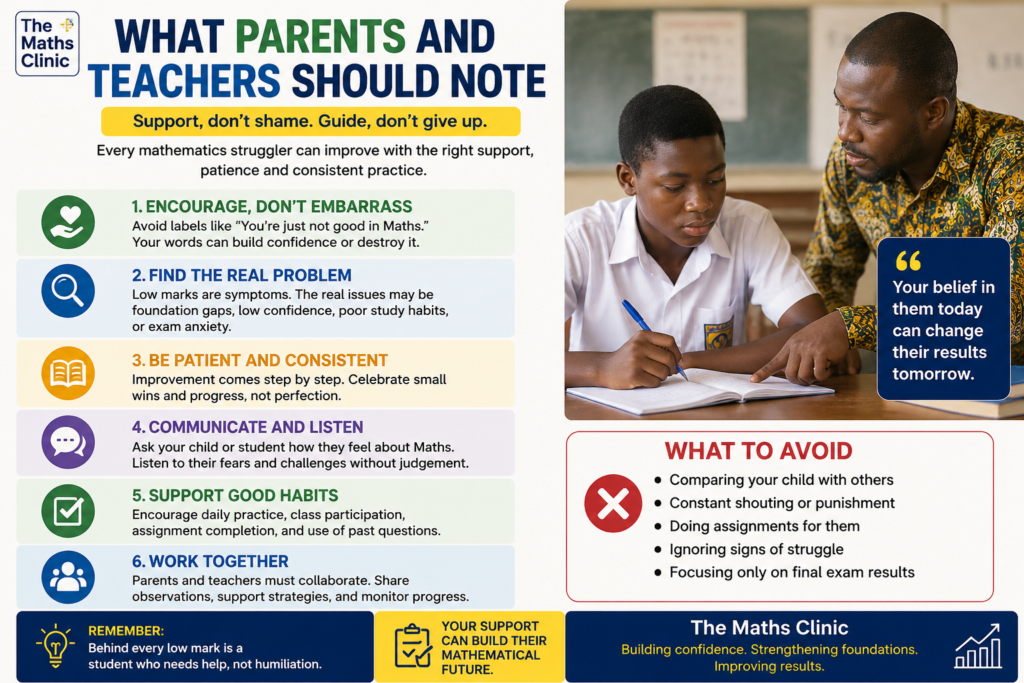
What Parents and Teachers Should Note
A struggling learner should not be judged only by the final mark. The mark is important, but the behavior behind the mark matters too. Does the learner avoid questions? Does the learner copy without understanding? Does the learner lose marks through units? Does the learner panic when questions look unfamiliar?
Teachers and parents can support better when they ask diagnostic questions instead of only asking why the learner failed. A good question is, “Which part confused you?” Another good question is, “What mistake did you repeat?” A better question is, “What support do you need to fix this gap?”
This approach reduces shame and increases responsibility. The learner is not excused from effort. The learner is guided to use effort in the right direction.
FAQ Section
1. What does a “mathematics struggler” mean?
A mathematics struggler is a learner who finds Core Maths difficult because of hidden gaps, fear, poor foundations, weak question reading, exam habits, or wrong study methods. It is not an insult. It is a way to identify the problem and fix it.
2. Can a weak SHS student improve in WASSCE Core Mathematics?
Yes. A weak SHS student can improve when the exact gap is diagnosed and corrected. Improvement becomes easier when the learner stops guessing, practices with feedback, and rebuilds weak foundations step by step.
3. Why do I understand in class but fail tests?
This often happens when you copy or follow the teacher’s steps without being able to solve them independently. It can also happen because of exam fear, poor question reading, weak basics, or poor presentation.
4. Are past questions enough for WASSCE Maths practice?
Past questions are useful, but they are not enough when the learner keeps repeating the same hidden mistakes. Past questions work better when combined with diagnosis, correction, and targeted practice.
5. Which struggle should I fix first?
Fix the struggle that blocks the most topics. For many learners, these are foundational skills such as fractions, percentages, signs, and basic algebra. For others, the urgent problem may be confidence, word problems, or exam presentation.
6. How does this post fit the new SHS mathematics curriculum?
The post supports conceptual understanding, reasoning, mathematical communication, application, and learner-centered correction. These skills help learners move beyond memorizing examples and prepare for Core Maths more practically.
Conclusion: You Are Not Finished; You Need the Right Diagnosis
Every mathematics struggler has a story behind the wrong answer. Some are afraid. Some have weak foundations. Some memorize without understanding. Some misread questions. Some know the work but lose marks through poor exam habits. Some practice past questions but never correct the real gap.
The solution is not to insult the learner. The solution is to diagnose the struggle correctly and treat it patiently.
If you are a weak or struggling Ghanaian SHS student, do not hide from mathematics. Start by asking a better question: What type of mathematics struggler am I?
When you know your struggle type, your practice becomes clearer. Your corrections become more useful. Your confidence begins to grow.
At The Maths Clinic, the aim is simple: find the gap, fix the gap, and help the learner stop guessing and start understanding. WASSCE Core Mathematics becomes less frightening when the learner knows exactly what to work on next.