Struggling with WASSCE Maths? Stop guessing. Let’s fix the gap step by step.
7 Warning Signs Your Core Maths Foundation Is Weak

Many Ghanaian SHS students do not fail Core Maths because they are lazy. Some fail because their foundation is weak, but nobody helped them notice it early.
A weak Core Maths foundation is like building a storey building on soft ground. At first, everything may look fine. You can copy notes. You can solve some class examples. You can even get some answers correct when the teacher guides you.
But when WASSCE brings mixed questions, word problems, graphs, algebra, percentages, bearings, statistics, and geometry together, the hidden cracks begin to show.
That is why this lesson is important.
This post will help you answer one key question: How does knowing these warning signs help a struggling SHS learner understand Core Maths better?
The answer is simple. When you know the real problem, you stop guessing. You stop saying, ‘Maths is hard.’ You begin to say, ‘This is the exact gap I must fix.’
That is where real improvement starts.

1. You Can Follow the Teacher in Class, But You Cannot Solve Alone
This is one of the first warning signs that your Core Maths foundation is weak.
In class, everything looks clear because the teacher is doing most of the thinking. The teacher chooses the formula. The teacher arranges the steps. The teacher knows where the question is going.
So you look at the board and say, ‘Oh, I understand.’
But when you sit alone with a similar question, your mind goes blank.
This does not always mean you are dull. It often means your understanding is too dependent on the teacher’s steps.
Why This Happens
Many learners copy solutions without learning the reason behind each step. They know what the teacher wrote, but they do not know why the teacher wrote it.
For example, in algebra, a learner may copy the following:
2x + 5 = 17
2x = 17 – 5
2x = 12
x = 6
But the learner may not understand why +5 became -5. So when the question changes slightly, confusion starts.
How This Helps You Understand Core Maths Better
This warning sign teaches you that understanding Core Maths is not copying steps. It is knowing the reason behind the steps.
From today, after every worked example, ask yourself: Can I explain why each step was done?
If you cannot explain it, that is the gap to fix.
2. You Forget Formulas Quickly After Learning Them
Some SHS students learn formulas today and forget them tomorrow. They memorize the formula for simple interest, area, volume, gradient, or probability, but they cannot remember it during a test.
This is another warning sign.
It shows that the formula is sitting in your memory, but it is not connected to meaning.
Why This Happens
A formula becomes easy to forget when you only cram it.
For example:
SI = PRT/100
Many learners can recite this formula, but they do not fully understand what P, R, and T mean.
So when the question gives the amount instead of interest or gives time in months instead of years, the learner becomes confused.
How This Helps You Understand Core Maths Better
This warning sign tells you to stop learning formulas like songs.
Instead, learn what each formula means.
For simple interest, ask: What is the principal? What is the rate? Is the time in years? Did the question ask for interest or amount?
When you understand the meaning of the formula, you do not panic when WASSCE changes the wording.
3. You Make Many Sign Errors in Algebra
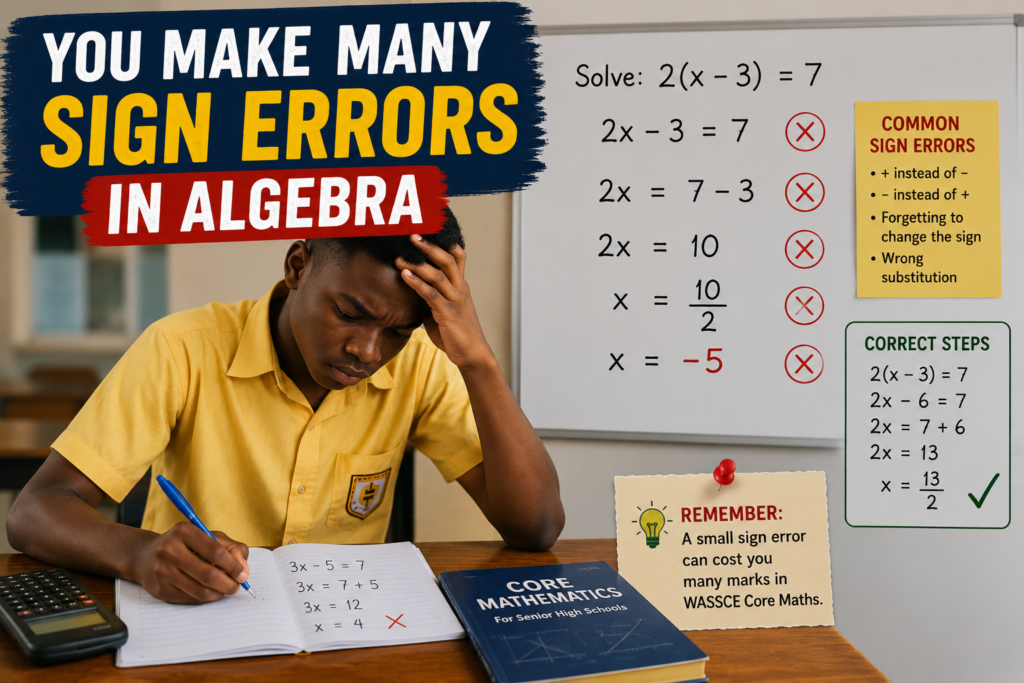
If you often lose marks because of plus and minus signs, your algebra foundation needs attention.
This is common in Core Maths. A learner may know the method but still get the answer wrong because of a sign error.
For example:
Why This Happens
3x – 7 = 11
Wrong: 3x = 11 – 7
Correct: 3x = 11 + 7
That small sign mistake changes the whole answer.
Sign errors happen when learners do not understand inverse operations.
When you move -7 from one side of the equation to the other side, it becomes +7. This is because you are doing the opposite operation to balance the equation.
The equation is like a balance scale. Whatever you do to one side must keep the balance correct.
How This Helps You Understand Core Maths Better
This warning sign helps you see that algebra is not magic. It follows balance.
Whenever you solve an equation, do not rush. Ask: What operation is affecting the unknown? What opposite operation will remove it?
That one habit can save many marks in WASSCE Core Maths.
4. You Cannot Tell Which Topic a Question Comes From
Another serious warning sign is when you read a question, and you cannot tell the topic.
You may ask yourself: Are these percentages? Is it a ratio? Is it simple interest? Is it a linear equation? Is it statistics?
This happens often in WASSCE because questions are not always labeled by topic.
The paper will not say, ‘This is a percentage question.’ You must recognize it from the language of the question.
Why This Happens
Many learners study topics separately but do not learn how to identify them inside questions.
For example, these words can point to different topics:
Profit may point to percentages. “Rate per annum” may point to simple interest. “Directly proportional” may point to variation. The mean score may point to statistics. Gradient may point to graphs.
If you cannot recognize the topic, you may choose the wrong method even before you start solving.
How This Helps You Understand Core Maths Better
This warning sign helps you understand that Core Maths is not only about calculation. It is also about interpretation.
Before solving any question, pause and ask: What topic is hiding inside this question?
Then underline the key words.
This helps your brain choose the correct method before your hand starts writing.
5. You Understand Numbers Better Than Word Problems
Some learners can calculate well when the question is direct. But once the question comes as a story, they are lost.
For example, they can solve 25% of 80, but they struggle when the question says, “A trader sold an item for GH₵80 after giving a discount of 25%. ” Find the original price.
The issue is not only percentage. The issue is reading and translation.
Why This Happens
Word problems require two skills: first, you must understand the English. Second, you must translate the English into mathematics.
Many struggling learners jump straight into calculation without first understanding what the question is asking.
That is why they may use the wrong base, wrong value, or wrong operation.
How This Helps You Understand Core Maths Better
This warning sign teaches you to slow down before solving word problems.
Use this simple approach: Read the question once to understand the story. Read it again and underline the key numbers. Identify what the question is asking you to find. Decide the topic. Choose the method.
This helps you stop guessing and start translating the question properly.
6. You Always Need to See the Same Example Before You Can Solve
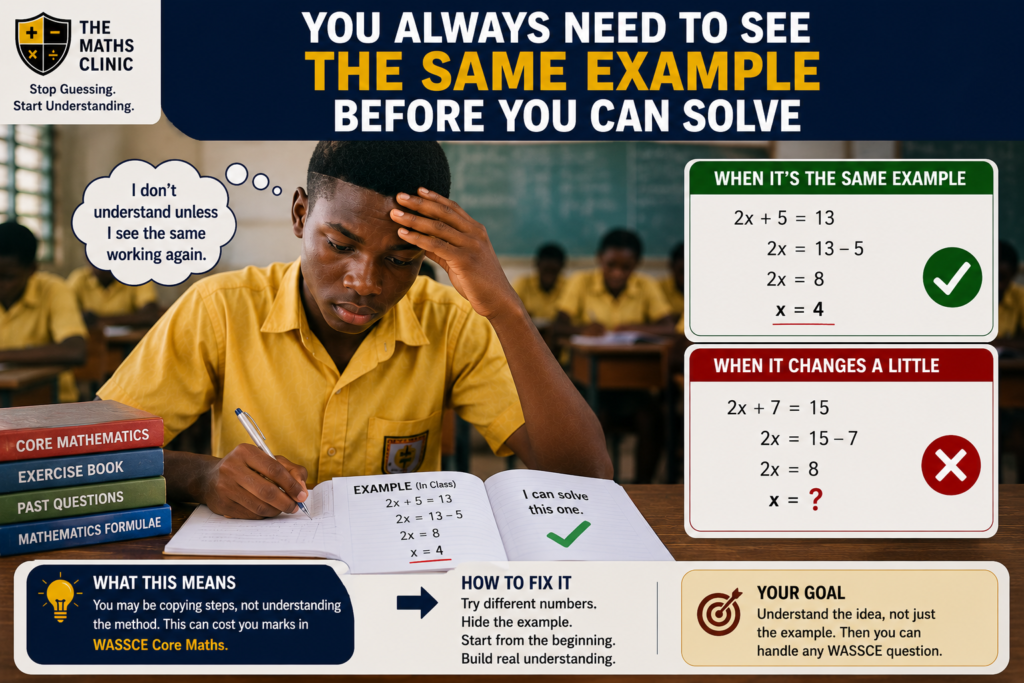
Some learners can solve a question only when it looks exactly like the one the teacher solved.
Once WASSCE changes the wording, numbers, diagram, or arrangement, they become confused.
This is a warning sign.
It means you may be memorizing examples instead of understanding concepts.
Why This Happens
Many learners prepare for Core Maths by repeating examples without asking what idea is behind them.
For example, in mensuration, a learner may know how to find the area of a rectangle. But if the same rectangle is part of a compound shape, the learner does not know what to do.
The shape has changed, but the idea is the same.
How This Helps You Understand Core Maths Better
This warning sign helps you learn the main idea behind each topic.
For every topic, ask, “What is the main idea here?”
In algebra, the main idea may be balance. In percentages, the main idea is part compared to whole. In graphs, the main idea is the relationship between values. In geometry, the main idea may be properties of shapes.
When you know the main idea, you can handle different versions of the same question.
7. You Keep Saying “I Know It,” But Your Test Scores Do Not Improve
This is a painful warning sign, but it is very important.
Some learners feel they know Core Maths because they have seen the topic before. But when they write tests, the marks do not show improvement.
They say, “I know this topic. I have learned it before. ‘I made only small mistakes.’
But the same mistakes keep repeating.
Why This Happens
There is a difference between familiarity and mastery.
Familiarity means you have seen the topic before.
Mastery means you can solve questions correctly, explain your steps, avoid common traps, and apply the idea in a new situation.
Many learners confuse the two.
How This Helps You Understand Core Maths Better
This warning sign helps you become honest with your learning.
Do not ask only, ‘Have I learnt this before?’ Ask better questions: Can I solve it without help? Can I explain the steps? Can I avoid the usual mistake? Can I solve a WASSCE-style version? Can I correct myself when I go wrong?
If the answer is no, then the topic still needs fixing.
That is not shameful. That is diagnosis.
Worked Example: How a Weak Foundation Shows in a Simple Question
Let us take a simple algebra question.
Question
Solve:
4x – 3 = 21
Common Wrong Approach
Some learners write:
4x = 21 – 3
4x = 18
x = 18/4
x = 4.5
The learner may think the work is correct because the steps look familiar.
But the mistake happened when -3 was moved wrongly.
Correct Method
4x – 3 = 21
Add 3 to both sides:
4x = 21 + 3
4x = 24
x = 6
What This Reveals
The real problem is not the whole topic of algebra. The hidden gap is sign movement and inverse operations.
That is how diagnosis helps. It shows the exact place where the learner is weak.
Once the learner fixes that gap, many algebra questions become easier.
Common Wrong Mindset Among Struggling Learners
Many struggling SHS learners say: ‘I am not good at Maths.’
That statement is too broad.
A better statement is: ‘I struggle with changing signs in equations.’ Or: ‘I struggle to know what a word problem is asking.’ Or: ‘I forget formulas because I do not understand what the letters mean.’
This kind of statement is more useful because it points to the real problem.
When you can name the weakness, you can fix it.
Correct Learning Method: Diagnose Before You Revise
Before WASSCE, do not only revise topics randomly.
Diagnose your weak foundation first.
Use this simple Maths Clinic method:
Step 1: Choose one topic
For example, percentages.
Step 2: Solve five questions without help
Do not check the answer first.
Step 3: Mark your work honestly
Look at where the mistake happened.
Step 4: Name the mistake
Was it a formula error? Was it a sign error? Was it a wrong interpretation? Was it poor substitution? Was it a careless calculation?
Step 5: Fix that exact gap
Do not run away from the mistake. That mistake is showing you where the foundation is weak.
This is how a struggling learner begins to understand Core Maths better.
Practice Task
Try these questions and use them to diagnose your foundation.
1. Algebra
Solve: 5x + 4 = 29
| Self-check: Ask yourself, did I handle the sign correctly? |
2. Percentages
A shirt is sold for GH₵120 after a discount of 20%. Find the original price.
| Self-check: Ask yourself, did I identify the correct base? |
3. Simple Interest
Find the simple interest on GH₵800 at 12% per annum for 9 months.
| Self-check Ask yourself: Did I change the time into years? |
4. Graphs
Find the gradient of the line passing through (2, 3) and (6, 11).
| Self-check Ask yourself: Did I subtract the coordinates in the correct order? |
5. Word Problem
The sum of two numbers is 35. One number is 9 more than the other. Find the two numbers.
| Self-check: Ask yourself, did I translate the words into an equation correctly? |
How This Helps a Struggling SHS Learner Understand Core Maths Better
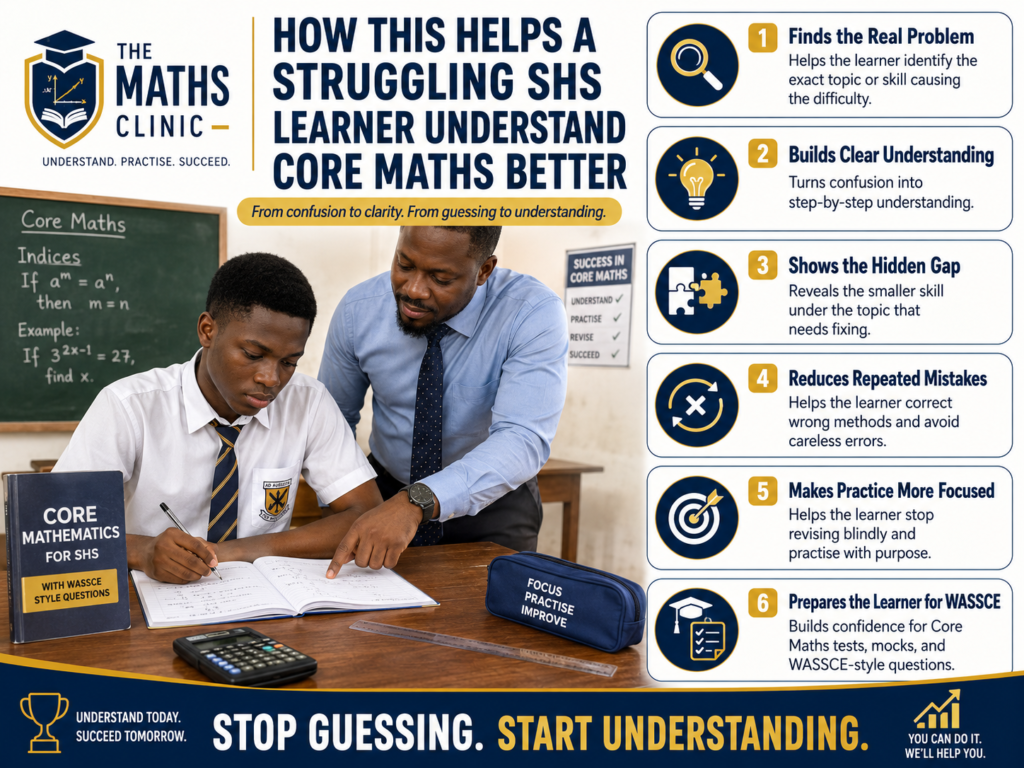
This lesson helps a struggling learner in five clear ways.
First, it helps the learner stop blaming himself or herself. The problem may not be the whole of Core Maths. It may be a small hidden gap.
Second, it helps the learner identify the exact weakness. A learner who knows the exact weakness can fix it faster.
Third, it helps the learner slow down and read questions properly. Many WASSCE mistakes happen before the calculation even begins.
Fourth, it helps the learner move from memorizing steps to understanding ideas. This is very important because WASSCE can change the style of a question.
Fifth, it helps the learner revise with purpose. Instead of reading everything in a panic, the learner focuses on the topics and mistakes that cost marks.
That is the real aim of The Maths Clinic.
We do not only want you to solve one question. We want you to understand why you got it wrong, fix the gap, and build confidence for the next question.
Final Advice Before WASSCE
If you have seen yourself in some of these warning signs, do not panic.
A weak foundation can be repaired.
But it must be repaired early.
Do not wait until the last week before WASSCE before you start asking why algebra, graphs, percentages, and word problems are confusing you.
Start now.
Pick one weak area. Solve questions. Check your mistakes. Name the gap. Fix it.
That is how struggling learners become stronger in Core Maths.
You do not need to guess your way through WASSCE Core Maths.
You need diagnosis, correction, practice, and patience.
At The Maths Clinic, we believe that weak does not mean finished. It only means the foundation needs attention.
And once the foundation becomes stronger, Core Maths begins to make better sense.