Struggling with WASSCE Maths? Stop guessing. Let’s fix the gap step by step.
8 Core Maths Symptoms Every Weak SHS Student Should Notice

Many SHS students do not wake up one day and suddenly become weak in Core Maths. The weakness usually shows small signs first.
At first, the learner may still copy notes, follow examples on the board, and even get a few class exercises correct. But when the teacher removes the support and the learner has to solve alone, the struggle begins to show.
That is why this post is important.
A symptom is not the final sickness. It is a signal. It tells you that something deeper needs attention.
In Core Maths, symptoms help a struggling SHS learner notice the exact place where the foundation is weak. Once the learner notices the symptom early, he or she can stop pretending, stop guessing, and start fixing the real problem before WASSCE.
This post answers one important question:
How does noticing these core maths symptoms help a weak SHS student understand mathematics better?
It helps because the learner stops saying, “I am bad at maths,” and starts saying, “This is the exact weakness I must correct.” That one change can save marks.
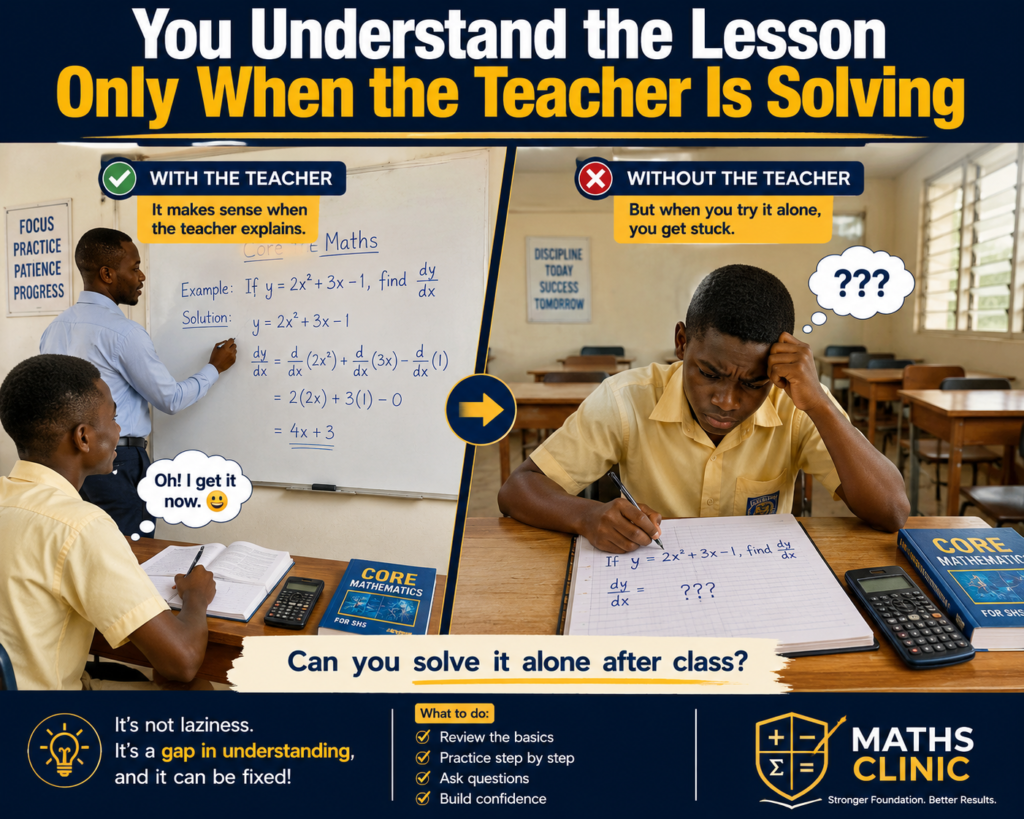
1. You Understand the Lesson Only When the Teacher Is Solving
This is one of the first Core Maths symptoms every weak SHS student should notice.
In class, the teacher explains the question. The teacher chooses the formula. The teacher arranges the working. The teacher knows the next step. As the learner watches, everything looks simple.
But when the learner gets home and tries a similar question alone, confusion starts.
Why This Symptom Happens
The learner may be following the teacher’s movement, not understanding the idea behind the movement.
For example, in algebra, the learner may copy how the teacher moves terms from one side of the equation to the other side. But the learner may not understand inverse operations and balancing.
So when the numbers change, the learner becomes stuck.
How This Helps the Learner Understand Core Maths Better
This symptom tells the learner that copying is not enough.
After every example, the learner must ask the following:
- Can I solve this same type of question without the teacher?
- Can I explain why each step was done?
- Can I solve another one with different numbers?
If the answer is no, the topic is not yet strong. The learner must return to the idea behind the method.
2. You Forget Formulas Very Quickly
Another symptom is when the learner learns a formula today and forgets it tomorrow.
This happens with simple interest, area, volume, trigonometry, probability, gradients, and many other Core Maths topics.
The learner may say, “Sir, I know the formula, but I forgot it in the exam.”
Why This Symptom Happens
Most times, the formula was memorized but not understood.
For example, a learner may memorize the following:
Simple Interest = (Principal x Rate x Time) / 100
But if the learner does not understand principal, rate, time, interest, amount, and per annum, the formula becomes weak in the mind.
When WASSCE changes the wording, the learner forgets or misuses the formula.
How This Helps the Learner Understand Core Maths Better
This symptom teaches the learner to stop learning formulas like songs.
Before using any formula, the learner must understand what each letter or part means.
For simple interest, ask:
- What is the principal?
- What is the rate?
- Is the time in years?
- Am I finding interest or amount?
When the meaning is clear, the formula becomes easier to remember and apply.
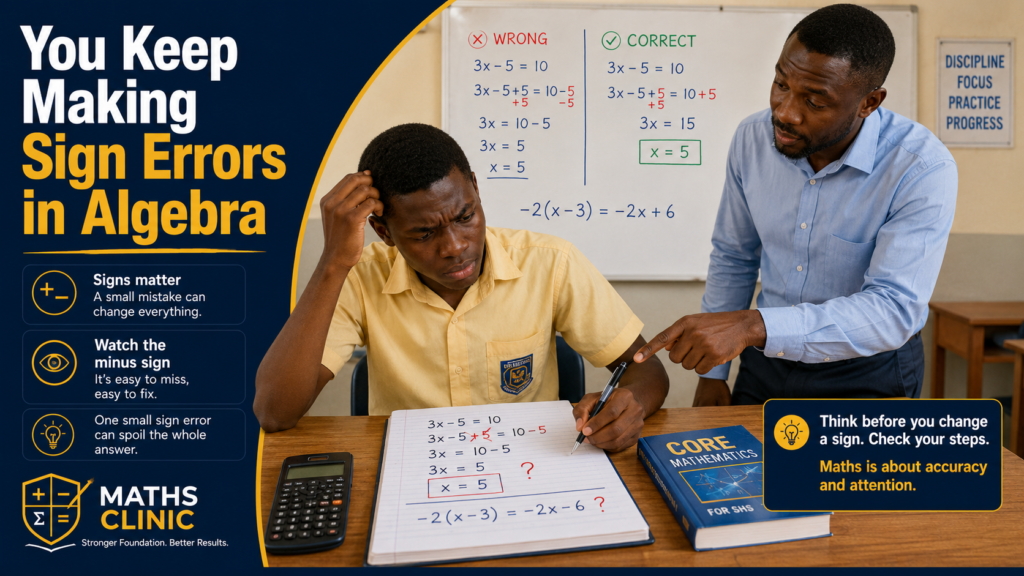
3. You Keep Making Sign Errors in Algebra
A sign error is one of the common symptoms of a weak Core Maths foundation. A learner may know the general method but lose marks because plus and minus signs are handled wrongly.
For example:
3x – 5 = 16
Some learners wrongly write:
3x = 16 – 5
Instead of:
3x = 16 + 5
Why This Symptom Happens
The hidden problem is usually a weak understanding of inverse operations. The learner is not thinking about the equation as a balance. He or she is only trying to “move” numbers. When algebra becomes mechanical, sign errors will keep coming.
How This Helps the Learner Understand Core Maths Better
This symptom shows that the learner does not need to fear the whole of algebra. The exact weakness may be signs, integers, and opposite operations. Once that gap is fixed, many algebra questions become easier.
The learner should always ask:
- What operation is affecting the unknown?
- What opposite operation will remove it?
- Have I kept the equation balanced?
4. You Can Calculate, But You Cannot Understand Word Problems
Some learners can solve direct calculations, but once the question comes as a story, they are lost. They can calculate 20% of 500, but they struggle when the question says a trader gave a discount of 20% on an item. This is a serious symptom before WASSCE because many Core Maths questions are written in words.
Why This Symptom Happens
Word problems require two skills. First, the learner must understand the English.
Second, the learner must translate the English into mathematics.
Many weak learners jump into calculation too early. They see numbers and start pressing the calculator without understanding what the question is asking.
How This Helps the Learner Understand Core Maths Better
This symptom helps the learner know that the problem may not be calculation. It may be an interpretation.
Before solving a word problem, the learner should follow this method:
- Read the question once to understand the story.
- Read it again and underline the key information.
- Write down what the question is asking you to find.
- Identify the topic hiding inside the question.
- Choose the correct method before calculating.
This slows the learner down in a good way and prevents blind guessing.
5. You Cannot Tell Which Topic a Question Belongs To
Another symptom is when a learner reads a question and cannot identify the topic.
The learner may ask:
- Is this percentage?
- Is this ratio?
- Is this simple interest?
- Is this variation?
- Is this statistics?
This is common because WASSCE questions do not always announce the topic directly.
Why This Symptom Happens
The learner may have studied topics separately without learning how to recognize them inside exam questions.
For example:
- “Rate per annum” may point to simple interest.
- “Profit” or “discount” may point to percentages.
- “Mean” or “median” may point to statistics.
- “Gradient” may point to graphs.
- “Directly proportional” may point to variation.
How This Helps the Learner Understand Core Maths Better
This symptom tells the learner to practice topic recognition. Before solving, ask: What topic is hiding inside this question?
Once the topic is identified, the learner can choose the correct tool. A carpenter does not use a saw when he needs a hammer. In the same way, a Maths learner must know which method fits the question.
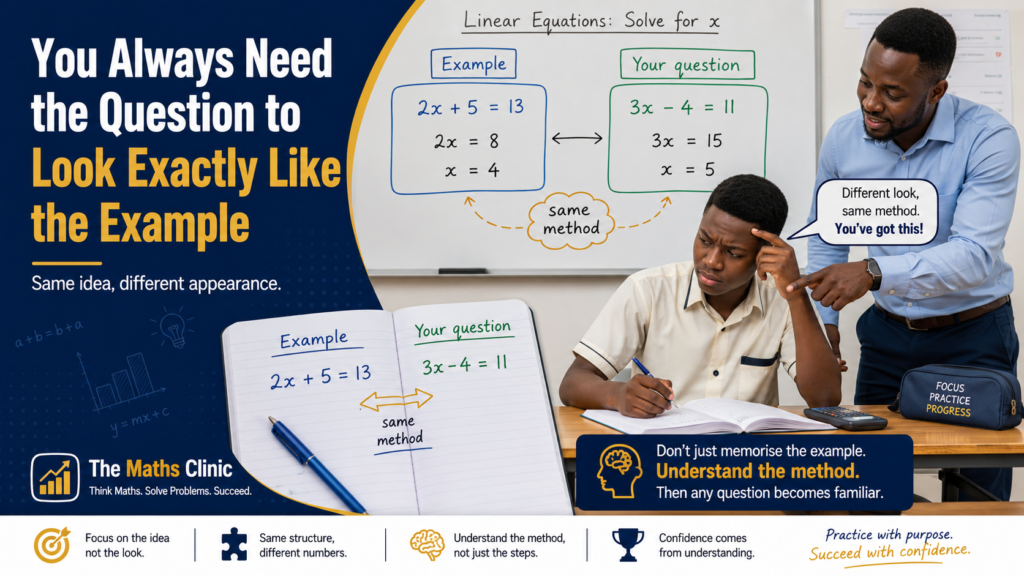
6. You Always Need the Question to Look Exactly Like the Example
Some learners can solve only when the question looks exactly like the teacher’s example. If the wording changes, the diagram changes, or the numbers are arranged differently, the learner becomes confused.
Why This Symptom Happens
This happens when the learner memorizes the pattern of the example but does not understand the main idea. For example, a learner may know how to find the area of a rectangle when it is drawn alone. But if the rectangle is part of a compound shape, the learner cannot see that the same area idea is still needed.
How This Helps the Learner Understand Core Maths Better
This symptom teaches the learner to look for the idea, not only the appearance of the question.
In Core Maths, questions can wear different clothes, but the idea may be the same.
For every topic, ask:
- What is the main idea here?
- What can change in the question?
- What must remain true?
This helps the learner handle WASSCE-style questions better.
7. You Make “Small Mistakes” That Keep Costing Marks
Many weak SHS students call some errors “small mistakes.”
They say:
“I knew it, but I made a small mistake.”
But if the same small mistake keeps happening, it is no longer small. It is a symptom.
Common “small mistakes” include:
- Copying the question wrongly
- Using the wrong sign
- Forgetting units
- Rounding too early
- Pressing the calculator wrongly
- Writing the final answer without checking
Why This Symptom Happens
Some learners do not check their work step by step. Others rush because they are afraid of time. Some are overconfident and do not revise their own work.
How This Helps the Learner Understand Core Maths Better
This symptom helps the learner build exam discipline. Mathematics is not only about knowing the method. It is also about accuracy.
After solving, check:
- Did I copy the question correctly?
- Did I use the correct formula?
- Did I substitute correctly?
- Did I include the correct unit?
- Did I answer what the question asked?
This habit can protect marks in WASSCE.
8. Your Test Scores Do Not Improve Even After Reading More
This is one of the most painful symptoms. The learner reads notes, watches videos, and attends classes, and still the marks remain low. At this point, the learner may begin to feel that Core Maths is not for him or her. But that conclusion may be wrong.
Why This Symptom Happens
Reading more does not always mean learning better. If the learner is reading without diagnosing mistakes, the same weakness remains hidden. For example, a learner may keep revising algebra, but the real weakness is negative numbers. Another learner may keep revising graphs, but the real weakness is scale and coordinates.
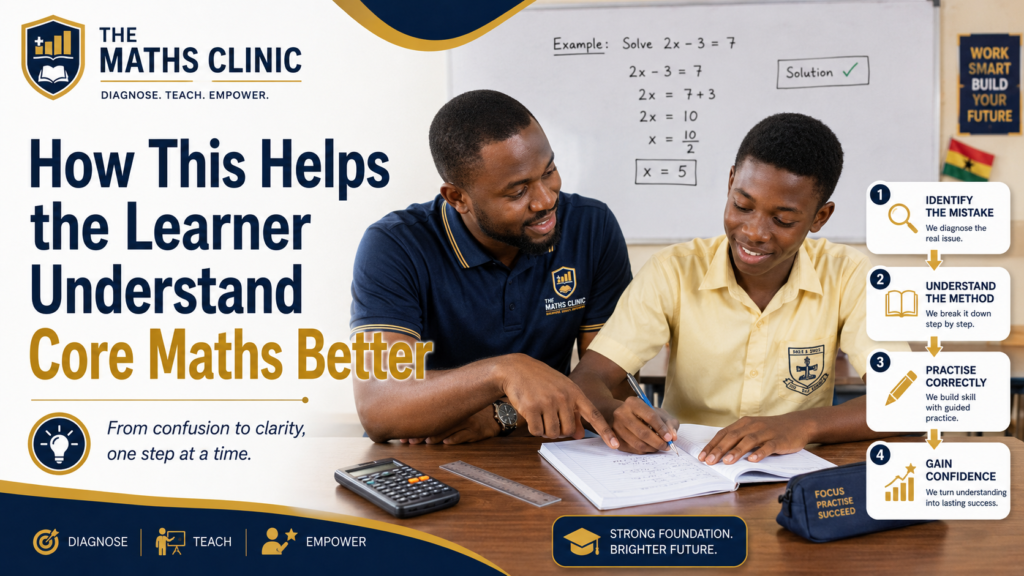
How This Helps the Learner Understand Core Maths Better
This symptom teaches the learner to stop revising blindly. After every test or practice, the learner should write:
- Which topic cost me marks?
- Which mistake was repeated?
- What foundation skill is missing?
- What exact practice must I do next?
This turns every low score into information. The mark may be low, but the lesson from the mistake can be powerful.
Worked Example: How One Symptom Reveals the Real Weakness
Question
Solve: 4x + 6 = 30
Common Wrong Approach
A learner may write:
4x = 30 + 6
4x = 36
x = 9
The learner may say, “I do not understand algebra.”
But let us diagnose it properly.
Where Did the Mistake Happen?
The mistake happened when +6 was moved wrongly. Since 6 is added to 4x, we subtract 6 from both sides.
Correct Method
4x + 6 = 30
4x = 30 – 6
4x = 24
x = 6
What This Reveals
The learner’s real weakness is not the whole of algebra. The hidden gap is the inverse operation and balancing equations. That is why symptoms matter. They show the real place where the foundation is weak.
Common Wrong Approach Among Weak Learners
Many weak learners react to symptoms in the wrong way.
They say:
- “I will read everything again.”
- “I will copy more notes.”
- “I will memorize more examples.”
- “I will avoid the hard topics.”
These approaches may look serious, but they do not always fix the weakness. If a learner does not know the exact gap, revision becomes like pouring water into a basket.
Correct Method: Use the Maths Clinic Symptom Check
Use this simple method after every topic, class test, or practice session.
Step 1: Write the Question You Got Wrong
Do not erase the wrong work too quickly. It shows how you were thinking.
Step 2: Find the Exact Step Where the Error Started
Was it the formula? The sign? The substitution? The reading? The unit?
Step 3: Name the Symptom
For example:
- I do not understand the question.
- I chose the wrong topic.
- I forgot the formula.
- I made a sign error.
- I could not solve without looking at notes.
Step 4: Find the Hidden Gap
The symptom is what you see. The hidden gap is the real cause.
For example:
- Symptom: I cannot solve word problems.
- Hidden gap: I cannot translate words into equations.
- Symptom: I always get algebra wrong.
- Hidden gap: I do not understand inverse operations.
Step 5: Practise the Exact Weak Area
Do not revise everything at once. Fix one gap at a time.
Practice Task: Check Your Own Symptoms
Try these questions. After solving, do not only check the answer. Write the symptom you noticed.
1. Algebra
Solve: 5x – 7 = 28
Symptom check: Did you handle -7 correctly?
2. Percentages
A bag was sold for GHC 240 after a 20% discount. Find the original price.
Symptom check: Did you identify the correct base?
3. Simple Interest
Find the simple interest on GHC 900 at 10% per annum for 6 months.
Symptom check: Did you change the time into years?
4. Graphs
Find the gradient of the line joining (2, 5) and (6, 13).
Symptom check: Did you subtract the coordinates in the correct order?
5. Word Problem
The sum of two numbers is 42. One number is 6 more than the other. Find the two numbers.
Symptom check: Did you translate the words into an equation?
How This Helps a Weak SHS Student Understand Core Maths Better
This post helps a weak SHS student understand Core Maths better because it changes the way the learner sees weakness.
Instead of saying, “I am not good at Maths,” the learner begins to notice symptoms.
A symptom points to a hidden gap. A hidden gap points to a specific correction.
A specific correction leads to better practice. Better practice builds confidence.
That is the path.
Many struggling learners do not need more pressure. They need a clearer diagnosis. When the learner knows exactly what is wrong, the learner can fix it with patience and guided practice.
That is why The Maths Clinic focuses on diagnosis before correction.
Final Advice Before WASSCE
If you noticed some of these symptoms in yourself, do not panic. A symptom is not a sentence. It is a signal. It is telling you where to start. Do not hide from your weak areas. Face them one by one.
Pick one symptom today. Find the hidden gap. Practice the exact skill. Check your progress. Core Maths becomes easier when the learner stops guessing and starts diagnosing.
At The Maths Clinic, we believe that weak does not mean finished. It means the foundation needs attention. And once the foundation is treated well, WASSCE Core Maths becomes less frightening and more understandable.