Struggling with WASSCE Maths? Stop guessing. Let’s fix the gap step by step.

Simple Interest in Mathematics: What P, R, T, I and A Really Mean
You can probably say “I = PRT/100” in your sleep. But when the question hides the principal inside a story, gives the time in months or asks for the amount, the marks still slip away. This lesson makes every letter in the formula mean something real, so you know exactly what goes where.

📚 Part of the Simple Interest Clinic: every lesson on this topic, in one place.
You can probably say “I = \dfrac{PRT}{100}” in your sleep. But when the question hides the principal inside a story, gives the time in months or asks for the amount, the marks still slip away. This lesson makes every letter in the formula mean something real, so you know exactly what goes where.
📘 This lesson is part of the Simple Interest Clinic
Work through the parts in order. Each one fixes a different gap. See the whole series
Many learners can say:
I = \dfrac{PRT}{100}However, they still make mistakes when a question:
- Hides the principal inside a money story
- Gives the time in months
- Asks for the amount instead of the interest
- Gives the amount and asks for the rate
- Uses words such as “invested,” “borrowed” or “amount due”
- Requires the formula to be rearranged
The problem is not always failure to remember the formula. The deeper problem is failure to understand what each letter represents and how the quantities are connected.
This simple-interest lesson identifies the formula-meaning and unit gap and repairs it step by step. It helps the learner move from copying numbers into a formula to explaining the money relationship, selecting the correct method and checking the answer under WASSCE conditions.
Maths Clinic Diagnosis: Knowing the Formula Is Not Enough
The hidden gap is:
The learner remembers the simple-interest formula but cannot reliably identify the role of each value or match the time unit to the rate period.
This gap may appear in several ways:
- Amount is used as principal.
- Interest is confused with amount.
- Nine months is treated as nine years.
- A yearly rate is combined with time measured in months.
- The percentage rate is handled incorrectly.
- The learner finds interest but stops when amount is required.
- The learner rearranges the formula incorrectly.
- An answer is written without a money, percentage or time unit.
- The final value is accepted without checking whether it makes sense.
The learner therefore needs more than a formula. The learner needs a clear map of the money story.
Simple Interest in Mathematics: The Learner’s Exact Problem
Simple-interest questions often look short. This causes some learners to rush.
They see:
- A money value
- A percentage
- A period of time
They immediately write I = \dfrac{PRT}{100} and insert the numbers in the order in which they appear.
This is dangerous because the formula does not understand the story for the learner. The learner must first decide:
- What money was present at the beginning?
- What extra money was earned or charged?
- What is the final total?
- What rate period has been stated?
- Does the time use the same unit as the rate?
- What exactly must be found?
A calculation that begins before these questions are answered may be neat but wrong.
What Simple Interest Means
Simple interest is interest calculated on the original principal throughout the stated period.
The principal does not change as the base of the interest calculation.
Suppose GH₵1,000 is invested at 10% simple interest per annum.
Interest for one year:
I = 10\%\ \text{of GH₵}1{,}000I = \text{GH₵}100Because the original GH₵1,000 remains the base:
| Time | Interest for the year | Total interest |
|---|---|---|
| End of Year 1 | GH₵100 | GH₵100 |
| End of Year 2 | GH₵100 | GH₵200 |
| End of Year 3 | GH₵100 | GH₵300 |
After three years:
\text{Amount} = \text{Principal} + \text{Interest}\text{Amount} = \text{GH₵}1{,}000 + \text{GH₵}300\text{Amount} = \text{GH₵}1{,}300The yearly interest remains GH₵100 because simple interest is calculated on the original GH₵1,000.
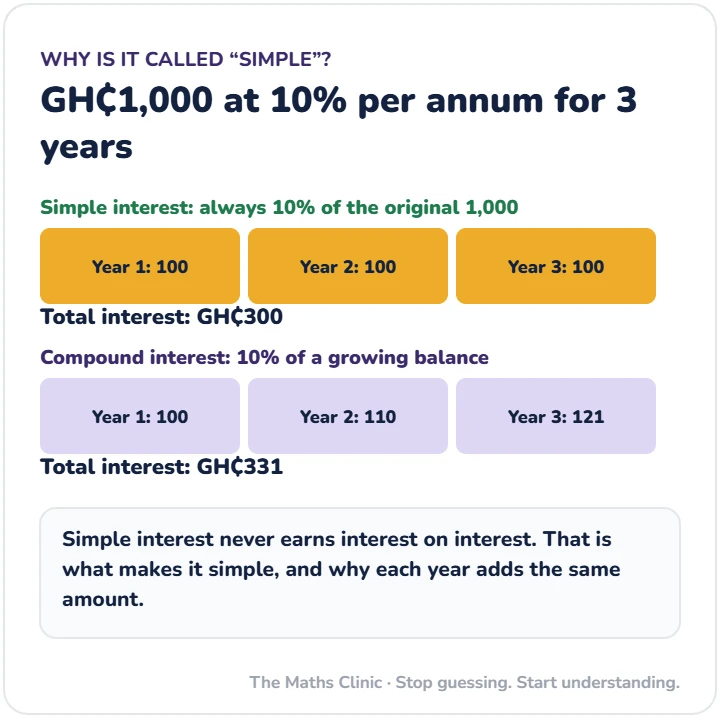
Simple interest is not compound interest
Under compound interest, interest may be added to the balance before the next period’s interest is calculated.
This lesson deals only with simple interest. Do not use a simple-interest method when the question clearly states compound interest.
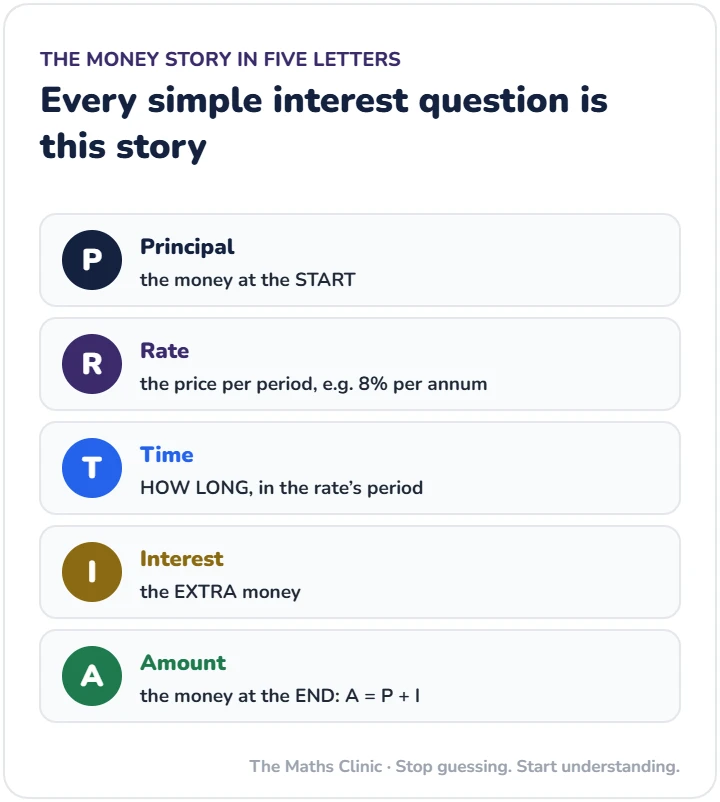
The Five Quantities Learners Must Identify
Principal, P
Principal is the original or starting money.
It may be money:
- Invested
- Saved
- Deposited
- Lent
- Borrowed
- Used as business capital
Examples:
- “Ama invests GH₵800” means P = \text{GH₵}800.
- “A loan of GH₵2,000” means P = \text{GH₵}2{,}000.
- “Kojo deposits GH₵1,500” means P = \text{GH₵}1{,}500.
Principal does not mean the final amount.
Rate, R
Rate is the percentage of the principal used to calculate interest for a stated period.
Examples:
- 12% per annum means 12% each year.
- 3% per month means 3% each month.
- 5% per quarter means 5% every three months.
Never separate the rate from its period.
The expression “12% per annum” contains two pieces of information:
- \text{Rate} = 12\%
- \text{Rate period} = \text{one year}
Time, T
Time tells us how long the money was invested, saved or borrowed.
The time unit must match the period attached to the rate.
- Rate per annum → use time in years.
- Rate per month → use time in months.
- Rate per quarter → use time in quarters.
If the rate is per annum:
- 3\ \text{months} = \dfrac{3}{12}\ \text{year} = \dfrac{1}{4}\ \text{year}
- 6\ \text{months} = \dfrac{6}{12}\ \text{year} = \dfrac{1}{2}\ \text{year}
- 8\ \text{months} = \dfrac{8}{12}\ \text{year} = \dfrac{2}{3}\ \text{year}
- 9\ \text{months} = \dfrac{9}{12}\ \text{year} = \dfrac{3}{4}\ \text{year}
- 15\ \text{months} = \dfrac{15}{12}\ \text{years} = 1.25\ \text{years}
- 18\ \text{months} = \dfrac{18}{12}\ \text{years} = 1.5\ \text{years}
Do not convert months to years automatically. Convert only when the rate period requires years.
Interest, I
Interest is the extra money earned on an investment or charged on a loan.
Interest is not the starting money, and it is not the complete final total.
If GH₵2,000 earns GH₵400:
- \text{Principal} = \text{GH₵}2{,}000
- \text{Interest} = \text{GH₵}400
- \text{Amount} = \text{GH₵}2{,}400
Amount, A
Amount is the principal plus the interest.
A = P + I
Amount may also be described as:
- Final amount
- Accumulated amount
- Total due
- Total repayment
- Principal plus interest
In school simple-interest questions, these expressions point to amount when no other fees or payments are stated.
In real financial arrangements, a total repayment may include fees, insurance or other charges. Use A = P + I only when the question gives a simple-interest arrangement without additional costs.
The Simple-Interest Formula
When the rate is written as a percentage number:
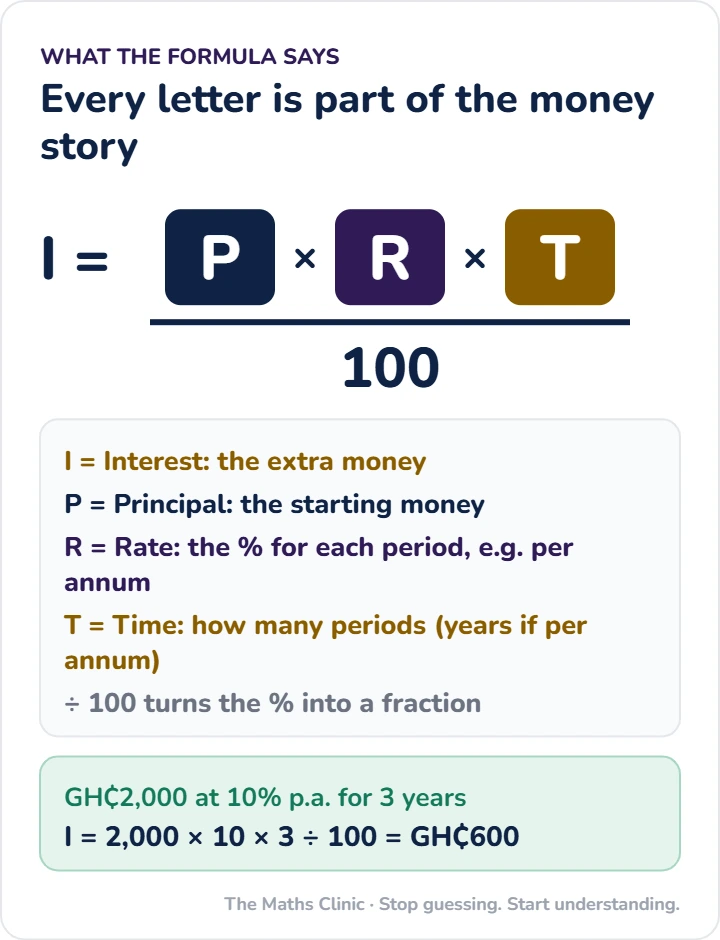
I = \dfrac{PRT}{100}Where:
- I = \text{Simple interest}
- P = \text{Principal}
- R = \text{Percentage rate for the stated period}
- T = \text{Number of matching rate periods}
For example, if R = 8%, substitute R = 8 and divide by 100.
The decimal-rate form
A rate of 8% may be written as:
8\% = 0.08
When the rate is written as a decimal, use:
I = PrT
where r is the decimal rate.
These are equivalent:
I = \dfrac{P \times 8 \times T}{100}and
I = P \times 0.08 \times T
Do not use 0.08 and divide by 100 again. That would divide the rate twice.
The Central Money Relationship
Interest and amount are connected by:
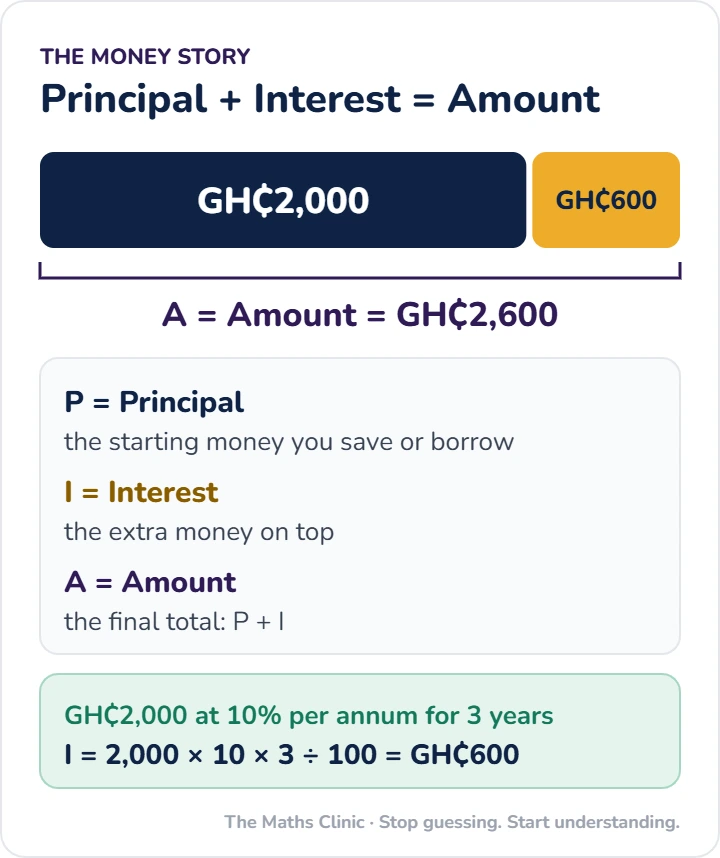
A = P + I
From this relationship:
To find amount
A = P + I
To find interest from amount
I = A - P
To find principal from amount and interest
P = A - I
These relationships must be kept separate from the formula I = \dfrac{PRT}{100}.
The simple-interest formula finds interest. The relationship A = P + I connects the starting money, extra money and final money.
Rearranging the Formula
Start with:
I = \dfrac{PRT}{100}Rearrange only after identifying the required quantity.
To find principal
P = \dfrac{100I}{RT}To find rate
R = \dfrac{100I}{PT}To find time
T = \dfrac{100I}{PR}Use brackets carefully when substituting into the denominator.
For example:
R = \dfrac{100 \times I}{P \times T}not:
R = 100 \times \dfrac{I}{P} \times TThe second expression may multiply by T instead of dividing by it.
Ten Fixes for Simple Interest in Mathematics
Fix 1: Identify the starting money
Ask:
What money was present before any interest was added?
That value is the principal.
Do not use the amount as principal unless the question clearly says the amount was the original sum invested or borrowed.
Fix 2: Separate original, extra and final money
Use this money map:
| Money role | Mathematical name | Symbol |
|---|---|---|
| Starting money | Principal | P |
| Extra money | Interest | I |
| Final money | Amount | A |
Remember:
A = P + I
Fix 3: Keep the rate with its period
Do not record only “12%.”
Write:
R = 12\%\ \text{per annum}This reminds you that the time must be measured in years.
Fix 4: Match the time unit to the rate
If the rate is per annum and time is given in months:
T = \dfrac{\text{Number of months}}{12}If the rate is per month, time may remain in months.
The rule is not simply “always change months to years.” The real rule is:
Make the time unit match the rate period.
Fix 5: Identify the target before calculating
Write the required quantity:
- Interest required → I = ?
- Amount required → A = ?
- Principal required → P = ?
- Rate required → R = ?
- Time required → T = ?
This stops the learner from calculating one quantity and presenting it as another.
Fix 6: Know what the formula produces
The formula:
I = \dfrac{PRT}{100}produces interest.
If the question asks for amount, another step is required:
A = P + I
Fix 7: Use an organisation table
Before substituting, complete a table such as this:
| Quantity | Value | Meaning |
|---|---|---|
| P | GH₵2,500 | Starting money |
| R | 7% per annum | Yearly percentage rate |
| T | 4 years | Matching time |
| I | ? | Extra money |
| A | ? | Final money |
A blank value usually shows what must be calculated.
Fix 8: Rearrange after labelling the values
Do not rearrange the formula while still trying to understand the story.
First write the known values. Then identify the unknown. After that, select or rearrange the correct relationship.
Fix 9: Attach the correct unit
- Principal, interest and amount require a money unit such as GH₵.
- Rate requires the percentage symbol and, where necessary, a period such as “per annum.”
- Time requires a unit such as years or months.
Writing only “5” is incomplete if the answer is 5% per annum.
Fix 10: Check the answer against the story
Ask:
- Should my answer be money, a percentage or time?
- If positive interest was earned, is the amount greater than the principal?
- Have I treated months as years?
- Did I answer interest or amount?
- Is the result too large or too small?
- Did I use the percentage form consistently?
A quick estimate can expose a major error.
A Reliable WASSCE Routine
Use the following routine for every simple-interest question.
Step 1: Read the full question
Do not calculate during the first reading.
Step 2: Underline the demand
Identify exactly what must be found.
Step 3: Label the values
Write P, R, T, I and A where appropriate.
Step 4: Match the units
Check the period attached to the rate and convert time if necessary.
Step 5: Select the relationship
Use:
I = \dfrac{PRT}{100}or:
A = P + I
or the correctly rearranged formula.
Step 6: Substitute carefully
Use brackets where needed and avoid mixing the percentage and decimal forms.
Step 7: Calculate
Show enough working for the method to be followed.
Step 8: Return to the demand
Check whether another step is required.
Step 9: State and label the answer
For example:
\text{Interest} = \text{GH₵}700or:
\text{Rate} = 5\%\ \text{per annum}Step 10: Check reasonableness
Make sure the size, meaning and unit of the answer fit the money story.
Worked Example 1: Find Interest
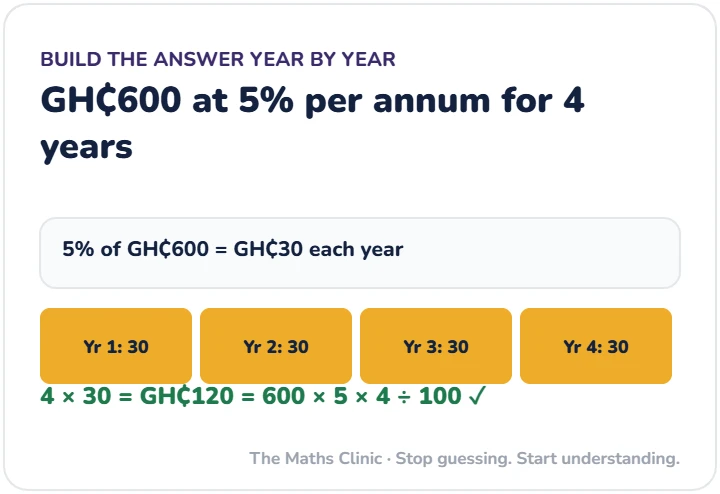
Find the simple interest on GH₵600 at 5% per annum for four years.
Organise the information
P = \text{GH₵}600
R = 5% per annum
T = 4\ \text{years}
I = ?
Apply the formula
I = \dfrac{PRT}{100}I = \dfrac{600 \times 5 \times 4}{100}I = 120
\text{Answer}: \text{Interest} = \text{GH₵}120.Reasonableness check
Five per cent of GH₵600 is GH₵30 per year.
For four years:
\text{GH₵}30 \times 4 = \text{GH₵}120The answer is reasonable.
Worked Example 2: Find Amount
Find the amount on GH₵2,500 invested at 7% simple interest per annum for four years.
Organise the information
| Quantity | Value | Meaning |
|---|---|---|
| P | GH₵2,500 | Starting money |
| R | 7% per annum | Yearly rate |
| T | 4 years | Investment period |
| I | ? | Extra money |
| A | ? | Final money |
Find the interest
I = \dfrac{PRT}{100}I = \dfrac{2{,}500 \times 7 \times 4}{100}I = \text{GH₵}700Find the amount
A = P + I
A = \text{GH₵}2{,}500 + \text{GH₵}700A = \text{GH₵}3{,}200\text{Answer}: \text{Amount} = \text{GH₵}3{,}200.Common trap
Writing GH₵700 as the amount is incorrect. GH₵700 is the interest only.
Worked Example 3: Convert Months to Years
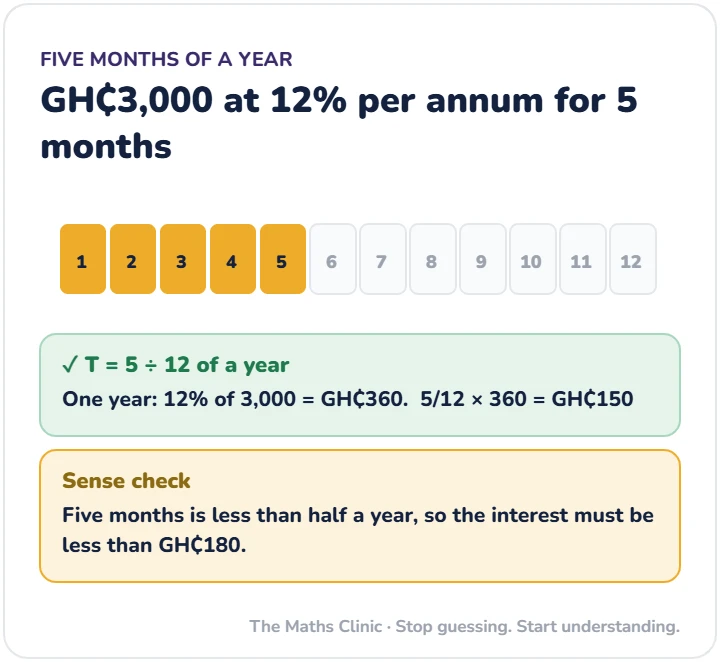
Find the interest on GH₵3,000 at 12% simple interest per annum for five months.
\begin{gathered}P = \text{GH₵}3{,}000 \\ R = 12\%\ \text{per annum} \\ T = \dfrac{5}{12}\ \text{year}\end{gathered}I = \dfrac{PRT}{100}I = \dfrac{3{,}000 \times 12 \times \dfrac{5}{12}}{100}I = \text{GH₵}150\text{Answer}: \text{Interest} = \text{GH₵}150.Quick check
Twelve per cent of GH₵3,000 for one full year is GH₵360.
Five months is less than half a year, so the interest should be less than GH₵180.
GH₵150 is reasonable.
Worked Example 4: Find Principal
A sum earns GH₵960 simple interest at 8% per annum for four years. Find the principal.
I = \text{GH₵}960
R = 8% per annum
T = 4\ \text{years}
P = ?
Start with:
I = \dfrac{PRT}{100}Make P the subject:
P = \dfrac{100I}{RT}Substitute:
P = \dfrac{100 \times 960}{8 \times 4}P = 96,\dfrac{000}{32}P = \text{GH₵}3{,}000\text{Answer}: \text{Principal} = \text{GH₵}3{,}000.Check
I = \dfrac{3{,}000 \times 8 \times 4}{100}I = \text{GH₵}960The principal is correct.
Worked Example 5: Find Rate from Principal and Amount
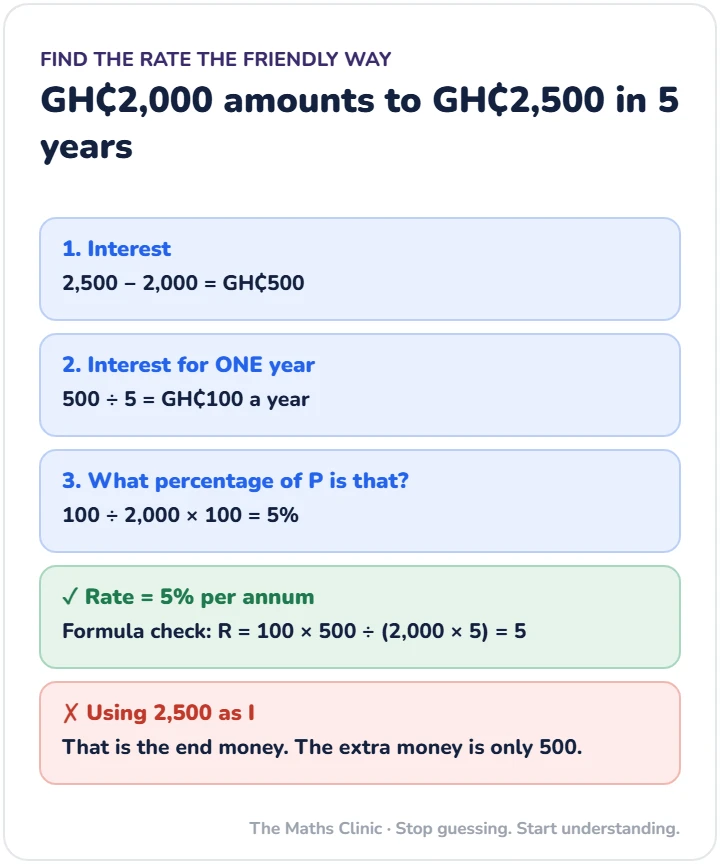
A loan of GH₵2,000 amounts to GH₵2,500 after five years under simple interest. Find the rate per annum.
The formula requires interest, but the question gives principal and amount.
First find the interest:
I = A - P
I = \text{GH₵}2{,}500 - \text{GH₵}2{,}000I = \text{GH₵}500Now identify the values:
P = \text{GH₵}2{,}000
I = \text{GH₵}500
T = 5\ \text{years}
R = ?
Use:
R = \dfrac{100I}{PT}R = \dfrac{100 \times 500}{2{,}000 \times 5}R = 50,\dfrac{000}{10},000R = 5
\text{Answer}: \text{Rate} = 5\%\ \text{per annum}.Hidden trap
GH₵2,500 is the amount, not the interest. Using it as I would produce an incorrect rate.
Worked Example 6: Find Time
GH₵1,200 earns GH₵270 simple interest at 7.5% per annum. Find the time.
P = \text{GH₵}1{,}200
I = \text{GH₵}270
R = 7.5% per annum
T = ?
T = \dfrac{100I}{PR}T = \dfrac{100 \times 270}{1{,}200 \times 7.5}T = 27,\dfrac{000}{9},000T = 3\ \text{years}\text{Answer}: \text{Time} = 3\ \text{years}.Worked Example 7: Rate Given Per Month
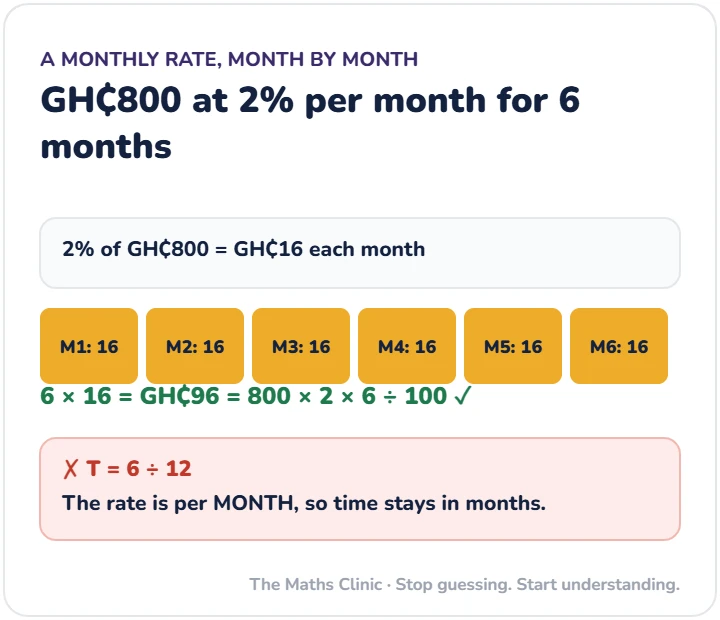
GH₵800 is borrowed at 2% simple interest per month for six months. Find the interest.
\begin{gathered}P = \text{GH₵}800 \\ R = 2\%\ \text{per month} \\ T = 6\ \text{months}\end{gathered}The time already matches the rate period. Do not convert six months to half a year.
I = \dfrac{PRT}{100}I = \dfrac{800 \times 2 \times 6}{100}I = \text{GH₵}96\text{Answer}: \text{Interest} = \text{GH₵}96.Important lesson
Time conversion depends on the period attached to the rate.
Common Wrong Approaches and Their Hidden Gaps
Wrong Approach 1: Using amount as principal
A loan of GH₵2,000 amounts to GH₵2,500.
Wrong identification:
P = \text{GH₵}2{,}500Correct identification:
\begin{gathered}P = \text{GH₵}2{,}000 \\ A = \text{GH₵}2{,}500 \\ I = \text{GH₵}500\end{gathered}Hidden gap: Starting money and final money have been confused.
Wrong Approach 2: Treating months as years
For five months, the learner writes T = 5 when the rate is per annum.
This calculates five years of interest.
Correct:
T = \dfrac{5}{12}\ \text{year}Hidden gap: Time does not match the rate period.
Wrong Approach 3: Stopping at interest when amount is required
The learner correctly finds:
I = \text{GH₵}700but presents GH₵700 as the amount.
Correct:
A = \text{GH₵}2{,}500 + \text{GH₵}700A = \text{GH₵}3{,}200Hidden gap: The learner did not return to the demand.
Wrong Approach 4: Adding principal when interest alone is required
If the question asks for interest and the learner finds GH₵120, adding the principal answers a different question.
Hidden gap: An unnecessary final step was added.
Wrong Approach 5: Mixing percentage and decimal forms
Wrong:
I = \dfrac{P \times 0.07 \times T}{100}The decimal 0.07 already means \frac{7}{100}.
Use either:
I = \dfrac{P \times 7 \times T}{100}or:
I = P \times 0.07 \times T
Hidden gap: The percentage was divided by 100 twice.
Wrong Approach 6: Forgetting the division by 100
Wrong:
I = P \times 7 \times T
\text{when} R = 7.Correct:
I = \dfrac{P \times 7 \times T}{100}Hidden gap: The percentage number was treated as an ordinary multiplier.
Wrong Approach 7: Rearranging incorrectly
Wrong:
P = \dfrac{IRT}{100}Correct:
P = \dfrac{100I}{RT}Hidden gap: The learner changed the subject without preserving equality.
Wrong Approach 8: Using amount as interest
If P = \text{GH₵}2{,}000 and A = \text{GH₵}2{,}500:
Wrong:
I = \text{GH₵}2{,}500Correct:
I = A - P = \text{GH₵}500Hidden gap: Final money was confused with extra money.
Wrong Approach 9: Writing an unlabelled answer
Writing only “700” does not show what the value represents.
Write:
\text{Interest} = \text{GH₵}700Hidden gap: Meaning and unit were not attached to the calculation.
Wrong Approach 10: Applying simple interest to every financial product
Not every loan, savings account or investment uses simple interest. Some real products use compound interest, reducing balances, fees or changing rates.
In an examination question, use simple interest when it is stated or clearly established by the question.
WASSCE-Style Trap Box
Before submitting your solution, complete these statements:
- The starting money is __________.
- The extra money is __________.
- The final money is __________.
- The rate is __________ per __________.
- The matching time is __________.
- The question requires __________.
- The formula or relationship I need is __________.
- My final answer represents __________.
If you cannot complete the first six statements, do not substitute yet.
Simple Interest in Mathematics Diagnostic Practice
Attempt all questions before checking the answers.
Questions
- Find the interest on GH₵600 at 5% simple interest per annum for four years.
- Find the amount on GH₵1,250 at 8% simple interest per annum for three years.
- Find the interest on GH₵3,000 at 12% simple interest per annum for five months.
- A sum earns GH₵960 simple interest at 8% per annum for four years. Find the principal.
- A loan of GH₵2,000 amounts to GH₵2,500 after five years under simple interest. Find the rate per annum.
- GH₵900 is invested at 10% simple interest per annum for nine months. Find the interest and amount.
- A principal of GH₵1,600 earns GH₵288 simple interest in three years. Find the rate per annum.
- GH₵750 earns GH₵150 simple interest at 8% per annum. Find the time.
- A final amount of GH₵4,600 includes GH₵600 simple interest. Find the principal.
- GH₵2,400 is borrowed at 1.5% simple interest per month for eight months. Find the interest and total repayment.
- A learner invests GH₵5,000 at 6% simple interest per annum. The investment earns GH₵450. Find the time in years and months.
- Akosua says that GH₵2,000 at 10% simple interest per annum for six months earns GH₵1,000 interest. Identify her mistake and find the correct interest.
Answers and Gap Diagnosis
1. Interest = GH₵120
I = \dfrac{600 \times 5 \times 4}{100}I = \text{GH₵}120If you wrote GH₵720: You added the principal when interest only was required.
2. Amount = GH₵1,550
First find interest:
I = \dfrac{1{,}250 \times 8 \times 3}{100}I = \text{GH₵}300Then:
A = P + I
A = \text{GH₵}1{,}250 + \text{GH₵}300A = \text{GH₵}1{,}550If you wrote GH₵300: You stopped at interest.
3. Interest = GH₵150
T = \dfrac{5}{12}\ \text{year}I = \dfrac{3{,}000 \times 12 \times \dfrac{5}{12}}{100}I = \text{GH₵}150If you used T = 5: You treated five months as five years.
4. Principal = GH₵3,000
P = \dfrac{100I}{RT}P = \dfrac{100 \times 960}{8 \times 4}P = \text{GH₵}3{,}000If you multiplied 960 by 8 and 4: You did not make P the subject correctly.
5. Rate = 5% per annum
First:
I = A - P
I = \text{GH₵}2{,}500 - \text{GH₵}2{,}000I = \text{GH₵}500Then:
R = \dfrac{100I}{PT}R = \dfrac{100 \times 500}{2{,}000 \times 5}R = 5\%\ \text{per annum}If you used GH₵2,500 as I: You confused amount with interest.
6. Interest = GH₵67.50; amount = GH₵967.50
T = \dfrac{9}{12}\ \text{year} = \dfrac{3}{4}\ \text{year}I = \dfrac{900 \times 10 \times \dfrac{3}{4}}{100}I = \text{GH₵}67.50A = \text{GH₵}900 + \text{GH₵}67.50A = \text{GH₵}967.50This question tests both time conversion and the difference between interest and amount.
7. Rate = 6% per annum
R = \dfrac{100I}{PT}R = \dfrac{100 \times 288}{1{,}600 \times 3}R = 28,\dfrac{800}{4},800R = 6\%\ \text{per annum}8. Time = 2.5 years
T = \dfrac{100I}{PR}T = \dfrac{100 \times 150}{750 \times 8}T = 15,\dfrac{000}{6},000T = 2.5\ \text{years}Since 0.5 year equals six months:
\text{Time} = 2\ \text{years}\ 6\ \text{months}.9. Principal = GH₵4,000
P = A - I
P = \text{GH₵}4{,}600 - \text{GH₵}600P = \text{GH₵}4{,}000There is no need to use PRT/100 because the amount and interest are already known.
10. Interest = GH₵288; total repayment = GH₵2,688
The rate is per month, so use T = 8\ \text{months}.
I = \dfrac{2{,}400 \times 1.5 \times 8}{100}I = \text{GH₵}288A = \text{GH₵}2{,}400 + \text{GH₵}288A = \text{GH₵}2{,}688If you converted eight months to years: You failed to notice that the rate was monthly.
11. Time = 1.5 years or 1 year 6 months
T = \dfrac{100I}{PR}T = \dfrac{100 \times 450}{5{,}000 \times 6}T = 45,\dfrac{000}{30},000T = 1.5\ \text{years}\text{Answer}: \text{Time} = 1\ \text{year}\ 6\ \text{months}.12. Correct interest = GH₵100
Akosua used six months as six years.
Correct time:
T = \dfrac{6}{12}\ \text{year} = \dfrac{1}{2}\ \text{year}I = \dfrac{2{,}000 \times 10 \times \dfrac{1}{2}}{100}I = \text{GH₵}100Hidden gap: The time unit did not match the annual rate.
Use Each Wrong Answer to Locate the Gap
Do not record only the number of correct answers. Record the type of error.
| Error pattern | Likely learner gap | Repair action |
|---|---|---|
| Used final money as P | Money-role gap | Rebuild principal, interest and amount |
| Used months as years | Time-unit gap | Match time to the rate period |
| Stopped at interest | Question-target gap | Return to the demand after calculating |
| Added principal unnecessarily | Final-step gap | Stop when interest alone is required |
| Used amount as I | Interpretation gap | \text{Calculate} I = A – P |
| Lost the division by 100 | Percentage-form gap | Compare percentage and decimal forms |
| Rearranged incorrectly | Algebra gap | Make one variable the subject carefully |
| Omitted GH₵ or % | Unit-control gap | Label every final answer |
| Accepted an extreme answer | Reasonableness gap | Estimate before submitting |
Score Guide
| Score | What it suggests | Next action |
|---|---|---|
| 10–12 correct | Formula meaning and unit control are becoming secure | Attempt unfamiliar mixed questions |
| 7–9 correct | One or two traps remain | Correct the specific error types and retest |
| 4–6 correct | Several quantities are still being confused | Return to the P–R–T–I–A organisation table |
| 0–3 correct | Substitution is beginning before meaning is established | Rebuild the money story before using formulas |
A high score with unclear working is not full mastery. The learner should be able to explain why every value was selected.
Correction and Retest Record
After marking the practice, complete this table for every wrong answer:
| Question | My wrong answer | Where the mistake began | Correct idea | Retest result |
|---|---|---|---|---|
| Reading / quantity / rate / time / formula / target / unit |
Use this correction cycle:
- Identify the first wrong decision.
- Name the hidden gap.
- Correct that one skill.
- Cover the worked answer.
- Solve the question again.
- Attempt a similar question.
- Record whether the gap has been repaired.
Copying the correction without attempting a retest does not show that the skill has been repaired.
Depth of Knowledge Progression
| Depth of Knowledge | Main demand | Questions |
|---|---|---|
| DoK 1 | Recall meanings and calculate directly | 1 |
| DoK 2 | Connect quantities, convert units and rearrange relationships | 2–10 |
| DoK 3 | Diagnose reasoning, explain an error and present an equivalent time | 11–12 |
The depth comes from the thinking required, not simply the size of the numbers.
Learner Reflection
Tick each statement only when you can complete it without copying.
- I can explain simple interest in my own words.
- I can identify the principal as the starting money.
- I can identify interest as the extra money.
- I can identify amount as principal plus interest.
- I keep the rate together with its period.
- I can match time to an annual or monthly rate.
- I \text{know that} I = \dfrac{PRT}{100}\ \text{produces interest}.
- I can find amount after calculating interest.
- I can calculate interest when amount and principal are given.
- I can rearrange the formula to find P, R or T.
- I can use either the percentage form or decimal form correctly.
- I can attach the correct unit to my answer.
- I can estimate whether my answer is reasonable.
- I return to the demand before writing my final answer.
How This Lesson Helps Before WASSCE
This lesson trains the learner to:
- Translate a money story into mathematical quantities
- Separate principal, interest and amount
- Connect rates to their stated periods
- Convert time only when necessary
- Choose between percentage and decimal rate forms
- Rearrange the formula accurately
- Complete amount questions fully
- Work backwards from a given amount
- Show clear, labelled working
- Use the correct unit
- Diagnose the source of a wrong answer
- Check whether a result makes sense
Official WAEC Ghana Chief Examiner’s Reports can also be consulted when studying reported examination performance and weaknesses.
Continue the Intervention
If the learner still struggles to translate full money stories, study Part 5 of the Simple Interest Clinic, on word problems.
If percentage meaning remains weak, visit the Maths Intervention Hub and repair the percentage foundation before attempting more formula work.
When the five quantities are clear, attempt targeted questions in the WASSCE Maths Practice Zone.
For other examination mistakes, explore WAEC Maths Traps.
Conclusion: Understand Simple Interest Before Substituting
Simple Interest in Mathematics becomes easier when the learner understands the money relationship before calculating.
Remember:
- P is the starting money.
- I is the extra money.
- A is the final money.
- R is the percentage rate for a stated period.
- T is the number of matching periods.
Use:
I = \dfrac{PRT}{100}to find interest when R is written as a percentage number.
Use:
A = P + I
to find the final amount.
Before substituting, ask:
- What is the starting money?
- What is the extra money?
- What is the final money?
- What period belongs to the rate?
- Does my time use the same unit?
- What exactly am I required to find?
Once these questions are answered, the formula becomes a useful tool instead of a memory trap.
Stop Guessing. Start Understanding.
Practice Zone CTA
Do not guess your way through Mathematics.
Visit the WASSCE Maths Practice Zone and attempt more simple-interest questions with purpose.
For every wrong answer, identify whether the mistake came from:
- Principal identification
- Interest–amount confusion
- Rate interpretation
- Time conversion
- Percentage form
- Formula rearrangement
- Demand-word reading
- Final-answer units
- Reasonableness checking
Correct that exact gap and then attempt a fresh question.
✏️ Try it yourself
Kofi saves GH₵1,500 at 8% per annum. Find the interest after 2 years, and the amount he will have.
Tap to see the answer
I = 1{,}500 \times 8 \times 2 \div 100 = GH₵240. Amount = 1{,}500 + 240 = GH₵1,740.

Written by
Dickson Sarpong
NTC-certified SHS Mathematics teacher in Ghana with WAEC marking experience, and author of The Bridge Series textbooks. Every lesson here is built around the mistakes WAEC examiners keep reporting.
About DicksonStuck? Ask a question
Want the whole topic, step by step? My textbooks, The Bridge to Mathematics and The Bridge to Additional Mathematics for SHS, follow the new curriculum and rebuild the basics as you go.
Read a free chapter →