Struggling with WASSCE Maths? Stop guessing. Let’s fix the gap step by step.

Formula Errors in Area and Volume: 10 Powerful WASSCE Fixes

Formula Errors in Area and Volume is meant for a struggling Ghanaian SHS learner who remembers several mensuration formulas but misidentifies the dimensions, radius, height, or required unit.
This mensuration formulas clinic diagnoses the dimension-and-formula gap, corrects it visibly, and prepares the learner for WASSCE and other WAEC-organized examinations.
A learner may be very close to the correct answer. However, one wrong formula, one missing height, one confused radius, or one incorrect unit can spoil the whole solution.
The main lesson is:
Do not begin with the formula. Begin with the meaning of the measurement.
Maths Clinic Learner-Gap Focus
This post addresses a dimension-and-formula gap.
The learner may remember formulas but cannot reliably answer these questions:
- Is the figure flat or solid?
- Is the question asking for length, area, surface area, or volume?
- Is the given measurement a radius or diameter?
- Which height is perpendicular?
- Should slant height or vertical height be used?
- Are all dimensions in the same unit?
- Should the answer be in ordinary, square, or cubic units?
The lesson helps the learner move from formula guessing to a clear routine:
Shape → Measurement → Dimensions → Formula → Unit → Check
Current Curriculum Connection
The learner should be able to:
- Observe, identify, or sketch a figure
- Identify the measurement required
- Label the important dimensions
- Explain why a chosen formula is suitable
- Solve practical mensuration problems
- Check units and the reasonableness of an answer
- Communicate the method clearly
Where appropriate, the learner may use a ruler, a grid, a cardboard model, or a dynamic geometry tool to test the idea before completing the formal calculation.
For official curriculum materials, teachers may consult the NaCCA secondary education curriculum portal.
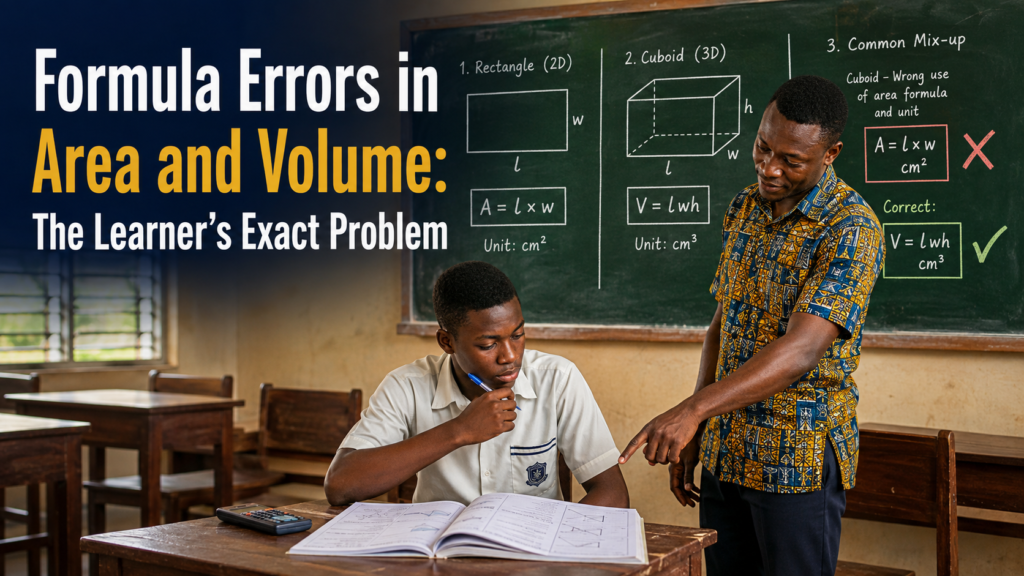
Formula Errors in Area and Volume: The Learner’s Exact Problem
The learner sees a familiar shape and immediately writes the first formula that comes to mind.
For example, the learner may:
- See a circle and write πr² when circumference is required
- Use diameter as radius
- Use a sloping side as the height of a triangle
- Use slant height in the volume of a cone
- Use πr² for the complete volume of a cylinder
- Use 2πrh when the question asks for volume
- Forget the factor ½ in the area of a triangle
- Forget the factor ⅓ in the volume of a cone
- Mix centimeters and meters in one calculation
- Give an area answer in cm³
- Give a volume answer in cm²
The working may look serious and organized. However, if the first formula does not match the measurement requested, every later step is built on the wrong foundation.
The hidden gap is
The learner remembers the appearance of a formula but has not attached the formula to a shape, measurement, and set of dimensions.
If this pattern appears in several topics, study 9 Powerful Clues That Show Where Your Maths Problem Started and identify the first step that breaks down.
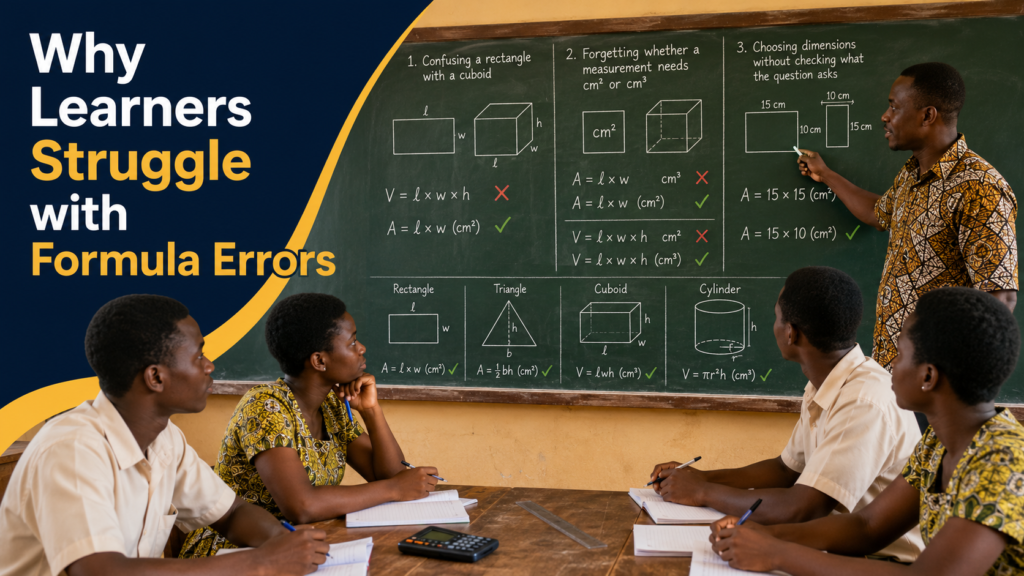
Why Learners Struggle with Formula Errors
1. Formulas are memorized without meaning.
A learner may recite:
A = ½bh
but may not know that:
- b is the chosen base
- h is the perpendicular height to that base
- The base and height must meet at 90°
When meaning is missing, any convenient-looking side may be used as the height.
2. Similar formulas are confused.
Several formulas contain π, r, and h. This makes blind memorization dangerous.
For example:
- πr² is the area of a circle
- 2πr is the circumference of a circle
- πr²h is the volume of a cylinder
- 2πrh is the curved surface area of a cylinder
- ⅓πr²h is the volume of a cone
A learner must know what each formula measures.
3. Dimensions are copied without labels.
If a question gives a diameter of 14 cm, the learner may write r = 14 cm.
The number was copied correctly, but its role was changed.
A safer method is:
d = 14 cm
r = d ÷ 2
r = 7 cm
4. The learner does not distinguish flat figures from solids.
A circle is a flat figure. A cylinder is a solid.
A flat figure may have:
- Perimeter or circumference
- Area
A solid may have:
- Surface area
- Volume
- Capacity
5. Units are treated as decoration.
Units are part of the mathematical meaning.
- cm measures length
- cm² measures area
- cm³ measures volume
A wrong unit can reveal a wrong formula or an incomplete understanding of the question.

What WASSCE-Style Mensuration Questions Can Test
A single mensuration question can combine several skills:
- Reading a diagram
- Identifying a shape or solid
- Deciding what must be measured
- Converting diameter to radius
- Distinguishing vertical height from slant height
- Finding a missing length
- Converting units
- Selecting a formula
- Substituting correctly
- Using π as instructed
- Rounding appropriately
- Giving the correct unit
- Explaining the method
The final number is therefore only one part of the solution. Clear working helps the examiner follow the reasoning.
Learners and teachers may consult the official WAEC Ghana Chief Examiner’s Reports when reviewing reported examination performance.
Formula Errors in Area and Volume Explained Simply
Before writing a formula, ask three questions.
Question 1: What shape am I working with?
Examples include:
- Rectangle
- Triangle
- Circle
- Trapezium
- Cube
- Cuboid
- Prism
- Cylinder
- Cone
- Sphere
Question 2: What measurement is required?
Possible targets include:
- Length
- Perimeter
- Circumference
- Area
- Curved surface area
- Total surface area
- Volume
- Capacity
- Cost
Question 3: Which dimensions are available?
Possible dimensions include:
- Length
- Breadth
- Base
- Perpendicular height
- Radius
- Diameter
- Vertical height
- Slant height
- Cross-sectional area
Only after answering these questions should the learner select a formula.
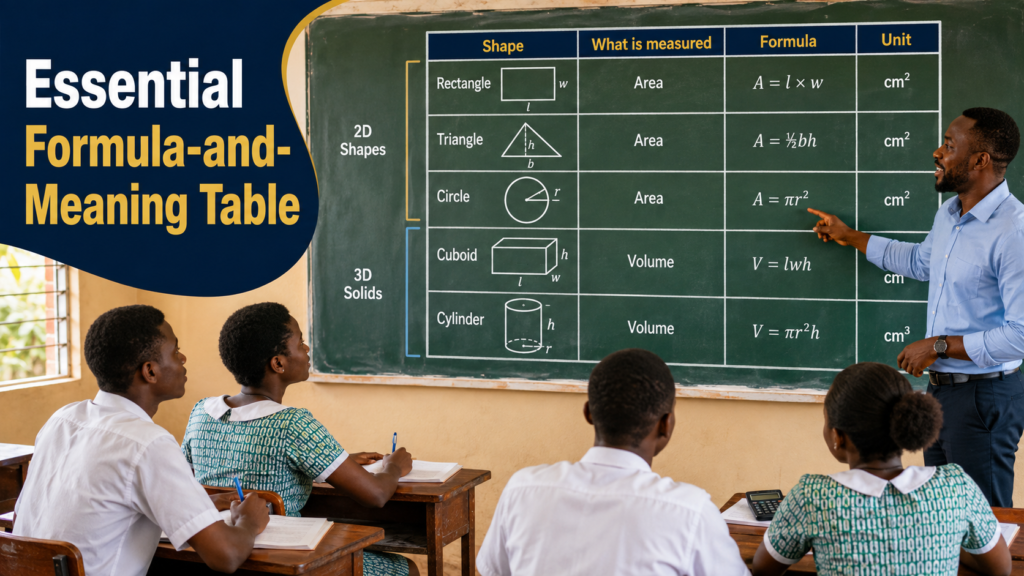
Essential Formula-and-Meaning Table
Flat figures
| Shape or measurement | Formula | Meaning and warning |
|---|---|---|
| Rectangle area | A = lb | Flat space inside the rectangle |
| Square area | A = a² | Side multiplied by itself |
| Triangle area | A = ½bh | Use the perpendicular height. |
| Parallelogram area | A = bh | Height must be perpendicular to the base. |
| Trapezium area | A = ½(a + b)h | a and b are the parallel sides. |
| Circle area | A = πr² | r is the radius, not the diameter |
| Circle circumference | C = 2πr or πd | Distance around the circle |
| Sector area | A = θ/360 × πr² | θ is the central angle |
Solids
| Solid or measurement | Formula | Meaning and warning |
|---|---|---|
| Cube volume | V = a³ | Space inside a cube |
| Cuboid volume | V = lbh | All three dimensions must use the same unit |
| Prism volume | V = cross-sectional area × length | Find the constant cross-section first. |
| Cylinder volume | V = πr²h | Base area multiplied by perpendicular height |
| Cone volume | V = ⅓πr²h | Use vertical height and include ⅓. |
| Pyramid volume | V = ⅓Bh | B is the area of the base. |
| Sphere volume | V = ⁴⁄₃πr³ | Radius is cubed. |
| Hemisphere volume | V = ⅔πr³ | Half the volume of a sphere |

Ten Powerful Fixes for Formula Errors
Fix 1: Separate Flat Figures from Solids
Ask whether the object is two-dimensional or three-dimensional.
A rectangle drawn on a page is flat. A cuboid has length, breadth, and height.
Flat figure → perimeter or area
Solid → surface area or volume
Fix 2: Name the Measurement Before the Formula
Write the target first. For example: Required measurement: Volume
This short statement prevents the learner from choosing a surface-area formula simply because the shape is a cylinder.
Fix 3: Label Every Given Dimension
Do not leave numbers unnamed.
Instead of writing 14 cm, 10 cm
Write:
d = 14 cm
r = 7 cm
h = 10 cm
The label protects the number from entering the wrong position.
Fix 4: Convert Diameter to Radius
Remember:
d = 2r
Therefore:
r = d ÷ 2
If the diameter is 14 cm:
r = 14 ÷ 2 = 7 cm
Do not substitute 14 for r.
Fix 5: Use Perpendicular Height
The height used in the area of a triangle, parallelogram, or trapezium must be perpendicular to the chosen base.
A perpendicular height meets the base, or its extension, at 90°.
A sloping side is not automatically the height.
Fix 6: Separate Vertical Height from Slant Height
In a right cone:
- h is the vertical or perpendicular height
- l is the slant height
- r is the radius
For volume:
V = ⅓πr²h
For curved surface area:
CSA = πrl
The slant height may be found from:
l² = r² + h²
but it should not replace h in the volume formula.
Fix 7: Protect the Factors ½ and ⅓
Two frequently lost factors are
Triangle area:
A = ½bh
Cone or pyramid volume:
V = ⅓Bh
Without these factors, the answer becomes too large.
Fix 8: Make Units Consistent Before Substitution
Do not multiply meters by centimeters without converting first.
For example:
1.5 m = 150 cm
A cuboid measuring 1.5 m by 80 cm by 40 cm should be written in one unit before its volume is calculated.
Fix 9: Separate Base Area from Complete Volume
For a cylinder:
πr² gives the area of one circular base.
To obtain the volume, multiply the base area by height:
V = πr²h
The same idea applies to a prism:
Volume = cross-sectional area × length
Fix 10: Predict the Final Unit
Before calculating, write the expected unit.
- Length → cm, m, or km
- Area → cm², m², or km²
- Volume → cm³, m³, or km³
- Capacity → mL or L
- Cost → GH₵
If the expected answer is a volume but the formula produces only square units, a dimension is probably missing.
Important Unit Conversions
Length, area, and volume do not convert in the same way.
Because:
1 m = 100 cm
it follows that:
1 m² = 100² cm² = 10,000 cm²
and:
1 m³ = 100³ cm³ = 1,000,000 cm³
A learner should not use 1 m² = 100 cm² or 1 m³ = 100 cm³.
For capacity:
1 cm³ = 1 mL
1,000 cm³ = 1 L
1 m³ = 1,000 L
Use these relationships only after confirming that the question requires a capacity conversion.
Worked Example: Volume of a Cylinder
A cylinder has a radius of 7 cm and a height of 10 cm. Find its volume. Use π = 22/7.
Step 1: Identify the shape.
The solid is a cylinder.
Step 2: Identify the measurement.
The question asks for volume: the space inside the cylinder.
Step 3: Label the dimensions.
r = 7 cm
h = 10 cm
Step 4: Select the formula.
V = πr²h
Step 5: Substitute
V = 22/7 × 7² × 10
V = 22/7 × 7 × 7 × 10
V = 1,540
Step 6: Attach the unit.
Volume = 1,540 cm³
Answer: The volume of the cylinder is 1,540 cm³.
The unit is cubic centimeters because volume measures three-dimensional space.
After mastering the method, attempt more questions in the WASSCE Maths Practice Zone.
Common Wrong Approaches
Wrong Approach 1: Using πr² Only
πr² gives the area of the circular base.
For the example:
πr² = 154 cm²
This is not the cylinder’s volume because the height has not been used.
Diagnosed gap: The learner found the base area instead of volume.
Wrong Approach 2: Using 2πrh
2πrh gives the curved surface area of a cylinder.
It measures the curved outside covering, not the space inside.
Diagnosed gap: Surface area and volume were confused.
Wrong Approach 3: Using Diameter as Radius
If d = 14 cm, using r = 14 cm makes the radius twice its correct value.
Because r is squared, this error can make the calculated area or volume four times too large.
Wrong Approach 4: Using Any Side as Triangle Height
A triangle’s sloping side may look like a height, but the area formula requires a perpendicular height.
Look for:
- A right-angle mark
- A perpendicular line inside the triangle
- A perpendicular line outside the triangle
- Enough information to calculate the height
Wrong Approach 5: Using Slant Height for Cone Volume
Volume requires vertical height:
V = ⅓πr²h
Slant height belongs to curved surface area:
CSA = πrl
Wrong Approach 6: Forgetting Square or Cube Symbols
Writing 54 cm instead of 54 cm² changes an area into a length.
Writing 1,540 cm² instead of 1,540 cm³ changes a volume into an area.
Wrong Approach 7: Converting Units After Mixing Them
Convert all necessary measurements before substitution. This reduces avoidable errors and makes the working easier to check.
If these errors continue across several questions, visit the Maths Intervention Hub and isolate the exact skill that needs repair.
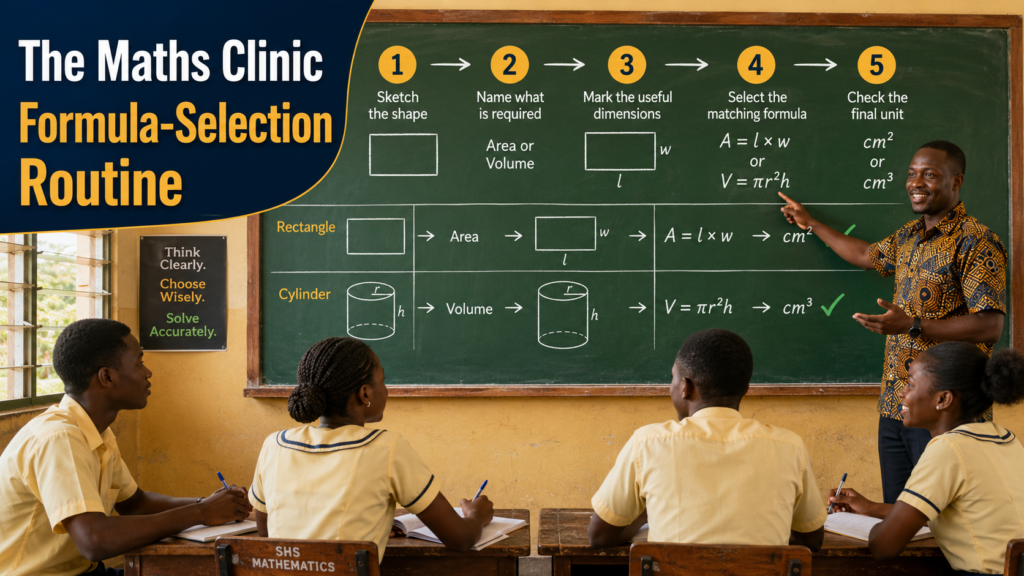
The Maths Clinic Formula-Selection Routine
Use this routine for every mensuration question.
Step 1: Read
Read the full question before calculating.
Step 2: Sketch
Draw or redraw the shape if the original diagram is unclear.
Step 3: State the target.
Write: Required measurement = ______
Step 4: Label the dimensions.
Use correct symbols such as:
- l for length
- b for breadth or base
- h for perpendicular height
- r for radius
- d for diameter
- l for slant height when clearly defined
Because the same letter may represent different quantities in different formulas, always state its meaning.
Step 5: Convert units
Put all required dimensions in a common unit.
Step 6: Write the formula in symbols.
Write the formula before inserting numbers.
Step 7: Substitute carefully.
Use brackets where necessary and square or cube the correct quantity.
Step 8: Calculate without rounding too early
Keep exact values or enough decimal places until the final step.
Step 9: Attach the correct unit.
Use ordinary, square, or cubic units as required.
Step 10: Check the answer.
Ask:
- Did I answer the stated question?
- Did I use radius rather than diameter?
- Did I use perpendicular height?
- Are all units consistent?
- Does the final unit match the measurement?
- Is the size of the answer reasonable?
Formula Errors in Area and Volume: Diagnostic Practice
Attempt all questions before checking the answers.
For each question, write:
- Shape
- Required measurement
- Given dimensions
- Formula
- Expected unit
Questions
- A circle has a diameter of 14 cm. Find its area. Use π = 22/7.
- A cube has a side of 5 cm. Find its volume.
- A triangle has a base of 12 cm and a perpendicular height of 9 cm. Find its area.
- A cylinder has a radius of 3 cm and a height of 8 cm. Find its volume in terms of π.
- A rectangular field is 30 m long and 18 m wide. Find its area.
- A trapezium has parallel sides of 8 cm and 14 cm. Its perpendicular height is 5 cm. Find its area.
- A cone has a radius of 3 cm, a vertical height of 4 cm, and a slant height of 5 cm. Find: a. its volume in terms of π;
b. Its curved surface area in terms of π. - A cylinder has a diameter of 14 cm and a height of 10 cm. Find its volume using π = 22/7.
- A triangular prism has a triangular cross-section of base 8 cm and perpendicular height 5 cm. The prism is 12 cm long. Find its volume.
- A cuboid measures 1.5 m by 80 cm by 40 cm. Find its volume:
a. in cubic centimeters;
b. in cubic meters.
- A sphere has a diameter of 12 cm. Find its volume in terms of π.
- A triangle has a base of 12 cm, a perpendicular height of 8 cm, and a sloping side of 10 cm. Find its area.
Answers and Gap Diagnosis
1. Circle area = 154 cm²
d = 14 cm
r = 7 cm
A = πr²
A = 22/7 × 7²
A = 154 cm²
If you used 14 as r, the diameter was confused with the radius.
2. Cube volume = 125 cm³
V = a³
V = 5³
V = 125 cm³
If you wrote 25 cm², you found the area of one square face.
3. Triangle area = 54 cm²
A = ½bh
A = ½ × 12 × 9
A = 54 cm²
If you wrote 108 cm², the factor ½ was omitted.
4. Cylinder volume = 72π cm³
V = πr²h
V = π × 3² × 8
V = 72π cm³
If you wrote 9π cm²: You found the circular base area and stopped.
5. Field area = 540 m²
A = lb
A = 30 × 18
A = 540 m²
6. Trapezium area = 55 cm²
A = ½(a + b)h
A = ½(8 + 14) × 5
A = 55 cm²
If you multiplied only one parallel side by the height, the trapezium formula was confused with the parallelogram formula.
7. Cone
a. Volume = 12π cm³
V = ⅓πr²h
V = ⅓ × π × 3² × 4
V = 12π cm³
b. Curved surface area = 15π cm²
CSA = πrl
CSA = π × 3 × 5
CSA = 15π cm²
This question tests the difference between vertical height and slant height.
8. Cylinder volume = 1,540 cm³
d = 14 cm
r = 7 cm
V = πr²h
V = 22/7 × 7² × 10
V = 1,540 cm³
If you used r = 14 cm, you missed the diameter-to-radius conversion.
9. Triangular-prism volume = 240 cm³
Area of triangular cross-section:
A = ½ × 8 × 5
A = 20 cm²
Volume:
V = cross-sectional area × length
V = 20 × 12
V = 240 cm³
10. Cuboid volume
Convert 1.5 m to centimeters:
1.5 m = 150 cm
a. Cubic centimeters
V = 150 × 80 × 40
V = 480,000 cm³
b. Cubic metres
480,000 cm³ ÷ 1,000,000 = 0.48 m³
If you multiplied 1.5 × 80 × 40, meters and centimeters were mixed.
11. Sphere volume = 288π cm³
d = 12 cm
r = 6 cm
V = ⁴⁄₃πr³
V = ⁴⁄₃ × π × 6³
V = 288π cm³
12. Triangle area = 48 cm²
Use the perpendicular height of 8 cm, not the sloping side of 10 cm.
A = ½ × 12 × 8
A = 48 cm²
If you wrote 60 cm²: You used the sloping side as the height.
Use Each Wrong Answer to Locate the Gap
| Error pattern | Likely gap | Corrective action |
|---|---|---|
| Used circumference instead of area | Measurement-selection gap | State what must be measured before selecting a formula. |
| Used diameter as radius | Dimension-label gap | Write d first, then calculate r = d ÷ 2. |
| Used a sloping side as height | Diagram-reading gap | Locate or calculate the perpendicular height. |
| Used slant height in cone volume | Height-meaning gap | Separate h from l. |
| Used πr² as cylinder volume | Missing-dimension gap | Multiply base area by height. |
| Used 2πrh for volume | Formula-meaning gap | Separate curved surface area from volume. |
| Forgot ½ or ⅓ | Formula-structure gap | Mark the factor before substitution. |
| Mixed centimeters and meters | Unit-conversion gap | Convert before calculating |
| Gave cm² for volume | Measurement-unit gap | Predict the final unit first. |
| Correct formula but wrong arithmetic | Substitution gap | Use brackets and calculate one step at a time. |
Score Guide
| Score | What it suggests | Next action |
|---|---|---|
| 10–12 correct | Formula meaning and dimension control are becoming secure. | Attempt unfamiliar WASSCE-style problems. |
| 7–9 correct | One or two specific traps remain. | Correct the repeated error and retest. |
| 4–6 correct | Formula recognition is stronger than formula meaning. | Return to the formula-and-meaning table. |
| 0–3 correct | Shape, measurement, and dimensions are not yet connected. | Rebuild one family of shapes at a time. |
Do not use the score alone. Two learners with the same score may have different gaps.
Correction and Retest Record
| Question | My wrong answer | Exact gap | Correction completed | Retest result |
|---|---|---|---|---|
| Formula selection/dimension/unit/substitution | Yes / No | Correct / Retry | ||
The correction cycle is:
- Identify the exact mistake.
- Restudy only the missing idea.
- Correct the original question.
- Explain why the correction works.
- Attempt a fresh question without help.
- Record whether the gap has closed.
Learner-Centered Clinic Activities
Activity 1: Formula Sorting
Write formulas on cards and sort them into:
- Length or perimeter
- Area
- Surface area
- Volume
Explain the meaning of every formula placed in a group.
Activity 2: Dimension Labelling
Sketch a circle, triangle, cylinder, and cone. Label:
- Radius
- Diameter
- Perpendicular height
- Vertical height
- Slant height
Do not calculate until every dimension is correctly identified.
Activity 3: Unit Prediction
Read ten questions and predict only the final unit.
For example:
- Area of a classroom floor → m²
- Volume of a water tank → m³
- Circumference of a flower bed → m
- Cost of tiling → GH₵
Activity 4: Error Detective
Study an incorrect solution and answer:
- Where did the first mistake occur?
- Was the shape identified correctly?
- Was the requested measurement identified?
- Were the dimensions labelled correctly?
- Did the formula match the measurement?
- Did the unit match the final answer?
Depth of Knowledge Progression
| Level | Main demand | Example |
|---|---|---|
| DoK 1 | Recall and apply a direct formula. | Find the area of a rectangle. |
| DoK 2 | Select a formula and interpret dimensions. | Find the circle area when the diameter is given. |
| DoK 3 | Combine conversion, interpretation, and several steps. | Find the volume of a mixed-unit prism or compare two solids. |
Difficulty does not come only from large numbers. It also comes from the number of decisions the learner must make.
Learner Reflection Checklist
Tick each statement only when you can do it without copying.
- I can separate flat figures from solids.
- I identify the requested measurement before selecting a formula.
- I label every dimension.
- I can convert diameter to radius.
- I know that the triangle height must be perpendicular to the base.
- I can distinguish vertical height from slant height.
- I remember the factors ½ and ⅓ where required.
- I convert measurements into consistent units.
- I can distinguish base area from complete volume.
- I use square units for area.
- I use cubic units for volume.
- I can explain why my chosen formula fits the question.
- I check whether my answer is reasonable.
How This Helps Before WASSCE
This lesson helps the learner to:
- Read diagrams more carefully
- Select formulas by meaning
- Identify relevant dimensions
- Avoid radius-and-diameter errors
- Use perpendicular height correctly
- Separate slant height from vertical height
- Control unit conversions
- Distinguish area, surface area, and volume
- Show orderly working
- Diagnose errors instead of repeating them
For more common examination traps, explore WAEC Maths Traps.
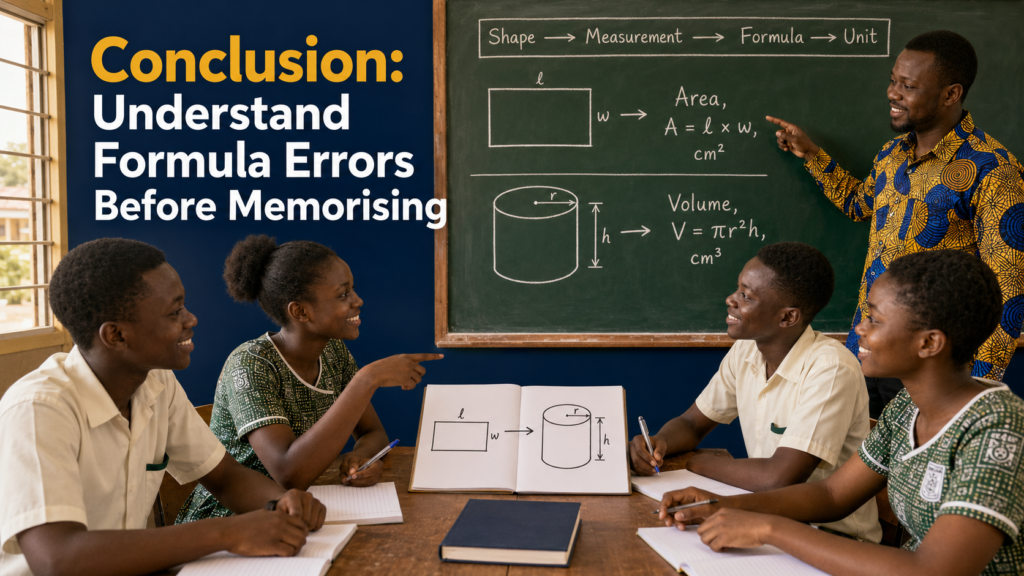
Conclusion: Understand Formula Errors Before Memorising
Formula errors in area and volume improve when the learner can see, explain, and check the relationship before calculating.
The learner should not begin by asking:
Which formula do I remember?
The learner should ask:
- What shape am I working with?
- What measurement is required?
- Which dimensions have been given?
- Is the value a radius or diameter?
- Which height is perpendicular?
- Are the units consistent?
- What unit should the final answer have?
A wrong formula can make a capable learner look weak. The correction is to connect every formula to its shape, measurement, dimensions, and unit.
Use this mensuration formulas clinic to identify the dimension-and-formula gap, correct it, practise again, and confirm the improvement through a fresh retest.
Stop Guessing. Start Understanding.
Still mixing up area and volume formulas?
Do not guess your way through Core Maths. Enter the Practice Zone and train yourself to identify the shape, choose the correct formula, substitute carefully, and write the right unit.
Visit the WASSCE Maths Practice Zone and attempt questions that reveal whether your mistake comes from:
- Shape recognition
- Measurement selection
- Formula selection
- Radius and diameter
- Perpendicular or slant height
- Unit conversion
- Substitution
- Arithmetic
- Final interpretation
Correct the exact gap before attempting another question.