Struggling with WASSCE Maths? Stop guessing. Let’s fix the gap step by step.

9 Powerful Clues That Show Where Your Maths Problem Started

A maths problem started somewhere—and finding that starting point is more useful than saying, “I am not good at Maths.” Many Ghanaian SHS students know they are struggling with WASSCE Core Maths, but they cannot identify the exact learner gap behind the struggle.
That is why a learner may revise for hours and still repeat the same Core Maths mistakes. The learner solves an equation today and forgets the method tomorrow. Percentages look easy in a direct exercise, but confusion starts when WAEC places the same percentage inside a discount, profit, interest, or population question.
The difficulty may not have started in the topic currently being studied. A quadratic equation problem may have started with signs, factorization, or substitution. A graph problem may have started with coordinates, scale, or a weak table of values. A word-problem difficulty may have started with reading mathematical language and identifying the unknown.
This guide will help you diagnose where your Maths problem started, connect the symptom to a specific foundation gap, and choose a focused Maths intervention. That approach suits the new standards-based SHS curriculum because the learner must not only remember procedures; the learner must reason, communicate, apply mathematics to real situations, and check whether an answer makes sense.
| A better diagnostic question: Do not ask only, “Which topic am I failing?” Ask, “At which step does my understanding break down, and which earlier skill should support that step?” |
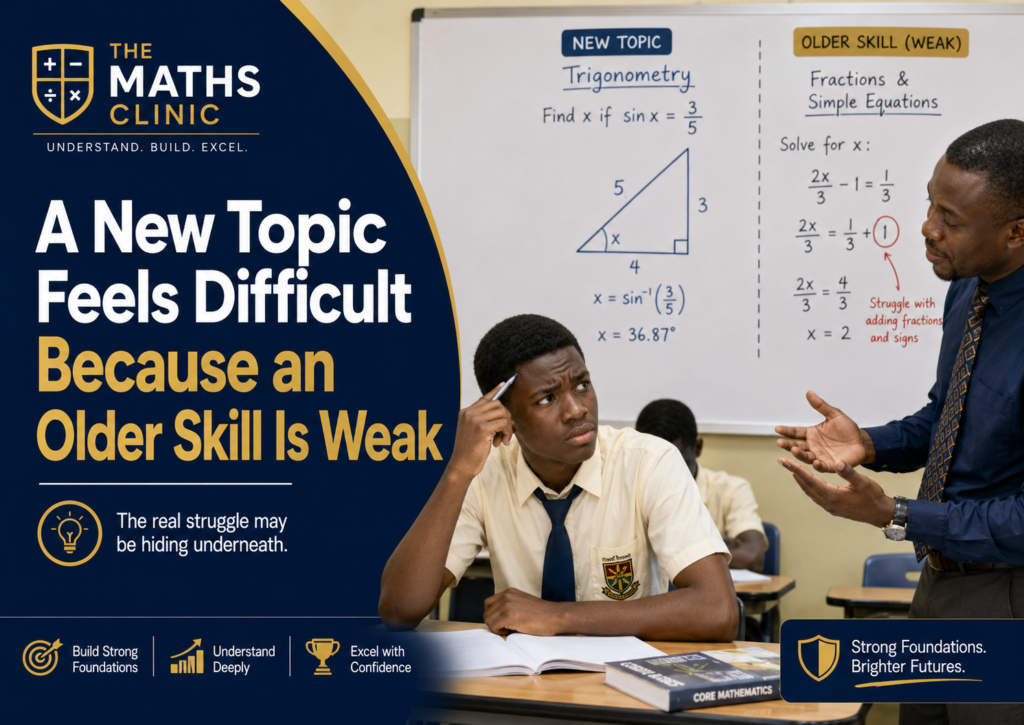
1. A New Topic Feels Difficult Because an Older Skill Is Weak
You may be studying simultaneous equations, graphs, mensuration, variation, or statistics, yet the real struggle appears before the main method even begins.
The hidden learner gap
Mathematics is built in layers. Simultaneous equations need confidence with signs, substitution, expansion, and collecting like terms. Graphs need coordinates, scale, substitution, and careful plotting. Mensuration needs units, formula meaning, fractions, and accurate substitution. When one supporting skill is weak, the whole topic feels heavier than it should.
Why this clue matters
This clue stops you from attacking the wrong problem. Saying, “I cannot do graphs,” is too broad. Saying, “I can form the table, but I choose scale wrongly,” gives you a gap that can be corrected.
What the learner should do next
Choose one difficult question and mark the first line where you became unsure. Write the earlier skill needed at that line. Revise that smaller skill with three simple examples before returning to the full question.
WASSCE connection
WAEC questions often combine several skills in one item. A candidate may know the main topic but lose marks because a supporting operation, unit conversion, or algebraic step is weak. Diagnosis must therefore begin at the first broken step, not at the final wrong answer.
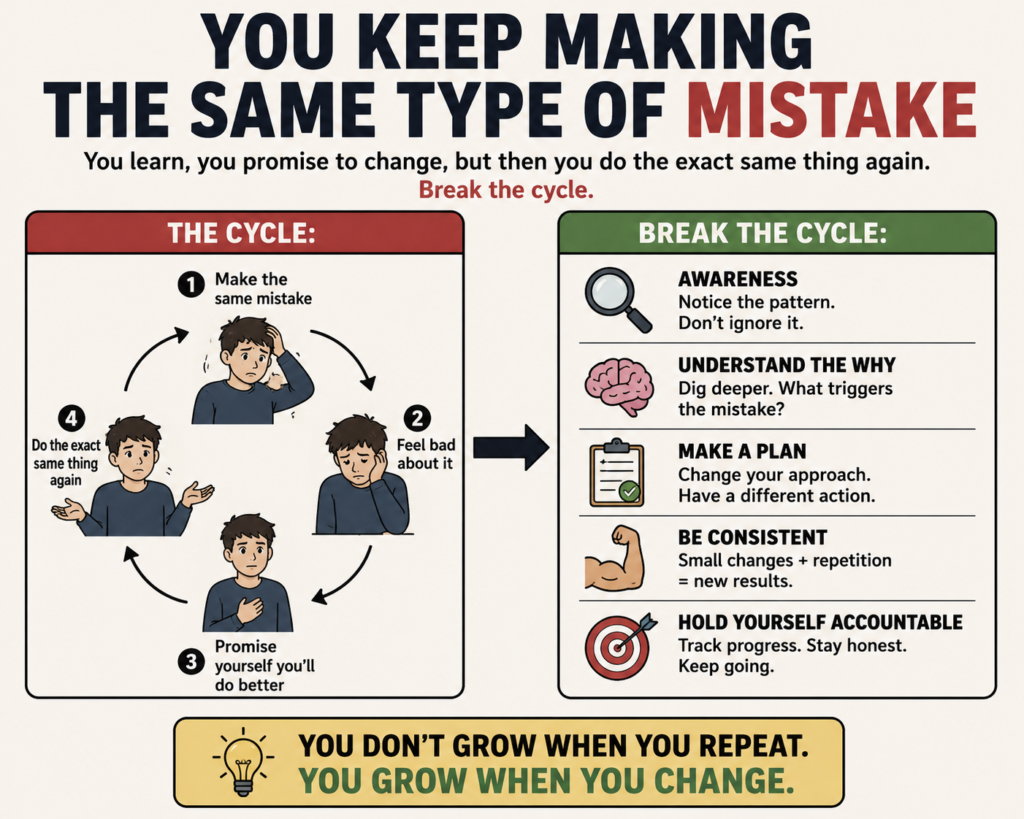
2. You Keep Making the Same Type of Mistake
A repeated error is not “bad luck.” It is evidence. You may keep changing signs wrongly, using the wrong percentage base, dropping brackets, copying values incorrectly, or rounding too early.
The hidden learner gap
The learner may be correcting answers without correcting the thinking that produced them. Seeing the teacher’s final answer is not enough. The learner must name the wrong decision: “I treated subtraction as movement,” “I used the selling price as the original price,” or “I rounded before completing the calculation.”
Why this clue matters
Repeated Core Maths mistakes reveal a stable habit. Unless the habit is identified and replaced, it will reappear in algebra, business mathematics, graphs, statistics, and other WASSCE questions.
What the learner should do next
Keep a small error log with four headings: question, wrong step, reason, and correct rule. Review the log before the next practice session. This turns mistakes into a personal revision guide rather than a source of shame.
WASSCE connection
Chief Examiners’ reports are meant to show common weaknesses in candidates’ work. At the learner level, your error log performs the same function: it shows which weakness keeps costing you marks and what correction should be practiced.
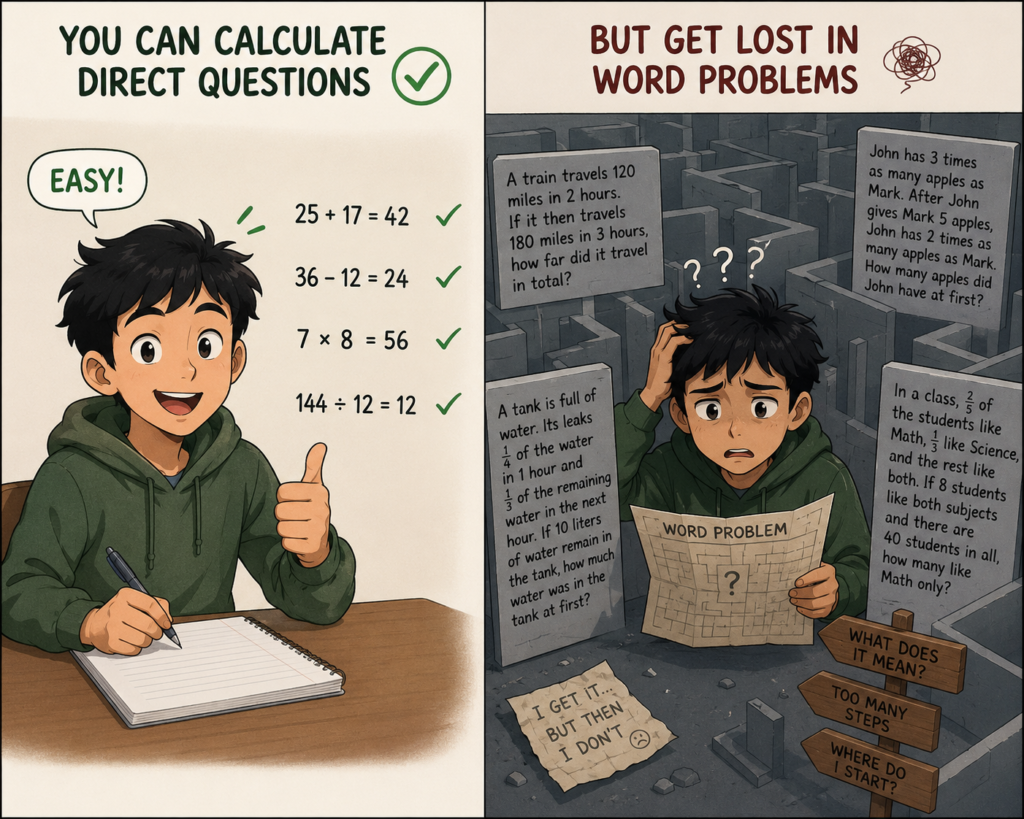
3. You Can Calculate Direct Questions but Get Lost in Word Problems
You can find 20% of GH₵500, but you become confused when the question says a trader gave a 20% discount on an item marked GH₵500. You can solve an equation already written, but you struggle to form the equation from a story.
The hidden learner gap
The main gap is not always calculation. It may be interpretation: identifying what is given, what is changing, what must be found, and which quantity is the correct base. The learner can operate on numbers but cannot yet translate language into mathematics.
Why this clue matters
The new curriculum expects learners to apply mathematics to real-life contexts, not only copy procedures. Word problems test mathematical communication, reasoning, modeling, and decision-making. These are also important in WASSCE Core Maths.
What the learner should do next
Before calculating, write four short lines: Given, Find, Relationship, and Operation or equation. Circle words that show change, comparison, total, rate, difference, increase, decrease, or remainder. Then estimate the kind of answer you expect.
WASSCE connection
WAEC frequently changes the surface wording while keeping the underlying concept. A learner who memorizes one example may freeze. A learner who can translate the situation can recognize the same percentage, ratio, interest, speed, or algebra idea in a new form.
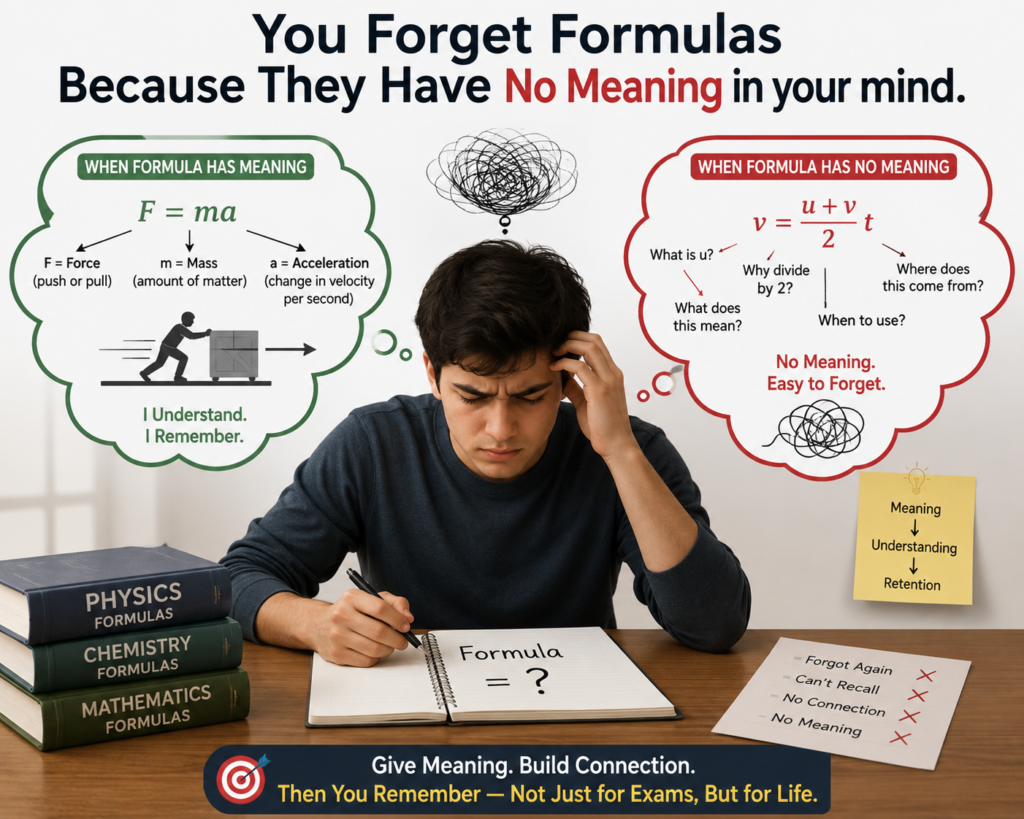
4. You Forget Formulas Because They Have No Meaning in Your Mind
You can recite a formula in class, but you cannot choose it independently or adjust it when the question gives time in months, diameter instead of radius, amount instead of interest, or mixed units.
The hidden learner gap
The learner has stored letters without relationships. For example, SI = PRT/100 is easier to use when P is understood as the principal, R as the annual rate, and T as time measured in years. A formula becomes useful when each symbol, unit, and condition has meaning.
Why this clue matters
Formula cramming creates fragile knowledge. The moment WAEC changes the wording, the learner cannot decide which value belongs where. Understanding the structure of the formula makes recall and substitution more reliable.
What the learner should do next
For every formula, make a five-part card: name of formula; meaning of each symbol; correct units; one direct example; one changed-form example. Also practice making a different letter the subject where appropriate.
WASSCE connection
WASSCE questions do not always provide values in the neat order of a classroom example. Candidates must select relevant information, convert units, and sometimes find a missing quantity. Meaning is therefore safer than memorization alone.
5. You Understand Only While the Teacher Is Solving
During the lesson, the method looks clear. You copy every line and may even predict the next answer. But when you sit alone, you do not know how to start.
The hidden learner gap
The learner is following another person’s thinking instead of producing personal reasoning. The teacher has already chosen the method, arranged the steps, and removed possible wrong paths. The learner’s own decision-making has not yet been tested.
Why this clue matters
Familiarity can feel like understanding. However, WASSCE gives no teacher prompt. The candidate must identify the topic, choose the method, organize the work, and check the answer independently.
What the learner should do next
After every worked example, close the book. Solve a similar question without looking. Then explain aloud why each step is valid. Where your explanation stops is where the learner gap is hiding.
WASSCE connection
Independent practice reveals whether the method is learner-owned. This reflects the curriculum’s emphasis on active learning, reasoning, communication, and problem-solving rather than passive copying.
6. Letters, Signs, Fractions, or Brackets Make You Panic
You may understand the story of a question but become blocked as soon as x, negative signs, fractions, brackets, or algebraic expressions appear.
The hidden learner gap
The problem may have started in early algebra and number work. Letters represent numbers or quantities; brackets show grouping; signs show operations or direction; fractions are numbers with rules. When these ideas are not secure, equations, functions, variation, graphs, probability, and geometry formulas become difficult.
Why this clue matters
Algebra is not one isolated topic. It is a mathematical language used across Core Maths. A learner who cannot read that language may wrongly conclude that many separate topics are impossible.
What the learner should do next
Rebuild in this order: integers and directed numbers; meaning of a variable; like and unlike terms; substitution; brackets; inverse operations; and simple linear equations. Use short questions and explain the rule before increasing difficulty.
WASSCE connection
WAEC awards method marks for valid mathematical steps. Weak sign control, poor expansion, or incorrect substitution can destroy a correct plan. Repairing basic algebra protects marks across several sections of the paper.
7. Your Answer Is Close, but You Still Lose Marks
Your method may be nearly correct, yet the final answer is rejected because of a wrong unit, inaccurate scale, premature rounding, copied digit, missing degree sign, or failure to answer the exact question.
The hidden learner gap
The learner gap may be precision and checking, not topic knowledge. Calling every such error “carelessness” hides the pattern. If the same small error returns, it is a checking habit that has not been trained.
Why this clue matters
Mathematical proficiency includes accuracy, communication, and judgement. A correct-looking number without the required unit, level of accuracy, or interpretation may be incomplete.
What the learner should do next
Use a 30-second final check: Have I answered what was asked? Are the units correct? Did I round only at the end? Is the answer reasonable? Did I transfer every value correctly? For graphs, also check axes, labels, scale, and plotted points.
WASSCE connection
WAEC marking considers method, accuracy, notation, and presentation. A learner who checks systematically can recover marks without learning a new topic—because the real weakness was incomplete mathematical communication.
8. You Avoid Diagrams, Tables, Number Lines, or Graphs
You try to hold every piece of information in your head. You avoid sketching shapes, organizing data in a table, drawing a number line, or making a rough graph.
The hidden learner gap
The learner may have a weak representation habit. Some mathematical relationships become easier when they are made visible. A table organizes values, a diagram shows shape and direction, a number line shows signed movement, and a graph shows change and relationship.
Why this clue matters
The standards-based curriculum values multiple representations and the ability to move between words, symbols, tables, diagrams, and graphs. Avoiding these tools overloads the mind and increases mistakes.
What the learner should do next
When a question involves shape, movement, comparison, data, sequence, or direction, represent it before calculating. The drawing need not be artistic. It must be clear enough to show the mathematical relationships.
WASSCE connection
In bearings, geometry, mensuration, statistics, probability, and graph work, a simple representation can expose information that is easy to miss in prose. It also makes the method easier for an examiner to follow.
9. You Have “Learnt” the Topic, but Your Marks Do Not Improve
You recognize the notes and examples, yet you cannot solve a fresh question without help. You may say, “We have done this topic,” but your test score remains the same.
The hidden learner gap
The learner has familiarity, not mastery. Familiarity means the page looks known. Mastery means you can explain the idea, select a method, solve unfamiliar questions, check the result, and correct your own errors.
Why this clue matters
Reading notes again can create confidence without evidence. Improvement must be measured through independent, mixed, and WASSCE-style practice. The score is not the only evidence; the kind of error and the amount of help needed also matter.
What the learner should do next
Use a three-level mastery check: Level 1—solve a direct question; Level 2—solve a changed or worded question; Level 3—explain the method and diagnose a wrong solution. Return to the hidden gap whenever one level breaks down.
WASSCE connection
WASSCE tests transfer. The wording, numbers, and context may change. A learner is ready when the concept survives those changes—not merely when the learner remembers the classroom example.
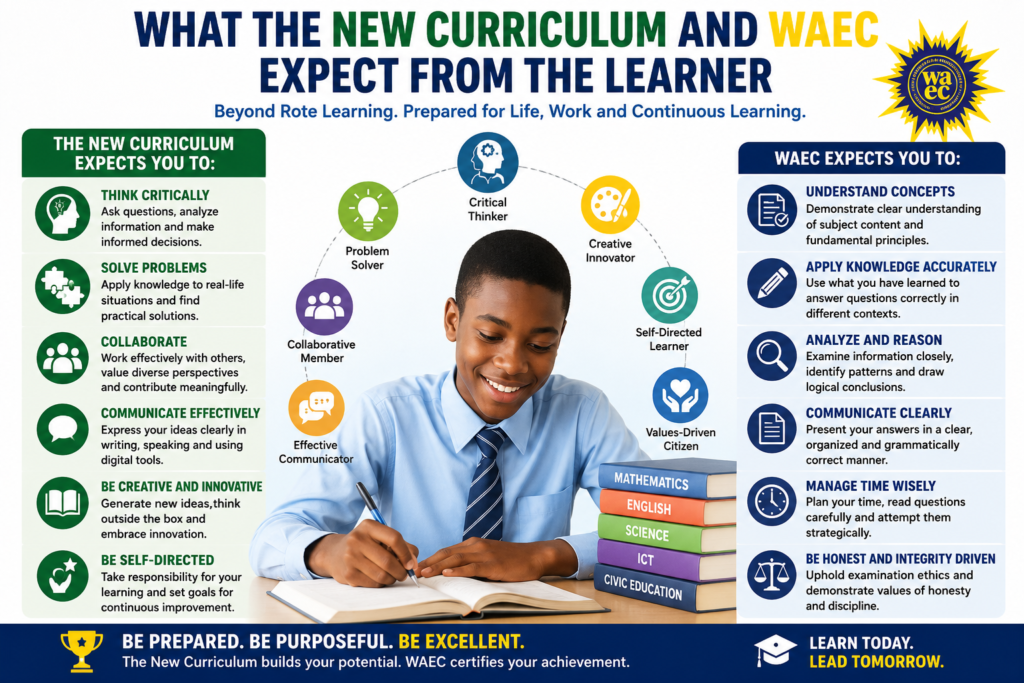
What the New Curriculum and WAEC Expect From the Learner
The diagnosis in this post supports both classroom learning and examination preparation. Ghana’s standards-based secondary curriculum is learner-centered and expects learners to develop knowledge, skills, values, reasoning, communication, problem-solving, and the ability to apply mathematics in everyday situations. This means a learner should not stop at remembering a rule. The learner should understand why the rule works, use it in a changed context, explain the method, and judge whether the answer is sensible.
WAEC-oriented preparation adds another demand: the learner must present clear working, interpret questions correctly, use accurate notation and units, and avoid repeated procedural errors. The Maths Clinic philosophy joins these two demands. We diagnose the foundation gap, reteach the meaning, practice the correct process, and then test the learner with an examination-style application.
| Important balance: The new curriculum is not a reason to ignore WASSCE. WASSCE preparation is also not a reason to teach memorization only. Strong preparation develops understanding first, then trains the learner to apply that understanding accurately under examination conditions. |
Worked Diagnosis: The Wrong Answer Is Not the Whole Problem
Question
Solve: 2x – 5 = 13
Student’s wrong solution
2x – 5 = 13
2x = 13 – 5
2x = 8
x = 4
The learner may conclude, “I do not understand algebra.” That diagnosis is too wide. The first wrong decision happened when -5 was removed. The learner treated “changing sides” as a sign trick instead of using inverse operations.
Correct reasoning
2x – 5 = 13
2x – 5 + 5 = 13 + 5
2x = 18
x = 9
The exact learner gap is inverse operations and equality. The correction is not to reread the whole algebra chapter. The learner should first practice keeping an equation balanced by doing the same operation to both sides, then return to linear equations.
| Maths Clinic diagnosis Symptom: wrong linear-equation answer. Hidden gap: inverse operations and equality. Intervention: balance simple equations with addition and subtraction. Proof of repair: solve a changed equation independently and explain each operation. |
Three Revision Habits That Hide the Real Gap
1. Reading every topic again: This feels serious, but it may waste time. Broad revision does not repair a specific weakness such as sign control, scale, percentage base, or interpretation.
2. Copying more solved examples: Copying makes the page full, but it does not test whether the learner can select and use the method independently.
3. Blaming the whole subject: “Maths is not for me” turns a repairable skill gap into an identity. A learner may be weak in one supporting skill, not in the whole of mathematics.
The Maths Clinic Backward-Trace Method
Use this six-step method whenever a topic feels difficult:
- Name the exact topic or question type troubling you.
- Solve three to five questions without notes or teacher prompts.
- Mark the work and identify the first wrong or uncertain step.
- Name the earlier skill needed at that step.
- Practice that smaller skill with simple examples, then mixed examples.
- Return to a WASSCE-style question and check whether the gap has been repaired.
This method prevents blind revision. It treats the visible error as a symptom and traces it back to the smallest teachable gap.
Practice Task: Find Where the Maths Problem Started
Do not only find the answers. After each question, record the first point where you became unsure. That point is more useful than the score alone.
1. Algebra
Solve: 4x + 3 = 23
Diagnosis question: Did the difficulty begin with inverse operations, signs, or division?
2. Percentages
A bag was sold for GH₵240 after a 20% discount. Find the original price.
Diagnosis question: Did the difficulty begin with choosing the correct percentage base?
3. Simple interest
Find the simple interest on GH₵900 at 10% per annum for 6 months.
Diagnosis question: Did the difficulty begin with converting months to years or interpreting the formula?
4. Graphs
Find the gradient of the line joining (2, 5) and (6, 13).
Diagnosis question: Did the difficulty begin with the gradient formula, coordinate order, or subtraction?
5. Word problems
The sum of two numbers is 40. One number is 6 more than the other. Find the numbers.
Diagnosis question: Did the difficulty begin with identifying the unknown or translating the relationship into an equation?
How This Helps a Struggling SHS Learner Understand Core Maths Better
This lesson changes the meaning of a wrong answer. A mistake is no longer proof that the learner is “bad at Maths.” It becomes evidence showing where understanding broke down.
That matters before WASSCE because focused correction saves time. Instead of reading every note again, the learner repairs the exact gap—signs, fractions, brackets, formula meaning, translation, scale, units, substitution, or checking—that is blocking progress.
It also supports confidence in a healthy way. Confidence does not come from pretending that the work is easy. It comes from seeing a small gap, fixing it step by step, and proving the improvement through independent practice.
This is the Maths Clinic philosophy: stop guessing, identify the hidden weakness, rebuild the missing skill, and return to the examination question with better understanding.
Final Advice Before WASSCE
Do not wait until the examination is close before asking where your Maths problem started. Begin with one difficult topic. Solve a few questions. Locate the first repeated error. Then move backwards to the smaller skill supporting that step.
You may discover that the big topic is not the real enemy. The difficulty may have started with signs, fractions, reading, units, formula meaning, substitution, scale, or checking. Finding that point is not a shame. It is the beginning of proper intervention.
A struggling learner is not finished. Sometimes the learner needs a clear diagnosis, a patient explanation, targeted practice, and one more honest attempt. Once the foundation gap is repaired, Core Maths begins to make better sense.