Struggling with WASSCE Maths? Stop guessing. Let’s fix the gap step by step.

Algebra for Beginners: 8 Powerful Rules to Stop Guessing

Algebra for Beginners is meant for a learner who can calculate with numbers but becomes unsure when familiar operations are written with letters. This core math and algebra lesson identifies the meaning and confidence gap and repairs it step by step. In many Ghanaian SHS classrooms, a learner can solve arithmetic very well. Give the learner 15 + 7, 45 ÷ 5, or 12 × 8, and the answer will come quickly. But immediately, as the question becomes 3x + 5 = 20, the learner becomes quiet.
That silence does not always mean the learner is lazy. Many times, it means there is a hidden gap. The learner has not yet understood what the letter stands for, what the sign is doing, or why one step must follow another step.
So the learner begins to guess. Sometimes the learner changes + to − without reason. Sometimes the learner moves a number across the equal sign and changes the sign because “that is what we normally do.” Sometimes the learner expands brackets wrongly. By the time the answer comes, the work is no longer mathematics; it is guessing dressed like mathematics.
Algebra for Beginners: 8 Powerful Rules to Stop Guessing
This Maths Clinic lesson will show you 8 powerful rules to stop guessing in algebra and begin solving with understanding. Find your hidden Core Maths learning gap.
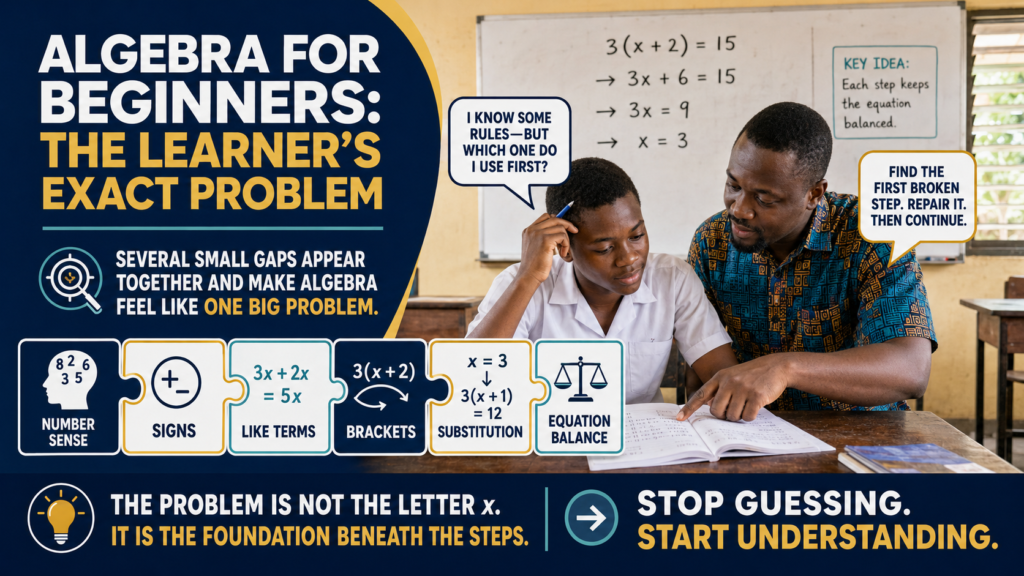
Algebra for Beginners: The Learner’s Exact Problem
A struggling SHS learner may say:
“Sir, I do not understand letters in Maths.”
“I always forget whether to add or subtract.”
“When I see brackets, I become confused.”
“I know the answer when someone explains, but I cannot start alone.”
These statements are not small complaints. They show the real problem: the learner is trying to solve algebra without a clear meaning of the symbols.
Algebra is not magic. Algebra is a short way of writing unknown numbers and relationships. The letter is not there to frighten you. The letter is simply standing for a number you do not know yet or a number that can change.
For example, if a pen costs x Ghana cedis, then 3 pens cost 3x Ghana cedis. The x is not decoration. It represents the price of one pen. That is the first mental shift every beginner must make.
Why Learners Struggle with Algebra for Beginners
Most algebra mistakes happen because the learner copies a method without understanding the reason behind the method. The learner has seen the teacher “move” numbers many times, so the learner also moves numbers. But the learner may not know that every movement must keep the equation balanced.
Another cause is weak number sense. A learner who is not comfortable with negative numbers will struggle with algebraic signs. A learner who is not comfortable with multiplication will struggle with brackets. A learner who does not understand fractions will struggle with algebraic fractions.
So algebra exposes old weaknesses. It does not create all the weaknesses by itself. This is why a learner can look weak in algebra even though the real weakness started from integers, fractions, factors, or basic operations.
| Diagnostic truth |
| When algebra is weak, do not only ask, “Can I solve for x?” Also ask, “Do I understand signs, brackets, fractions, and equality?” That is where many WASSCE marks are lost. |
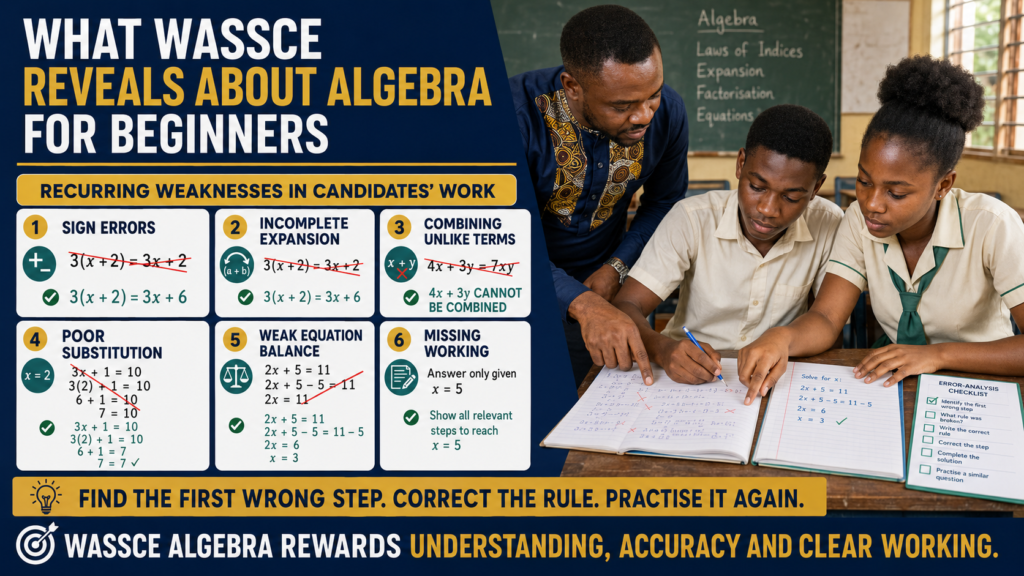
What WASSCE Reveals About Algebra for Beginners
Core Mathematics does not treat algebra as an isolated topic. Algebra enters many WASSCE areas: linear equations, simultaneous equations, inequalities, functions, graphs, variation, sequences, word problems, and even mensuration when formulas must be rearranged.
That means a weak algebra foundation will not remain in one corner. It will follow the learner into many topics. A learner who guesses signs in simple algebra may also guess when solving graph questions, changing the subject of a formula, or interpreting a word problem.
This is why the beginner must not rush. In Core Maths, algebra is like a bridge. If the bridge is weak, many topics become difficult to cross.
Algebra for Beginners Explained Simply
Algebra uses letters to represent numbers. The letter may stand for an unknown number, a changing number, or a general rule.
Look at this simple expression:
This means multiply by 3, then add 5. If , then it becomes
Now look at this equation:
3x + 5 = 20
This means a number multiplied by 3, then increased by 5, gives 20. Your job is to find that number. You are not guessing. You are undoing the operations carefully.
So algebra becomes easier when you ask the following:
- What does the letter represent?
- What operation is happening first?
- What operation must I undo?
- How do I keep both sides balanced?
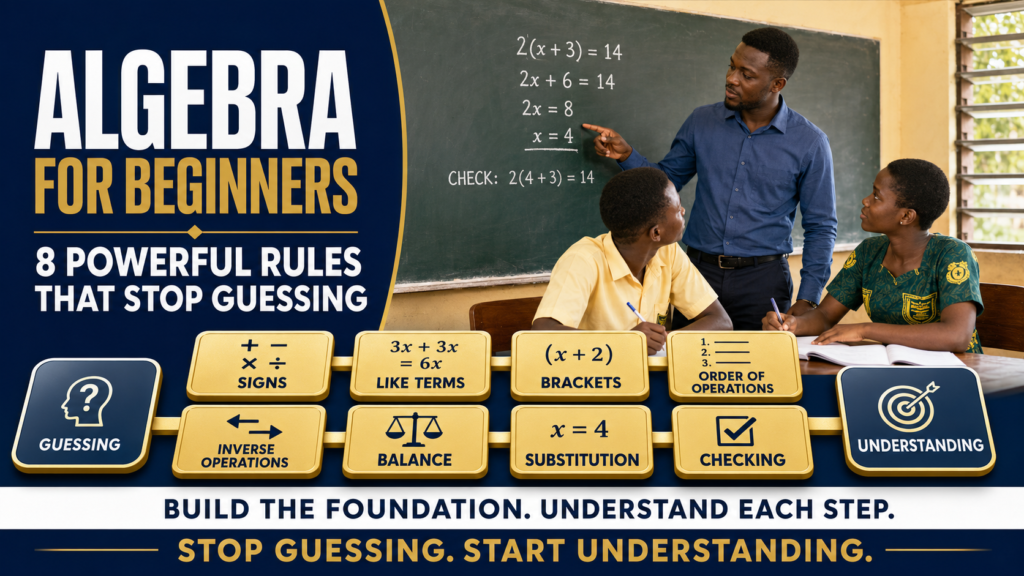
Algebra for Beginners: 8 Powerful Rules That Stop Guessing
Rule 1: Know What the Letter Represents
Do not treat x, y, a, or b as strange objects. A letter in algebra usually represents a number. Before solving, say in your mind, “This letter is standing for a number I do not know yet.”
Example: If , is the number that becomes 15 after 7 is added. So .
Hidden gap fixed: fear of letters.
Rule 2: Respect the Equal Sign
The equal sign means the left side and the right side have the same value. It does not mean “the answer is coming.” It means balance.
Example: In 2x + 3 = 11, whatever you do to the left side, you must do to the right side.
Correct thinking: subtract 3 from both sides: 2x + 3 − 3 = 11 − 3, so 2x = 8, and x = 4.
Hidden gap fixed: moving numbers without understanding balance.
Rule 3: Do the Same Thing to Both Sides
An equation is like a balanced scale. If you remove 5 from one side, remove 5 from the other side. If you divide one side by 3, divide the other side by 3.
Wrong habit: x + 5 = 12; therefore, x = 12 + 5. This is wrong because the learner added instead of undoing the addition.
Correct method: x + 5 = 12. Subtract 5 from both sides: x = 7.
Hidden gap fixed: wrong transposition.
Rule 4: Use Opposite Operations to Undo
To solve for a letter, undo the operations around it. Addition is undone by subtraction. Subtraction is undone by addition. Multiplication is undone by division. Division is undone by multiplication.
Example: 4x = 28. Since x is multiplied by 4, divide both sides by 4. x = 7.
Example: x/5 = 6. Since x is divided by 5, multiply both sides by 5. x = 30.
Hidden gap fixed: choosing operations by guessing.
Rule 5: Treat Negative Signs Carefully
Many SHS learners lose algebra marks because of negative signs. A negative sign is not a small decoration. It changes the value of the term.
Example: . Divide both sides by −3.
Common wrong answer: x = 4. The learner divided 12 by 3 and forgot the negative sign.
Hidden gap fixed: sign errors.
Rule 6: Expand Brackets Before Combining Terms
When a number is outside a bracket, it must multiply every term inside the bracket. Do not multiply only the first term.
Example: 3(x + 4) = 3x + 12, not 3x + 4.
Example: −2(x − 5) = −2x + 10. The second sign changes because −2 × −5 = +10.
Hidden gap fixed: bracket expansion errors.
Rule 7: Combine Only Like Terms
Like terms have the same letter part. You can add 3x and 5x because both are x terms. But you cannot add 3x and 5 as if they were the same kind.
Example: 3x + 5x = 8x.
Example: 3x + 5 cannot become 8x. It stays 3x + 5 because 5 has no x.
Hidden gap fixed: mixing unlike terms.
Rule 8: Check Your Answer by Substitution
After solving, put your answer back into the original question. This is one of the best ways to catch mistakes before WASSCE catches them for you.
Example: Solve 2x + 3 = 11. You get x = 4. Check: 2(4) + 3 = 8 + 3 = 11. Correct.
If your answer does not make the original equation true, something went wrong. Go back and check signs, brackets, or division.
Hidden gap fixed: finishing without verification.
Algebra for Beginners Worked Example
Question: Solve 3(x − 2) + 4 = 16.
Step 1: Expand the bracket.
3(x − 2) = 3x − 6
So the equation becomes 3x − 6 + 4 = 16
Step 2: Combine like terms.
−6 + 4 = −2
So 3x − 2 = 16
Step 3: Undo subtraction by adding 2 to both sides.
3x − 2 + 2 = 16 + 2
3x = 18
Step 4: Undo multiplication by dividing by 3.
x = 6
Step 5: Check by substitution.
Original question: 3(x − 2) + 4 = 16
Put x = 6: 3(6 − 2) + 4 = 3(4) + 4 = 12 + 4 = 16
The answer is correct.
Common Wrong Approach in Algebra for Beginners
Some learners may write:
3(x − 2) + 4 = 16
3x − 2 + 4 = 16
3x + 2 = 16
3x = 14
x = 14/3
This is wrong because the learner expanded the bracket wrongly. The 3 outside the bracket must multiply both x and −2. So 3(x − 2) is 3x − 6, not 3x − 2.
The mistake did not happen at the final answer. It happened at the bracket stage. That is why a Maths Clinic learner must learn to diagnose where the breakdown started.
Correct Method for Algebra for Beginners
- Read the algebraic expression or equation carefully.
- Identify what the letter represents.
- Expand brackets correctly, if any.
- Collect or combine only like terms.
- Use opposite operations to isolate the letter.
- Do the same thing to both sides of the equation.
- Watch negative signs carefully.
- Check your answer by substitution.
Algebra for Beginners WAEC Trap: Where Marks Are Lost
| WAEC-style trap | Wrong learner habit | Better habit |
| Negative signs | Ignoring the minus sign | Circle or underline negative terms before solving. |
| Brackets | Multiplying only the first term | Multiply every term inside the bracket. |
| Like terms | Adding unlike terms together | Group only terms with the same letter part |
| Equal sign | Moving numbers anyhow | Keep both sides balanced. |
| Fractions | Clearing denominators wrongly | Multiply every term by the LCM. |
| Checking | Stopping after first answer | Substitute your answer into the original question. |
Algebra for Beginners Practice Task
Purpose check: This Algebra for Beginners practice is not only for scoring. If the learner misses a question, determine whether the error stemmed from the meaning-confidence gap before presenting the next question.
Try these without guessing. Show every step and check your answer.
- Solve
- Solve
- Solve
- Solve
- Solve
- Simplify
- Expand
- Solve
Answers to the Algebra for Beginners Practice
How Algebra for Beginners Helps Before WASSCE
This lesson helps the learner stop seeing algebra as a guessing game. It shows the learner that every algebra step has a reason. When the learner understands the reason, confidence begins to grow.
For WASSCE Core Maths, this is very important because algebra appears inside many different questions. A learner who can handle signs, brackets, like terms, and equations will be stronger in word problems, graphs, inequalities, functions, formula substitution, and many other areas.
The goal is not to rush into difficult questions. The goal is to repair the foundation first. When the foundation becomes clear, the bigger questions become less frightening.
Try beginner algebra practice questions before WASSCE.
Conclusion: Use Algebra for Beginners with Understanding
Algebra for Beginners becomes useful when the learner can explain the next step instead of copying it. Use this Core Maths algebra lesson to repair the named gap, practice it again, and then retest it. My dear learner, if algebra has been worrying you, do not conclude that you are bad at mathematics. Ask a better question: “Which algebra rule am I breaking?”
Are you breaking the rule of the equal sign? Are you ignoring negative signs? Are you expanding brackets wrongly? Are you combining unlike terms? Are you solving without checking?
Once you find the exact mistake, you can fix it. That is the Maths Clinic way. We do not shame the learner. We diagnose the gap, correct the method, and practice with purpose.
So the next time you see x, do not panic. x is only a number waiting to be found. Follow the rules, show your steps, and stop guessing.
Stop Guessing. Start Understanding.