Struggling with WASSCE Maths? Stop guessing. Let’s fix the gap step by step.
Algebra Foundation in Core Maths: 7 Powerful Signs

An algebra foundation in core maths is one of the quiet reasons many Ghanaian SHS students lose marks before they even reach the main part of a WASSCE question.
In class, a learner may say, “Sir, I understand algebra a little.” But when the question changes from 2x + 3 = 11 to a word problem, a graph, a formula, or simultaneous equations, the same learner becomes stuck. The learner is not lazy. The learner is meeting a hidden foundation gap.
This is why The Maths Clinic does not begin by saying, “You are bad at maths.” We begin with a better question: where exactly is the breakdown happening?
Algebra is not just about letters. Algebra is the language Core Maths uses to talk about numbers, patterns, formulas, graphs, equations, and problem-solving. So when your algebra foundation is weak, it affects many other WASSCE Core Maths topics.
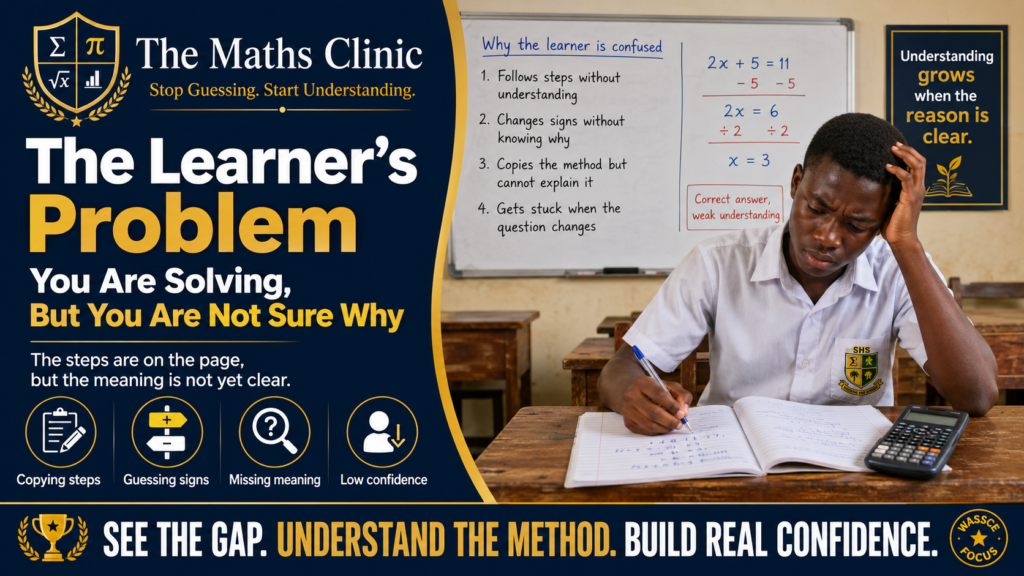
The Learner’s Problem: You Are Solving, But You Are Not Sure Why
Many struggling learners can copy steps from the board, but they cannot explain why the steps work. That is the first warning sign. In algebra, copying alone is dangerous because one small change in the question can spoil the whole method.
For example, a learner may know how to solve x + 5 = 12. But the same learner may struggle with 5 – x = 12, 3(x – 2) = 18, or y = 2x + 1. The issue is not the difficulty of the question only. The issue is that the learner has not fully understood signs, equality, brackets, substitution, and operations.
Before WASSCE, you must check whether your algebra foundation is strong enough to carry bigger topics like functions, graphs, variation, sequences, word problems, simultaneous equations, and financial mathematics.
Why the Mistake Happened: Algebra Is Built in Layers
Algebra is like a building. If the lower blocks are weak, the top part will shake. A learner may think the problem is simultaneous equations, but the real weakness may be integer signs. Another learner may blame word problems, but the real weakness may be translating words into algebraic expressions.
This is why algebra must be diagnosed. When a learner keeps failing algebra questions, the teacher must not only mark the final answer wrong. The teacher must check the exact point where the learner departed from the correct path.
In WASSCE, WAEC does not usually test algebra in isolation. Algebra enters other topics. That is why a weak algebra foundation can quietly reduce your marks across the whole Core Maths paper.
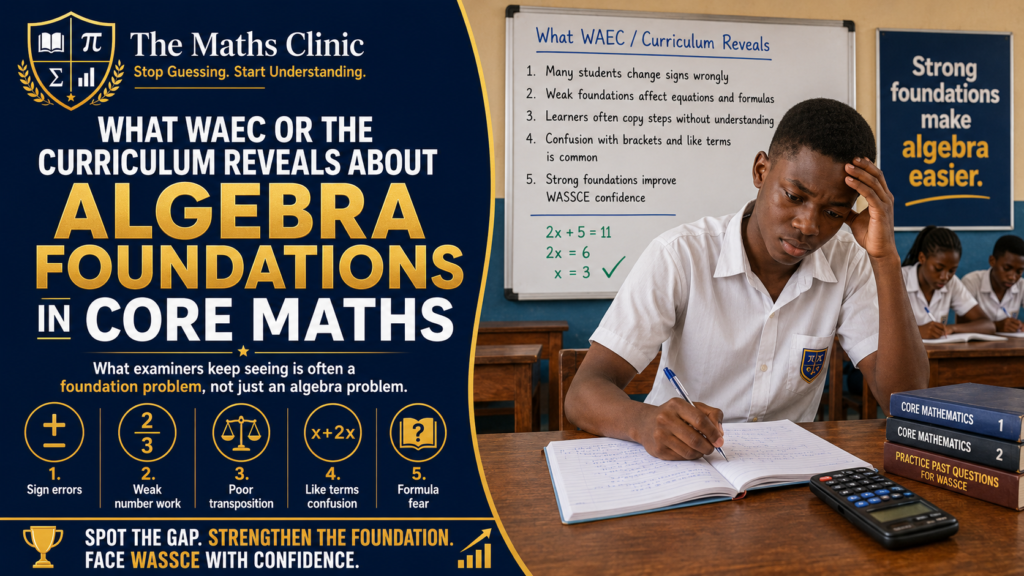
What WAEC or the Curriculum Reveals About Algebra Foundations in Core Maths
The SHS Core Maths curriculum expects learners to use algebra to represent relationships, solve equations, manipulate expressions, interpret functions, and apply formulas. This means algebra is not a small topic you can avoid. It is a tool you need again and again.
WASSCE questions also reward correct processes. A learner who understands algebra can show work clearly. But a learner who is guessing may jump steps, change signs wrongly, misuse brackets, or substitute values without checking the structure of the question.
The hidden lesson is simple: before you fight difficult WASSCE questions, fix the algebra foundation that carries those questions.
Sign 1: You Change Signs Without Understanding the Operation
This is one of the most common algebra mistakes. A learner moves a term from one side of the equal sign to the other side, then changes the sign because the teacher once said, “When it crosses, it changes.” But the learner does not understand what operation was done.
That shortcut can work only when it represents a correct inverse operation. If you do not understand the operation, you will change signs in places where no sign change is needed.
Weak example: Solve x – 7 = 15. Some learners write x = 15 – 7, so x = 8. That is wrong because the -7 must be removed by adding 7 to both sides.
Correct method: x – 7 = 15, so add 7 to both sides. x = 22.
Clinic diagnosis: The problem is not only the answer. The hidden gap is poor understanding of inverse operations.
Sign 2: You Cannot Handle Negative Numbers Inside Algebra
Many algebra errors are really integer errors wearing algebra clothes. Once negative numbers enter the question, the learner becomes confused.
Example: Simplify -3x + 5x. Some learners write -8x because they see 3 and 5 and just add them. But -3x + 5x means you owe 3x and you receive 5x. You are left with 2x.
Correct answer: -3x + 5x = 2x.
Another example: -2(x – 4) = -2x + 8, not -2x – 8. The negative outside the bracket must multiply every term inside the bracket.
Clinic diagnosis: The hidden gap is sign control. Until you fix negative numbers, algebra will continue to feel unpredictable.
Sign 3: You Treat Letters as Decoration, Not as Quantities
In algebra, x, y, a, b, and other letters are not decorations. They represent numbers or quantities. Some learners copy the letters but do not know what they mean.
For example, if a question says the cost of one pen is x Ghana cedis, then the cost of 5 pens is 5x Ghana cedis. The letter carries meaning. It is not there to frighten you.
If you cannot explain what a letter stands for in a word problem, your algebra foundation is still weak.
Correct thinking: Ask yourself, “What quantity is this letter representing?” Then build the expression from the meaning.
Clinic diagnosis: The hidden gap is poor translation between real-life language and algebraic language.
Sign 4: You Remove Brackets Carelessly
Brackets are not for decoration. Brackets tell you that a whole group must be treated together. In WASSCE Core Maths, careless brackets can cost easy marks.
Weak example: 3(x + 4) = 3x + 4. This is wrong because the 3 must multiply both x and 4.
Correct method: 3(x + 4) = 3x + 12.
Another dangerous example: -(x – 5) = -x + 5. The negative sign affects every term inside the bracket.
Clinic diagnosis: The hidden gap is weak distributive property. If this is not fixed, expansion, factorization, equations, and functions will all suffer.
Sign 5: You Can Solve Simple Equations, But You Get Lost When the Question Has Fractions
Many learners are comfortable with 2x + 3 = 11. But when the same idea appears as (x/3) + 2 = 7, they freeze. The algebra has not changed much. The fraction has exposed a foundation gap.
Correct method: x/3 + 2 = 7. Subtract 2 from both sides: x/3 = 5. Multiply both sides by 3: x = 15.
When equations contain fractions, the aim is still to keep the equation balanced. Whatever you do to one side, do the same to the other side.
Clinic diagnosis: The hidden gap is not only algebra. It may be fractions, LCM, and balancing equations. That is why some learners need foundation repair before more practice.
Sign 6: You Substitute Values Without Respecting the Formula
Substitution looks simple, but many learners lose marks here. The mistake happens when the learner puts numbers into a formula without checking brackets, powers, signs, or the order of operations.
Example: If y = 2x² – 3x and x = -2, then y = 2(-2)² – 3(-2). This gives y = 2(4) + 6 = 14.
Wrong approach: Some learners write 2(-2^2) – 3(-2), then get confused. The bracket around -2 matters because the whole value is being squared.
Clinic diagnosis: The hidden gap is careless substitution. This affects graphs, functions, mensuration formulas, variation, and statistics formulas.
Sign 7: You Cannot Explain Your Own Working After Solving
A strong algebra learner can explain the reason behind each step. A weak foundation learner may get the answer today but cannot repeat the method tomorrow because the work was based on memory or guessing.
After solving any algebra question, ask yourself, “Why did I subtract here?” Why did I divide here? Why did the sign change? Why did I expand this bracket? Why did I group like terms?
If you cannot answer these questions, do not condemn yourself. It only means your foundation needs diagnosis and repair.
Clinic diagnosis: The hidden gap is process understanding. WASSCE rewards working, so your method must be clear, not accidental.
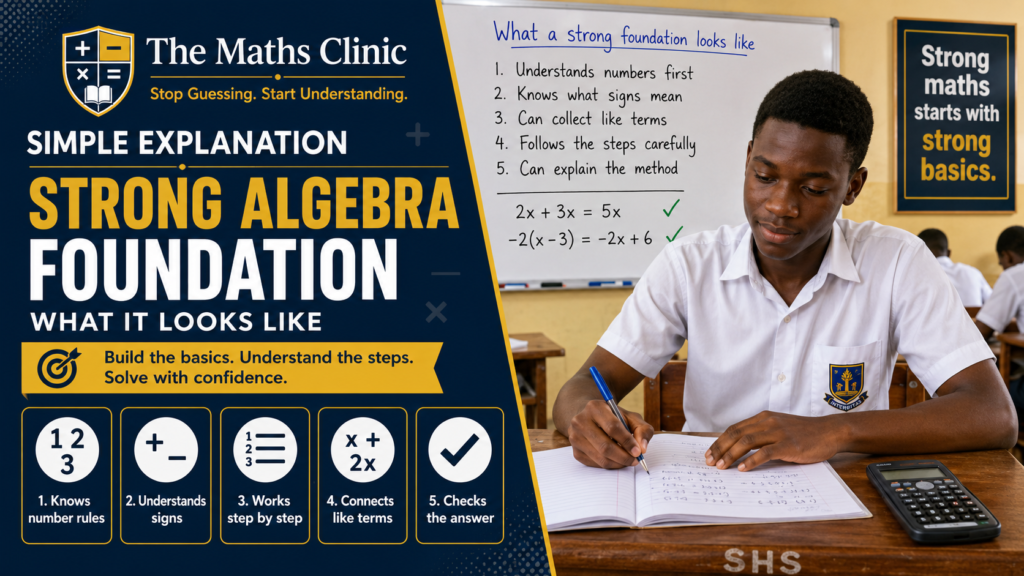
Simple Explanation: What Strong Algebra Foundations in Core Maths Look Like
A strong algebra foundation does not mean you know every difficult question. It means you understand the basic moves well enough to apply them when the question changes.
A learner with a strong foundation can identify like terms, control signs, remove brackets correctly, balance equations, substitute values carefully, translate words into expressions, and explain the reason behind each step.
When these basics are strong, higher Core Maths topics become easier because you are no longer fighting the language of the question.
Worked Example: Diagnose the Algebra Gap
Question: Solve 3(x – 2) + 4 = 16.
Step 1: Remove the bracket correctly. 3(x – 2) = 3x – 6, so the equation becomes 3x – 6 + 4 = 16.
Step 2: Combine like terms. 3x – 2 = 16.
Step 3: Add 2 to both sides. 3x = 18.
Step 4: Divide both sides by 3. x = 6.
Check: Substitute x = 6 into the original equation: 3(6 – 2) + 4 = 3(4) + 4 = 16. Correct.
What this example is testing: brackets, like terms, balancing, inverse operations, and checking. If a learner misses this question, the teacher should not only say “wrong.” The teacher should locate which part failed.
Common Wrong Approach
3(x – 2) + 4 = 16
3x – 2 + 4 = 16
3x + 2 = 16
3x = 14
x = 14/3
The first error is in the bracket. The learner multiplied 3 by x but did not multiply 3 by -2. That small bracket mistake spoiled the rest of the work.
This is why algebra correction must go beyond the final answer. The wrong answer is only the symptom. The real sickness is the bracket rule.
Correct Method: The Algebra Clinic Checklist
| Algebra skill | Question to ask yourself | What to do |
| Signs | Are positive and negative terms being handled correctly? | Slow down and apply integer rules. |
| Brackets | Is one term outside multiplying the whole bracket? | Multiply every term inside the bracket. |
| Like terms | Do the terms have the same letter part? | Combine only like terms. |
| Equation balance | What operation removes the unwanted term? | Do the same operation to both sides. |
| Fractions | What denominator is disturbing the equation? | Use LCM or inverse operations carefully. |
| Substitution | Have I put the value inside brackets where needed? | Respect signs, powers, and order of operations. |
| Meaning | What does the letter represent? | Translate the words before solving. |
Practice Task: Check Your Algebra Foundation
Try these questions without rushing. After each one, write the exact skill being tested.
1. Simplify: -4x + 9x – 2x
2. Expand: 5(a – 3)
3. Solve: 2x – 7 = 15
4. Solve: x/4 + 3 = 9
5. If y = 3x^2 – 2x and x = -1, find y.
6. Write an expression for Kofi having x mangoes. Ama has 4 more than twice Kofi’s mangoes.
7. Solve: 4(2x – 1) = 20
Suggested Answers
1. 3x
2. 5a – 15
3. x = 11
4. x = 24
5. y = 5
6. 2x + 4
7. x = 3
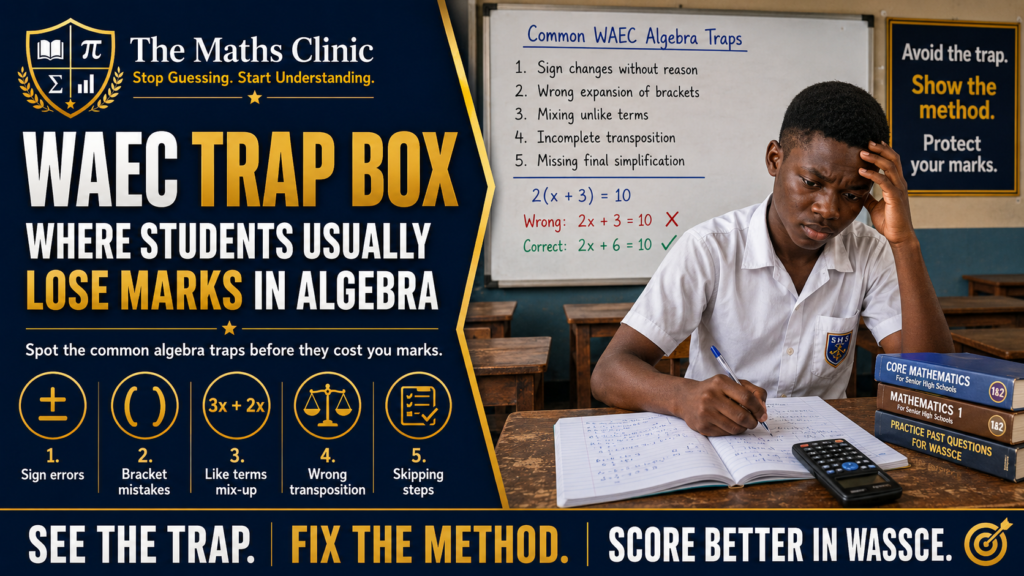
WAEC Trap Box: Where Students Usually Lose Marks in Algebra
- Changing signs without doing a proper inverse operation.
- Multiplying only the first term inside a bracket.
- Combining unlike terms, such as 3x + 2y.
- Forgetting that a negative value must be placed in brackets during substitution.
- Clearing fractions wrongly because the learner is rushing.
- Using memorized steps without understanding the meaning of the equation.
- Failing to check whether the final answer satisfies the original question.
How This Helps a Struggling SHS Learner Before WASSCE
This lesson helps the learner stop blaming the whole of Core Maths. Instead of saying, “I do not understand algebra,” the learner can now say, “My problem is signs,” or “My problem is brackets,” or “My problem is substitution.” That is progress.
Once the weakness is named, the correction becomes easier. A learner who knows the exact gap can practice with purpose. The learner is no longer doing random questions and hoping something will change.
That is the Maths Clinic approach: diagnose the gap, explain the cause, fix the method, and practice the exact skill until the learner gains control.
Conclusion: Fix the Foundation Before You Fight the Big Questions
If your algebra foundation in Core Maths is weak, it does not mean you cannot pass WASSCE. It means you must stop guessing and start repairing the exact skill that is breaking down.
Algebra becomes easier when you understand signs, brackets, like terms, equations, substitution, and the meaning of letters. These are not small things. They are the foundation blocks that support many Core Maths questions.
So before you rush into harder questions, check these seven signs. Find the weak point. Fix it step by step. Then practice again with better understanding. That is how a struggling learner begins to move from fear to control in WASSCE Core Maths.