Struggling with WASSCE Maths? Stop guessing. Let’s fix the gap step by step.

Algebra Practice for Weak Students: 10 Powerful Tasks

Algebra practice for weak students should not begin with difficult examination questions. It should begin with a simple diagnosis: can the learner look at an algebra question and identify the first correct step?
Many Ghanaian SHS learners can add and multiply numbers, yet they become stuck when letters, brackets, and signs appear together. The main problem is often not calculation. The learner does not know which rule controls the question. That is why one learner combines unlike terms, another expands only the first term in a bracket, and another moves a number across the equal sign without understanding why its sign changes.
This lesson answers that exact need. The ten tasks move from like terms to formula rearrangement. Each one names the hidden gap, shows the first decision, works through the method, and checks the result where possible. It is purposeful Core Maths algebra practice, not a collection of random questions.
| Maths Clinic diagnosis: If a learner cannot explain the first step, more difficult questions will only hide the foundation gap. Teach the decision before demanding speed. |
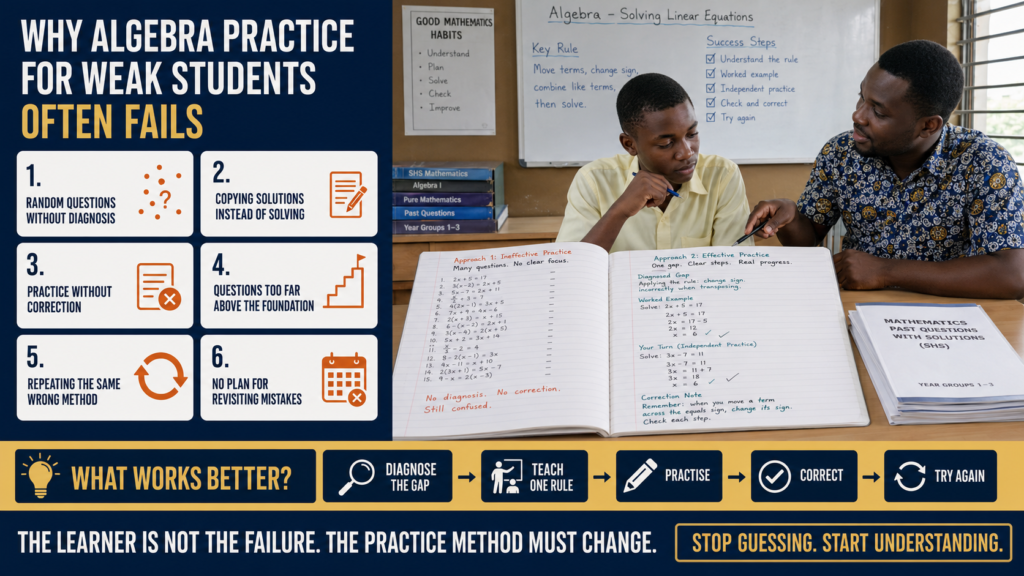
Why Algebra Practice for Weak Students Often Fails
Some learners practice by copying a worked example and checking only the final answer. This can create false confidence. The learner may remember what happened in one question but still fail when the numbers or signs change.
Algebra practice becomes weak when the learner:
- tries to perform every step mentally;
- treats all terms as like terms because they contain letters;
- memorizes “change side, change sign” without balancing both sides;
- substitutes negative values without brackets;
- ignores the order of operations; or
- checks the score but does not identify the type of mistake.
The correction is simple: after every question, the learner should name the rule used and the mistake avoided. That small habit turns ordinary exercises into useful Core Maths algebra practice.
What Good Algebra Practice for Weak Students Should Build
WASSCE Core Mathematics uses algebra inside equations, inequalities, graphs, variation, mensuration, financial mathematics, and word problems. A learner who has a weak algebra foundation may therefore lose marks in several topics, even when the main topic is not called algebra.
Good practice should help the learner answer four questions:
- What type of algebra question is this?
- Which rule or operation should I use first?
- Which sign, bracket, or term needs special care?
- How can I check whether my answer is reasonable?
How to Use This Algebra Practice for Weak Students
Cover the solution first. Attempt the question and write the first step. Then compare your method with the worked solution. If your answer is wrong, do not write only a cross. Record whether the gap came from like terms, signs, brackets, substitution, balance, or inverse operations.
| Simple rule: One carefully corrected question can teach more than ten rushed questions. Accuracy must come before speed. |
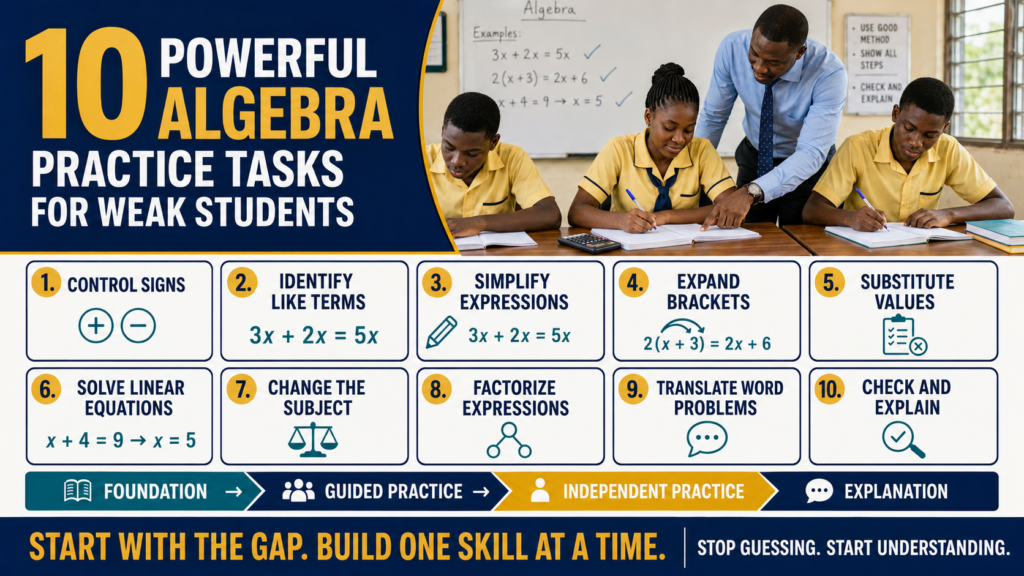
10 Powerful Algebra Practice Tasks for Weak Students
The tasks are arranged from basic simplification to formula work. Do them in order because each new task depends on an earlier skill.
Algebra Practice for Weak Students – Task 1: Recognize and Collect Like Terms
Question:
Simplify
Gap being tested: recognizing terms with the same variable and power
Step 1: Identify the like terms.
, and are all x-terms.
Step 2: Add their coefficients.
Answer:
| WAEC trap: Do not add the three x symbols. Add only their coefficients: 3, 5, and -2. |
Algebra Practice for Weak Students – Task 2: Keep Unlike Terms Separate
Question:
Simplify
Gap being tested: sorting terms before combining them
Step 1: Group the a-terms and b-terms.
Step 2: Simplify each group.
Answer:
| WAEC trap: 3a and 5b cannot become 8ab. Their variable parts are different. |
Algebra Practice for Weak Students – Task 3: Control Positive and Negative Signs
Question:
Simplify
Gap being tested: separating variable terms from constant terms and controlling signs
Step 1: Collect the x-terms.
Step 2: Collect the numbers.
Answer:
| WAEC trap: Since 5 is larger than 2, the result of 2 – 5 is negative. |
Algebra Practice for Weak Students – Task 4: Expand Every Term in a Bracket
Question:
Expand
Gap being tested: using the distributive law
Step 1: Multiply 3 by x.
3 × x = 3x
Step 2: Multiply 3 by 4.
Answer:
| WAEC trap: Writing 3x + 4 means that 3 is multiplied only by x. The 4 must also be multiplied. |
Algebra Practice for Weak Students – Task 5: Expand a Bracket with a Negative Multiplier
Question:
Expand
Gap being tested: multiplying signs correctly during expansion
Step 1: Multiply -2 by x.
Step 2: Multiply -2 by -5.
Answer:
| WAEC trap: A negative multiplied by a negative gives a positive. The second term is +10, not -10. |
Algebra Practice for Weak Students – Task 6: Factorize by Taking Out the Common Factor
Question:
Factorize
Gap being tested: finding the greatest factor common to every term
Step 1: Find the common factor.
6 divides both 6x and 12.
Step 2: Divide each term by 6.
6x ÷ 6 = x and 12 ÷ 6 = 2
Answer:
6(x + 2)
| WAEC trap: Factoring is the reverse of expanding. Expand your answer to check it. |
Check:
6(x + 2) = 6x + 12
Algebra Practice for Weak Students – Task 7: Substitute a Negative Value Safely
Question:
If x = -3, find 2x2 + 5.
Gap being tested: using brackets around a negative number and applying indices first
Step 1: Replace x with (-3).
2(-3)2 + 5
Step 2: Evaluate the power first.
(-3)2 = 9
Step 3: Complete the calculation.
2(9) + 5 = 18 + 5 = 23
Answer:
23
| WAEC trap: -3² can be misread as -(3²). Write (-3)², so the negative value is clearly being squared. |
Algebra Practice for Weak Students – Task 8: Solve a One-Step Equation by Balancing
Question:
Solve x + 9 = 17
Gap being tested: using the same operation on both sides of an equation
Step 1: Subtract 9 from both sides.
x + 9 – 9 = 17 – 9
Step 2: Simplify.
x = 8
Answer:
x = 8
| WAEC trap: Do not merely say that +9 crossed the equal sign and became -9. Subtract 9 from both sides. |
Check:
8 + 9 = 17
Algebra Practice for Weak Students – Task 9: Solve a Two-Step Equation in the Correct Order
Question:
Solve 4x – 6 = 18
Gap being tested: undoing addition or subtraction before undoing multiplication
Step 1: Add 6 to both sides.
Step 2: Divide both sides by 4.
x = 6
Answer:
x = 6
| WAEC trap: Dividing by 4 before removing -6 can create avoidable fractions. Remove the constant term first. |
Check:
Algebra Practice for Weak Students – Task 10: Make a Letter the Subject
Question:
Make x the subject of
Gap being tested: reversing operations while keeping the equation balanced
Step 1: Subtract 4 from both sides.
Step 2: Divide both sides by 3.
Answer:
| WAEC trap: The whole expression y – 4 must be divided by 3. Keep it together with brackets or a fraction bar. |
Check:
What This Algebra Practice for Weak Students Has Diagnosed
| If you missed… | Likely learning gap | Your next repair |
| Tasks 1–3 | Like terms or signs | Sort terms before calculating. |
| Tasks 4–5 | Expansion and sign rules | Draw arrows from the multiplier to every term. |
| Task 6 | Common factors | Find what divides every term, then expand to check. |
| Task 7 | Substitution and indices | Use brackets around negative values. |
| Tasks 8–9 | Equation balance | Write the same operation on both sides. |
| Task 10 | Inverse operations | Undo operations in reverse order. |
Independent Core Maths Algebra Practice
Attempt these without looking back at the worked tasks. Beside each answer, write the rule you used. This second round checks whether the method has become yours.
- Simplify:
- Simplify:
- Expand:
- Expand:
- Factorize:
- If a = -2, find
- Solve:
- Solve:
- Solve:
- Make P the subject of
Answers to the Core Maths Algebra Practice
- 7p
- –
- 11
| Do not stop at the score: Return to every wrong answer and name the gap. A score tells you how many you missed; a diagnosis tells you what to practice next. |
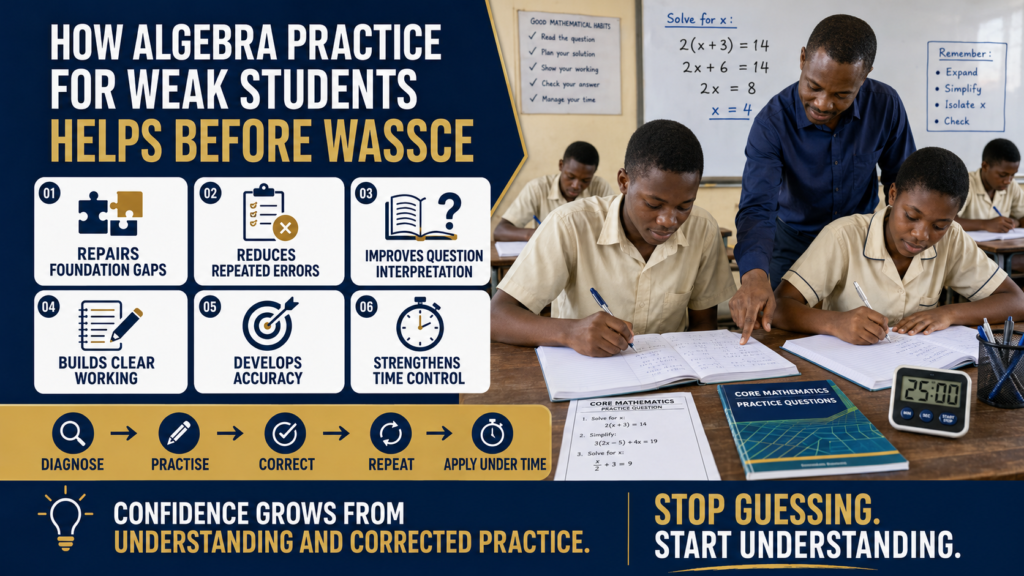
How Algebra Practice for Weak Students Helps Before WASSCE
These tasks do more than supply answers. They show whether the learner’s difficulty comes from signs, unlike terms, brackets, substitution, equation balance, or formula work. Once the exact gap is known, practice becomes focused. The learner no longer says, “I am bad at algebra.” The learner can say, “I need more practice with negative signs when expanding brackets.” That is a smaller and repairable problem.
For continued Core Maths algebra practice, the next useful step is to complete a short set on the weakest area before attempting mixed WASSCE-style questions. A learner who missed Tasks 1–3 should not jump straight to simultaneous equations. Repair like terms and signs first.
Continue Your Algebra Practice for Weak Students
Internal link suggestion: link “Targeted Core Maths Practice Zone” to the Maths Clinic Practice Zone. Link “repair your algebra foundation” to the Intervention Hub. Add one related algebra clinic lesson on like terms, substitution, or linear equations.
Outbound link suggestion: where you discuss curriculum expectations, add one natural link to an official NaCCA curriculum page or a relevant WAEC guidance page.
Conclusion: Algebra Practice for Weak Students Must Repair One Gap at a Time
Algebra Practice for Weak Students works best when the learner understands why each step is taken. The goal is not to rush through many questions. The goal is to recognize the question type, choose the correct first operation, control the signs, and check the result.
Begin with the task that exposed your weakness. Correct it carefully, try a similar question, and explain the rule in your own words. That is how a weak algebra foundation becomes steady before WASSCE.
Stop Guessing. Start Understanding.