Struggling with WASSCE Maths? Stop guessing. Let’s fix the gap step by step.

Algebra Traps: 8 Powerful Ways Learners Lose Easy Marks

Algebra traps are one major reason many Ghanaian SHS students lose easy marks in WASSCE Core Maths. The sad part is that some of these marks are not lost because the learner does not know mathematics. The marks are lost because the learner rushes, copies wrongly, changes signs without thinking, removes brackets carelessly, or treats letters like decoration.
In many classrooms, you can see the problem clearly. A learner starts the solution well, but after two lines, the work begins to change shape. A plus sign becomes a minus. A bracket disappears. Like terms are joined wrongly. A fraction is cleared on one side only. By the final answer, the student is far from the correct solution, but the first line was not bad.
That is why this Maths Clinic lesson is not written to shame weak learners. It is written to diagnose the real algebra mistakes and fix them one after the other. Once the hidden gap is corrected, algebra becomes more manageable. The learner stops guessing and begins to solve with control.
The Learner’s Problem
The common problem is simple: the learner knows some algebra rules, but the rules are not yet stable. So when the question changes slightly, the learner also changes the method anyhow.
For example, the learner may solve x + 5 = 12 correctly today but lose marks when the question becomes 3x – 5 = 16. Another learner may expand 2(x + 3) as 2x + 3 instead of 2x + 6. A third learner may simplify 4a + 3b – 2a as 5ab because the letters confuse them.
The issue is not always laziness. Many learners have a weak foundation in the meaning of terms, operations, brackets, signs, and equality. They have seen many examples, but they have not understood why the steps work.
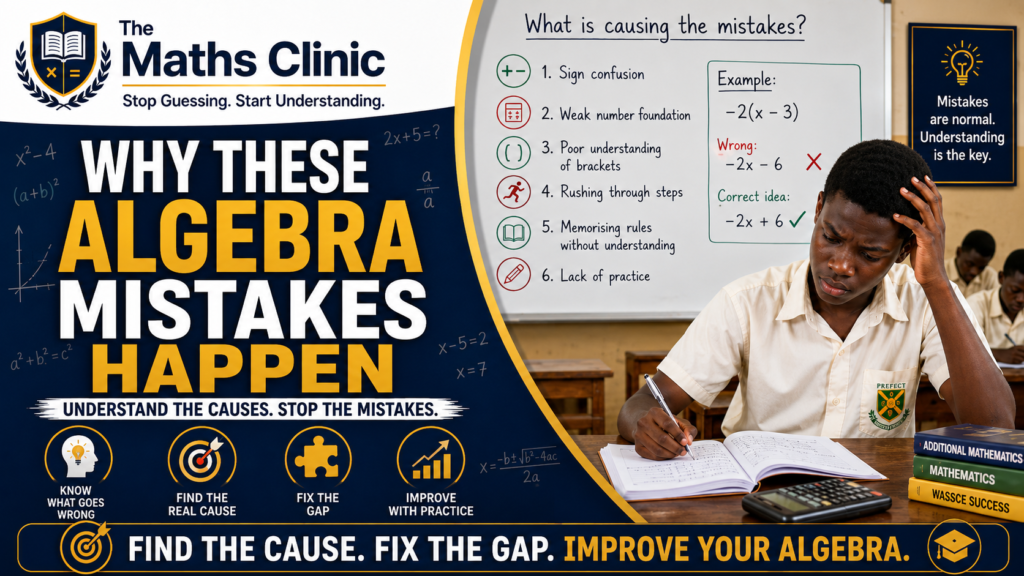
Why These Algebra Mistakes Happen
Most algebra mistakes happen because learners memorize movements instead of understanding operations. They say things like “when it crosses the equal sign, it changes sign.” That statement may sometimes lead to the right answer, but it is not the full idea. The real idea is that we use inverse operations to keep the equation balanced.
Another cause is poor attention to structure. Algebra is like a sentence. The position of a sign, bracket, denominator, exponent, or equal sign can change the whole meaning. When the learner does not read the structure, the work becomes guessing.
A third cause is weak number sense. If a learner is not comfortable with directed numbers, fractions, multiplication facts, and order of operations, algebra exposes the weakness quickly. Algebra does not create all the problems; it reveals the gaps that were already there.
What WAEC or the Curriculum Reveals about Algebra Traps
In WASSCE Core Maths, algebra appears in many forms. It may come as a simplification, expansion, factorization, substitution, linear equations, simultaneous equations, inequalities, formula work, functions, variation, graphs, or word problems. This means a learner who is weak in algebra does not lose marks in algebra alone. The weakness follows the learner into other topics.
The Ghana SHS mathematics curriculum expects learners to reason with symbols, use operations correctly, interpret relationships, and solve problems. Algebra is therefore not just about finding x. It is about understanding how quantities are connected.
So when a learner keeps losing easy marks in algebra, the correction should not only be “learn more examples.” The better correction is to find the trap, understand why it happens, and practice the correct move until it becomes stable.
Simple Explanation: What Algebra Really Wants From the Learner
Algebra wants the learner to respect meaning. A letter stands for a number. A term is a mathematical item separated by plus or minus signs. A bracket groups items together. An equal sign means both sides have the same value. A sign belongs to the term after it unless a bracket or operation changes the situation.
Once the learner understands these meanings, algebra becomes less frightening. The learner no longer asks, “Should I change the sign?” The learner asks a better question: “What operation is being done, and what inverse operation will undo it correctly?”
This is the mindset that saves marks in WASSCE Core Maths.
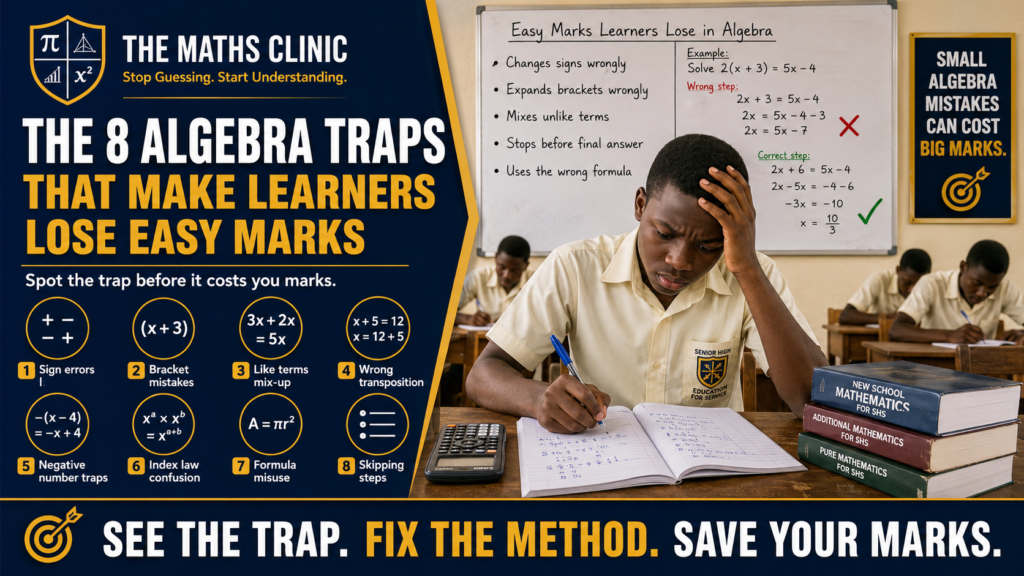
The 8 Algebra Traps That Make Learners Lose Easy Marks
These 8 algebra traps make learners lose easy marks because they look small at first. A learner may know the topic, copy the right formula, and even start the solution well. But one wrong sign, one missed bracket, one mixed-up like term, or one skipped step can change the whole answer.
This is why algebra mistakes are dangerous before WASSCE. They do not always come from laziness. Many times, they come from weak understanding of the process. The learner is solving, but the reason behind each step is not clear.
When you learn to notice these traps early, you stop treating algebra as guesswork. You begin to check your signs, expand brackets carefully, combine only like terms, transpose correctly, and finish the question properly. That is how easy marks are protected.
Trap 1: Changing Signs Without Understanding Inverse Operations
Many learners have been told that when a number crosses the equal sign, it changes sign. The danger is that they start moving things without knowing the operation they are undoing.
Example: Solve x + 7 = 15. The correct thinking is that 7 is added to x, so subtract 7 from both sides. Therefore x = 15 – 7 = 8. The sign change is not magic. It came from subtracting 7 from both sides.
Maths Clinic fix: Correct fix: Teach learners to say the operation aloud: added, subtracted, multiplied, or divided. Then use the opposite operation on both sides.
Trap 2: Removing Brackets Carelessly
A bracket means the outside number affects everything inside the bracket. Learners lose marks when they multiply only the first term and leave the rest untouched.
Example: Wrong: 3(x + 4) = 3x + 4. Correct: 3(x + 4) = 3x + 12.
Maths clinic fix: Correct fix: Every term inside the bracket must receive the outside multiplier. Let learners draw arrows from the outside number to each term inside the bracket.
Trap 3: Combining Unlike Terms
Learners sometimes join terms simply because they see letters. But only like terms can be combined. Like terms must have the same letter part with the same powers.
Example: Wrong: 4a + 3b = 7ab. Correct: 4a + 3b cannot be simplified further because a and b are unlike terms.
Maths clinic fix: Correct fix: Before adding or subtracting algebraic terms, check the letter part. The same letter and the same power can join. Different letter parts must stay separate.
Trap 4: Forgetting That a Minus Sign Belongs to the Term After It
In algebra, signs are not decoration. A minus sign carries the term after it. When learners copy work without carrying the sign, the answer changes.
Example: Simplify 7x – 3x + 2. The term -3x must remain negative until it is combined with 7x. So 7x – 3x = 4x, and the answer is 4x + 2.
Maths Clinic fix: Correct fix: Train learners to circle each term with its sign before simplifying.
Trap 5: Clearing Fractions on One Side Only
When fractions appear in equations, some learners multiply only the side they dislike. That breaks the balance of the equation.
Example: x/3 = 5. Multiply both sides by 3. So x = 15. If the equation is x/3 + 2 = 7, first subtract 2 from both sides, then multiply by 3.
Maths Clinic fix: Correct fix: Whatever operation you use to clear a fraction must be applied to the whole equation, not one small part only.
Trap 6: Substituting Values Without Brackets
Substitution becomes dangerous when negative numbers are involved. A learner may replace x with -2 but forget to use brackets. This creates sign errors.
Example: If x = -2, find 3x^2. Correct: 3(-2)^2 = 3 x 4 = 12. Wrong: 3(-2^2) = -12.
Maths clinic fix: Correct fix: Any time a negative value is substituted, put it in brackets first. Brackets protect the value.
Trap 7: Misusing Index Laws
Learners lose marks when they multiply powers and multiply the exponents instead of adding them. Index laws require careful conditions.
Example: Correct: a³ x a² = a³⁺² = a⁵. 5. Wrong: a³ x a² = a⁶. The exponents are added because the base is the same and the operation is multiplication.
Maths Clinic fix: Correct fix: Ask learners to expand powers as repeated multiplication first. This helps them see why the index law works.
Trap 8: Losing the Equal Sign During Working
Some learners write algebra as if each line is a new answer. They drop the equal sign and jump steps, and the solution loses meaning.
Example: 2x + 5 = 17 should become 2x = 12, then x = 6. Each line must remain true. The equal sign is the balance beam of the equation.
Maths Clinic fix: Correct fix: Every equation line must have an equal sign until the final value is found. This habit protects the learner from careless jumps.
Worked Example: Fixing More Than One Algebra Trap at Once
Solve the equation: 3(x – 2) + 4 = 2x + 9
Step-by-step solution
Step 1: Expand the bracket carefully. 3(x – 2) = 3x – 6, so the equation becomes 3x – 6 + 4 = 2x + 9.
Step 2: Simplify the left side. 3x – 6 + 4 = 3x – 2. So 3x – 2 = 2x + 9.
Step 3: Collect like terms using inverse operations. Subtract 2x from both sides: x – 2 = 9.
Step 4: Undo the subtraction. Add 2 to both sides: x = 11.
Step 5: Check the answer. Left side: 3(11 – 2) + 4 = 3(9) + 4 = 31. Right side: 2(11) + 9 = 31. The answer is correct.
Hidden lesson: This one question tested brackets, signs, like terms, inverse operations, and checking. That is why algebra traps must be fixed together, not only separately.
Common Wrong Approach
A learner may write:
3(x – 2) + 4 = 2x + 9
3x – 2 + 4 = 2x + 9
3x + 2 = 2x + 9
3x – 2x = 9 + 2
x = 11
The final answer happens to be correct here, but the work contains a dangerous bracket error. In WASSCE, a learner may not always be lucky. If the wrong step leads to a wrong answer, the easy marks are gone.
WAEC Trap Box: Do not judge algebra only by the final answer. The method matters. A wrong expansion, wrong sign, or missing equal sign can destroy the solution even when the learner understands part of the question.
Correct Method Learners Should Practise
The correct algebra habit is not to rush. Learners should use this five-check method before moving from one line to the next:
- Check the bracket: Has every term inside the bracket been affected?
- Check the sign: Did each term carry its correct plus or minus sign?
- Check like terms: Are the terms truly alike before combining them?
- Check the balance: Was the same operation applied correctly to both sides?
- Check the final answer: Does substituting the answer make both sides equal?
Practice Task: Spot and Correct the Algebra Trap
Try these before checking the answers. The aim is not speed first. The aim is correct thinking.
| No. | Question |
| 1 | Expand: 4(x + 5) |
| 2 | Simplify: 6a + 2b – 3a |
| 3 | Solve: x – 8 = 13 |
| 4 | Solve: 2(x + 3) = 18 |
| 5 | If x = -3, find x² + 2x |
| 6 | Simplify: y^4 x y^3 |
| 7 | Solve: x/4 + 3 = 9 |
| 8 | Simplify: 5m – 2n + 3m + n |
Answers
- 1. 4x + 20
- 2. 3a + 2b
- 3. x = 21
- 4. x = 6
- 5. (-3)^2 + 2(-3) = 9 – 6 = 3
- 6. y^7
- 7. x = 24
- 8.8m – n
How Teachers and Parents Can Use This Lesson
Teachers can use this post as a diagnostic checklist during algebra revision. Instead of marking only right or wrong, identify the exact trap: bracket trap, sign trap, like-term trap, fraction trap, substitution trap, index trap, or equal-sign trap.
Parents can also use it to understand why a child may say, “I understand it in class, but I forget in the exam.” Many times, the child has not forgotten everything. One small algebra trap has broken the whole solution.
Conclusion: Algebra Improves When the Trap Is Named
Algebra traps are dangerous because they look small. A missing bracket, a wrong sign, or a careless combination of unlike terms may look harmless, but it can cost a learner easy marks in WASSCE Core Maths.
The good news is that these mistakes can be corrected. Once the learner learns to name the trap, slow down, and apply the correct method, algebra begins to feel less confusing. The learner no longer solves by fear. The learner solves by understanding.
That is the aim of The Maths Clinic: to help weak and struggling learners stop guessing, find the hidden gap, and rebuild Core Maths one correct step at a time.
Try targeted WASSCE Maths practice and fix your algebra learning gaps.