Struggling with WASSCE Maths? Stop guessing. Let’s fix the gap step by step.

Area, perimeter, or volume? Teacher’s Quick Diagnostic Checklist

Area, perimeter, or volume is meant for a struggling Ghanaian SHS learner who knows several mensuration formulas but cannot decide whether a practical situation requires distance around, flat covering, outside covering, or space inside.
A learner may know: , and:
But still use the wrong formula.
Why? The learner may not understand what the question is asking to be measured.
This mensuration in the Core Maths Clinic identifies the measurement-type decision gap, corrects it visibly, and prepares the learner for WASSCE and other WAEC-organized examinations.
The central question is not initially:
Which formula do you remember?
The better diagnostic question is:
What does the answer represent in the real situation?
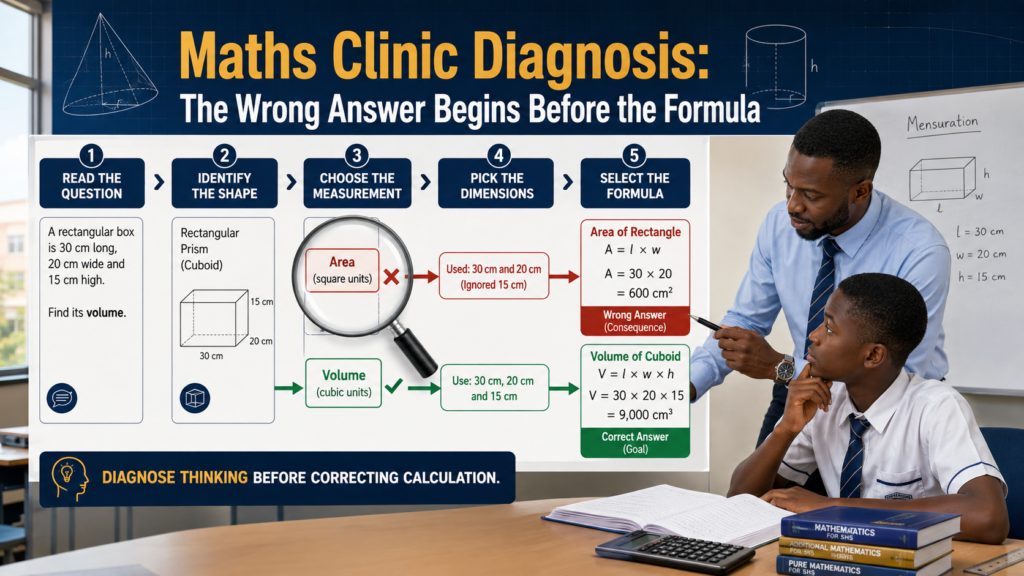
Maths Clinic Diagnosis: The Wrong Answer Begins Before the Formula
The hidden gap is:
The learner moves from the numbers in the question to a formula without first deciding whether the required measurement is length, perimeter, area, surface area, volume, or capacity.
This is why a learner may:
- Use the area to calculate fencing
- Use perimeter to calculate floor tiles
- Use volume to calculate paint for a flat wall
- Use the area to calculate water inside a tank
- Use curved surface area when total surface area is required
- Give for a volume
- Find the correct measurement but stop before calculating cost
- Copy a three-dimensional formula for a flat figure
These errors are not always caused by weak arithmetic. The breakdown often occurs during interpretation.
Current Curriculum Connection
A learner working with mensuration should be able to:
- Observe or sketch a figure
- Identify the shape or solid
- State what is being measured
- Explain why a selected rule or formula fits
- Label the given dimensions
- Calculate accurately
- Check units
- Solve practical problems
- Communicate the reasoning clearly
Where suitable, the learner may use:
- A ruler
- A measuring tape
- A grid
- Paper cut-outs
- Boxes and containers
- Simple models
- Dynamic geometry tools
These materials help the learner connect mathematical measurements to real objects.
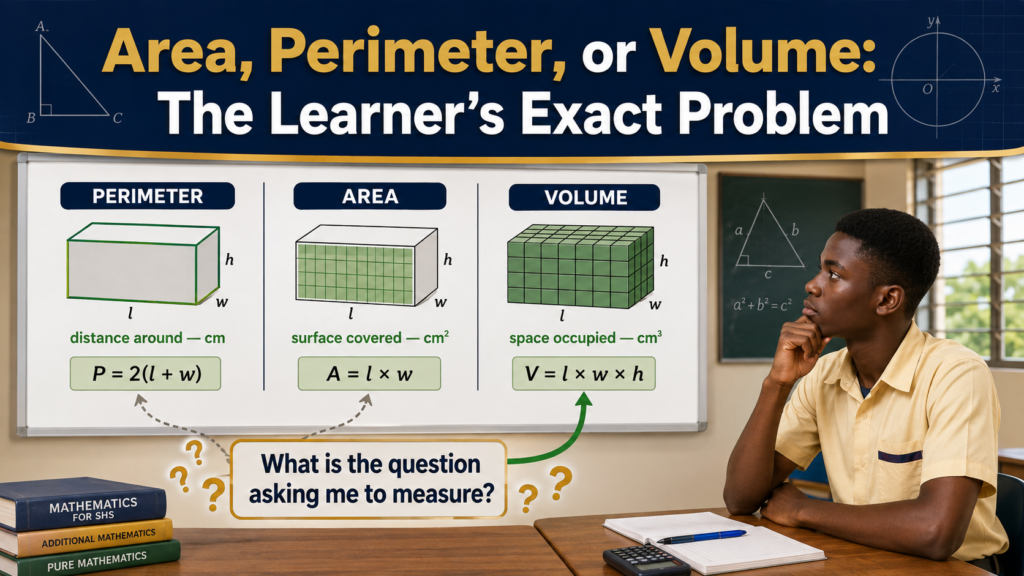
Area, Perimeter, or Volume: The Learner’s Exact Problem
The weak point is decision-making.
The learner may know several formulas but cannot answer:
- Is the question asking for a boundary?
- Is it asking for a flat surface?
- Is it asking for the outside of a solid?
- Is it asking for space inside?
- Is it asking how much liquid can be held?
- Is it asking for the cost after the measurement is found?
Area, perimeter, surface area, and volume are not interchangeable.
They answer different practical needs.
The exact correction is:
Translate the real action into a measurement before choosing a formula.
The Five Measurements Learners Must Separate
Length
Length measures distance from one point to another.
Examples include:
- Height
- Width
- Radius
- Diameter
- Slant height
- Distance travelled
Common units:
- mm
- cm
- m
- km
Perimeter
Perimeter measures the total distance around a closed flat figure.
Examples include:
- Fencing a field
- Framing a photograph
- Putting ribbon around a card
- Creating a border
- Walking around a pitch
Perimeter uses ordinary length units:
- cm
- m
- km
Area
Area measures the flat space inside a two-dimensional figure.
Examples include:
- Tiling a floor
- Carpeting a room
- Painting one flat wall
- Planting grass
- Measuring land
- Cutting cloth for a flat surface
Area uses square units:
- (
- (
Surface area
Surface area measures the outside covering of a three-dimensional object.
Examples include:
- Painting a tank
- Wrapping a box
- Covering the outside of a cylinder
- Finding material for a closed container
- Painting the outside of a spherical object
Surface area also uses square units.
Volume
Volume measures the three-dimensional space occupied by a solid or available inside it.
Examples include:
- Space inside a tank
- Sand inside a box
- Air in a room
- Concrete used in a block
- Space occupied by a cylinder
Volume uses cubic units:
Capacity
Capacity measures how much liquid a container can hold.
Common units include
- mL
- L
Useful conversions are
, ,
The “Around, Cover, or Fill?” Decision Map
| Real action | Measurement |
|---|---|
| Going around | Perimeter or circumference |
| Covering a flat region | Area |
| Covering the outside of a solid | Surface area |
| Filling or holding | Volume or capacity |
| Buying by meter | Length or perimeter |
| Buying by square meter | Area or surface area |
| Buying by cubic meter | Volume |
A quick learner prompt is:
Is it going around, covering, or filling?
However, the learner must also distinguish flat covering from covering a solid:
- Flat covering → area
- Outside covering of a solid → surface area
Main Teaching Point 1: If It Goes Around, Think Perimeter
Words that often suggest perimeter include:
- Fence
- Border
- Frame
- Boundary
- Edge
- Ribbon around
- Distance around
- Wire around
For a rectangle:
For a square:
For a circle, the distance around is called circumference: or:
Important caution
A fence may contain:
- A gate
- An opening
- An unfenced side
If so, calculate the full perimeter and subtract the part that is not fenced.
Main Teaching Point 2: If It Covers a Flat Surface, Think Area
Words that often suggest an area include:
- Tile
- Carpet
- Grass
- Paint a wall
- Cloth
- Paving
- Land size
- Floor space
- Cover a flat surface
For a rectangle:
For a triangle:
For a circle:
Area measures the region inside the boundary.
Main Teaching Point 3: If It Covers a Solid, Think Surface Area
A three-dimensional object has outside faces or surfaces.
Words that may suggest surface area include:
- Wrap the box
- Paint the outside
- Cover the cylinder
- Material for a container
- Metal sheet required
- Outside surface
The learner must check whether the object is:
- Open
- Closed
- Missing a base
- Missing a top
- Curved only
- Completely covered
For a cuboid:
For a closed cylinder:
For the curved part of a cylinder only:
Main Teaching Point 4: If It Fills or Holds, Think Volume
Words that often suggest volume or capacity include:
- Fill
- Hold
- Contain
- Store water
- Space inside
- Capacity
- Air inside
- Sand required
- Petrol in a tank
For a cuboid:
For a cylinder:
For a cone:
The final unit must be cubic unless the answer is converted to capacity.
Main Teaching Point 5: Use the Shape as a Second Check
The action tells the learner what type of measurement is required. The shape then determines the formula.
For example:
Find the area to be tiled.
The required measurement is area.
If the floor is rectangular:
If the floor is circular:
The word “tile” does not provide the complete formula. It identifies the measurement type. The shape provides the formula.
Main Teaching Point 6: Use the Unit as a Final Check
| Measurement | Expected unit |
|---|---|
| Length | cm, m, km |
| Perimeter | cm, m, km |
| Area | , |
| Surface area | , |
| Volume | , |
| Capacity | mL, L |
| Cost | GH₵ |
If the question asks for volume and the answer is written in , the learner should pause.
The wrong unit may reveal that the wrong measurement or formula was selected.
Main Teaching Point 7: Ask What a Real Person Would Buy
This question can help a struggling learner.
Fencing
A person buys fencing by length.
Therefore, find the perimeter.
Tiles
A person buys tiles to cover a surface.
Therefore, find the area before calculating the number or cost of tiles.
Paint
Paint may involve:
- Area of a flat wall
- Surface area of a solid object
Read the full question.
Water
Water inside a container involves volume or capacity.
Wrapping paper
Wrapping a box involves surface area, not volume.
The wrapping paper covers the outside. It does not fill the inside.
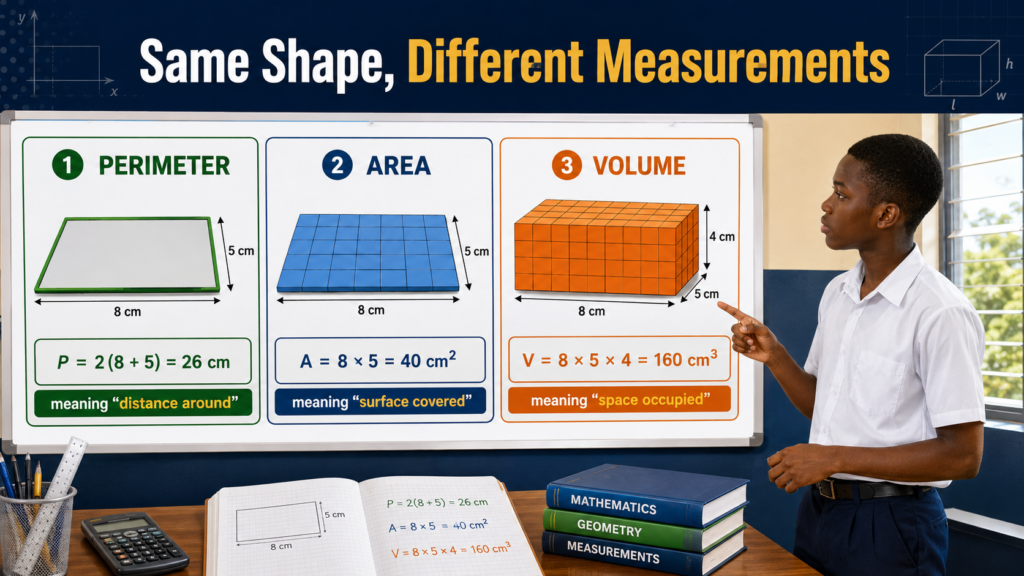
Same Shape, Different Measurements
A rectangular garden is long and wide.
Question A: Find the distance around the garden.
This requires a perimeter:
Question B: Find the area for planting grass.
This requires area:
Central lesson
The measurements are the same, but the action changes:
- Around → perimeter
- Inside flat region → area
The learner should not select a formula from the shape alone.
Same Solid, Different Measurements
A box measures by by
Question A: Find the space inside.
This requires volume:
Question B: Find the cardboard required to make a closed box.
This requires the total surface area:
The same dimensions enter different formulas because the questions measure different things.
Common Wrong Approaches
Wrong Approach 1: Using area for fencing
The learner multiplies length by width.
Hidden gap: The learner did not connect fencing to the distance around.
Wrong Approach 2: Using perimeter for tiles
The learner adds the side lengths.
Hidden gap: The learner did not connect tiles to flat covering.
Wrong Approach 3: Using surface area for water inside a tank
Hidden gap: Outside covering has been confused with inside space.
Wrong Approach 4: Using volume to wrap a box
Hidden gap: Filling and covering have been confused.
Wrong Approach 5: Choosing from the shape only
The learner sees a cylinder and immediately writes:
even when curved surface area is required.
Hidden gap: The request was not identified.
Wrong Approach 6: Trusting one keyword alone
The word “paint” may mean the area of a wall or the surface area of a solid.
Hidden gap: The learner did not read the full situation.
Wrong Approach 7: Ignoring an opening
The learner calculates the full perimeter even though a gate is not fenced.
Hidden gap: The practical condition was overlooked.
Wrong Approach 8: Stopping before cost
The learner calculates correctly but fails to multiply by the tile cost.
Hidden gap: The final demand was not revisited.
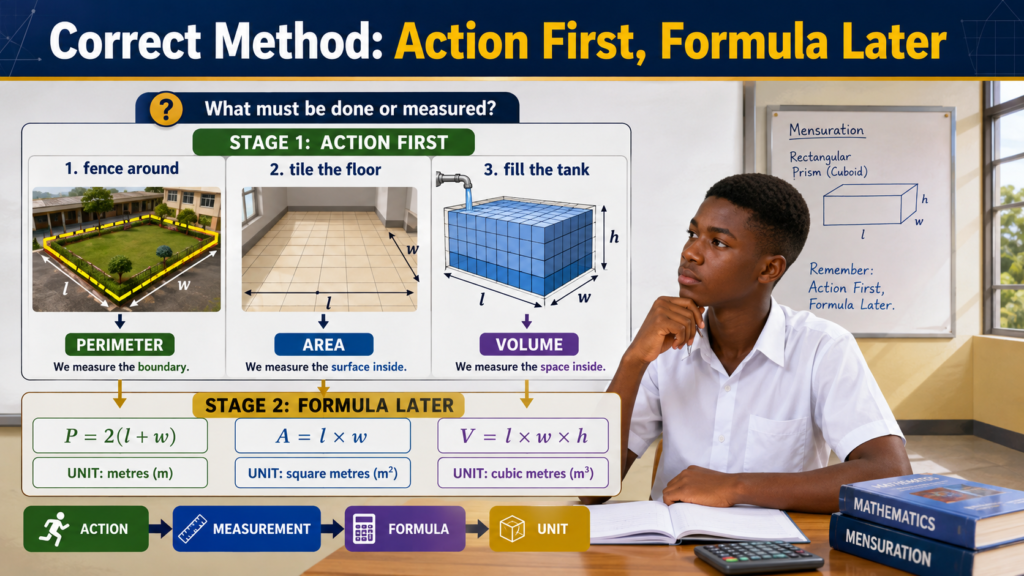
Correct Method: Action First, Formula Later
Use this method.
Step 1: Read the final demand.
What must be found?
Step 2: Underline the action word.
Examples:
- Fence
- Tile
- Cover
- Paint
- Fill
- Hold
- Wrap
- Border
Step 3: Translate the action
Write:
The action means __________.
For example:
Fencing means distance around.
Step 4: Name the measurement.
Write:
Required measurement = perimeter.
Step 5: Identify the shape
The shape determines the exact formula.
Step 6: Label the dimensions.
Write (l), (b), (h), (r) or (d) beside the correct values.
Step 7: Select the formula.
Only now should the formula be written.
Step 8: Calculate
Show orderly substitution.
Step 9: Complete any practical step.
Calculate cost, capacity, or number of items where required.
Step 10: Check the unit
Make sure the answer represents the measurement requested.
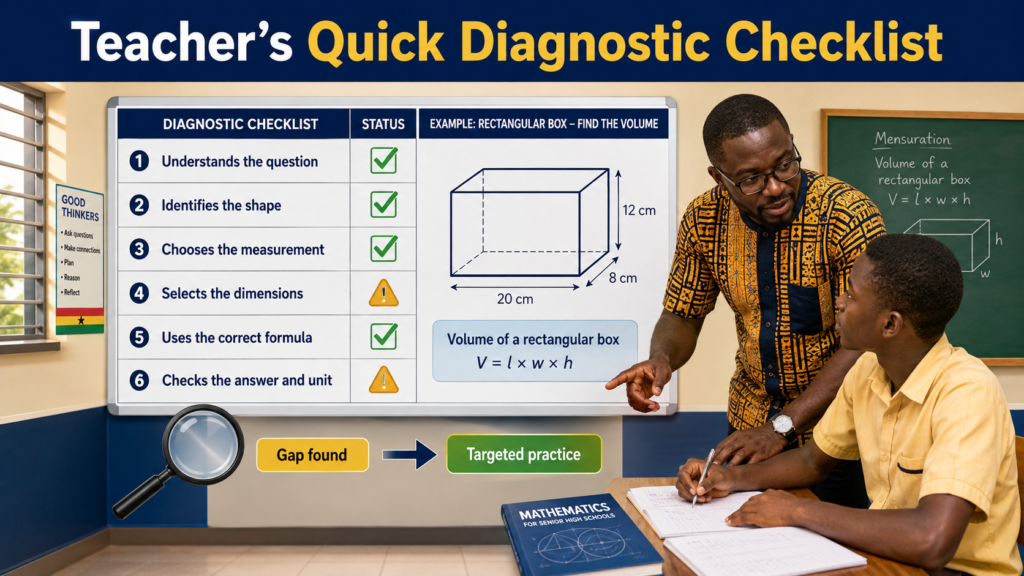
Teacher’s Quick Diagnostic Checklist
Use the checklist before giving the learner more formulas.
| Diagnostic question | If yes | If no |
|---|---|---|
| Can the learner name the shape? | Continue to measurement type. | Repair shape recognition. |
| Can the learner state what is being measured? | Continue to formula choice. | Separate around, covering, and filling |
| Can the learner identify perimeter, area, surface area, or volume? | Continue to dimensions. | Use real objects and action words. |
| Can the learner label the dimensions? | Continue to formula. | Repair radius, diameter, height, and side meanings |
| Can the learner choose the correct formula? | Continue to substitution | Match formulas to measurement meanings. |
| Can the learner substitute correctly? | Continue to calculate. | Practice labelled substitution. |
| Can the learner use the correct unit? | Continue the explanation. | Repair ordinary, square, and cubic units. |
| Can the learner explain the answer? | Move to mixed questions. | The learner may be copying without understanding. |
| Can the learner complete a cost or capacity step? | Move to WASSCE-style problems. | Repair multi-step interpretation. |
| Can the learner solve a fresh similar question? | Gap is becoming secure. | Reteach and retest the exact gap. |
Five-Minute Teacher Diagnostic
This short diagnostic can be completed before formal calculation.
Part A: Classification only
Ask the learner to classify each situation without using a formula.
- Fencing a rectangular garden
- Tiling a classroom floor
- Filling a water tank
- Painting the outside of a cylinder
- Putting ribbon around a circular card
Expected responses:
- Perimeter
- Area
- Volume or capacity
- Surface area
- Circumference
Part B: Unit prediction
Ask the learner to choose the likely unit.
- Fence length → m
- Floor area →
- Tank volume →
- Water capacity → L
- Painting cost → GH₵ after area and price are used
Part C: Explanation
Ask:
Why did you choose that measurement?
A learner who gives the correct word but cannot explain it may still be guessing.
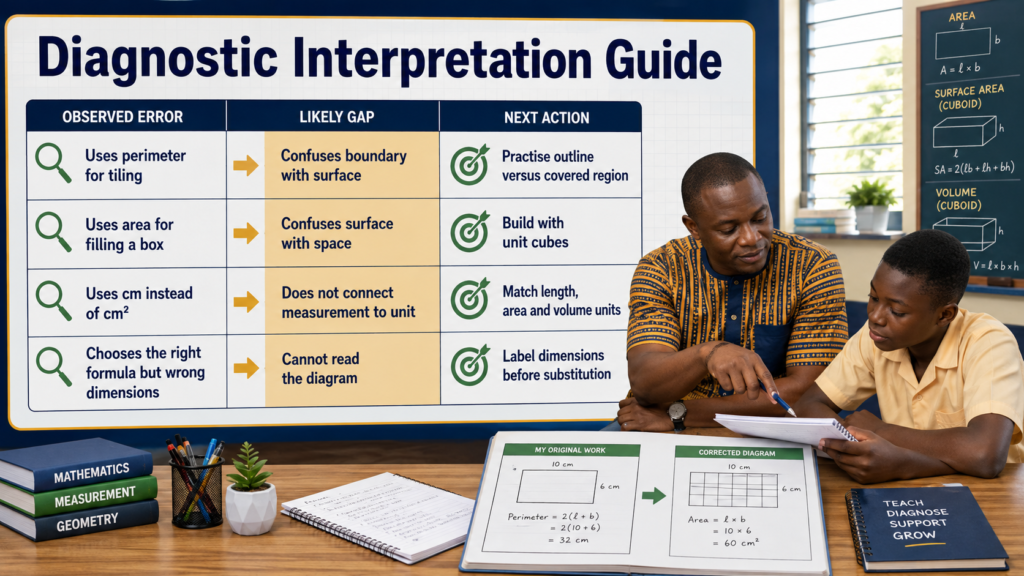
Diagnostic Interpretation Guide
| Learner’s response | Likely gap |
|---|---|
| Cannot name rectangle, circle, or cuboid | Shape-recognition gap |
| Knows shape but cannot identify the action | Language-translation gap |
| Says every flat question is an area | Boundary–region gap |
| Says every solid question is volume | Surface–space gap |
| Selects formula from familiar letters | Formula-meaning gap |
| Uses diameter as radius | Dimension-label gap |
| Writes for volume | Unit-dimension gap |
| Stops after finding an area when cost is required | Final-demand gap |
| Cannot explain the method | Understanding-and-communication gap |
Intervention Route After Diagnosis
If the learner cannot recognise the shape
Use:
- Shape cards
- Classroom objects
- Simple sketches
- Sorting activities
Do not begin with formulas.
If the learner cannot identify the measurement
Use the language:
- Around
- Flat covering
- Outside covering
- Filling
Give classification questions without numbers.
If the learner cannot choose the formula
Place one shape beside two or three possible measurements.
For example, with a rectangle:
- Perimeter →
- Area →
Ask the learner to explain what each formula measures.
If the learner cannot label dimensions
Practice:
- Radius and diameter
- Length and breadth
- Vertical and slant height
- Side and diagonal
If the learner cannot handle units
Use a measurement table and require the learner to predict the final unit before calculating.
If the learner cannot explain the answer
Ask the learner to complete:
My answer means __________.
This checks whether the learner understands the result.
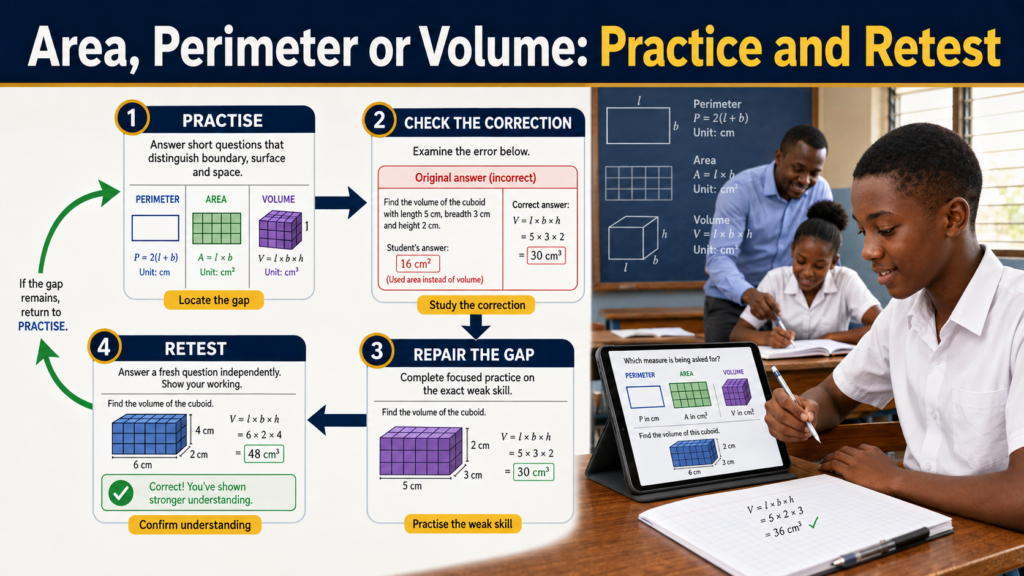
Area Perimeter or Volume Practice and Retest
For each question:
- Name the shape.
- Name the measurement.
- Predict the unit.
- Write the formula.
- Solve.
- Explain what the answer represents.
Questions
- A football pitch is long and wide. Find the distance around it.
- A classroom floor is long and wide. Find the area to be tiled.
- A rectangular tank measures by by Find its volume.
- A circular flower bed has a radius of . Find the distance around it using
- A wall islong and high. Find the area to be painted.
- A closed box measures) by by. Find its total surface area.
- A cube has edge. Find its volume.
- A circular garden has a radius . Find its area and circumference using
- A rectangular garden is long and wide. A -wide gate is left unfenced. Find the length of fencing required.
- A wall is long and high. It contains a door measuring by finding the area to be painted.
- A cylindrical tank has radius and height . Find its volume in terms of
- A classroom floor is measured by square tiles of side that are used to cover it. Find the number of tiles required, ignoring breakage and gaps.
Answers and Gap Diagnosis
1. Distance around =
Measurement:
Distance around means perimeter.
If you wrote (6,000\text{ m}^2): You found area instead of perimeter.
2. Area =
Measurement:
Tiling means flat covering.
[
A=lb
]
If you wrote : You found perimeter instead of area.
3. Volume =
Measurement:
Space inside a tank means volume.
If capacity is required:
The question asks for volume, so is sufficient.
4. Circumference =
Measurement:
Distance around a circle means circumference.
If you used (\pi r^2): You found the flower-bed area rather than its boundary.
5. Area =
Measurement:
Painting one flat wall means area.
6. Total surface area =
Measurement:
Outside covering of a closed box means total surface area.
If you wrote (120\text{ cm}^3): You found volume instead of outside covering.
7. Volume =
The cubic unit confirms that space inside is being measured.
8. Area = ; circumference =
Area:
Circumference:
This question deliberately compares flat space with distance around.
9. Fencing required =
Full perimeter:
[
P=2(30+18)
]
[
Subtract the gate:
If you wrote (96\text{ m}): You found the full perimeter but ignored the unfenced gate.
10. Area to be painted =
Area of wall:
Area of door:
Painted area:
If you wrote (36\text{ m}^2): You failed to remove the door area.
11. Volume =
Measurement:
Space inside the cylindrical tank means volume.
If you used You calculated curved surface area.
Change block type or style.
Move the paragraph block from position 352 up to position 351.
Move the paragraph block from position 352 down to position 353.
Change alignment
Change text alignment.
Displays more block tools
12. Number of tiles = 300
Floor area:
Convert the tile side:
Area of one tile:
Number of tiles:
Answer: 300 tiles.
If you divided by , you used a length instead of the area of one tile.
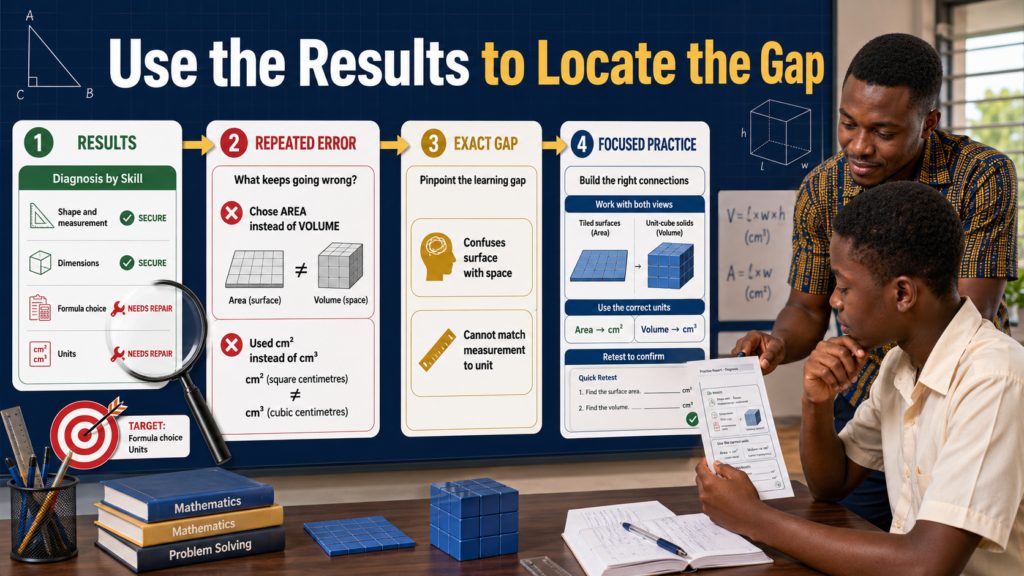
Use the Results to Locate the Gap
| Error pattern | Likely gap | Repair action |
|---|---|---|
| Area used for fencing | Boundary–region gap | Classify “around” situations. |
| Perimeter used for tiles | Flat-covering gap | Classify “cover” situations. |
| Surface area used for capacity | Surface–space gap | Separate outside from inside. |
| Volume used for wrapping | Covering–filling gap | Use a box model. |
| Correct shape but wrong formula | Measurement-decision gap | State the request before the formula. |
| Wrong ordinary, square, or cubic unit | Unit-dimension gap | Predict the unit before calculating. |
| Gate, door, or pond ignored | Practical-reading gap | Mark excluded regions or openings. |
| Area found but cost unfinished | Final-demand gap | Return to the final sentence. |
| Cannot explain the result | Meaning gap | Complete “My answer represents…” |
Score Guide
| Score | What it suggests | Teacher’s next action |
|---|---|---|
| 10–12 correct | Measurement selection is becoming secure. | Use unfamiliar mixed WASSCE-style questions. |
| 7–9 correct | One or two action-word traps remain. | Retest the missed measurement types. |
| 4–6 correct | Perimeter, area, and volume are still being mixed. | Return to classification without formulas. |
| 0–3 correct | The learner is guessing from shapes and numbers | Rebuild around covering and filling with real objects. |
Diagnostic Retest Record
| Question | Action word | Measurement selected | Formula selected | First wrong decision | Retest |
|---|---|---|---|---|---|
For every wrong answer:
- Locate the first wrong decision.
- Name the exact gap.
- Correct that small skill.
- Solve the original question again.
- Attempt a similar question without help.
- Record whether the mistake returns.
Learner-Centered Clinic Activity
Activity 1: Sort the actions
Write these actions on cards:
- Fence
- Tile
- Fill
- Wrap
- Paint a wall
- Paint a tank
- Put ribbon around
- Store water
The learner sorts them into:
- Perimeter
- Area
- Surface area
- Volume or capacity
Activity 2: Match actions to units
Match:
- Fence → m
- Floor →
- Box covering →
- Tank space →
- Water capacity → L
Activity 3: Explain before solving
The learner must say:
This question needs __________ because __________.
For example:
This question needs perimeter because fencing measures the distance around the garden.
Activity 4: Fresh retest
Change only the action while keeping the dimensions the same.
For by garden, ask separately for:
- Fencing
- Grass coverage
- Cost of paving
This reveals whether the learner is reading the demand or merely repeating one formula.
Depth of Knowledge Progression
| Depth of Knowledge | Main demand | Questions or activity |
|---|---|---|
| DoK 1 | Identify perimeter, area, surface area, or volume. | Questions 1–5 |
| DoK 2 | Select formulas and handle practical conditions | Questions 6–11 |
| DoK 3 | Coordinate area, unit conversion, and number of objects. | Question 12 |
| Diagnostic reasoning | Explain and justify measurement selection. | Learner-centered activities |
The depth comes from the reasoning required, not merely the length of the calculation.
Learner Reflection
Tick each statement only when you can do it without copying.
- I can name common flat shapes and solids.
- I know that perimeter measures distance around.
- I know that area measures flat covering.
- I know that surface area measures outside covering.
- I know that volume measures three-dimensional space.
- I can connect capacity to volume.
- I identify the action before choosing a formula.
- I use the shape to select the exact formula.
- I can distinguish a flat wall from the outside of a solid.
- I can handle gates, doors, and excluded regions.
- I predict the final unit before calculating.
- I know that square units indicate area.
- I know that cubic units indicate volume.
- I return to the final demand after calculating.
- I can explain what my answer represents.
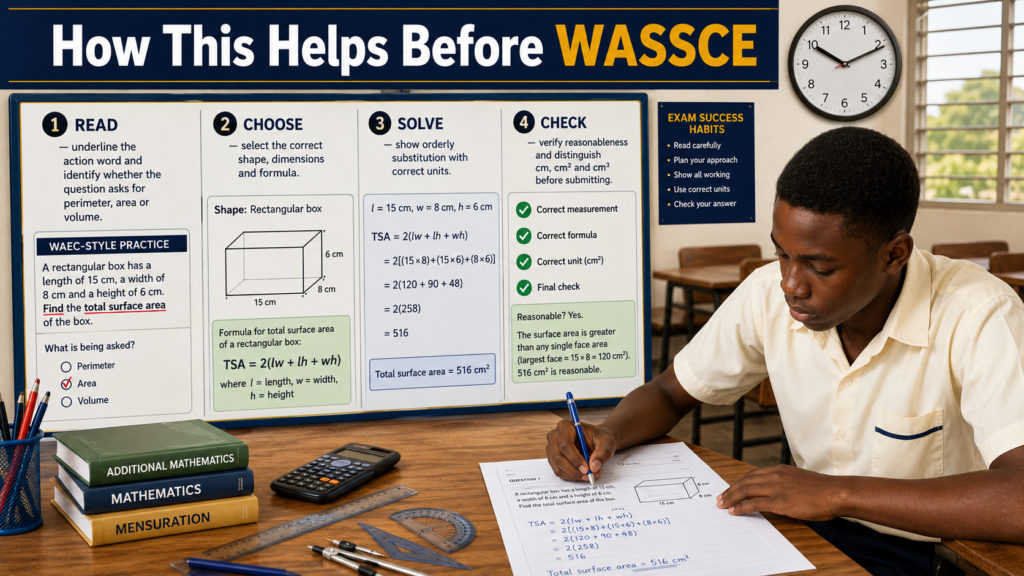
How This Helps Before WASSCE
This diagnostic checklist helps the learner to:
- Translate practical words into measurements
- Separate boundary from flat region
- Separate outside covering from inside space
- Choose formulas from meaning rather than appearance
- Predict the correct answer unit
- Handle gates, doors, and openings
- Complete cost and capacity questions
- Explain why a formula applies
- Identify the first wrong decision
- Correct a small gap before attempting harder questions
The official WAEC Ghana Chief Examiner’s Reports may be consulted when studying reported examination performance and weaknesses.
Continue the Mensuration Intervention
If the learner cannot reliably separate the measurement types, visit the Maths Intervention Hub to fix the specific core maths learning gap.
When the decisions are becoming secure, attempt targeted questions in the WASSCE Maths Practice Zone.
For examination errors involving units, diagrams, and wrong formula selection, explore WAEC Maths Traps.
Conclusion: Decide the Measurement Before the Formula
Area, perimeter, or volume becomes clearer when the learner understands what the real action means.
Before writing a formula, ask:
- Is something going around?
- Is something covering a flat surface?
- Is something covering the outside of a solid?
- Is something filling or being held inside?
- What shape or solid is involved?
- What should the final unit be?
- Is a cost, capacity, or number-of-items step still required?
Remember:
Around → perimeter
Flat covering → area
Outside covering → surface area
Filling or holding → volume or capacity
A learner who knows formulas but cannot make this decision will continue choosing correct formulas for the wrong questions.
The teacher’s job is not to add more formulas immediately. The first task is to locate where the decision breaks down.
Once the learner can name the action, identify the measurement, choose the formula, and explain the unit, mensuration becomes more organized.
Stop Guessing. Start Understanding.
Do Not Just Check Your Score—Locate the Gap
The Maths Clinic Practice Zone is not only for testing what is already known. It helps to reveal the exact point where understanding breaks down.
Answer the questions carefully. When an answer is wrong, study the correction box to identify the gap—whether it is the shape, measurement, dimensions, formula, calculation, or unit. Then practice that weak area again until the method becomes clear.
Do not guess your way through mensuration.
Visit the WASSCE Maths Practice Zone and attempt more questions with purpose.
For every wrong answer, record whether the mistake came from:
- Shape recognition
- Action-word translation
- Measurement selection
- Formula selection
- Dimension labelling
- Unit control
- Practical interpretation
- An unfinished final step
- Inability to explain the result
Correct that exact gap before attempting a fresh question.
Enter the Practice Zone: Locate the Gap. Fix the error. Build Understanding.