Struggling with WASSCE Maths? Stop guessing. Let’s fix the gap step by step.

9 Powerful Ways to Stop Mixing Up Expressions and Equations

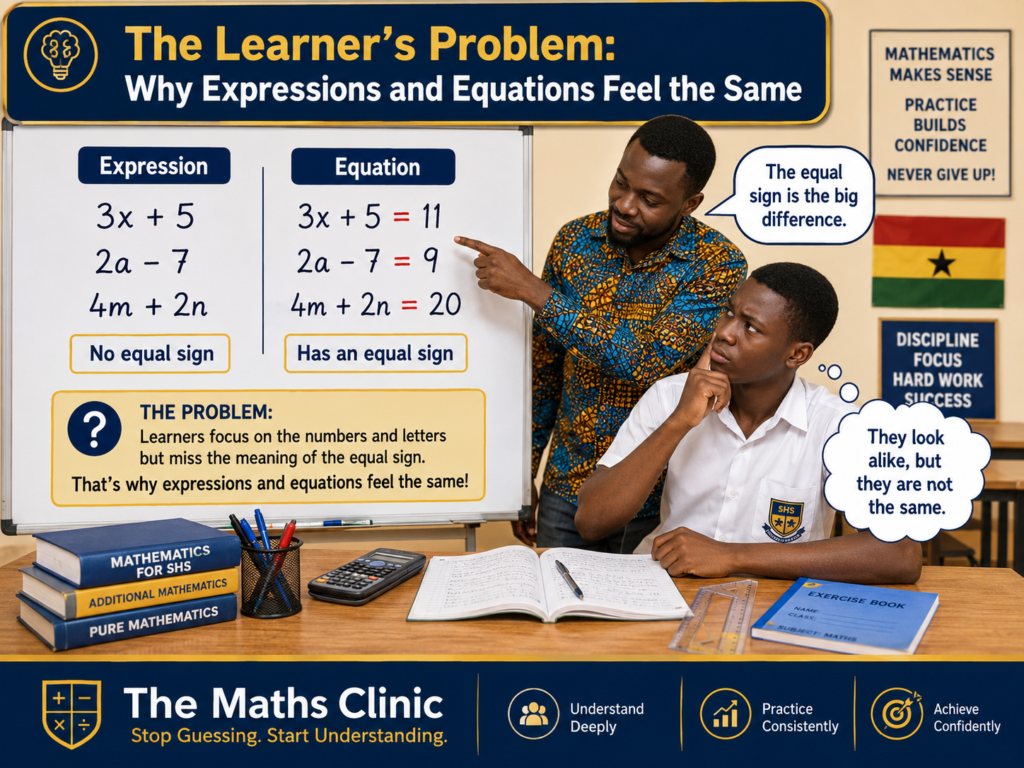
9 Ways to Stop Mixing Up Expressions and Equations begins with a simple classroom problem. A learner sees 3x + 5 and immediately asks, “Sir, should I move 5 to the other side?” But there is no other side yet. Another learner sees 3x + 5 = 20 and treats it the same way as 3x + 5. That small confusion is one reason many Ghanaian SHS students lose easy marks in WASSCE Core Maths.
This problem does not mean the learner is lazy. It usually means the learner has not clearly separated an expression from an equation. Until that gap is fixed, algebra will look like one big guessing game.
The Learner’s Problem: Why Expressions and Equations Feel the Same
The learner is not only struggling with letters. The learner is struggling with the instruction attached to the letters. An expression is something you simplify, expand, factorize, or evaluate. An equation is something you solve. When a student cannot see that difference, the wrong method starts before the first line of working.
For example, 2x + 7 is an expression. It has no equal sign, so you cannot solve it unless a value of x is given or it is connected to something else. But 2x + 7 = 15 is an equation. It has an equal sign, so the aim is to find the value of x that makes the statement true.
Why Learners Mix Up Expressions and Equations?
The mistake happens because many students learn algebra as a set of commands instead of meanings. They hear “collect like terms,” “change side, change sign,” “open bracket,” and “divide through,” but they do not first ask, “What type of algebra object am I looking at?”
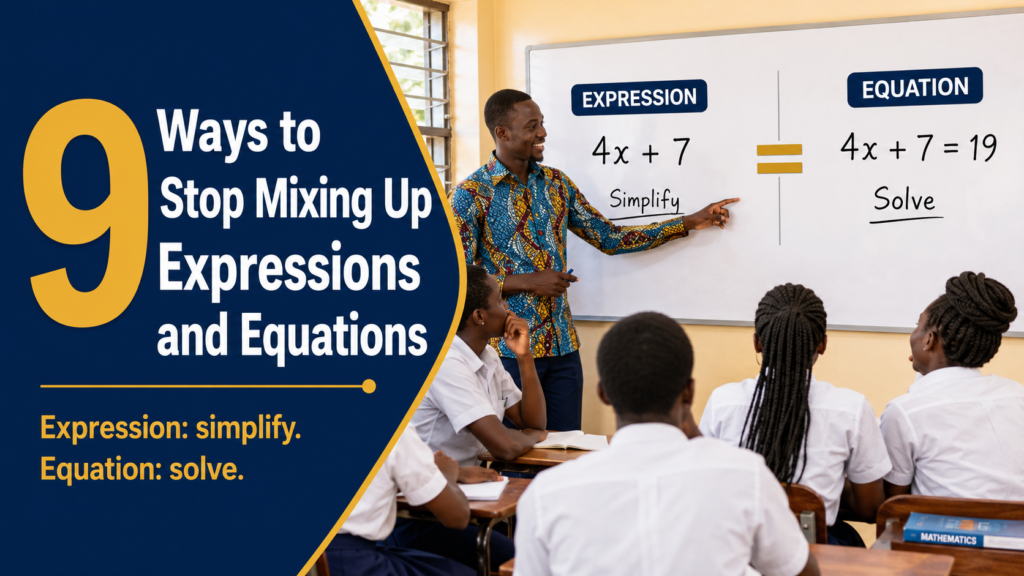
This is like entering the wrong room before asking what lesson is going on. If the work is an expression, your job may be to simplify. If the work is an equation, your job is to solve it. If you do not identify the room first, you may use a correct rule in the wrong place.
What WAEC and the Curriculum Reveal About Expressions and Equations
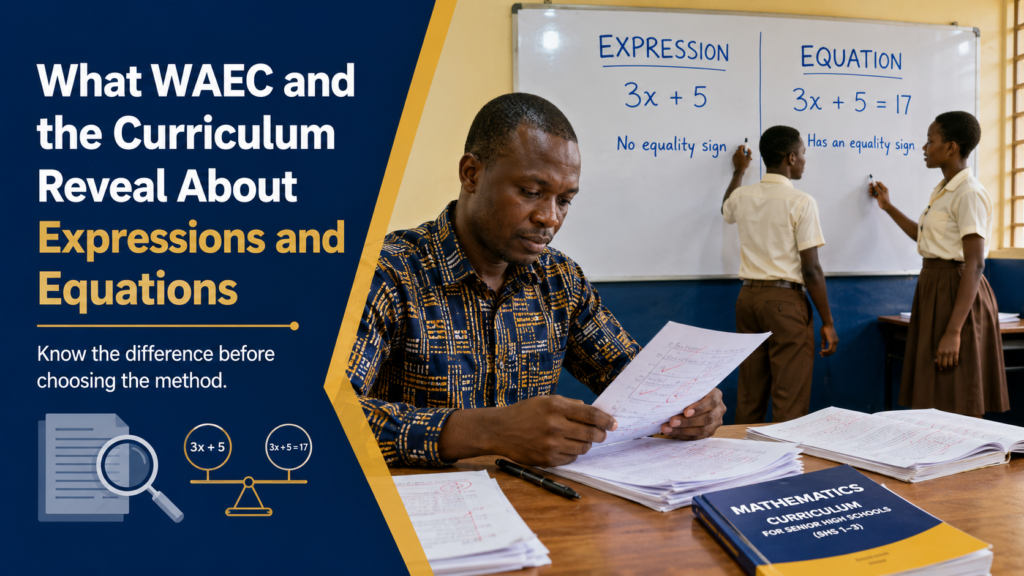
In WASSCE algebra questions, the examiner may ask learners to simplify, solve, expand, factorize, evaluate, or make a subject. These commands do not mean the same thing. A learner who treats every algebra question as “solve for x” will lose marks even when the algebra looks easy.
The new SHS mathematics curriculum also expects learners to reason with algebraic forms, not only memorize steps. That means learners must know when an equal sign is present, when a variable is only part of an expression, and when the question demands a value.
Simple Explanation: Expression vs Equation
| Algebra form | What it means | What you usually do |
| 3x + 5 | Expression | Simplify, expand, factorise, or evaluate if x is given |
| 3x + 5 = 20 | Equation | Solve to find the value of x |
| 2(a + 3) | Expression | Expand or simplify |
| 2(a + 3) = 18 | Equation | Open the bracket, then solve |
| P = 2l + 2w | Formula/equation | Use it to calculate or make a subject |
The quickest test is this: if there is no equal sign, you cannot solve for one answer unless extra information is given. If there is an equal sign, then you are dealing with a statement that can be true or false, and you may be asked to solve it.
9 Ways to Stop Mixing Up Expressions and Equations
1. Look for the equal sign before touching the question
Before expanding, collecting, or moving anything, pause and ask: Is there an equal sign? This one-second check can save many marks. If there is no equal sign, do not start moving terms to another side.
2. Read the command word carefully
The command word tells you the job. “Simplify” is not the same as “solve.” “Expand” is not the same as “evaluate.” Many wrong answers begin because the student solves when the examiner asked for simplification.
3. Treat expressions as unfinished algebra statements
An expression like 5x – 3 does not make a full mathematical statement. It is like a phrase in English, not a full sentence. You can clean it, simplify it, or substitute a value into it, but you cannot find a single fixed answer unless more information is provided.
4. Treat equations as balance statements
An equation is like a balance. Whatever you do to one side, you must do to the other side. This is why solving equations is not really “throwing terms across.” It is undoing operations while keeping the balance true.
5. Do not use “change side, change sign” without understanding
The phrase can help sometimes, but it can also destroy work when used blindly. What is really happening is an inverse operation. Adding becomes subtracting because we are undoing addition. Multiplication becomes division because we are undoing multiplication.
6. Check whether x is being asked for
If the question says “simplify 4x + 3x – 2,” you are not finding x. You are combining like terms to get 7x – 2. But if the question says “solve 4x + 3x – 2 = 19,” then you can find x.
7. Use substitution to test your understanding
When you are confused, choose a simple value like x = 2 and substitute. In an expression, substitution gives one numerical value. In an equation, substitution helps you test whether the left side equals the right side.
8. Separate simplifying steps from solving steps
Sometimes an equation must first be simplified before solving. For example, 2(x + 3) = 18 starts with expansion, but expansion is not the final answer. After getting 2x + 6 = 18, you must still solve for x.
9. Write the meaning beside the question during practice
A weak learner can write small labels during practice: Expression—simplify. Equation—solve. Formula – substitute or rearrange. This may look slow at first, but it trains the mind to choose the correct method.
Worked Example
Question A: Simplify 3x + 5x – 4.
Correct method: Combine like terms. 3x + 5x = 8x. So the answer is 8x – 4.
Notice that we did not find x. There is no equal sign and no value given for the expression.
Question B: Solve 3x + 5x – 4 = 20.
Correct method: First simplify the left side. 8x – 4 = 20. Add 4 to both sides: 8x = 24. Divide both sides by 8: x = 3.
Here, the equal sign made it possible to solve.
Common Wrong Approaches When Solving Expressions and Equations
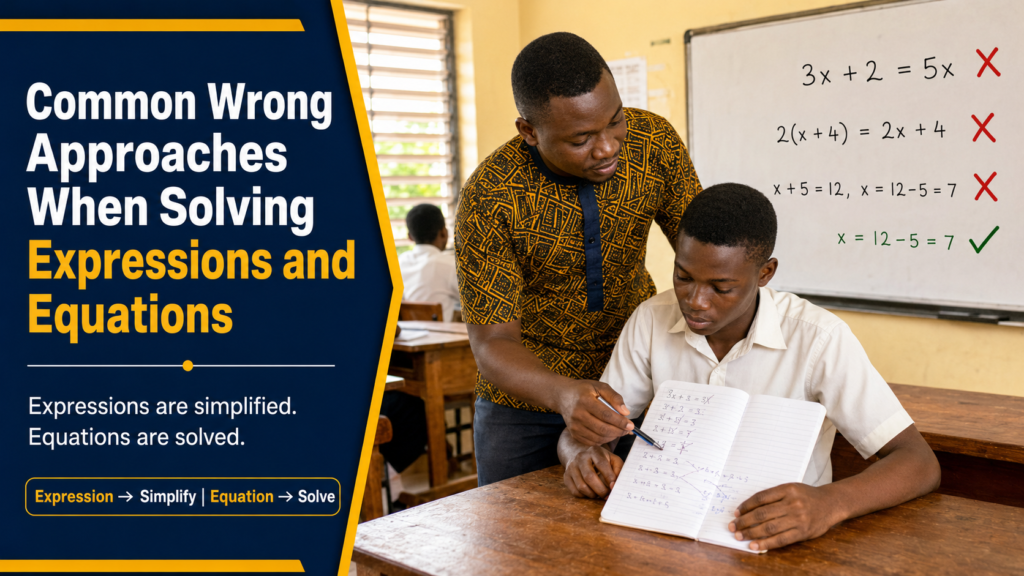
| WAEC Trap Box: Seeing 5x + 7 and writing 5x = -7 as if there were an equal sign. Solving an expression when the instruction says simplify. Leaving an equation halfway after simplifying, without finding x. Changing signs randomly because the learner thinks all algebra means movement. |
The Correct Method for Remembering Expressions and Equations
- Check for an equal sign.
- Read the command word.
- Decide whether the question is an expression, equation, or formula.
- Use the matching method: simplify, expand, evaluate, solve, or rearrange.
- Check your final answer against the command word.
Practice Task on Equations and Expressions
Decide whether each item is an expression or an equation, then state what you should do.
- 4x + 9
- 4x + 9 = 21
- 2(a – 5)
- 2(a – 5) = 14
- 7p – 3p + 6
- 7p – 3p + 6 = 18
- A = lw
- 3m + 4 when m = 5
Answers
- Expression—simplify only if possible.
- Equation—solve for x.
- Expression—expand or simplify.
- Equation – expand, then solve.
- Expression—simplify to 4p + 6.
- Equation—simplify, then solve.
- Formula/equation – substitute values or make a subject if asked.
- Expression with value given—evaluate.

How Understanding Expressions and Equations Helps a Struggling SHS Learner Before WASSCE
This lesson helps the learner stop treating all algebra questions the same way. Once the learner can identify the type of algebra question, the method becomes clearer. That is how a weak Core Maths learner begins to move from guessing to understanding.
Conclusion
Do not rush to solve every algebra question. First, diagnose it. Is it an expression? Is it an equation? Is it a formula? Once that small decision is correct, the rest of the working becomes easier. In The Maths Clinic, we do not shame the learner for mixing things up. We find the exact confusion, correct it, and practice until the learner can see the difference clearly.