Struggling with WASSCE Maths? Stop guessing. Let’s fix the gap step by step.

How to Pass WASSCE and NOVDEC Core Maths: A Teacher’s Complete Guide
Studied hard but still failing Core Maths? A teacher’s guide to finding where your WASSCE or NOVDEC marks leak, fixing each gap, and passing.
Every year I meet learners who studied hard and still failed Mathematics, or what most people still call Core Maths. They solved past questions every night. They knew the formulas. Then the results came out and the grade didn’t move.
That is painful, and it is not a sign that you can’t do maths. In my experience, and in what WAEC’s Chief Examiners report year after year, most marks are not lost because candidates know nothing. They are lost in small, repeated gaps: reading the question wrongly, using the wrong base, forgetting to convert time, leaving out working, or reading a graph by eye.
This guide is for WASSCE school candidates and NOVDEC private candidates alike. It shows you how to pass WASSCE and NOVDEC Core Maths by finding where your marks leak and plugging those leaks one at a time. Every section links to a clinic where that exact gap is fixed step by step.
The one idea behind this whole guide: don’t just do more questions. Find the step where your answer first goes wrong, fix that step, and prove it is fixed with a fresh question.
Why so many candidates fail Core Maths
When a learner tells me, “Sir, I’m just bad at maths,” I ask to see their script. Nearly every time, the problem is one of these:
- Reading gaps. The question asked for the amount and they gave the interest, or it asked for the selling price and they gave the discount.
- Base gaps. They took a percentage of the wrong number, such as profit as a percentage of the selling price.
- Unit gaps. Nine months used as 9 years; diameter used as radius; a count given in GH₵.
- Working gaps. A correct answer with no working, so method marks are lost.
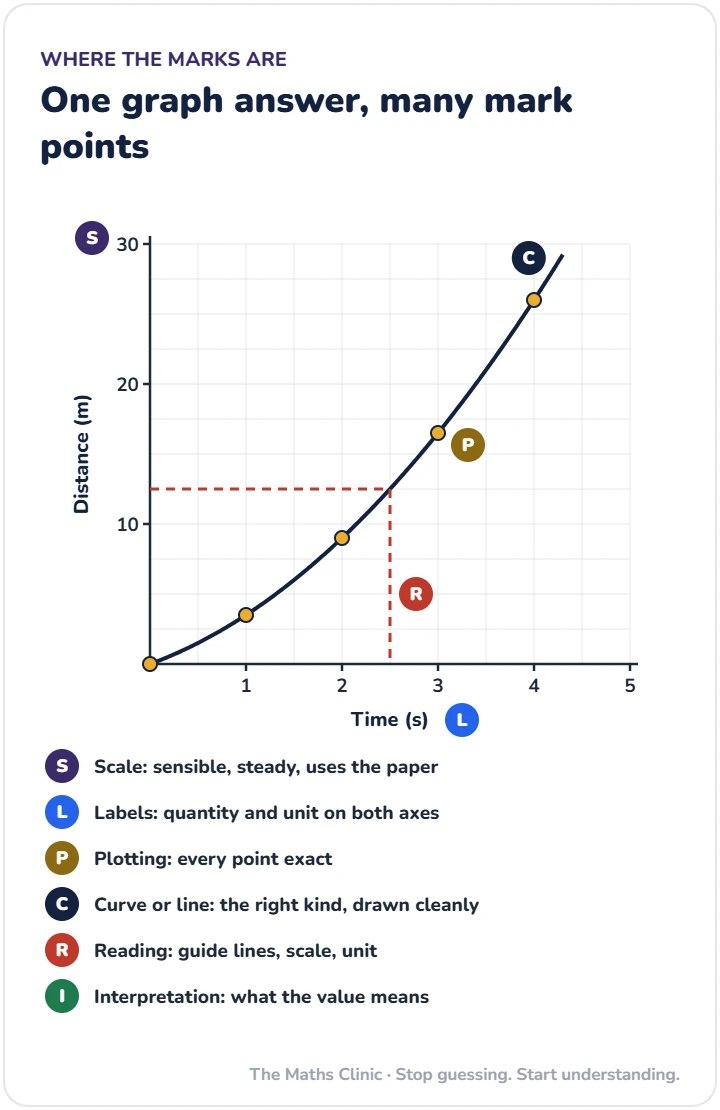
- Graph gaps. A poor scale, a misplotted point, or a value read by eye instead of with guide lines.
- Foundation gaps. Sign errors, brackets and fractions from JHS that were never fixed.
None of these needs a new topic. Each needs one habit repaired. That is good news: habits can be fixed in weeks, not years. Start by finding yours with Find My Gap, our free check, or read Find Your Maths Gap.
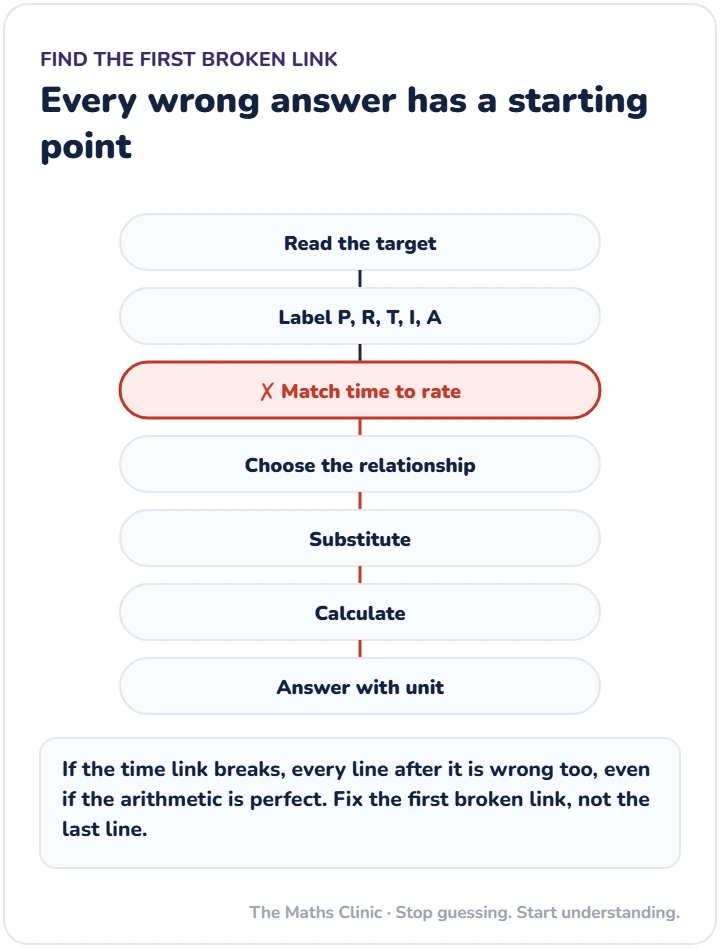
Step 1: Find your gap before you revise
Most revision is wasted because it is general. A learner who keeps losing marks on percentages does not need another night of mixed past questions. They need the percentage base fixed. Spend your first few days finding out which topics and which habits cost you the most:
- Take one full past-style paper under timed conditions.
- Mark it honestly, then sort every lost mark into a reason: reading, base, units, working, graph or foundation.
- Count. The reason with the most lost marks is where your revision starts.
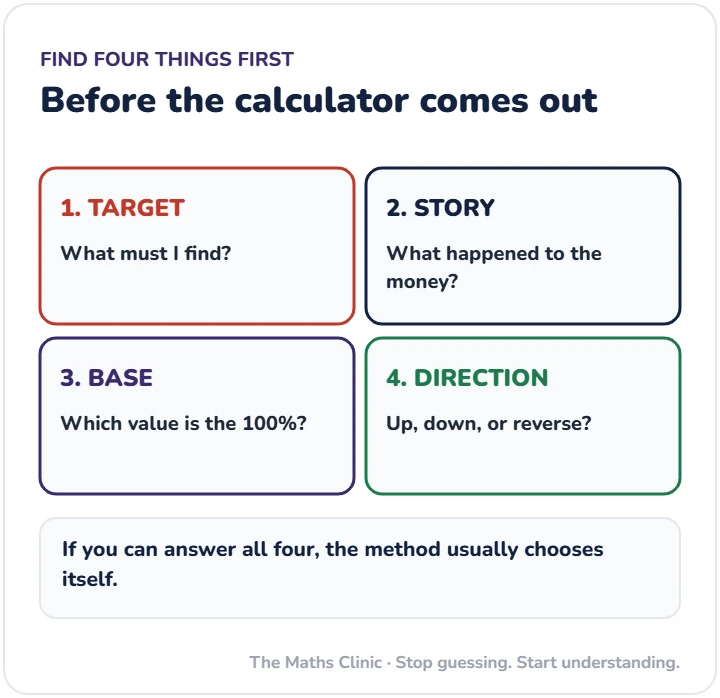
Step 2: Learn the four questions to ask before calculating
Before you touch the calculator, answer four questions. They prevent most reading and base errors in business maths, simple interest and mensuration.
Step 3: Fix the topics that carry the most marks
Core Maths covers many topics, but some carry marks in almost every paper. Work through these clinics in order of your weakest area:
| Clinic | What it fixes | Start here |
|---|---|---|
| Simple Interest | P, R, T, I and A; time conversion; interest or amount | Simple Interest Clinic |
| Business Maths | percentages, profit and loss, discount, commission, tax, hire purchase | Business Maths Clinic |
| Algebra | signs, brackets, equations, change of subject, word problems | Algebra Clinic |
| Graphs & Statistics | scale, plotting, quadratic graphs, reading values, gradient, cumulative frequency | Graphs & Statistics Clinic |
| Mensuration & Geometry | area, volume, surface area, circle theorems, bearings | Mensuration & Geometry Clinic |
| Finding your gap | why you keep failing and how to restart | Find Your Maths Gap |
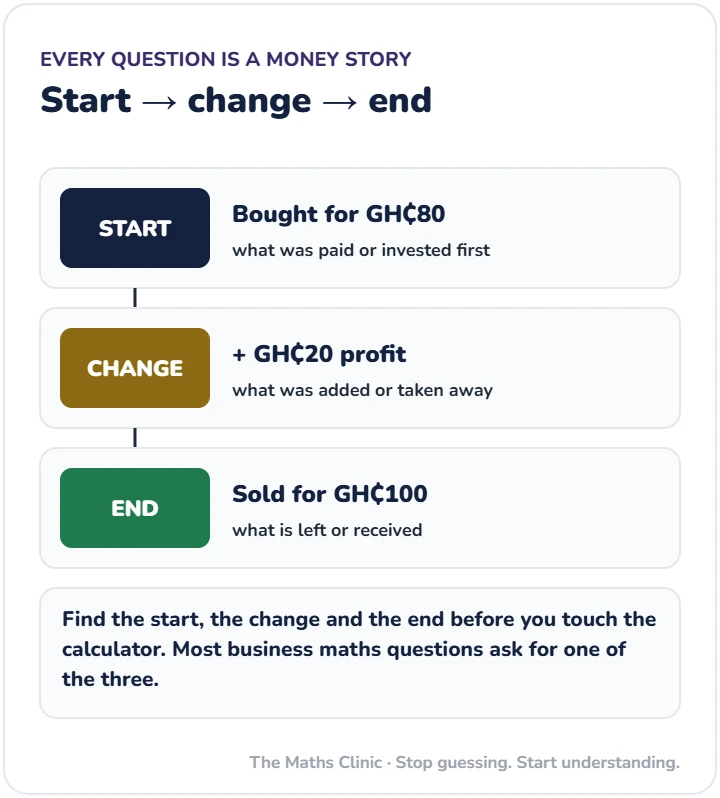
Step 4: Show your working, every time
WAEC marking gives credit for method, not only for the final answer. A learner who writes the right relationship, substitutes correctly and makes one arithmetic slip can still earn most of the marks. A learner who writes only a final number earns nothing if that number is wrong.
- Write the formula or relationship before substituting.
- Label values: P = GH₵2,000, not just 2000.
- Keep units on every line.
- Leave guide lines on graphs. They are your evidence.
Step 5: Check before you move on
Two quick checks catch a surprising number of wrong answers:
- Does the size make sense? Interest for nine months must be less than interest for a year. An amount must be bigger than the principal. A cylinder’s surface area cannot be in cm³.
- Did I answer the question asked? Re-read the last line of the question and compare it with your final line.
Step 6: Practise with purpose, then retest
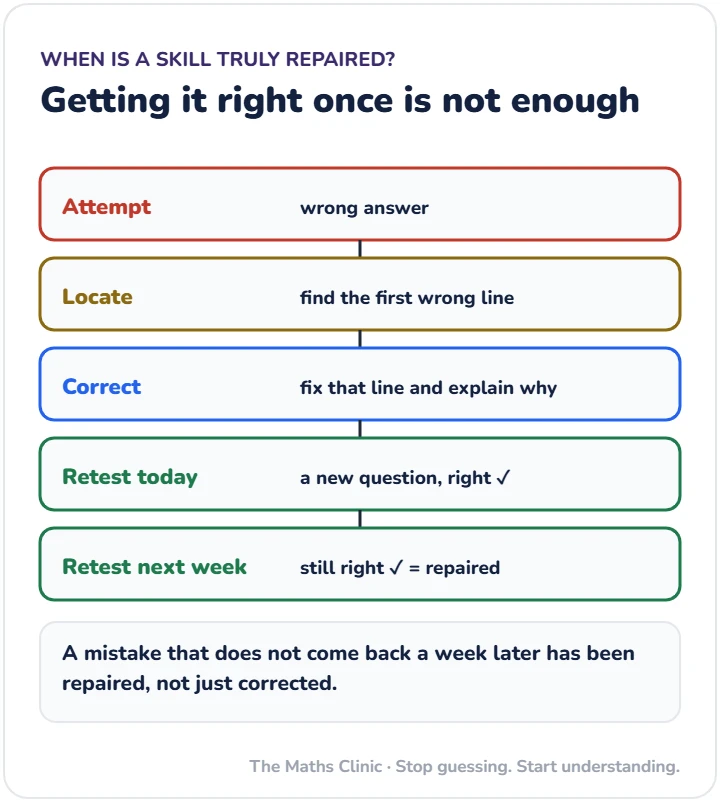
Practice should change something. After every wrong answer, find the first wrong line, name the gap, correct it, and then try a fresh question of the same type. A gap is only repaired when the mistake stays away a week later.
Use the Practice Zone to practise one topic at a time, and the WAEC Maths Traps page to see the mistakes examiners keep reporting.
If your exam is close: a two-week plan for NOVDEC and WASSCE
| Days | Focus |
|---|---|
| 1–2 | Take one timed paper. Sort every lost mark by reason. |
| 3–5 | Fix your biggest gap using its clinic. One topic per day. |
| 6–8 | Business maths and simple interest: bases, time and the demand word. |
| 9–10 | Graphs: scale, plotting, smooth curves, reading with guide lines. |
| 11–12 | Mensuration and geometry: units, radius, the right formula for the right measurement. |
| 13 | A second timed paper. Compare your lost-mark reasons with day 1. |
| 14 | Rest, light review of your own mistake list, and early sleep. |
For private candidates wondering whether the November/December exam is harder, read Is Nov/Dec Harder Than WASSCE? An Honest Answer.
On exam day
- Read each question twice: once for the story, once for the target.
- Start with questions you are sure of to build confidence and secure marks.
- Write units, label your answers, and show every step.
- For graphs, use a sharp pencil, a ruler, and guide lines.
- Leave a few minutes to check sizes, units and the demand word.
Questions learners often ask
Is Core Maths hard?
It is demanding, but most failures come from a small number of repeated gaps, not from the whole subject. Find yours and fix them one at a time.
Which topics should I start with?
Start with the topic where you lose the most marks, not the one you enjoy. If you are not sure, take Find My Gap first.
Can I pass if I failed before?
Yes. A failed result tells you where the gaps are. Read Maths Confidence: 7 Ways to Start Again for how to restart without repeating the same mistakes.
Do I need a textbook?
A good textbook helps you rebuild the basics in order. My Bridge Series textbooks follow the new SHS curriculum and fill the gaps step by step.
Start now
Pick one clinic from the table above, the one that matches your biggest gap, and work through it this week. One repaired gap is worth more than ten more past papers done the same way. If you get stuck, ask me a question.

Written by
Dickson Sarpong
NTC-certified SHS Mathematics teacher in Ghana with WAEC marking experience, and author of The Bridge Series textbooks. Every lesson here is built around the mistakes WAEC examiners keep reporting.
About DicksonStuck? Ask a question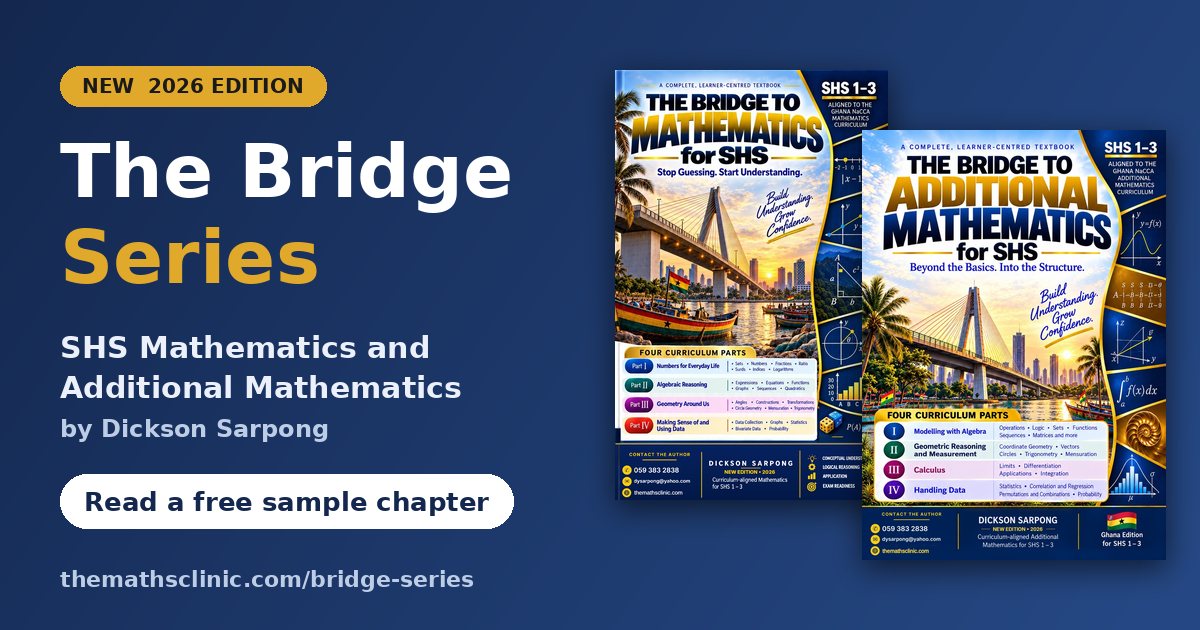
Want the whole topic, step by step? My textbooks, The Bridge to Mathematics and The Bridge to Additional Mathematics for SHS, follow the new curriculum and rebuild the basics as you go.
Read a free chapter →