Struggling with WASSCE Maths? Stop guessing. Let’s fix the gap step by step.

Simultaneous Equations: 7 Powerful Hidden Gaps Behind Wrong Answers

Simultaneous equations can deceive many SHS students. The question may look short. The method may also look familiar. But after two or three lines, the answer becomes wrong, and the learner does not know where the mistake entered.
In many Ghanaian classrooms, a learner will say, “Sir, I know simultaneous equations, but my final answer is always different.” That statement is important. It means the learner is not completely lost. The real problem may be hidden inside one small step: changing signs, choosing elimination wrongly, substituting carelessly, expanding brackets, or failing to check the answer.
So this Maths Clinic post is not written to shame any learner. It is written to help you diagnose the exact place where your simultaneous equations break down before WASSCE Core Maths.
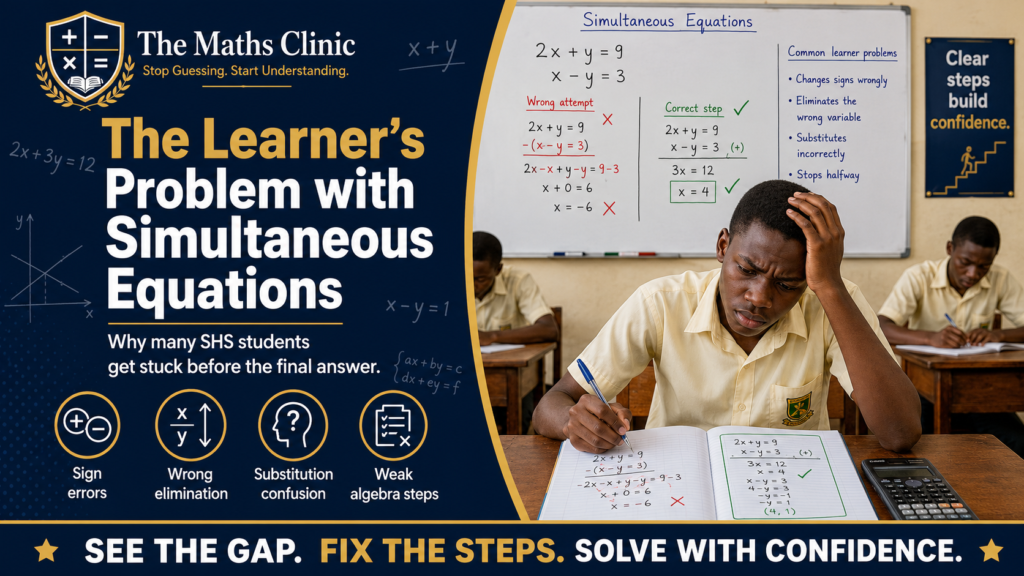
The Learner’s Problem with Simultaneous Equations
The learner’s problem is usually not that they have never seen simultaneous equations before. The problem is that they solve the question like a routine without watching the small operations. They copy the two equations, rush to eliminate one letter, and trust the final answer without checking.
For a weak learner, simultaneous equations become hard because two equations are moving at the same time. If one sign, coefficient, or bracket is mishandled, both answers can become wrong. That is why the topic needs careful diagnosis.
Why Did the Mistake Happen?
The mistake usually happens because the learner has not fully joined three ideas together: equality, inverse operations, and substitution. The learner may know how to add and subtract numbers, but they may not know why they are adding or subtracting the equations. That is the hidden gap.
Some students also confuse method with memory. They remember that “same signs subtract” or “different signs add,” but they do not understand that the main aim is to make one unknown disappear. Once the aim is not clear, the method becomes guesswork.
What WAEC or the Curriculum Reveals about Simultaneous Equations
In WASSCE Core Maths, simultaneous equations often test more than finding x and y. The examiner is also checking whether the learner can organize work, handle signs, substitute correctly, simplify accurately, and verify a final answer. A learner may know the method but still lose marks through weak algebraic control.
The new SHS mathematics direction also expects learners to reason, communicate steps, and apply algebra to real problems. That means learners must stop treating simultaneous equations as only a memorized trick.
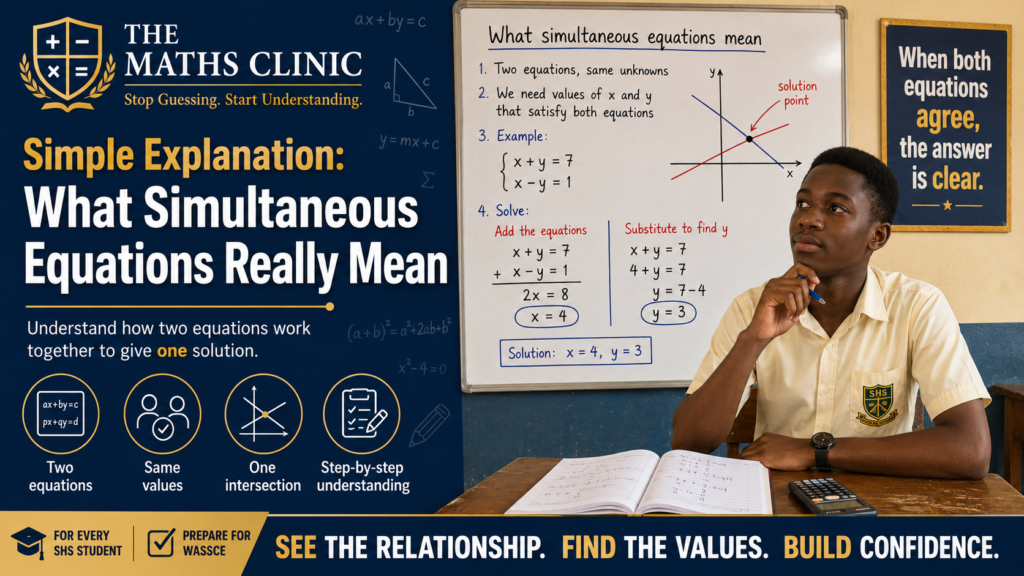
Simple Explanation: What Simultaneous Equations Really Mean
Simultaneous equations are two or more equations that are true at the same time. The solution is the value of the unknowns that makes all the equations correct at once.
Example: If x = 2 and y = 1, then 2x + y = 5 is true because 2(2) + 1 = 5. But for simultaneous equations, the same x and y must also satisfy the second equation. So the answer must pass both equations, not only one.
7 Hidden Gaps Behind Wrong Answers in Simultaneous Equations
Wrong answers in simultaneous equations do not usually happen by accident. Most of the time, they come from small hidden gaps that the learner has been carrying for some time. A student may know that elimination or substitution is needed but still lose marks because of weak signs, poor expansion, wrong subtraction, careless multiplication, or confusion about which variable has been eliminated.
This is why simultaneous equations can expose a learner’s real algebra foundation. The question may look simple, but each line tests whether the learner understands equality, signs, coefficients, brackets, and substitution. If one of these small skills is weak, the final answer will likely be wrong even when the learner appears to be following the correct method.
The 7 hidden gaps below will help the learner stop blaming the whole topic and start checking the exact point where the error begins. Once that gap is found, simultaneous equations become easier to correct, practice, and handle with more confidence before WASSCE.
1. The learner does not align like terms properly
Some students place x under y or constants under variables. When the work is not arranged well, addition or subtraction becomes dangerous. Always write x terms under x terms, y terms under y terms, and constants under constants.
2. The learner eliminates without checking the coefficient
You can eliminate only when the coefficients of one unknown are the same or opposites. If they are not, first multiply one or both equations. Do not rush to subtract because you see the same letter.
3. The learner applies the sign rule without understanding the aim
A rule can help, but the aim is more important. If the y terms are +3y and +3y, subtracting will remove y. If they are +3y and -3y, adding will remove y. The learner must ask, “Which operation will make this unknown become zero?”
4. The learner forgets to multiply every term
When multiplying an equation, every term must be multiplied. If 2x + y = 7 is multiplied by 3, it becomes 6x + 3y = 21. Many wrong answers begin when only the first term is multiplied.
5. The learner substitutes into the harder equation
After finding one unknown, choose the simpler original equation for substitution. A short equation reduces sign mistakes. Do not choose a complicated equation just because it is the last one you wrote.
6. The learner mishandles negative answers
A negative answer is not automatically wrong. But it must be handled carefully. If y = -2, then 3y means 3(-2), not 3 – 2. Weak bracket use is one major cause of wrong final answers.
7. The learner does not check the final pair
Checking is not a waste of time. It is the clinic test that confirms whether your answer is alive. Put your x and y into both original equations. If one fails, something went wrong.
Worked Example
Solve: 2x + y = 7 and x – y = 2.
Step 1: Arrange the equations:
2x + y = 7 … (1)
x – y = 2 … (2)
Step 2: Add the equations because +y and -y will cancel.
(2x + y) + (x – y) = 7 + 2
3x = 9
x = 3
Step 3: Substitute x = 3 into the simpler equation x – y = 2:
3 – y = 2
-y = -1
y = 1
Step 4: Check in the first equation:
2(3) + 1 = 7
6 + 1 = 7, correct.
So x = 3 and y = 1.
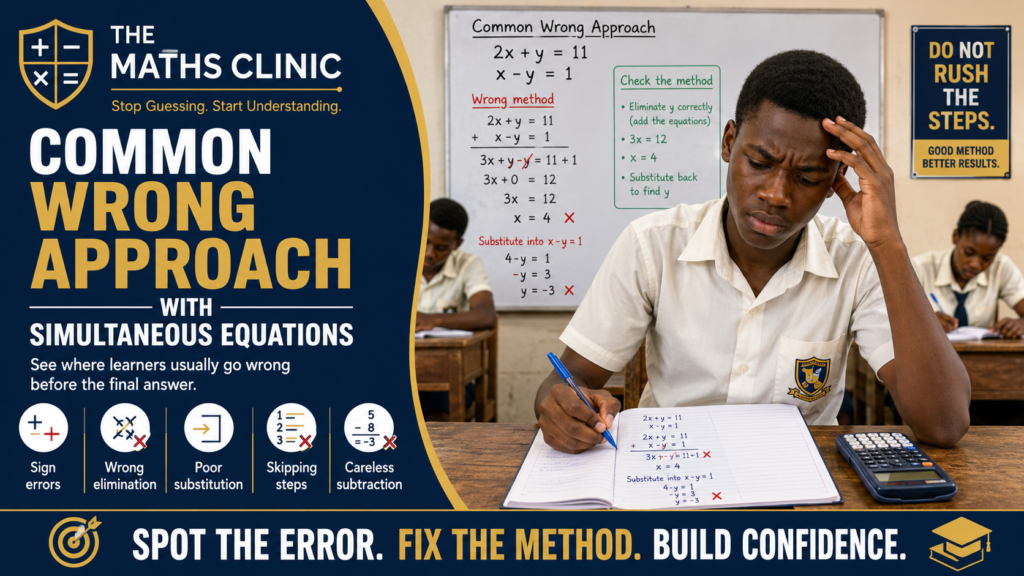
Common Wrong Approach with Simultaneous Equations
Wrong method: A learner may subtract the two equations just because they see y. That gives 2x + y – x – y = 7 – 2. The learner may then write x = 5, which is wrong. The problem is that the y terms were opposites already, so addition was the better operation.
Correct Method
Before you add or subtract, pause and ask: Which letter do I want to remove, and which operation will make it zero? After that, multiply if needed, eliminate carefully, substitute into the simpler original equation, and check both equations.
Practice Task
Solve these simultaneous equations. Do not rush. Show your elimination, substitution, and checking.
- 1. x + y = 8, x – y = 2
- 2. 2x + 3y = 12, x + y = 5
- 3. 3x – y = 10, x + y = 6
- 4. 2a + b = 11, a – b = 1
- 5. 4x + y = 17, 2x – y = 1
Answers: 1. x = 5, y = 3. 2. x = 3, y = 2. 3. x = 4, y = 2. 4. a = 4, b = 3. 5. x = 3, y = 5.
Conclusion
Simultaneous equations become easier when the learner stops rushing and starts diagnosing. The answer is not only in the final x and y. The real learning is in how you align terms, eliminate, substitute, simplify, and check. Once these hidden gaps are fixed, wrong answers reduce sharply before WASSCE.