Struggling with WASSCE Maths? Stop guessing. Let’s fix the gap step by step.

Substitution in Maths: 9 Costly Mistakes to Avoid

Substitution in Maths looks simple until the learner starts losing marks. The question may say, “If , find ” The learner feels confident, writes quickly, and still gets the wrong answer.
In the Maths Clinic, this kind of mistake tells us something. The learner may not have a formula problem. The learner may have a replacement problem. Substitution means replacing a letter with its value carefully. If the value is negative, fractional, or has brackets, the work must be handled with discipline.
Before WASSCE Core Maths, substitution must become a controlled habit, not a rushed step.
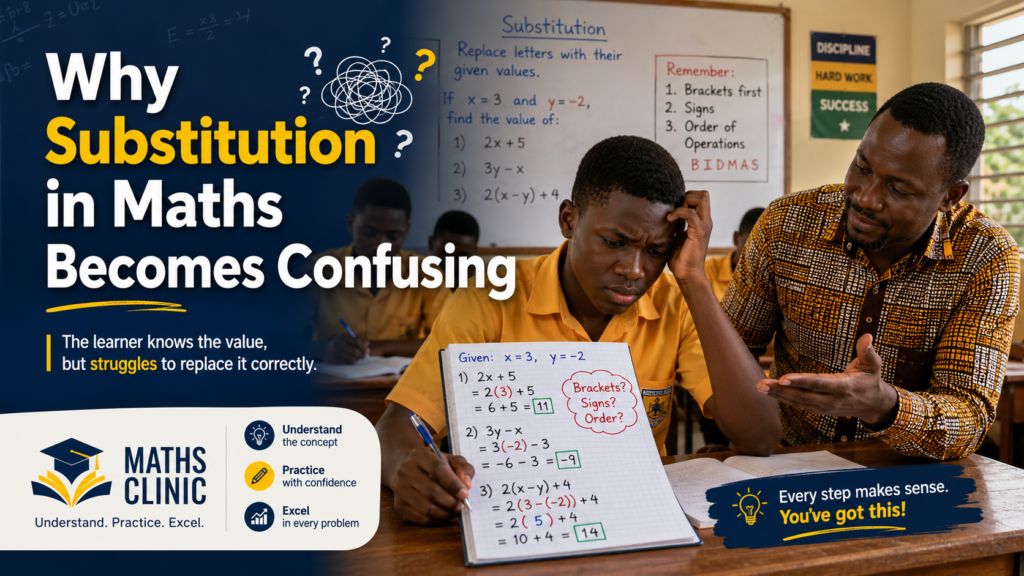
The Learner’s Problem: Why Substitution in Maths Becomes Confusing
The learner’s problem is careless replacement. Many students replace the letter but forget that the value must behave exactly like the letter it has replaced. If , then every x must become (-3), not just 3 or .
This problem appears in algebra, functions, coordinates, mensuration formulas, statistics formulas, and simultaneous equations. So substitution is not a small skill. It is a foundation skill.
Why Did the Mistake Happen in Substitution in Maths?
The mistake happens because learners often substitute without brackets, without order of operations, and without checking whether the value is negative. They also rush because substitution looks easier than factorization or equations.
But in WASSCE, easy-looking steps are where many marks get lost. A learner who cannot substitute carefully may know the formula and still fail the question.
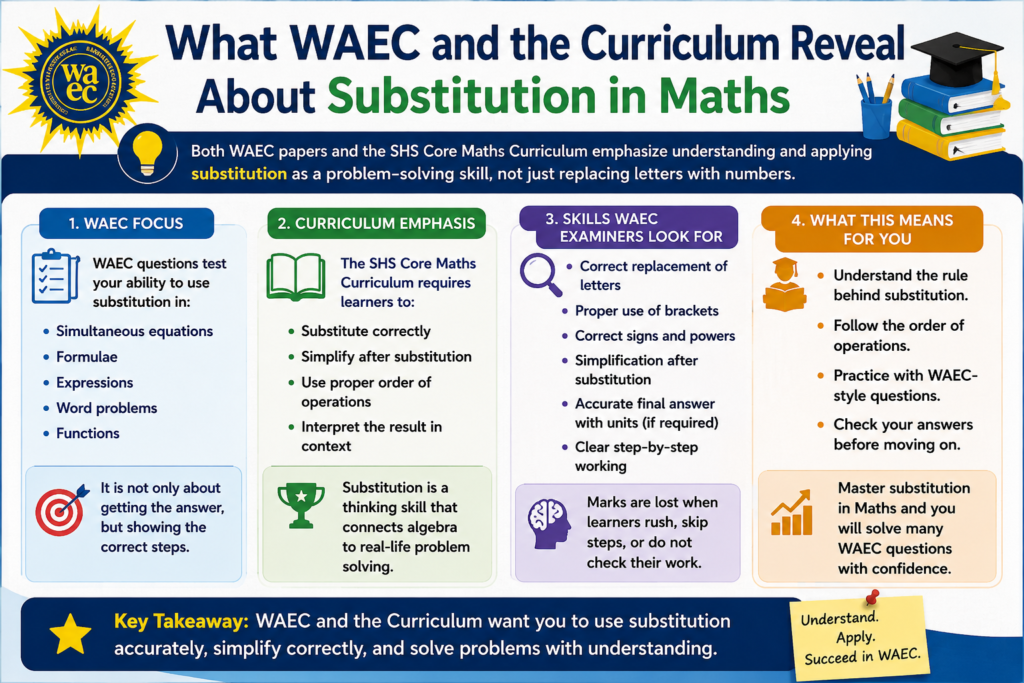
What WAEC and the Curriculum Reveal About Substitution in Maths
WASSCE Core Maths questions frequently require learners to substitute values into expressions, equations, and formulas. The skill may appear in algebra, functions, variation, mensuration, and statistics. This means substitution is tested across topics, not only under algebra.
The curriculum direction expects learners to use mathematical relationships correctly. Substitution is one way learners show that they understand the relationship between variables and values.
Simple Explanation: What Substitution in Maths Really Means
Substitution means replacing a letter with a given value. If , then becomes . If , then 2x + 3 becomes .
The bracket is not decoration. It protects the sign and shows that the whole value has entered the expression.
9 Costly Mistakes in Substitution in Maths and How to Avoid Them
1. Substituting without brackets
Wrong: If , then . Correct: . Brackets protect negative values.
2. Forgetting to replace every occurrence of the letter
If an expression has x in three places, all three must be replaced. Do not substitute only the first one and leave the others unchanged.
3. Treating a negative value as a positive value
If y = -5, then . It is not 15. The sign belongs to the value.
4. Squaring wrongly
If a negative number is squared inside brackets, the answer becomes positive. But if the negative sign is outside the square, it remains negative. For example, , but .
5. Ignoring order of operations
In , square the value of x first, then multiply by 3. If , then = = 12, not = .
6. Substituting into the wrong formula
Some students remember a formula partially and force values into it. First write the correct formula, then substitute. Do not substitute into a formula you are not sure of.
7. Mixing up x and y values
In coordinate or function questions, learners sometimes put the x value where y should be. Label values clearly before substituting.
8. Cancelling after substitution without checking factors
You can cancel common factors, not random terms. After substitution, simplify step by step. Do not cancel across addition or subtraction carelessly.
9. Not checking whether the answer is reasonable
After substitution, ask whether the answer makes sense. If a length becomes negative or a probability becomes more than 1, check your substitution again.
Worked Example
If , find .
Step 1: Replace x with (-2):
Step 2: Apply the order of operations:
(-2)² = 4
Step 3: Multiply:
Step 4: Add
So the value of when is .
Common Wrong Approach to Substitution in Maths
Wrong approach: = = -3. The learner’s mistake is that the square was applied without protecting -2 in brackets. This is a common WASSCE mark-loss point.
Correct Method
Write the expression first. Put every negative or fractional value in brackets. Replace every letter carefully. Follow the order of operations. Then simplify line by line. Do not do too many steps in your head.
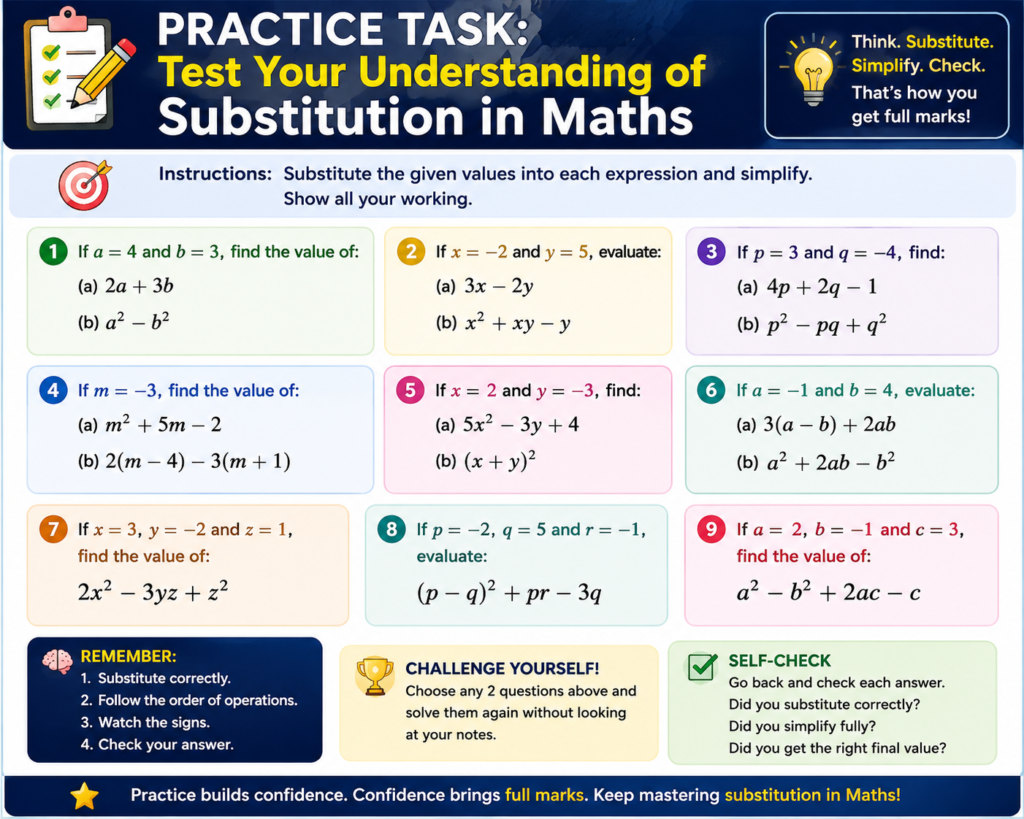
Practice Task: Test Your Understanding of Substitution in Maths
Substitute carefully. Use brackets where necessary.
- 1. If x = -3, find .
- 2. If a = -4, find
- 3. If p = 2 and q = -1, find
- 4. If x = -2, find .
- 5. If r = 3, find
- 6. If m = -1 and n = 4, find mn – 2m.
Answers: 1. -1. 2. 8. 3. 10. 4. 0. 5. 19. 6. -2.
Conclusion: Master Substitution in Maths Before WASSCE
Substitution in Maths is not difficult when the learner respects brackets, signs, and order of operations. Many wrong answers do not come from not knowing the topic. They come from replacing the letter carelessly. Once substitution becomes careful, many algebra, function, formula, and simultaneous equation questions become easier before WASSCE.