Struggling with WASSCE Maths? Stop guessing. Let’s fix the gap step by step.

8 Simple Examples to Understand Like Terms Properly

Understand like terms properly, and algebra will stop looking like a crowd of letters fighting on the page. Many Ghana SHS students struggle with algebra because they collect terms by appearance, not by meaning.
A learner sees 3x, 4y, 5x², and 2x, then starts adding anything that has a letter. That is where the trouble begins. In algebra, terms are not like terms just because they all contain letters. They are like terms because they have the same variable part.
This post will fix that gap with eight simple examples. We shall not rush. We shall diagnose the mistake, explain it clearly, and help the learner practice like a serious WASSCE Core Maths candidate.

The Learner’s Problem: Why You Struggle to Understand Like Terms Properly
Many students can repeat the phrase “collect like terms,” but they do not know what makes terms “like.” So they combine unlike terms and create answers that look short but are mathematically wrong.
For example, some learners write 3x + 4y = 7xy. Others write 2x + 5x² = 7x². These answers show a hidden gap: the learner is trying to simplify by force instead of checking whether the terms are truly alike.
Why Did the Mistake Happen? The Hidden Gap That Stops You from Understanding Like Terms Properly
The mistake happens because learners focus only on the coefficient, or only on the letter, and forget the full variable part. In the term 5x squared, the coefficient is 5, but the variable part is x². In the term 5x, the variable part is x. These two are not the same.
Another cause is weak language. When we say “like,” learners may think it means “similar-looking.” But in algebra, like terms must have the same letters raised to the same powers.
What WAEC and the Curriculum Reveal About How to Understand Like Terms Properly
In WASSCE Core Maths, like terms appear in simplification, expansion, factorization, equations, substitution, graphs, and word problems. A learner who cannot collect like terms properly will struggle across many topics, not only in basic algebra.
The curriculum expects learners to use symbols meaningfully. So the learner must know that x, x squared, xy, and y are different algebraic objects, even if they all contain letters.
Simple Explanation: How to Understand Like Terms Properly
Like terms are terms with the same variable part. The numbers in front may be different, but the letters and their powers must match.
| Terms | Are they like terms? | Reason |
| 3x and 7x | Yes | Both have x. |
| 4a and -9a | Yes | Both have a. |
| 2x and 2x squared | No | x is not the same as x squared. |
| 5xy and 8xy | Yes | Both have xy. |
| 6x and 6y | No | x and y are different variables. |
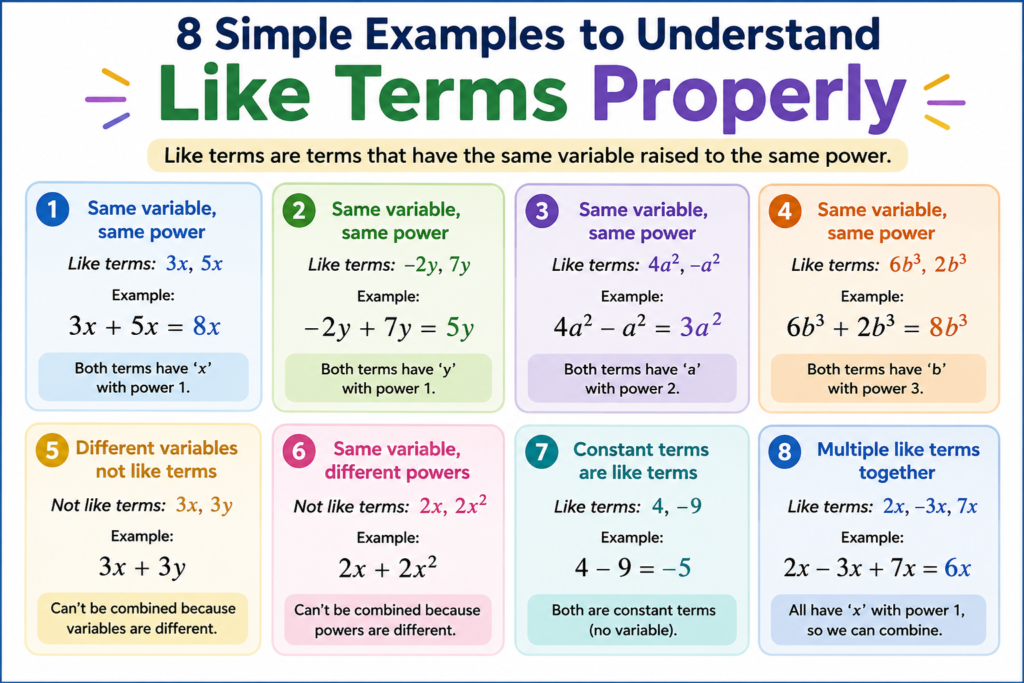
8 Simple Examples to Understand Like Terms Properly
1. 3x + 5x = 8x. The terms are alike because both contain x.
2. 9a – 4a = 5a. Keep the letter a and subtract the coefficients.
3. 7y + 2x cannot be simplified. Y and X are different.
4. 5x squared + 3x squared = 8x squared. Both variable parts are x squared.
5. 6x squared + 2x cannot be combined. x² and x are not the same.
6. 4ab + 9ab = 13ab. Both terms contain ab.
7. 8m – 3n + 2m = 10m – 3n. Collect only the m terms.
8. 2p + 5 – p + 7 = p + 12. The like terms are 2p and -p, and then 5 and 7.
Worked Example: Collecting Like Terms Step by Step
Simplify: 4x + 7y – 2x + 3y – 5
Step 1: Group the like terms with their signs.
4x – 2x + 7y + 3y – 5
Step 2: Combine the coefficients.
2x + 10y – 5
Final answer: 2x + 10y – 5
Common Wrong Approach
Wrong: 4x + 7y – 2x + 3y – 5 = 12xy – 5
This is wrong because the learner joined x terms and y terms together as if all letters were the same. Algebra does not work like that. x terms stay with x terms. y terms stay with y terms. Constant numbers stay with constant numbers.
Correct Method Learners Should Use
- First identify the variable part of each term.
- Carry the sign with the term.
- Group terms that have the same letters and powers.
- Add or subtract only the coefficients.
- Leave unlike terms as they are.
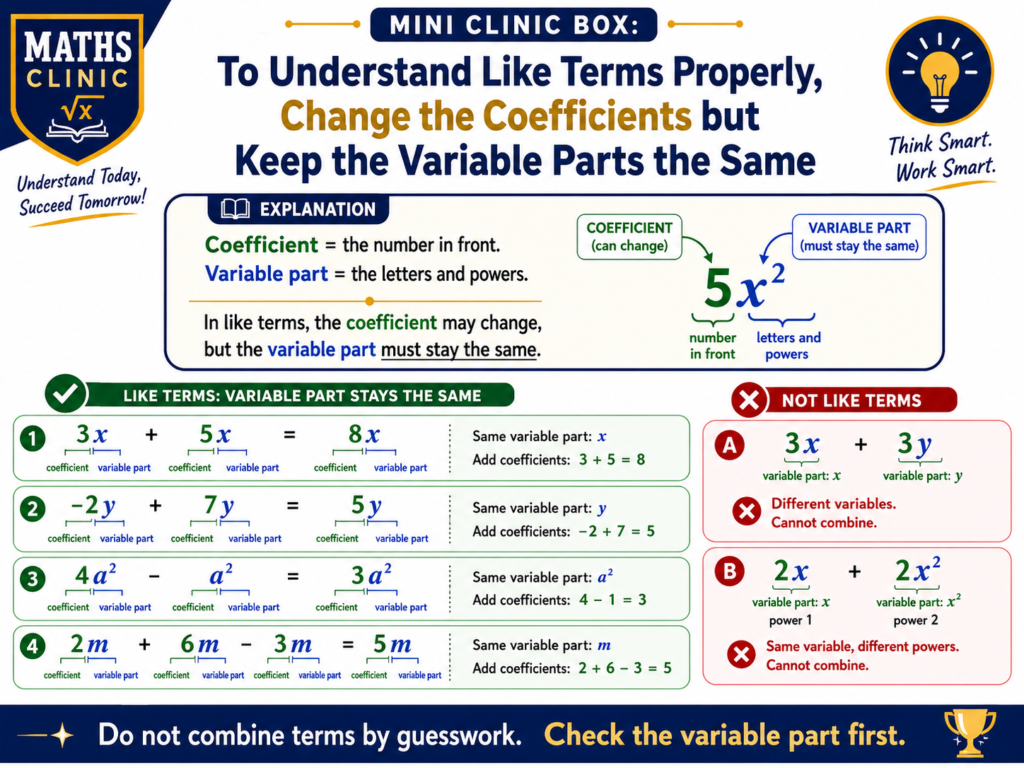
Mini Clinic Box: To Understand Like Terms Properly, Change the Coefficients but Keep the Variable Parts the Same
When collecting like terms, the coefficient may change, but the variable part stays the same. That is why 3x + 5x becomes 8x, not 8x squared. We are counting x’s. We are not multiplying x by x.
Practice Task
Simplify the following:
1. 6x + 4x
2. 9a – 2b + 3a
3. 5x squared + 2x squared – x
4. 7m – 3 + 2m + 8
5. 4pq + 6p + 3pq
Answers:
1) 10x
2) 12a – 2b
3) 7x squared – x
4) 9m + 5
5) 7pq + 6p
Conclusion: Like Terms Are Not a Guessing Game
To understand like terms properly, the learner must stop asking, “Do they all have letters?” and start asking, “Do they have the same variable part?” That small question fixes many algebra mistakes.
Once learners can identify like terms, they can simplify expressions, solve equations, expand brackets, and factorize with more confidence. Algebra becomes cleaner because every term knows where it belongs.