Struggling with WASSCE Maths? Stop guessing. Let’s fix the gap step by step.
Algebra Foundation: 5 Warning Signs Students Must Fix Before WASSCE

Your algebra foundation is the part of Core Maths that carries letters, signs, brackets, equations, formula work, substitution, and many word problems. When this foundation is weak, algebra will not only disturb one topic. It can disturb graphs, functions, mensuration, variation, simultaneous equations, and even financial mathematics.
In many Ghanaian SHS classrooms, a learner may say, “Sir, algebra is confusing.” But when you check the work carefully, the real problem may not be the whole of algebra. Sometimes the learner is mixing signs. Sometimes the learner does not understand what x represents. Sometimes brackets are being removed incorrectly. Sometimes the learner can copy the teacher’s steps but cannot explain why the step was taken.
That is why The Maths Clinic treats algebra mistakes like symptoms. We do not only ask, “Is the answer correct?” We ask, “Which part of the algebra foundation broke down?” Once the weak area is named, the recovery becomes clearer.
This ready-to-use guide will help Ghana SHS students identify 5 warning signs that their algebra foundation is weak, understand why the mistake happens, and follow a structured recovery plan before WASSCE Core Maths.
1. The Learner’s Problem
The learner’s problem is not always that algebra is too hard. The real problem is that the learner is trying to solve higher-level questions with a weak algebra foundation.
A weak algebra foundation usually appears in these five warning signs:
- Sign 1: You change sides in an equation but forget to change the operation correctly.
- Sign 2: You remove brackets incorrectly, especially when a negative sign is in front of the bracket.
- Sign 3: You treat letters as decoration instead of unknown numbers or changing quantities.
- Sign 4: You cannot collect like terms without mixing unlike terms.
- Sign 5: You know formulas but make errors when substituting algebraic values.
These signs may look small, but they are serious Core Maths mistakes. They can make a learner lose marks even when the learner understands the topic being tested.
Maths Clinic Diagnosis Question
Do not only ask: “Why am I poor in algebra?”
Ask: “Which algebra skill breaks down when I start solving?”
Sign 1: You Change Sides but Forget the Inverse Operation
A learner solving 2x + 5 = 19 may write 2x = 19 + 5. That mistake shows that the learner is moving terms by memory, not by understanding inverse operations.
Sign 2: You Remove Brackets Without Controlling the Sign
A learner expanding -(x – 4) may write -x – 4 instead of -x + 4. The hidden weakness is not only expansion. The hidden weakness is sign control.
Sign 3: You Do Not Understand What the Letter Means
In algebra, x is not a strange decoration. It stands for a number we do not know yet or a quantity that can change. If the learner treats letters as confusing symbols only, word problems and formulas become difficult.
Sign 4: You Mix Like and Unlike Terms
A learner may write 3x + 2 = 5x. This shows a weak understanding of like terms. Numbers without letters and terms with letters do not combine as if they are the same item.
Sign 5: You Make Substitution Errors in Formulas
A learner may know A = lw but still substitute the wrong length, the wrong width, or the wrong unit. This is why Core Maths algebra affects many other topics beyond equations.
Internal link placement: After the five signs, link “linear equations” to your Linear Equations post and link “word problems” to your Word Problems in WASSCE Maths post.

2. Why Did the Mistake Happen?
Algebra mistakes happen because the learner is often copying movement, not understanding balance. In class, the teacher may say, “Take 5 to the other side,” and the learner copies the step. But if the learner does not understand that an equation is like a balanced scale, the rule becomes a guessing game.
Reason 1: The Learner Memorized Steps Without Meaning
The learner remembers that something changes when it crosses the equal sign but cannot explain why it changes. This leads to wrong signs and wrong operations.
Reason 2: The Learner’s Integer Skills Are Weak
If negative numbers are weak, algebra will suffer. A student who struggles with -3 + 7 or -2 × -5 will struggle badly when letters join the signs.
Reason 3: The Learner Has Poor Bracket Discipline
Brackets require patience. When there is a number or a negative sign outside the bracket, every term inside must be multiplied or divided accordingly.
Reason 4: The Learner Does Not Check Whether the Answer Works
Many Ghana SHS students stop once they get a value for x. But substitution can check whether the value is correct. This habit helps reduce algebra mistakes before WASSCE.
Reason 5: The Learner Has Practiced Too Many Random Questions
Random practice can keep a learner busy but not improve them. If the weak area is brackets, the learner must practice brackets. If the weak area is transposition, the learner must practice inverse operations. That is structured recovery.
3. What WAEC or the Curriculum Reveals
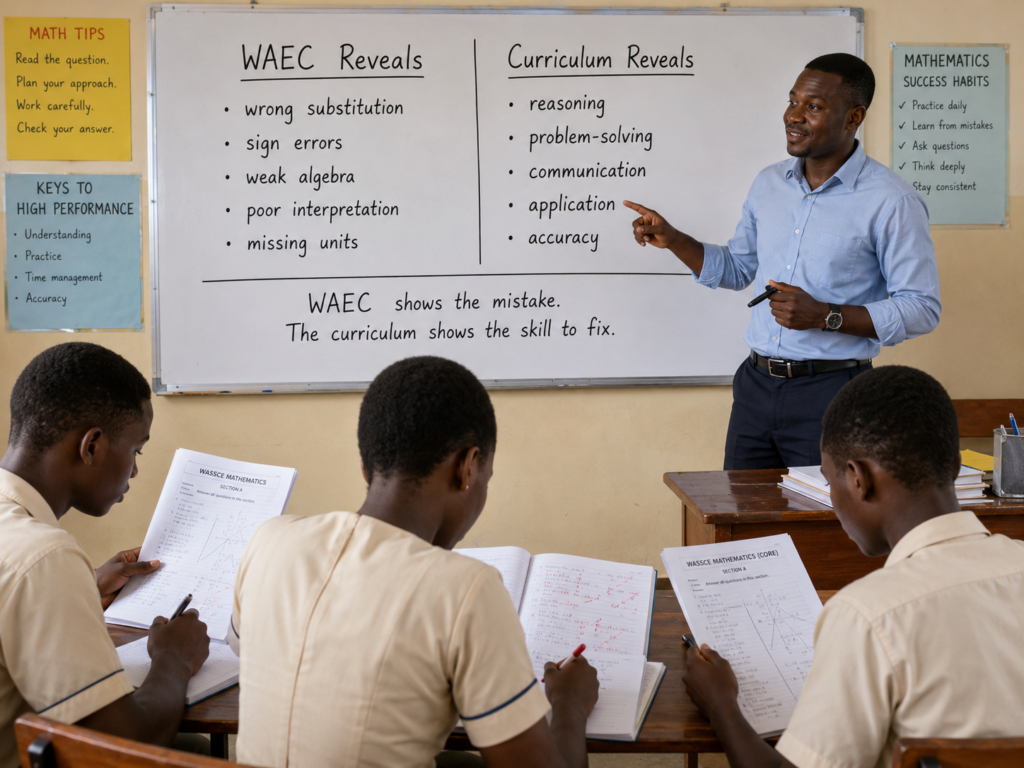
WASSCE Core Maths does not test algebra in isolation. Algebra appears in equations, graphs, functions, mensuration, variation, formula substitution, and word problems. That is why a weak algebra foundation can reduce performance across many areas of Core Maths.
The curriculum direction also expects learners to reason, communicate, solve problems, and apply mathematics in meaningful situations. This means a student must not only copy algebraic steps from the board. The student must understand what each step is doing.
In WAEC-style questions, algebra weakness often shows through wrong expansion, wrong collection of like terms, poor substitution, sign errors, and inability to translate words into algebraic statements.
WAEC Trap Box
A learner may know the formula but lose marks because the substitution is wrong.
A learner may know how to solve equations but lose marks because signs are mishandled.
A learner may understand the topic but fail because the algebra hidden inside the topic is weak.
4. Simple Explanation
Algebra is not magic. Algebra is a way of using letters to stand for numbers and using rules to keep the statement true.
Think of an equation like a balance. If one side changes, the other side must be treated properly so the balance is not destroyed.
Simple Example
Solve: 2x + 5 = 19
The +5 is attached to the left side. To remove +5, we subtract 5 from both sides.
2x + 5 – 5 = 19 – 5
2x = 14
x = 7
The Hidden Meaning
We did not “throw 5 across.” We used the opposite operation to keep the equation balanced.
When a learner understands this, transposition becomes less confusing.
5. Worked Example
Example Question
Solve: 3(2x – 1) – 4 = 17
Step 1: Expand the Bracket
3(2x – 1) = 6x – 3
So the equation becomes:
6x – 3 – 4 = 17
Step 2: Collect the Numbers on the Left
6x – 7 = 17
Step 3: Remove -7 by Adding 7 to Both Sides
6x – 7 + 7 = 17 + 7
6x = 24
Step 4: Divide Both Sides by 6
x = 4
Step 5: Check the Answer
Substitute x = 4 into the original equation:
3(2(4) – 1) – 4 = 3(8 – 1) – 4 = 3(7) – 4 = 21 – 4 = 17
Since the left side becomes 17, the answer is correct.
Final Answer
x = 4
Diagnosis from the Example
If you wrote 6x – 1 instead of 6x – 3, your weak area is expansion.
If you wrote 6x – 7 = 17, then 6x = 17 – 7; your weak area is inverse operations.
If you got x = 24/6 but did not simplify, your weak area is final simplification.
If you never checked the answer, your weak area is exam habits.
6. Common Wrong Approach
A common wrong approach is shown below:
3(2x – 1) – 4 = 17
6x – 1 – 4 = 17
6x – 5 = 17
6x = 17 – 5
6x = 12
x = 2
Why This Is Wrong
The first mistake happened when the learner expanded 3(2x – 1) as 6x – 1. The 3 must multiply every term inside the bracket, so 3 × -1 = -3.
The second mistake happened when the learner moved -5 wrongly. From 6x – 5 = 17, the correct step is 6x = 17 + 5, not 17 – 5.
What the Wrong Approach Reveals
This wrong approach reveals two weak areas: bracket expansion and inverse operation. The learner does not need to say, “I am bad at algebra.” The learner should say, “I must revise expansion and solving equations with negative signs.”
7. Correct Method
The correct method is not to rush. Use this five-step algebra recovery method whenever you meet an equation.
Step 1: Clear Brackets Carefully
Multiply every term inside the bracket. Do not multiply only the first term.
Step 2: Collect Like Terms
Put terms with letters together and numbers together. Do not combine unlike terms.
Step 3: Use Inverse Operations
Addition is undone by subtraction. Subtraction is undone by addition. Multiplication is undone by division. Division is undone by multiplication.
Step 4: Solve for the Letter
Keep working until the letter stands alone.
Step 5: Substitute to Check
Put your answer back into the original question to see whether it works.
Simple Rule for Weak Algebra Learners
Do not practice algebra only to get answers. Practice algebra to find which step breaks down.
That is how maths learning gaps are treated properly.
8. Practice Task
Use these questions to test your algebra foundation. After each question, do not only check the answer. Write the weak area that the question exposed.
1. Solve: 2x + 7 = 21.
2. Solve: 5x – 3 = 22.
3. Expand: 4(x + 3).
4. Expand: -2(x – 5).
5. Simplify: 3x + 4 + 2x – 7.
6. Solve: 2(x + 4) = 18.
7. If y = 2x + 3, find y when x = 5.
8. A number is multiplied by 3, and 4 is added to give 25. Form and solve the equation.
Practice Task Solutions and Diagnosis
Question 1
Solution: 2x + 7 = 21; 2x = 14; x = 7.
Diagnosis: If you wrote 2x = 21 + 7, your weak area is inverse operations.
Question 2
Solution: 5x – 3 = 22; 5x = 25; x = 5.
Diagnosis: If you wrote 5x = 22 – 3, your weak area is handling subtraction in equations.
Question 3
Solution: 4(x + 3) = 4x + 12.
Diagnosis: If you wrote 4x + 3, your weak area is bracket expansion.
Question 4
Solution: -2(x – 5) = -2x + 10.
Diagnosis: If you wrote “-2x – 10,” your weak area is multiplying negative signs.
Question 5
Solution: 3x + 4 + 2x – 7 = 5x – 3.
Diagnosis: If you wrote 5x – 11 or 9x, your weak area is collecting like terms.
Question 6
Solution: 2(x + 4) = 18; 2x + 8 = 18; 2x = 10; x = 5.
Diagnosis: If you jumped to x + 4 = 18, your weak area is equation balance.
Question 7
Solution: y = 2(5) + 3 = 10 + 3 = 13.
Diagnosis: If you wrote y = 25 + 3, your weak area is substitution.
Question 8
Solution: Let the number be x. 3x + 4 = 25; 3x = 21; x = 7.
Diagnosis: If you could not form 3x + 4 = 25, your weak area is translating words into algebra.
Self-Assessment: Identify Your Weak Algebra Area
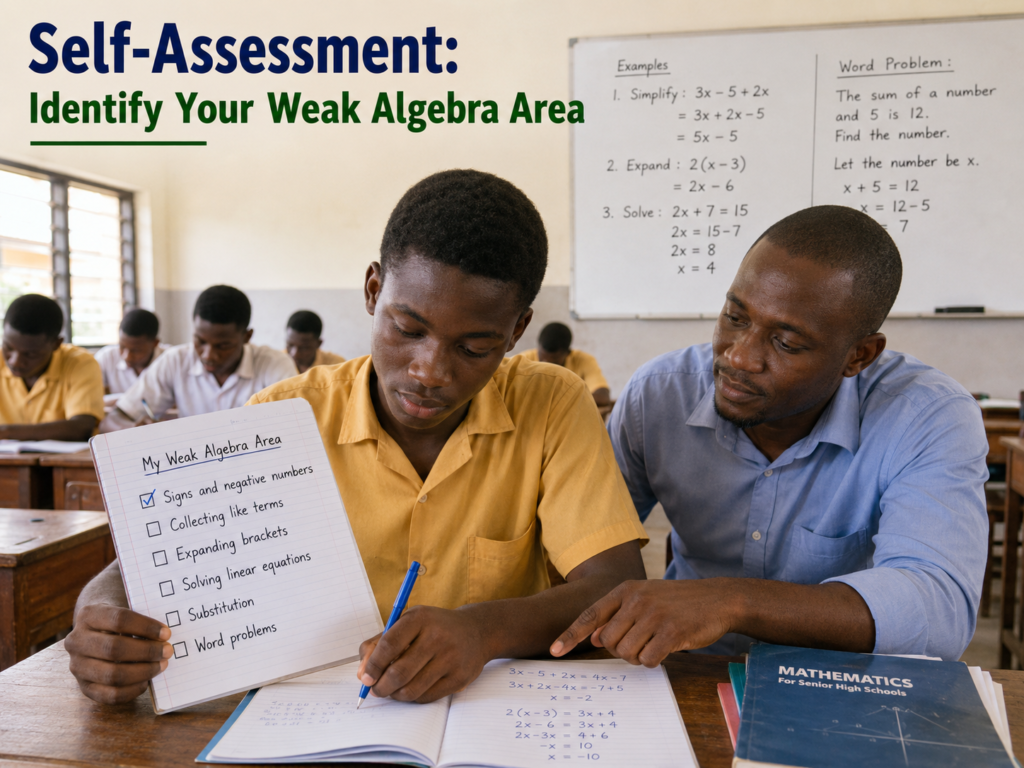
Use this self-assessment after completing the practice task. Tick the area that matches your mistakes.
| Weak Area | What the Mistake Looks Like | Recovery Action |
| Integer weakness | Wrong signs, especially with negatives | Revise directed numbers before solving harder equations. |
| Bracket weakness | Only the first term is multiplied | Practice expansion with positive and negative multipliers. |
| Like-term weakness | Combining numbers and letters wrongly | Sort terms first before simplifying. |
| Equation-balance weakness | Wrong transposition or inverse operation | Use “do the same to both sides” until the balance is clear. |
| Substitution weakness | Putting values in the wrong place | Label the formula first, then substitute slowly. |
| Word-to-algebra weakness | Cannot form equations from sentences | Underline keywords and translate one phrase at a time. |
Structured Recovery Plan for a Weak Algebra Foundation
After diagnosing your weak area, do not jump straight into difficult past questions. Use this recovery order.
Day 1: Repair Signs and Directed Numbers
Practice adding, subtracting, multiplying, and dividing negative numbers.
Day 2: Repair Brackets
Expand brackets with positive and negative numbers outside the brackets.
Day 3: Repair Like Terms
Simplify expressions by grouping like terms before calculating.
Day 4: Repair Linear Equations
Solve one-step, two-step, and bracket equations.
Day 5: Repair Substitution
Substitute values into formulas and check units where needed.
Day 6: Repair Word-to-Algebra Translation
Change short sentences into equations before solving.
Day 7: WASSCE Maths Practice
Try mixed Core Maths algebra questions and write the diagnosis for every wrong answer.
FAQ: Algebra Foundation and Core Maths Mistakes
1. What does algebra foundation mean?
It means the basic skills that help you handle letters, signs, brackets, equations, formulas, and substitutions. If these skills are weak, many Core Maths topics become difficult.
2. Can a weak algebra foundation affect WASSCE Core Maths?
Yes. Algebra appears in equations, graphs, functions, word problems, mensuration, variation, and formulas. A weak algebra foundation can make many topics feel harder than they should.
3. Why do I understand algebra in class but fail when I solve it alone?
It may mean you copied the steps without understanding the reason behind them. You need to practice independently and diagnose the exact step where your thinking breaks down.
4. Should I solve more past questions if my algebra foundation is weak?
Yes, but not blindly. First, repair the weak skill, then use past questions to test whether the skill is improving.
5. How can The Maths Clinic help?
The Maths Clinic helps Ghana SHS students diagnose maths learning gaps, correct Core Maths mistakes, and practice with purpose before WASSCE.
Conclusion: Fix the Foundation Before You Fight the Big Questions
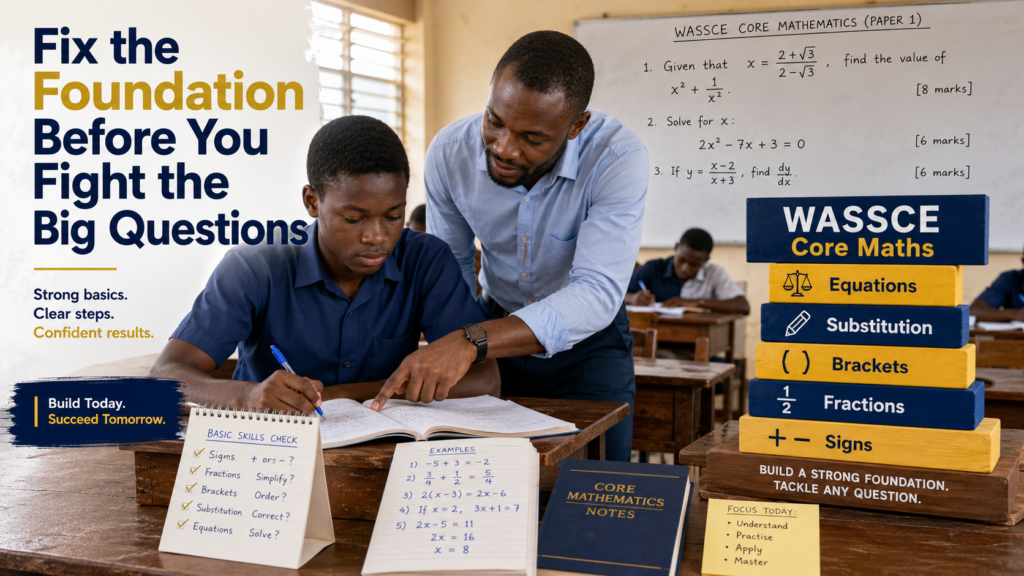
A weak algebra foundation does not mean a learner is finished. It means there is a gap that must be found and treated.
In Core Maths, algebra is like the pillar inside many topics. If the pillar is weak, the learner may struggle with equations today, graphs tomorrow, and word problems next week. But when the learner diagnoses the exact weak area, recovery becomes possible.
So do not only say, “I am weak in algebra.” Be more exact. Say, “I struggle with signs,” or “I remove brackets wrongly,” or “I cannot translate words into equations,” or “I make substitution errors.”
Once you can name the weakness, you can treat it. Once you treat it, your confidence in WASSCE Core Maths can grow step by step.
Stop guessing. Start diagnosing. Start understanding.