Struggling with WASSCE Maths? Stop guessing. Let’s fix the gap step by step.

Linear Equations: 5 Steps to Solve Without Guessing

Linear equations in Core Maths are one of the topics where many Ghanaian SHS students lose marks, not because the topic is too difficult, but because they solve too quickly without checking the balance of the equation. In fact, linear equations in Core Maths become easier when learners stop memorizing movement tricks and start understanding what the equal sign means.
In many Ghanaian SHS classrooms, when linear equations appear on the board, some students start behaving as if the question is looking for speed, not understanding. One student will move numbers left and right. Another will change signs anyhow. Another will guess a value for x and hope it works.
But linear equations are not magic. They are not for guessing. They are like a balance scale. Whatever you do to one side, you must do to the other side so that the equation remains fair.
This is where many learners lose marks in WASSCE Core Mathematics. They know the topic name. They may even know that the final answer should be something like x = 3 or y = -2. But the working exposes the hidden gap: poor sign control, weak bracket expansion, confusion with fractions, and no habit of checking the answer.
This post will fix the problem step-by-step. No rush. No guessing. We shall treat the mistake like a maths clinic case: diagnose it, explain why it happens, show the correct method, and give practice tasks.

1. The Learner’s Problem
The learner’s problem is that he or she sees linear equations as a set of movements instead of a balance relationship.
A common classroom statement is
| Student’s Voice: “Sir, when the number crosses the equal sign, the sign changes, but sometimes I do not know when to change it.” |
That sentence shows the real gap. The learner has memorized a shortcut but does not understand the reason behind it.
This confusion shows up in questions such as the following:
3x + 5 = 20
2(x – 3) = 14
(x / 4) + 3 = 8
5x – 7 = 2x + 11
The learner may start well, but one small sign error destroys the whole answer. This is why linear equations in Core Maths must be taught as a balance problem first, before learners are introduced to shortcuts.
2. Why Did the Mistake Happen?
The mistake happens because many learners were taught the movement rule before they understood the balance rule.
They say, “When it crosses, change the sign,” but they do not know that what is really happening is the same operation being applied to both sides of the equation.
For example:
x + 5 = 12
To remove +5 from the left side, we subtract 5 from both sides:
x + 5 – 5 = 12 – 5
x = 7
So the sign did not change because the number “crossed.” The sign changed because we used the opposite operation to keep the equation balanced.
The hidden gaps are usually these:
- Weak understanding of equality as balance
- Poor handling of positive and negative signs
- Confusion when brackets are involved
- Fear of fractions in equations
- No habit of substituting back to check the answer
3. What WAEC or the Curriculum Reveals
WAEC-style Core Mathematics questions do not only test whether a learner can get x. They also test whether the learner can present clear algebraic steps, apply inverse operations correctly, and avoid careless sign errors.
The curriculum direction also expects learners to reason, communicate mathematically, and apply algebra to real situations. This means a learner must know why each step is correct, not only copy a method from the board.
In WASSCE, linear equations can appear alone, but they can also hide inside other topics, such as:
- Word problems
- Simultaneous equations
- Mensuration formula substitution
- Financial mathematics
- Variation
- Graphs and coordinate geometry
- Functions and mappings
| WAEC Trap A learner may think the question is about mensuration, but the mark is lost because the learner cannot solve the linear equation after substituting into the formula. |
4. Simple Explanation
A linear equation is an equation where the highest power of the unknown is 1. It usually looks like this:
ax + b = c
The unknown may be x, y, m, p, or any letter. The aim is to find the value of the unknown that makes the equation true.
Think of the equal sign as a balance scale. The left side and the right side must remain equal. So if you add, subtract, multiply, or divide one side, you must do the same to the other side.
Example:
2x + 3 = 11
The 3 is added to 2x, so we remove it by subtracting 3 from both sides:
2x + 3 – 3 = 11 – 3
2x = 8
Now 2 is multiplying x, so we divide both sides by 2:
2x / 2 = 8 / 2
x = 4
That is the correct value because when x = 4:
2(4) + 3 = 8 + 3 = 11
5. Worked Example
Example: Solve the equation below.
3x – 4 = 2x + 9
Step 1: Collect the x terms on one side
We want the x terms together. Subtract 2x from both sides:
3x – 4 – 2x = 2x + 9 – 2x
x – 4 = 9
Step 2: Remove the constant beside x
The -4 is beside x. To remove -4, add 4 to both sides:
x – 4 + 4 = 9 + 4
x = 13
Step 3: Check the answer
Substitute x = 13 into the original equation:
Left side = 3(13) – 4 = 39 – 4 = 35
Right side = 2(13) + 9 = 26 + 9 = 35
Both sides are equal, so the answer is correct.
Final Answer: x = 13
6. Common Wrong Approach
A learner may solve the same equation like this:
3x – 4 = 2x + 9
3x – 2x = 9 – 4
x = 5
This is wrong.
The learner treated -4 as if it should become -4 on the other side. But when -4 is moved from the left side, it should be removed by adding 4 to both sides. So it becomes +4 on the right side.
Correctly:
3x – 2x = 9 + 4
x = 13
| Hidden Gap The learner did not understand inverse operations. He or she only memorized “change the sign” but applied it wrongly. |
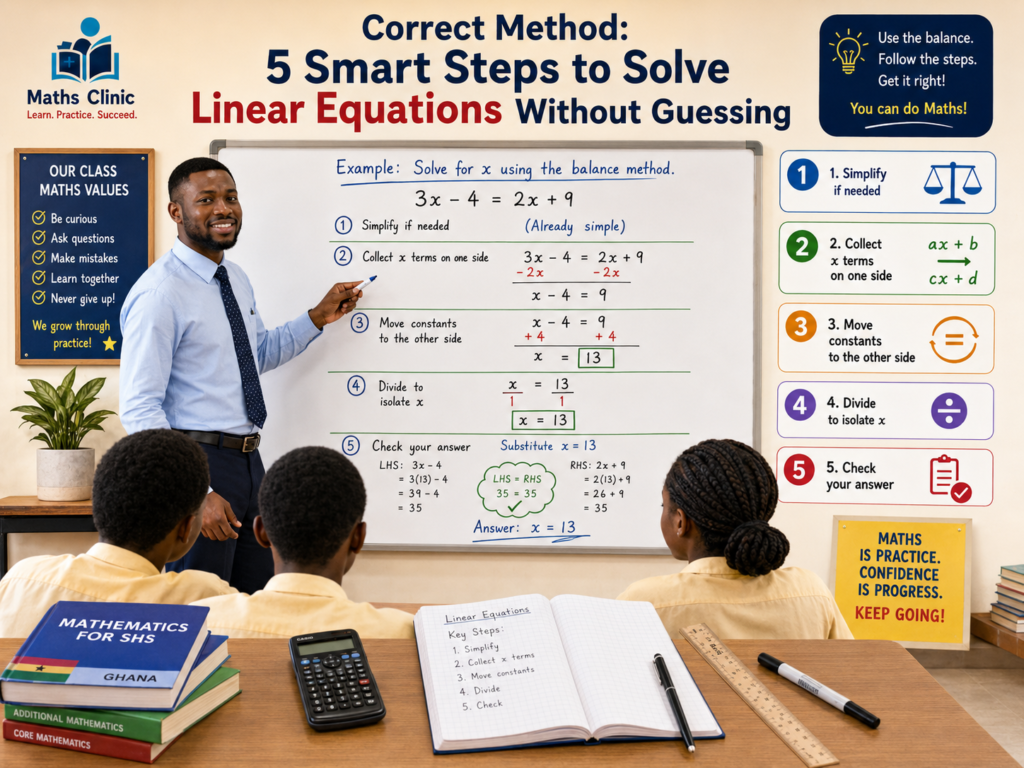
7. Correct Method: 5 Smart Steps to Solve Linear Equations Without Guessing
Step 1: Read the Equation Before Touching the Numbers
Do not start moving terms immediately. First look at the structure. Ask: Are there brackets? Are there fractions? Are x terms on both sides? Are there negative signs? This first reading prevents careless work.
Step 2: Remove Brackets Correctly
If the equation contains brackets, expand them before collecting like terms. Be very careful when a negative sign is outside the bracket.
Step 3: Clear Fractions or Decimals Early
If fractions are involved, multiply through by the lowest common multiple of the denominators. This makes the equation easier to handle.
Step 4: Collect Like Terms Without Spoiling the Signs
Keep the unknown terms on one side and constants on the other side. Use inverse operations, not blind movement.
Step 5: Divide and Check the Answer
After isolating the unknown, divide by its coefficient. Then substitute your answer back into the original equation to confirm it works.
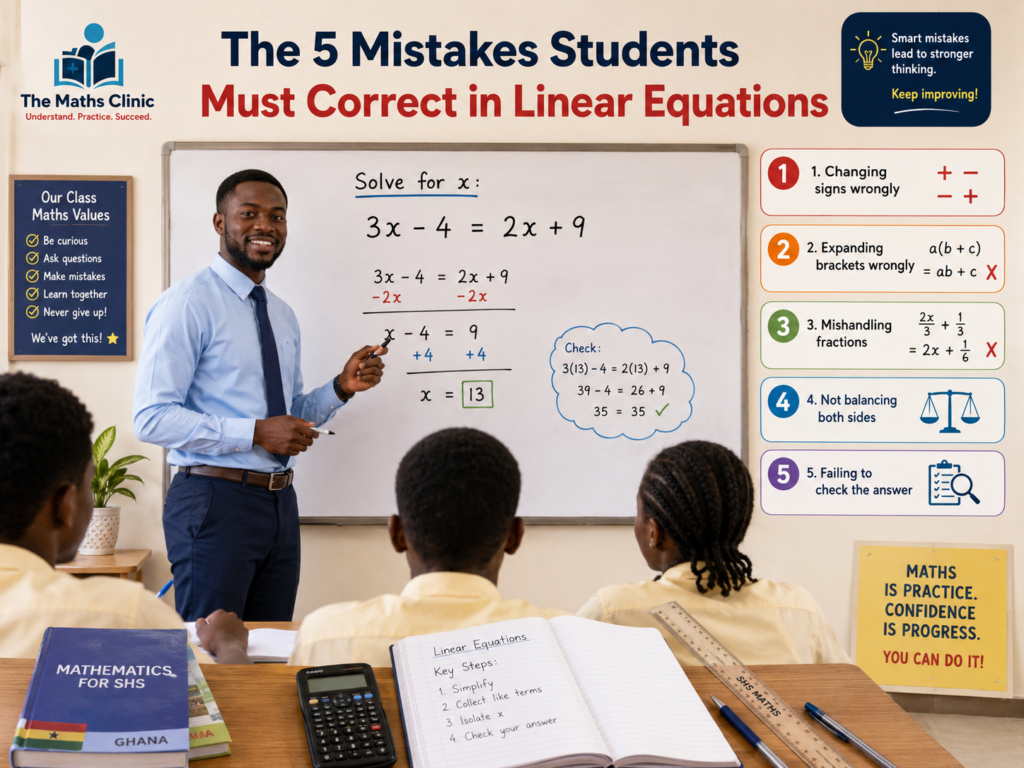
8. The 5 Mistakes Students Must Correct
Mistake 1: Changing Signs Without Understanding Why
Many learners change signs because a term “crossed the equal sign.” This shortcut becomes dangerous when the equation is longer. The safer understanding is this: use the opposite operation on both sides.
Mistake 2: Expanding Brackets Poorly
For example, 2(x – 5) is not 2x – 5. The 2 must multiply everything inside the bracket: 2(x – 5) = 2x – 10.
Mistake 3: Mishandling Negative Signs
A negative sign can change the whole answer. For example, -(x – 3) = -x + 3, not -x – 3.
Mistake 4: Fearing Fractions in Equations
Some learners panic when they see fractions. The cure is to multiply every term by the LCM of the denominators.
Mistake 5: Not Checking the Answer
Checking is not a waste of time. It is a mark-saving habit. Substitute the answer back into the original equation. If both sides are equal, your answer is correct.
9. Extra Worked Examples for Weak Learners
Example 1: Equation with Brackets
Solve:
2(x + 3) = 18
Expand the bracket:
2x + 6 = 18
Subtract 6 from both sides:
2x = 12
Divide by 2:
x = 6
Check:
2(6 + 3) = 2(9) = 18
Example 2: Equation with Fractions
Solve:
(x / 3) + 2 = 7
Subtract 2 from both sides:
x / 3 = 5
Multiply both sides by 3:
x = 15
Check:
(15 / 3) + 2 = 5 + 2 = 7
Example 3: Equation with x on Both Sides
Solve:
4x + 1 = 2x + 13
Subtract 2x from both sides:
2x + 1 = 13
Subtract 1 from both sides:
2x = 12
Divide by 2:
x = 6
Check:
4(6) + 1 = 25
2(6) + 13 = 25
10. Practice Task
Try these questions before checking the solutions. Do not guess. Show clear working.
- 1. Solve: x + 7 = 19
- 2. Solve: 3x = 24
- 3. Solve: 2x – 5 = 17
- 4. Solve: 5x + 3 = 2x + 18
- 5. Solve: 3(x – 2) = 21
- 6. Solve: (x / 5) + 4 = 10
Practice Task Solutions
Solution to Question 1
x + 7 = 19
x = 19 – 7
x = 12
Solution to Question 2
3x = 24
x = 24 / 3
x = 8
Solution to Question 3
2x – 5 = 17
2x = 17 + 5
2x = 22
x = 11
Solution to Question 4
5x + 3 = 2x + 18
5x – 2x = 18 – 3
3x = 15
x = 5
Solution to Question 5
3(x – 2) = 21
3x – 6 = 21
3x = 27
x = 9
Solution to Question 6
(x / 5) + 4 = 10
x / 5 = 6
x = 30
Link to Practice Zone or Intervention Hub
If you made a mistake in any of the practice questions, do not only mark it wrong. Ask what caused the mistake. Was it a sign error? Was it brackets? Was it fractions? Was it collecting like terms? That is how improvement starts.
Use the Practice Zone to try more linear equation questions. Use the Intervention Hub if you want to identify the exact algebra gap behind your mistake.
| Page | Suggested Anchor Text | Purpose |
| Practice Zone | Try WASSCE linear equation practice. | For guided questions and instant feedback. |
| Intervention Hub | Fix My Algebra Learning Gap | For diagnosis and correction of weak foundations. |
| WAEC Trap | Avoid Common Algebra Mistakes in WASSCE | For warning learners about common mark-loss areas. |
| Ask Dickson | Ask a core math question. | For learners who need help with a specific equation. |
FAQ Section
What is a linear equation?
A linear equation is an equation where the highest power of the unknown is 1. Examples include x + 3 = 10 and 2y – 5 = 11.
Why do students make mistakes in linear equations?
Most mistakes come from weak signs, poor bracket expansion, misunderstanding the equal sign, and copying shortcut rules without understanding inverse operations.
Should I move numbers across the equal sign?
You can use that shortcut only if you understand the reason behind it. The safer method is to do the opposite operation on both sides of the equation.
How can I check if my answer is correct?
Substitute your answer into the original equation. If the left side equals the right side, the answer is correct.
Are linear equations important for WASSCE core mathematics?
Yes. Linear equations appear directly and also inside word problems, graphs, formula substitution, simultaneous equations, financial mathematics, and mensuration.
Ghanaian SHS student learning linear equations in Core Maths for WASSCE at The Maths Clinic
Conclusion: Do Not Guess the Equation; Balance It
Linear equations become easier when the learner stops guessing and starts balancing. The equal sign is not a decoration. It tells us that both sides must remain fair.
So when you solve an equation, do not rush to move numbers anyhow. Read the equation, remove brackets, clear fractions, collect like terms, divide carefully, and check your answer.
In WASSCE Core Mathematics, one sign error can change a correct method into a wrong final answer. But with the right habit, linear equations can become one of the easiest places to pick marks.
At The Math Clinic, we do not only ask whether the answer is right. We ask what caused the mistake and how to fix the hidden gap. That is how weak learners grow into confident problem solvers. When a learner understands linear equations in Core Maths properly, the same skill helps in word problems, graphs, substitution, simultaneous equations, and many other WASSCE topics.
| Final Message to the Learner Do not fear linear equations. Respect the signs, balance both sides, and check your answer. That small discipline can save you marks in WASSCE. |