Struggling with WASSCE Maths? Stop guessing. Let’s fix the gap step by step.
7 Powerful Ways to Find the Exact Topic Costing You Marks

Many Ghanaian SHS students revise core math with serious effort, yet their marks still refuse to rise. They read notes, solve examples, attend extra classes, and still say, ‘Sir, I have learnt this topic before.’ But when the test paper comes back, the score tells another story.
The painful part is this: many learners do not know the exact topic costing them marks. They only know that ‘Maths is hard.’ That statement is too broad. It does not show the learner where to start, what to correct, or which skill to practice first.
At The Maths Clinic, we diagnose before we treat. If a learner keeps losing marks in WASSCE Core Maths, we do not first ask, ‘Why are you not serious?’ We ask, ‘Where exactly are the marks leaking?’ That is where proper math intervention begins.
This post is for the learner who is tired of revising blindly. It will help you find the topic costing you marks, separate core math mistakes from real mathematics weaknesses, and prepare for WASSCE with a clearer plan.
Main Question
How does finding the exact topic costing you marks help a struggling SHS learner understand core math better?
It helps because you stop fighting the whole of Core Maths at once. Once you know the exact topic, exact mistake, and exact skill gap, your WASSCE preparation becomes focused. You repair one weak area at a time, and your practice begins to produce better understanding, not only more pages of work.
1. Study Your Test Paper Topic by Topic
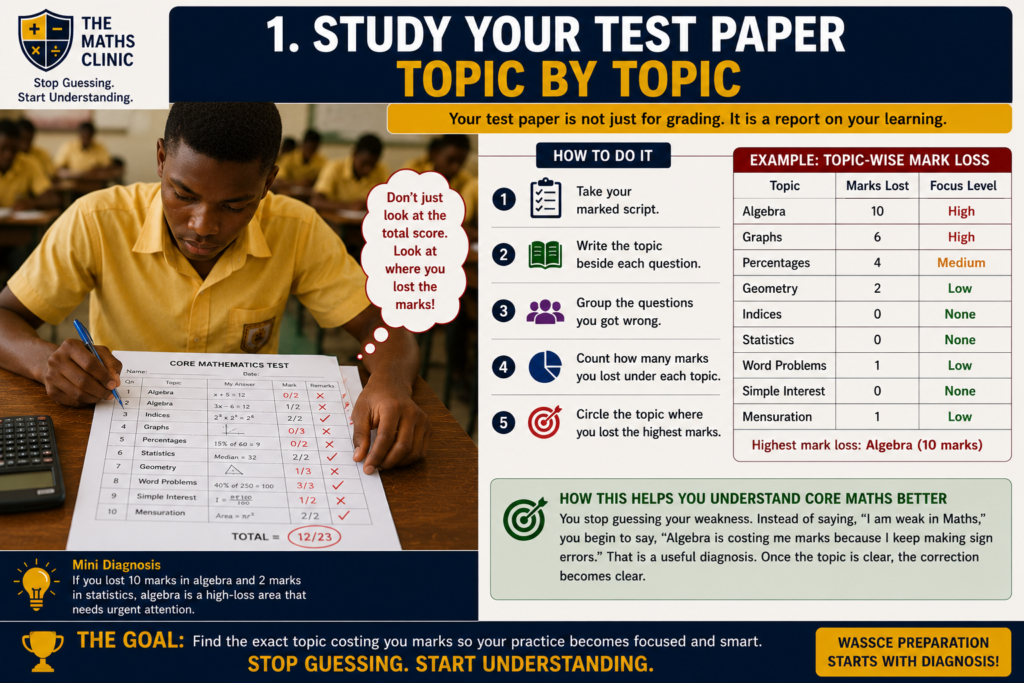
The first powerful way to find the topic costing you marks is to study your test paper topic by topic. Do not only look at the total score. The total score can make you sad, but it may not show you what to fix.
For example, a learner may score 24 out of 50 on a Core Maths test. If the learner only looks at 24, he may conclude, ‘I am weak.’ But if he studies the paper carefully, he may notice that most of the lost marks came from algebra and graphs.
Why This Matters
A test paper is not just for grading. It is also a report on your learning. Every wrong answer is pointing to a possible weak topic, weak method, or hidden foundation gap.
How to Do It
- Take your marked script.
- Write the topic beside each question.
- Group the questions you got wrong.
- Count how many marks you lost under each topic.
- Circle the topic where you lost the highest marks.
Mini Diagnosis
If you lost 10 marks in algebra and 2 marks in statistics, algebra is not just one of your weak areas. It is a high-loss area that needs urgent SHS math help and targeted practice.
How This Helps You Understand Core Maths Better
This helps you stop guessing your weakness. Instead of saying, ‘I do not know Maths,’ you begin to say, ‘Algebra is costing me marks because I keep making sign errors.’ That is a useful diagnosis. Once the topic is clear, the correction becomes clear.
2. Separate Careless Mistakes from Topic Weaknesses
Not every wrong answer means you do not understand the topic. Sometimes, the topic is known, but careless habits are stealing the marks.
For example, a learner may know how to calculate simple interest but still lose marks because he forgot to change 9 months into years. Another learner may know how to find the gradient but subtract the coordinates in the wrong order.
Why This Matters
If you do not separate careless mistakes from topic weaknesses, you may revise the wrong thing. You may spend time relearning the whole topic when the actual problem is checking units, signs, substitution, or careful reading.
How to Do It
- Topic weakness
- Careless arithmetic
- Wrong reading of the question
- Wrong formula
- Wrong substitution
- Unit mistake
- Sign error
- Rounding error
Classroom Example
If you got the formula correct but substituted wrongly, the topic may not be the main problem. The problem may be accuracy and checking. That is one of the common core maths mistakes that can be corrected with deliberate practice.
How This Helps You Understand Core Maths Better
This helps you avoid unnecessary fear. Some learners think they do not understand a whole topic, but the real problem is one habit inside the topic. Once that habit is fixed, the topic becomes easier.
3. Track Repeated Mistakes Across Different Questions
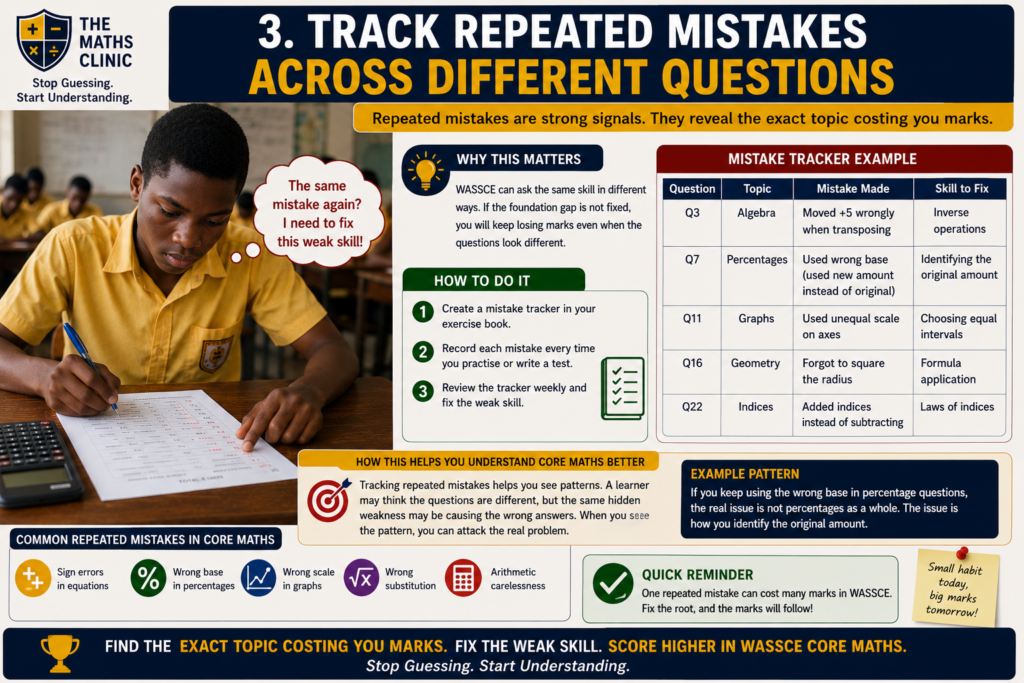
A repeated mistake is a strong signal. If the same mistake appears in different questions, then that mistake is not ordinary. It is a foundation gap.
For example, if you keep changing signs wrongly in equations, the topic costing you marks may be algebra. But more specifically, the weak skill is inverse operations. If you keep choosing the wrong base in percentages, the topic is percentages, but the smaller skill is identifying the original amount.
Why This Matters
WASSCE can ask the same skill in different ways. If the foundation gap is not addressed, the learner will continue to lose marks even when the questions look different.
How to Do It
Create a mistake tracker in your exercise book. Use it after every test, mock paper, or WASSCE practice exercise.
| Question | Topic | Mistake Made | Skill to Fix |
| Q3 | Algebra | Moved +5 wrongly | Inverse operation |
| Q7 | Percentages | Used wrong base | Original amount |
| Q11 | Graphs | Wrong scale | Choosing equal intervals |
Mistake Tracker Example
How This Helps You Understand Core Maths Better
Tracking repeated mistakes helps you see patterns. A learner may think the questions are different, but the same hidden weakness may be causing the wrong answers. When you see the pattern, you can attack the real problem.
4. Check Which Questions You Leave Blank
The questions you leave blank can reveal the exact topics costing you marks. Some learners attempt all algebra questions but leave graph questions blank. Some attempt statistics but leave geometry blank. Some start word problems and stop halfway.
A blank space is not empty. It is information.
Why This Matters
Learners usually leave questions blank when they do not know how to start. That means the topic may have an entry problem. The learner does not know the first step.
How to Do It
- Look at the questions you did not attempt.
- Write the topic beside each blank question.
- Ask why you could not start.
- Write the missing first step you needed.
Example
If you leave bearing questions blank, ask the following: Did I fail because I did not know how to draw North? Did I fail because I did not understand clockwise measurement? Did I fail because I could not identify the angle?
How This Helps You Understand Core Maths Better
This helps you find the exact starting point of your weakness. Sometimes the learner does not need the whole topic repeated. The learner needs the first step explained properly.
5. Compare Your Classwork Scores with WASSCE-Style Practice Scores
Some learners do well in classwork but perform poorly when the question becomes WASSCE-style. This is an important diagnosis.
Classwork may be direct. WASSCE core math questions often require interpretation, application, and careful reading.
Why This Matters
A learner may know the basic topic but struggle when it is hidden in a word problem, table, diagram, or graph. For example, a learner may know how to find 15% of a number, but when the question is about discount, profit, or original price, the learner gets confused.
How to Do It
- Solve five direct questions from the topic.
- Solve five WASSCE-style questions from the same topic.
- Compare the scores.
- If the direct questions are good but WASSCE-style questions are poor, the weakness is application, not basic knowledge.
Learner Check
If your direct classwork score is strong but your WASSCE-style practice score is weak, do not panic. It means your next math intervention should focus on application, interpretation, and exam-style practice.
How This Helps You Understand Core Maths Better
This helps you know whether the problem is basic understanding or exam application. That difference is very important. If your basics are weak, rebuild them. If your application is weak, practice more WASSCE-style questions.
6. Ask What Smaller Skill Is Hiding Under the Topic
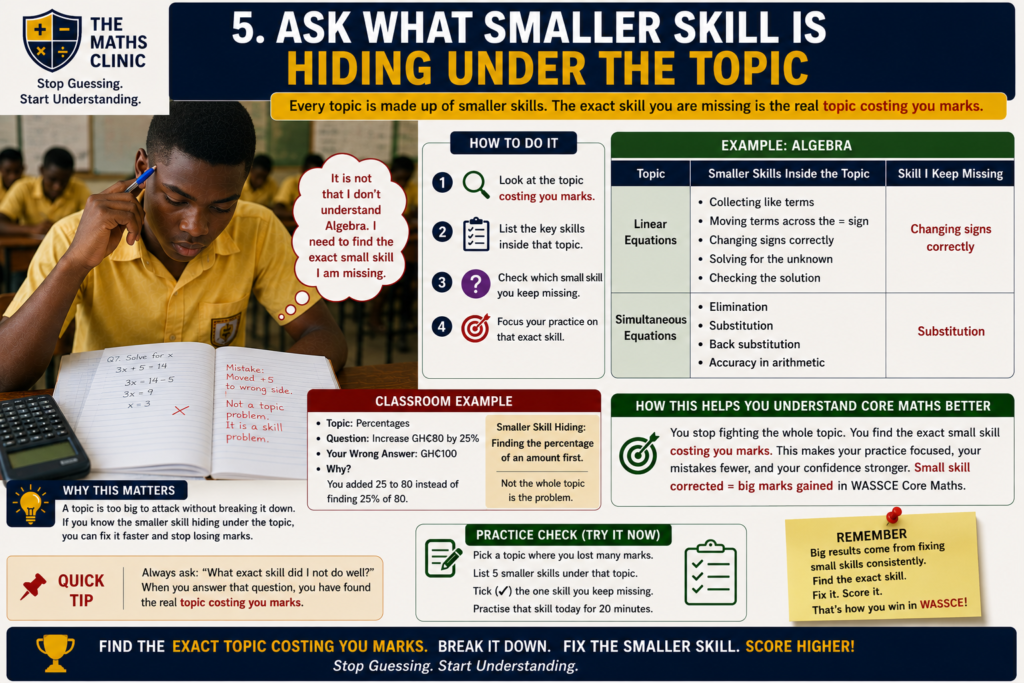
Sometimes the topic costing you marks is not the real root problem. The real problem may be a smaller skill under the topic.
For example, a learner may say, ‘I do not understand simultaneous equations.’ But the real weakness may be negative numbers, substitution, or removing brackets. Another learner may say, ‘I do not understand graphs.’ But the real weakness may be coordinates, scale, or substitution into a table of values.
Why This Matters
Mathematics topics are connected. If the earlier skill is weak, the current topic becomes heavy. This is why some mathematical weaknesses hide under bigger topics.
How to Do It
- What smaller skills do I need before this topic can make sense?
- Which of those smaller skills am I weak in?
- Can I practice that smaller skill separately before returning to the main topic?
Examples of Hidden Skills
Algebra may need integers, brackets, collections of like terms, and inverse operations.
Graphs may need coordinates, a scale, a table of values, and a gradient.
Percentages may need fractions, decimals, ratios, and the idea of a base.
How This Helps You Understand Core Maths Better
This helps you stop fighting the big topic blindly. Once the smaller missing skill is repaired, the main topic becomes lighter.
7. Use a One-Topic Retest to Confirm the Weak Area
After you suspect that a topic is costing you marks, do not just assume. Test it. A one-topic retest helps you confirm whether that topic is truly weak.
Why This Matters
Sometimes a learner thinks a topic is weak because of one bad question. But one question is not enough evidence. A short retest gives better proof.
How to Do It
- Choose the suspected weak topic.
- Select 10 questions from that topic.
- Mix simple, moderate, and WASSCE-style questions.
- Solve without checking notes.
- Mark honestly.
- Write the errors under the topic.
Confirmation
If you score low and the same errors appear again, you have confirmed the high-loss topic. Now you know where your WASSCE preparation must begin.
How This Helps You Understand Core Maths Better
This gives you evidence. You are no longer guessing your weakness. You have tested it, seen it, and can now fix it with purpose.
Worked Example: Finding the Exact Topic Costing a Learner Marks
Let us use a simple example. A learner writes a 50-mark core math test and scores 27 marks. The learner feels discouraged and says, “I am weak in math. But instead of stopping there, we diagnose the paper.
| Topic | Marks Available | Marks Lost | Main Error |
| Algebra | 10 | 7 | Sign errors |
| Graphs | 8 | 5 | Wrong scale |
| Percentages | 6 | 4 | Wrong base |
| Statistics | 8 | 2 | Minor arithmetic |
| Mensuration | 10 | 3 | Formula selection |
| Probability | 8 | 2 | Careless reading |
Diagnosis
The learner is not weak in the whole of core math. The first urgent topic is algebra. The exact weakness inside algebra is sign errors and inverse operations. This is the topic costing the learner the highest number of marks now.
What the Learner Should Do Next
- Revise inverse operations.
- Practice simple linear equations.
- Check every sign movement carefully.
- Solve 10 more algebra questions.
- Mark and record the errors again.
This is how diagnosis turns confusion into a clear action plan. The learner stops wasting energy and begins to repair the exact skill that is causing the mark loss.
Common Wrong Approach
Many struggling learners make this mistake: they revise all topics equally. That may look serious, but it is not always effective.
If algebra is costing you 12 marks and probability is costing you 2 marks, both topics are not crying for the same attention. Algebra needs urgent treatment. This is why SHS math help must be diagnostic, not general.
Another wrong approach is judging yourself by the total score only. A score of 24 out of 50 is not enough information. You must find where the 26 marks were lost.
Correct Method: Use the Maths Clinic Mark-Loss Diagnosis
Use this simple method anytime you finish a test, mock paper, or practice exercise.
- Mark your work honestly.
- Write the topic beside every wrong question.
- Group the wrong questions by topic.
- Count the marks lost under each topic.
- Identify the topic with the highest mark loss.
- Find the exact mistake inside that topic.
- Practice that exact skill before moving to another topic.
Important Reminder
Do not only ask, “What did I get wrong?” Ask, “Which topic is taking my marks again and again?” That is the question that leads to improvement in WASSCE core math.
Practice Task: Find Your Own High-Loss Topic
Use your most recent Core Maths test, class exercise, mock paper, or WASSCE practice paper.
- Write your total score.
- List every question you got wrong.
- Write the topic beside each wrong question.
- Write the number of marks lost.
- Write the mistake you made.
- Add the marks lost under each topic.
- Circle the topic with the highest mark loss.
Then complete this learner diagnosis sentence:
The exact topic costing me marks now is ____________________.
The mistake I keep making in that topic is ____________________.
The smaller skill I must fix first is ____________________.
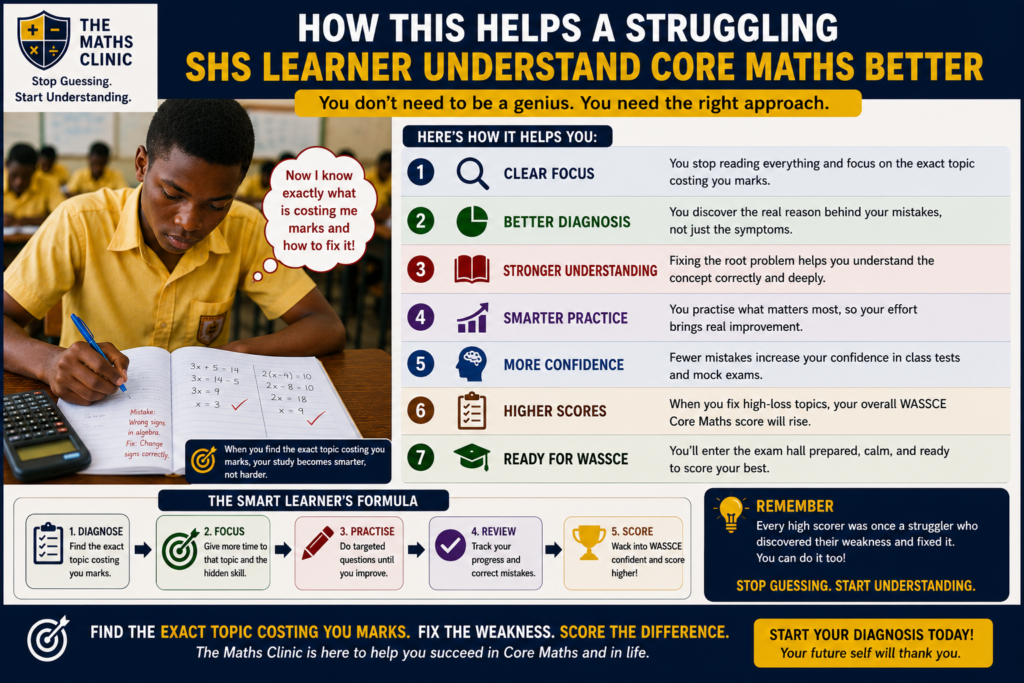
How This Helps a Struggling SHS Learner Understand Core Maths Better
Finding the exact topic costing you marks helps because it removes confusion from your revision. Many Ghanaian SHS students feel that the whole of Core Maths is against them. But when the paper is diagnosed properly, the learner may discover that only two or three topics are causing most of the damage.
That discovery is powerful. It helps the learner move from fear to focus. It helps the learner stop wasting time on topics that are already strong. It helps the learner practice the exact skill that is breaking the solution.
It also helps the teacher, parent, or tutor know where to support the learner. This is the heart of math intervention: diagnose the mark-loss area, identify the smaller skill, teach it clearly, and practice it until the learner can solve it without guessing.
Most importantly, it helps the learner understand that wrong answers are not the end. Wrong answers are evidence. They show where the repair must begin.
When a learner knows the exact topic, exact mistake, and exact skill gap, Core Maths becomes easier to approach. The learner no longer feels lost. The learner now has a direction for WASSCE preparation.
Final Advice Before WASSCE
Do not wait until the last month before WASSCE before you find the topic costing you marks. Start now.
Take one test paper. Study it. Group the mistakes. Count the marks lost. Find the highest-loss topic. Then treat that topic with serious attention.
You do not need to revise blindly. You need a diagnosis.
At The Math Clinic, we believe that a struggling learner is not finished. Sometimes, the learner only needs to know where the marks are leaking and how to seal that gap.
Once you find the exact topic costing you marks, your revision becomes sharper, your practice becomes wiser, and your confidence begins to return.