Struggling with WASSCE Maths? Stop guessing. Let’s fix the gap step by step.
7 Hidden Reasons You Understand in Class but Fail Tests

Many Ghana SHS students know this painful feeling: you understand in class but fail tests. During the lesson, the teacher explains the topic, and everything looks clear. You nod your head. You copy the steps. You may even answer one or two questions correctly on the board.
But when the class test, mock, or WASSCE-style question comes, the same topic suddenly becomes difficult. The learner looks at the paper and asks, “But I understood this in class, so why am I failing the test?” This is one of the most common Core Maths mistakes behind poor test performance.
This problem is common in WASSCE Core Maths, and it does not always mean the learner is lazy. Sometimes, the learner understands the teacher’s explanation but has not yet built independent solving power for test conditions.
That is the hidden gap. Understanding in class and performing on a test are not always the same skill. This is why many learners need targeted SHS Maths help, not only more notes.
The key question this post answers is this: How does knowing the hidden reasons you understand in class but fail tests help a struggling SHS learner understand Core Maths better?
It helps because the learner stops blaming the whole of mathematics and starts identifying the exact reason marks are being lost. Once the exact reason is known, correction becomes easier, revision becomes focused, and WASSCE preparation becomes more useful.
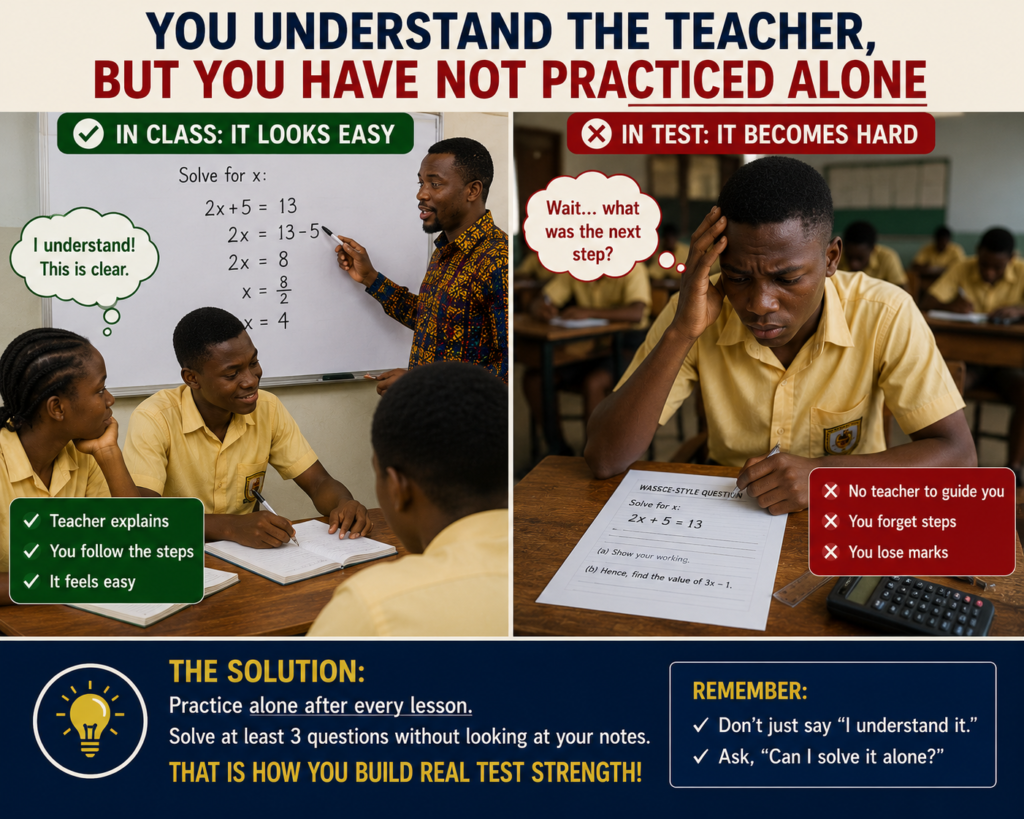
1. You Understand the Teacher, But You Have Not Practiced Alone
In class, the teacher carries most of the thinking. The teacher chooses the method, arranges the steps, explains the difficult parts, and corrects the Core Maths mistakes immediately.
So the lesson feels easy. But when you sit alone in a test, nobody is there to guide your thinking. That is when the weakness appears, and that is why some learners understand in class but fail tests.
Why This Happens
Many learners mistake guided understanding for personal mastery. They follow the teacher’s hand, but they have not trained their own hand and mind to solve from start to finish. This weak independent practice often leads to test failure.
How This Helps You Understand Core Maths Better
This shows the learner that class understanding must be followed by independent practice. After every lesson, solve at least three questions without looking at the board or your notes. That is how the topic moves from the teacher’s explanation into your own brain and becomes useful for WASSCE Core Maths.
Do not only say, ‘I understand it.’ Ask, ‘Can I solve it alone?’
2. You Copy the Steps, But You Do Not Understand the Reason Behind Them
Some learners write beautiful notes, but the meaning behind the steps is missing. They know what the teacher wrote, but they cannot explain why each step was done. This is a common reason many learners understand in class but fail tests.
For example, a learner may know that a number changes sign when moved across the equal sign. But the learner may not understand that this comes from doing the opposite operation to keep the equation balanced.
Why This Happens
This happens when learners focus on copying quickly instead of thinking carefully. The exercise book becomes full, but the understanding remains light. Later, the same learner needs SHS Maths help because the method was copied, not understood.
How This Helps You Understand Core Maths Better
This helps the learner shift from memorising steps to understanding ideas. In core mathematics, WAEC can change the style of a question. If you only memorized steps, you may get stuck. If you understand the reason, you can adjust during WASSCE preparation and avoid common Core Maths mistakes.
After every example, ask: ‘Why did we do this step?’
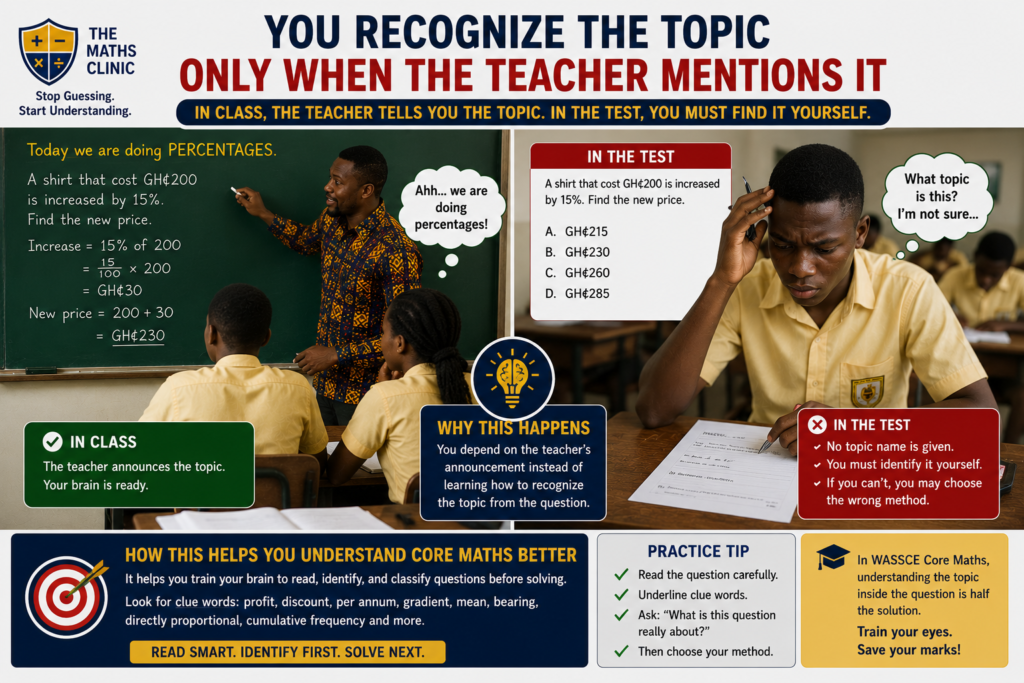
3. You Recognize the Topic Only When the Teacher Mentions It
In class, the teacher may say, “Today we are doing percentages,” or “This is a question on simultaneous equations.” That announcement helps your brain choose the method.
But in a test, the question will not always announce the topic. You must read the question and identify the topic by yourself. This is one major reason learners understand in class but fail tests.
Why This Happens
Many learners study topics separately but do not learn how to recognize them inside mixed questions. So when the topic name is removed, they become confused and lose marks in WASSCE Core Maths.
How This Helps You Understand Core Maths Better
This helps the learner understand that mathematics is not only calculation. It is also interpretation. Before solving, identify the topic hiding inside the question. This is an important part of Maths intervention for struggling learners.
Words like “profit,” “discount,” “per annum,” “gradient,” “mean,” “bearing,” “directly proportional,” and “cumulative frequency” are clues. Learn to read them carefully during WASSCE preparation.
4. You Depend on Familiar Examples
Some learners can solve a question only when it looks exactly like the teacher’s example. If the numbers, diagram, or wording changes, they panic.
This is a hidden reason many learners understand in class but fail tests. The class example trained memory, but the test requires application. WASSCE Core Maths often checks whether the learner can use the idea in a new form.
Why This Happens
This happens when learners practice only one type of question. They master the appearance of the example, not the idea behind it. That weak application is one of the Core Maths mistakes that causes test failure.
How This Helps You Understand Core Maths Better
This helps the learner see that WASSCE tests flexible understanding. After learning one example, practice different versions of the same idea. Change the numbers. Change the wording. Try a word problem. Try a diagram. That is how Ghana SHS students build test strength.
Do not ask only, ‘Have I seen this before?’ Ask, ‘What idea is this question testing?’
5. You Understand Slowly, But the Test Demands Speed and Accuracy
Some learners truly understand the topic, but they work too slowly. By the time they finish one question, the test is almost over. Others rush because of time and make careless mistakes.
So the issue may not be lack of understanding. It may be weak exam speed, poor checking habits, or lack of timed practice. This is another reason learners understand in class but fail tests.
Why This Happens
In class, there is more time. The teacher can pause, explain again, and allow questions. In a test, time is limited. The learner must understand, choose a method, calculate, and check within a short time.
How This Helps You Understand Core Maths Better
This helps the learner understand that practice must include timing. Core Maths preparation is not only about knowing the method. It is also about using the method under test conditions, especially for WASSCE Core Maths.
Practice some questions with time. Start gently, then increase your speed without destroying accuracy.
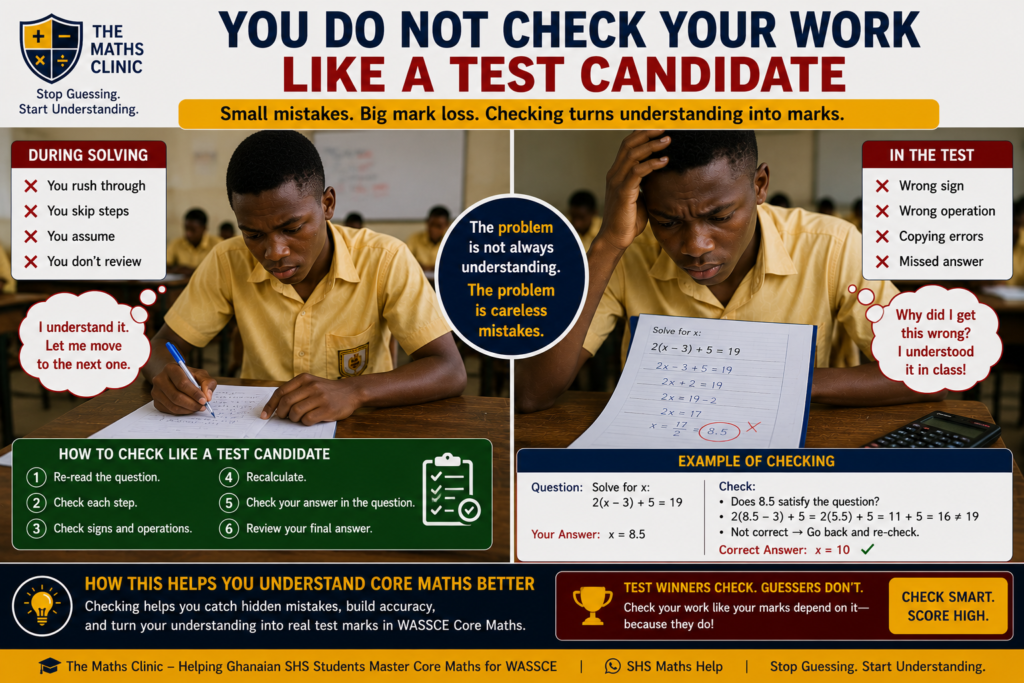
6. You Do Not Check Your Work Like a Test Candidate
In class, the teacher may catch your mistake quickly. A friend may whisper, “Check your sign.” But in a test, small mistakes can pass unnoticed.
A learner may understand the method but lose marks through wrong signs, wrong substitution, wrong units, wrong rounding, or copying the question wrongly. These are small Core Maths mistakes, but they can cause serious test failure.
Why This Happens
Many learners think checking means looking at the final answer only. But proper checking means going through the steps to see where marks can be lost. This habit is important for every Ghana SHS student preparing for WASSCE.
How This Helps You Understand Core Maths Better
This helps the learner build self-correction. WASSCE rewards correct reasoning, not only confidence. Before submitting, check signs, formulas, units, substitution, scale, and whether the final answer answers the question asked.
A learner who can check well can save marks that others throw away.
7. Your Foundation Skill Under the Topic Is Weak
Sometimes, the topic taught in class is not the real problem. The real problem is a smaller foundation skill under that topic.
For example, a learner may say, “I don’t understand graphs.” But the real weakness may be coordinates, scale, substitution, or gradient. Another learner may say, “I don’t understand percentages.” But the real weakness may be fractions, decimals, or ratios. This is why proper Maths intervention looks for the smaller gap first.
Why This Happens
Mathematics topics are connected. If the earlier foundation is weak, the new lesson may look clear in class but collapse during the test. That collapse is one reason a learner can understand in class but fail tests.
How This Helps You Understand Core Maths Better
This helps the learner stop fighting the big topic blindly. Instead, look for the smaller missing skill. Fixing that smaller skill can make the whole topic easier and improve WASSCE preparation.
Ask: ‘What smaller skill must I know before this topic can make sense?’
Worked Example: Class Understanding vs Test Understanding
Let us use a simple algebra question to see the hidden difference between class understanding and test understanding.
Question
Solve: 4x – 6 = 18
What May Happen in Class
When the teacher is solving it, the learner follows the steps easily:
4x – 6 = 18
4x = 18 + 6
4x = 24
x = 6
The learner says, ‘I understand.’
What May Happen in the Test
The learner may write:
4x – 6 = 18
4x = 18 – 6
4x = 12
x = 3
The method looked familiar, but the sign was handled wrongly.
Diagnosis
The learner does not need to fear the whole of algebra. The exact weakness is inverse operations and balancing equations. Naming the exact weakness is the beginning of real SHS Maths help.
Correct Thinking
Since 6 is subtracted from 4x, we add 6 to both sides to remove it:
4x – 6 = 18
4x = 18 + 6
4x = 24
x = 6
This is how diagnosis helps. It shows the learner the exact place where understanding is weak, instead of blaming the whole of Core Maths.
Common Wrong Approach
Many learners respond to poor test scores by saying, “I will read everything again.”
Reading everything again may feel serious, but it may not solve the real problem. The learner may read the notes, feel comfortable, and still fail the next test because the hidden weakness has not been corrected.
Another wrong approach is copying more solved examples without independent practice. Copying can make the learner feel busy, but busy is not the same as prepared. Strong WASSCE preparation needs diagnosis, correction, and fresh practice.
Correct Method: Turn Class Understanding into Test Performance
Use this Maths Clinic method after every lesson to move from classroom understanding to better test performance:
- Close the notes and solve one question alone.
- Explain the method in your own words.
- Try a second question with different numbers.
- Try a WASSCE-style question with words, a diagram, table, or mixed ideas.
- Mark your work and name the exact Core Maths mistake.
- Practice that exact weakness again.
- Time yourself after the method becomes clear.
This method trains the learner to move from class comfort to test confidence. It also shows why a learner may understand in class but fail tests if independent practice is missing.
Practice Task: Check Why You Fail Tests
Solve these questions without looking at your notes. After each question, write what slowed you down or caused a mistake. This is a simple Maths intervention you can start today.
Algebra: Solve 5x + 4 = 29
Diagnosis question: Did you remove +4 correctly?
Percentages: A bag was sold for GH₵240 after a 20% discount. Find the original price.
Diagnosis question: Did you identify the correct base?
Simple Interest: Find the simple interest on GH₵900 at 10% per annum for 8 months.
Diagnosis question: Did you convert months to years?
Graphs: Find the gradient of the line joining (2, 5) and (6, 13).
Diagnosis question: Did you subtract the coordinates in the correct order?
Word Problem: The sum of two numbers is 40. One number is 6 more than the other. Find the two numbers.
Diagnosis question: Did you translate the words into an equation?
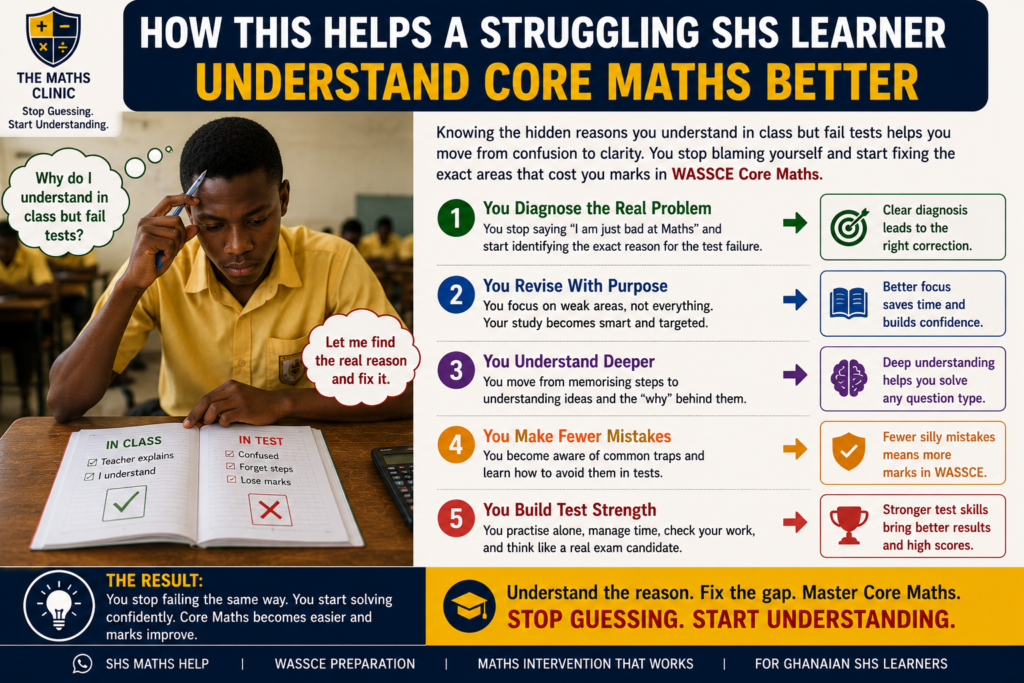
How This Helps a Struggling SHS Learner Understand Core Maths Better
This lesson helps a struggling SHS learner understand Core Maths better because it separates real understanding from class comfort.
A learner may feel fine in class because the teacher is guiding the work. But tests show whether the learner can read, decide, solve, check, and correct independently. That is why some Ghana SHS students understand in class but fail tests.
When learners know the hidden reasons behind test failure, they stop saying, “Maths is not for me.” They begin to say, “I need more independent practice,” or “I need to fix signs,” or “I need to learn how to read word problems.”
That kind of diagnosis is powerful. It gives the learner a clear direction and turns SHS Maths help into targeted correction, not guesswork.
The aim is not to shame the learner. The aim is to locate the gap, correct it, and practice again until the learner can stand on his or her own during the test.
Final Advice Before WASSCE
Do not judge your Core Maths strength only by how you feel during class. Judge it by what you can do alone after class.
If you understand in class but fail tests, do not panic. It means there is a gap between guided learning and independent performance. That gap can be fixed with diagnosis, correction, and steady WASSCE preparation.
Start small. Pick one topic. Solve questions alone. Check your mistakes. Name the weakness. Fix it. Then practice again.
At The Maths Clinic, we believe that struggling in mathematics does not mean you are finished. Sometimes, it only means your learning needs diagnosis, correction, better practice, and the right Maths intervention.
When you fix the hidden reasons, Core Maths becomes clearer. And when Core Maths becomes clearer, tests become less frightening for WASSCE Core Maths learners.