Struggling with WASSCE Maths? Stop guessing. Let’s fix the gap step by step.
Probability Clinic
Every Probability Clinic lesson in one place: rules, not/and/or, without replacement, Venn diagrams, common mistakes and WASSCE-style questions with answers.
Probability is one of the friendliest topics in WASSCE Mathematics, and one of the easiest places to lose marks. The fraction is rarely the problem. The problem is the total, a small word like “not” or “at least”, an overlap counted twice, or a second pick from a smaller bag.
The Probability Clinic fixes those gaps one at a time. Each lesson names one mistake, shows why it happens, and gives worked WASSCE-style questions with answers and diagrams.
What you’ll be able to do by the end
- Find the right total and the right favourable outcomes every time
- Read “not”, “at least”, “at most”, “both”, “neither” and “or” correctly
- Use the complement, the “and” and “or” rules, and without-replacement fractions
- Read and fill Venn diagrams, including find-x questions
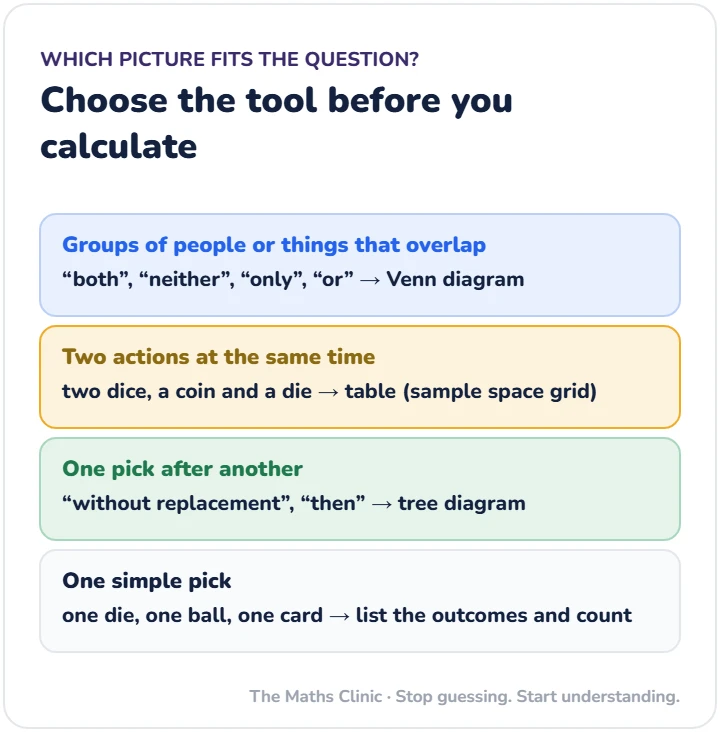
- Choose between a list, a table, a tree diagram and a Venn diagram
- Check that every answer makes sense before you move on
Probability in one page
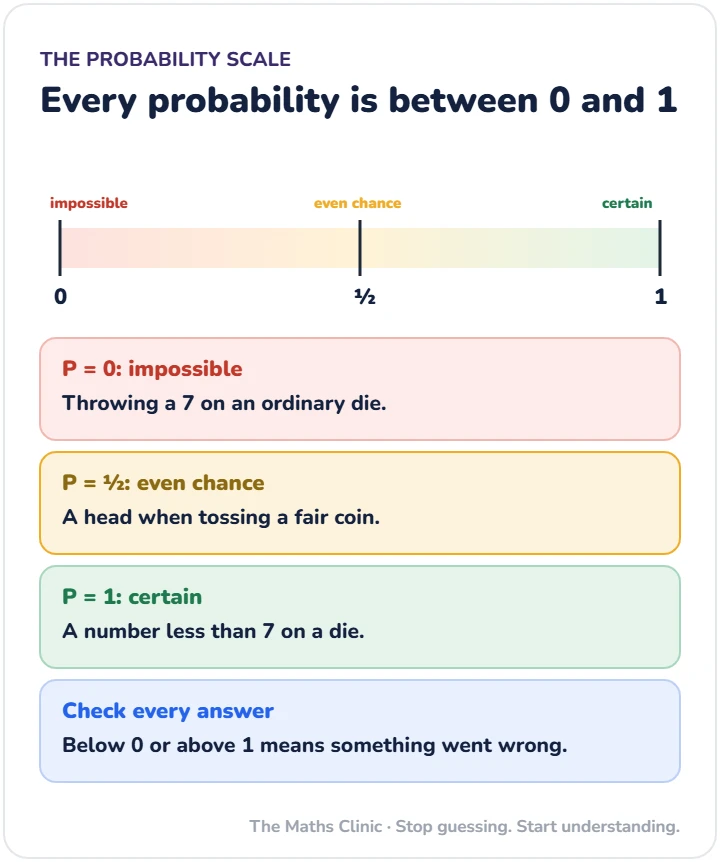
1. Favourable over total
List the outcomes, count the ones the question wants, and divide by all of them. The total is the whole group the choice is made from, never just the other colour.
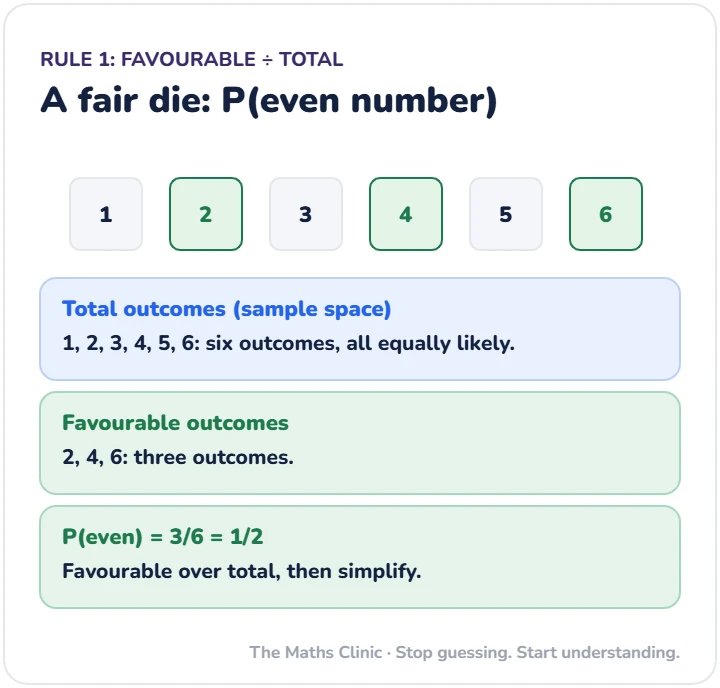
2. “Not” and the complement
An event and its “not” always add up to 1, so P(\text{not A}) = 1 – P(A). It is the quickest route for “not” and “at least one” questions.
3. “And” and “or”
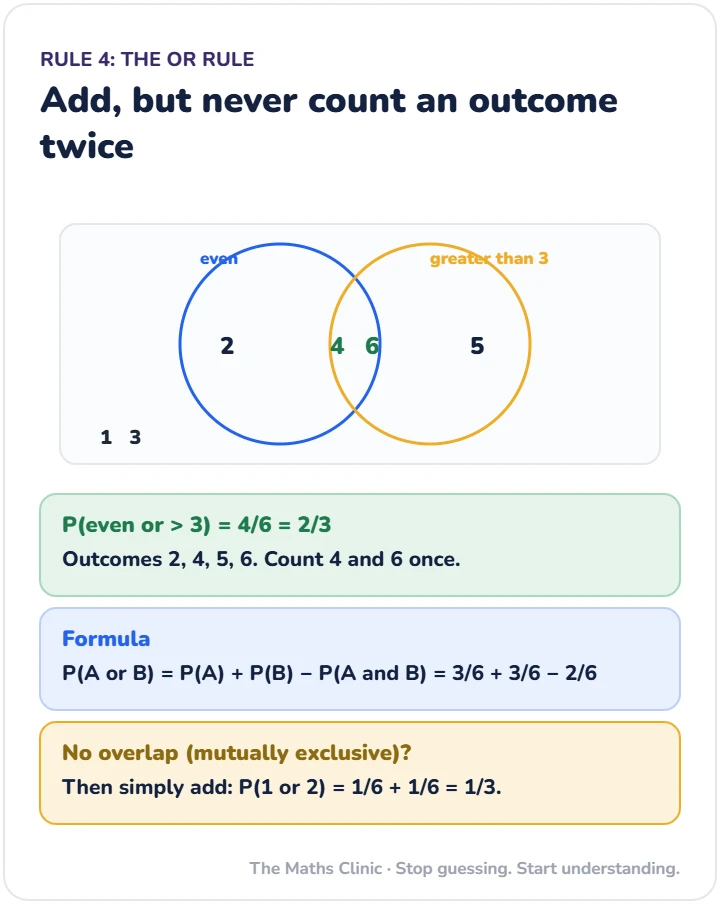
“Or” within one action: add, then remove anything counted twice. “And” across separate actions: multiply.
4. Without replacement
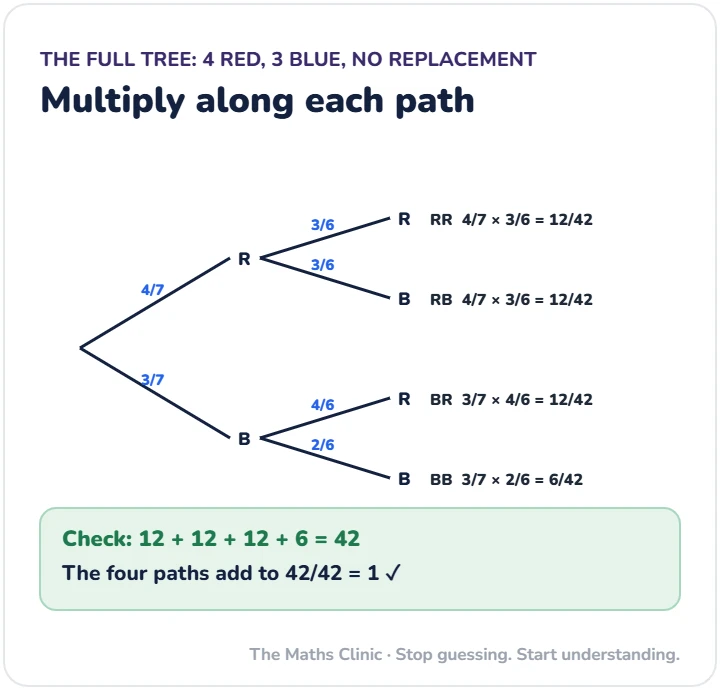
When the first item is not put back, the second fraction changes: one fewer in the total, and one fewer of what was taken. A tree diagram keeps it organised.
5. Sets and Venn diagrams
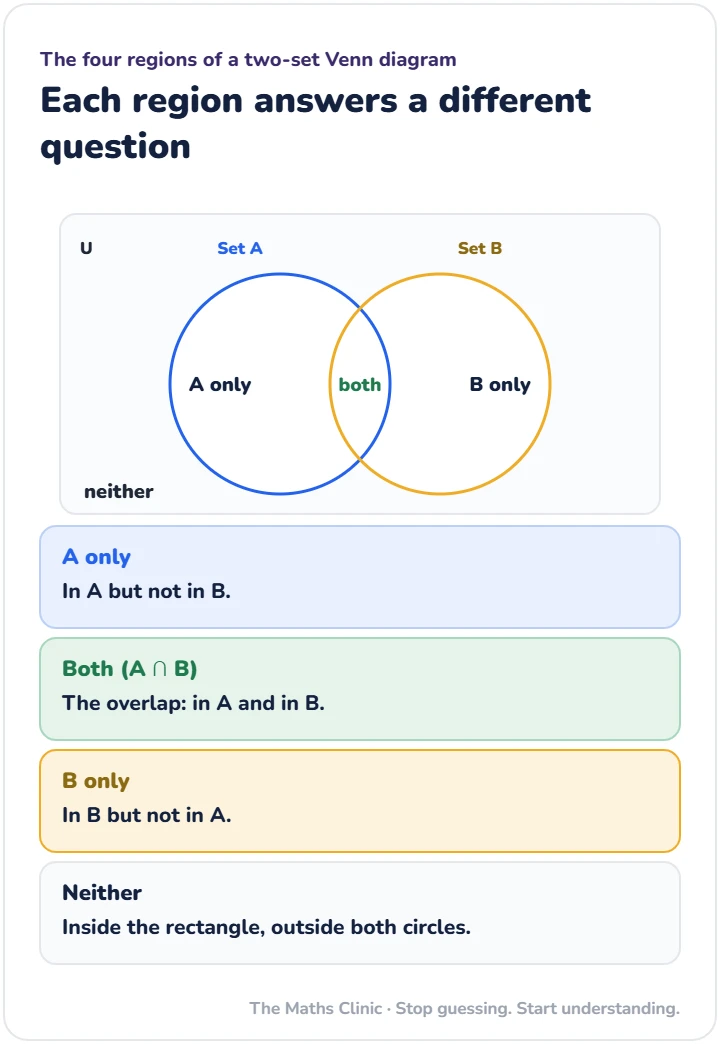
Fill the overlap first, then the “only” regions, then “neither”. The universal set is the denominator.
6. Choosing the right picture
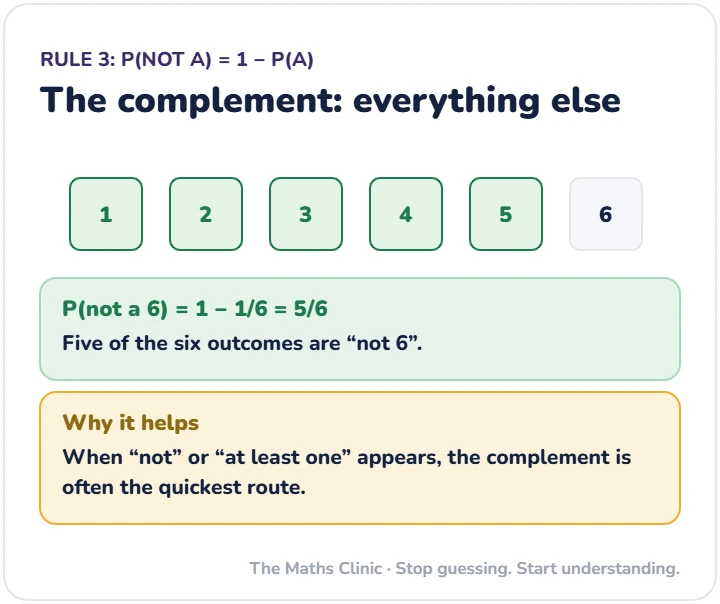
7. Checking every answer
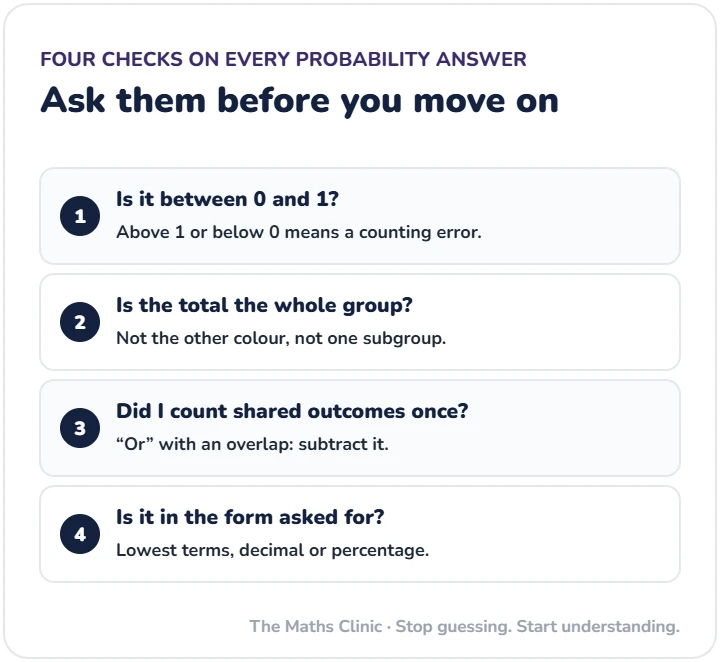
The lessons
The first Probability lessons go live on 12 December, one a day.
Practise as you go
After each lesson, try mixed questions in the Practice Zone. Not sure which skill is weak? Start with Find Your Maths Gap.
The probability mistakes examiners see most
| Mistake | Fix |
|---|---|
| 3 red, 7 blue: P(red) = 3/7 | Red over all the balls: 3/10 |
| Die: P(less than 7) = 7/6 | Count outcomes: 6/6 = 1 |
| P(even or prime) = 3/6 + 3/6 | Count 2 once: 5/6 |
| P(head and 6) = 1/2 + 1/6 | Multiply: 1/12 |
| Two picks without replacement: 5/8 × 5/8 | Smaller bag: 5/8 × 4/7 |
| Two dice: P(total 7) = 1/11 | 36 equally likely pairs: 6/36 = 1/6 |
Questions learners often ask
Is probability on the WASSCE Mathematics paper every year?
Probability appears very regularly, in objective questions and often as part of a theory question, sometimes combined with sets or statistics. It is worth securing.
Which lesson should I start with?
Start with the probability rules lesson at the top of the list, then follow the lessons in order. If you already know the basics, try the practice questions to find your weakest area.
Can a probability be more than 1?
Never. Every probability is between 0 (impossible) and 1 (certain). An answer outside that range means a counting mistake.
This clinic is part of How to Pass WASSCE and NOVDEC Core Maths.
Sources and further reading
These lessons are built on what WAEC examiners report year after year, matched to Ghana’s SHS curriculum.
- WAEC Chief Examiner’s Reports: the yearly reports on where candidates lose marks
- NaCCA SHS curriculum: the official Ghana Senior High School curriculum
- Ghana curriculum resources: official teaching and learning resources

Written by
Dickson Sarpong
NTC-certified SHS Mathematics teacher in Ghana with WAEC marking experience, and author of The Bridge Series textbooks. Every lesson here is built around the mistakes WAEC examiners keep reporting.
About DicksonStuck? Ask a question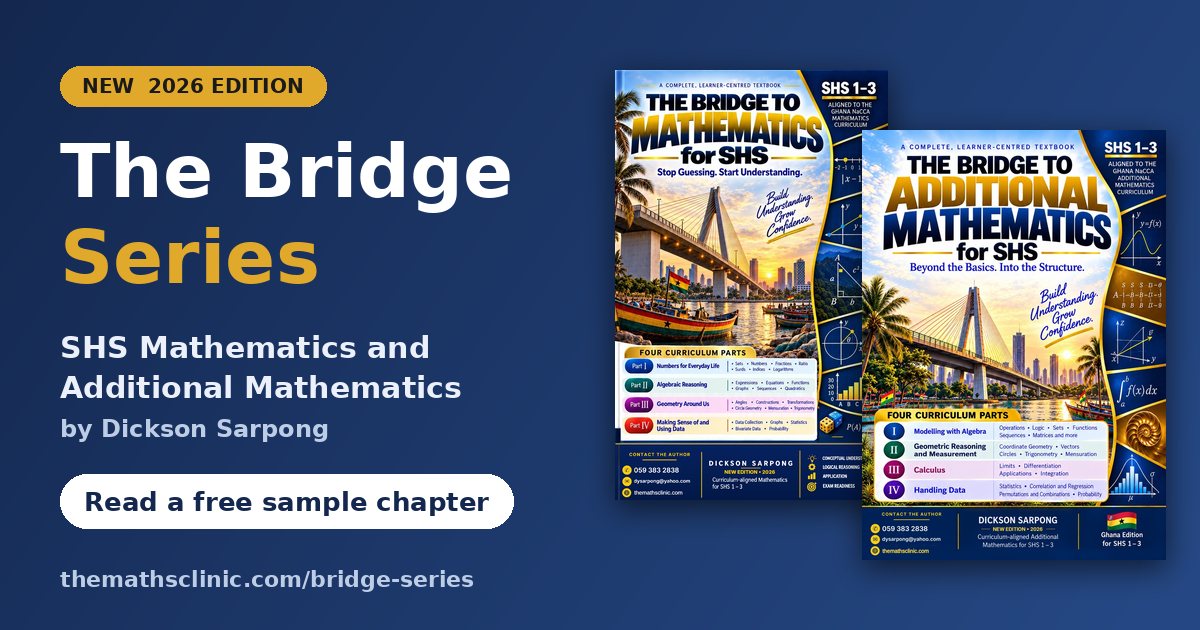
Want the whole topic, step by step? My textbooks, The Bridge to Mathematics and The Bridge to Additional Mathematics for SHS, follow the new curriculum and rebuild the basics as you go.
Read a free chapter →