Struggling with WASSCE Maths? Stop guessing. Let’s fix the gap step by step.

Bearings in Core Maths: 7 Tips to Read Directions Correctly

In many Ghanaian SHS classrooms, the moment some students hear “bearing,” their confidence drops. You will hear somebody say, “Sir, this one is for pilots and sailors.” Another learner will draw many lines on the paper, turn the protractor around, and still get the wrong answer.
But bearings in Core Maths are not meant to punish learners. They test whether the learner can read directions carefully, measure angles from the correct starting line, and follow instructions without guessing.
The painful part is this: many students know how to use a protractor. They also know that bearings are measured in degrees. Yet, they still lose marks because they forget one small rule: bearings are measured clockwise from North.
So in this Maths Clinic lesson, we are not just going to say, “Draw north and measure.” We will diagnose the hidden mistake, fix the direction-reading gap, and practice the correct method step by step.
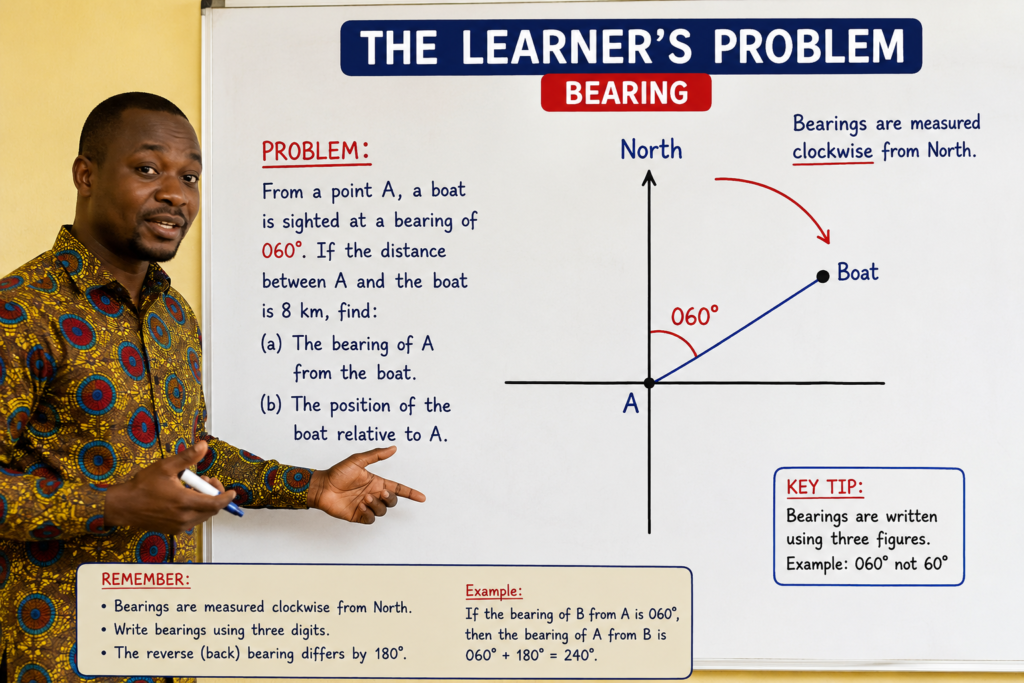
1. The Learner’s Problem
The learner’s main problem is not always the formula. It is direction reading.
In bearing questions, many learners lose marks because they do one or more of the following:
- They start measuring from East, West, or the slant line instead of the North.
- They measure anticlockwise instead of clockwise.
- They forget to write bearings using three digits, such as 045° instead of 45°.
- They confuse the bearing of A from B with the bearing of B from A.
- They draw the North line at only one point instead of drawing a North line at each required point.
- They see a diagram and assume the answer without measuring or reasoning.
- They cannot connect angle facts, such as parallel North lines and angles on a straight line, to bearings.
This is why a student can know that “bearing is measured clockwise from North” and still fail the question. Knowing the sentence is not the same as applying it correctly on a diagram.
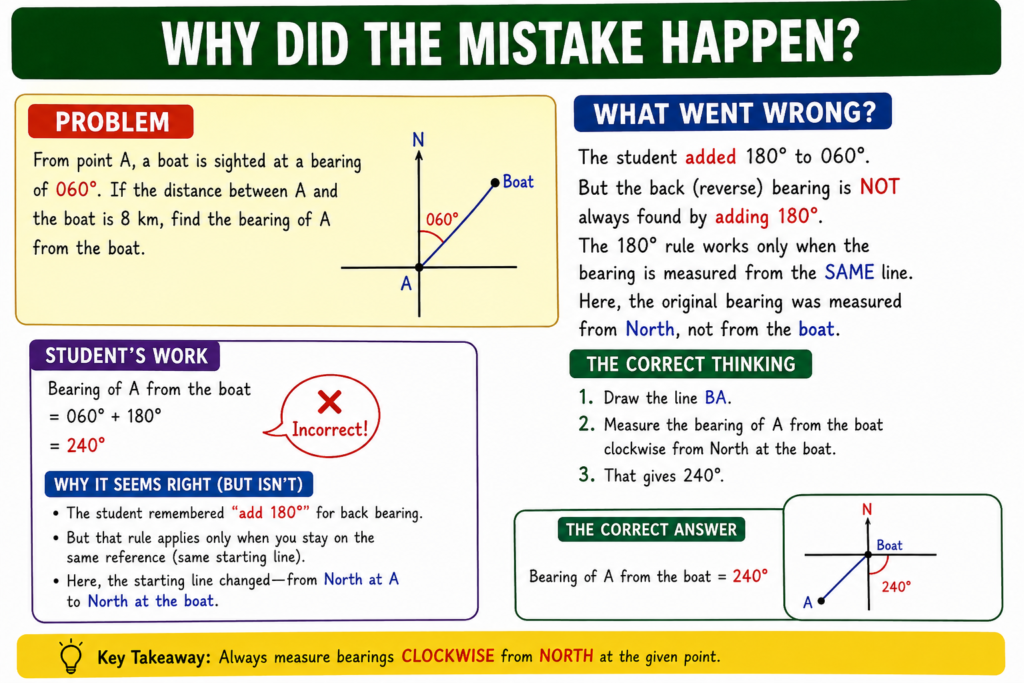
2. Why Did the Mistake Happen?
The mistake usually happens because the learner treats bearings like ordinary angle measurements. That is the hidden gap.
Hidden Gap 1: The Learner Does Not Know the Starting Line
For ordinary angles, a learner may measure from any given arm, depending on the diagram. But in bearings, the starting line is special. The starting line is always the North line at the point where the journey starts.
Hidden Gap 2: The Learner Measures in the Wrong Direction
Bearings are measured clockwise. If the learner measures anticlockwise, the answer may look mathematically possible, but it will be wrong for bearings.
Hidden Gap 3: The Learner Confuses “From” and “Of”
When the question says “the bearing of B from A,” it means standing at A and looking towards B. The word “from” tells you where to stand. Many students stand at the wrong point, so the whole solution is wrong from the beginning.
Hidden Gap 4: The Learner Has Weak Angle Facts
Bearings often use angle facts such as angles on a straight line, alternate angles, vertically opposite angles, and angles in triangles. If these are weak, the bearing question becomes confusing even when the diagram is clear.
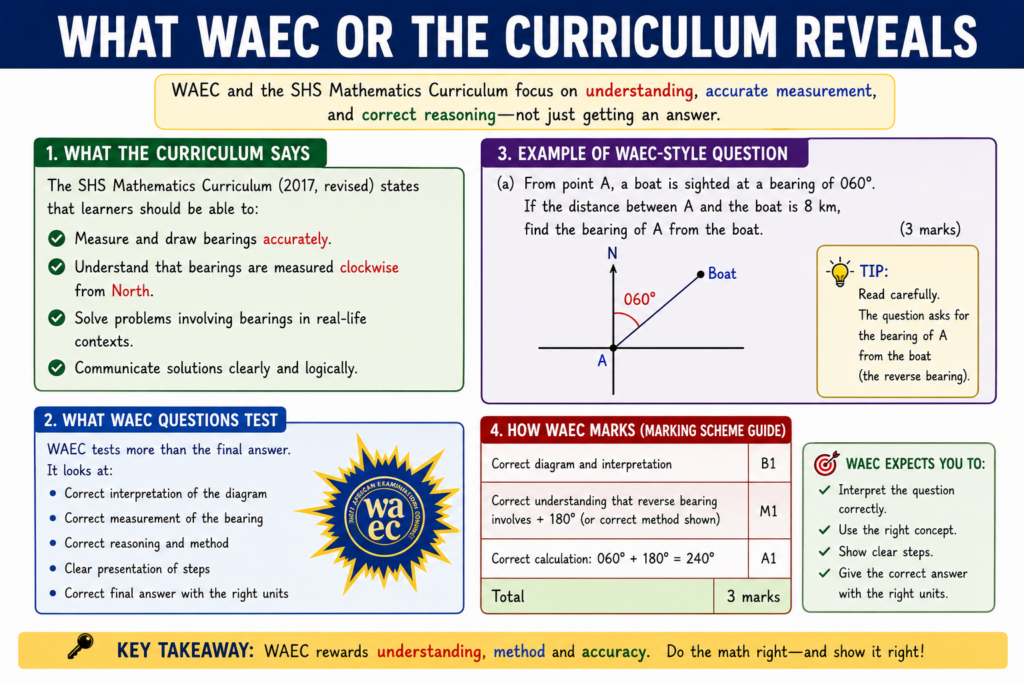
3. What WAEC or the Curriculum Reveals
In WASSCE Core Mathematics, bearings usually assess more than one skill at once. The learner may need to read a route, sketch a diagram, measure or calculate an angle, use scale drawings, and present the answer properly.
The new curriculum direction also expects learners to apply mathematics to real situations. Bearings fit this direction because they connect mathematics to movement, location, navigation, maps, and direction.
So when learners fail bearings, the problem may not be bearings alone. The paper may be exposing a combination of weaknesses: poor question reading, weak angle facts, poor diagram drawing, careless measurement, and failure to follow mathematical conventions.
That is why The Maths Clinic treats bearings as a diagnostic topic. An incorrect bearing reading can reveal many hidden gaps at once.
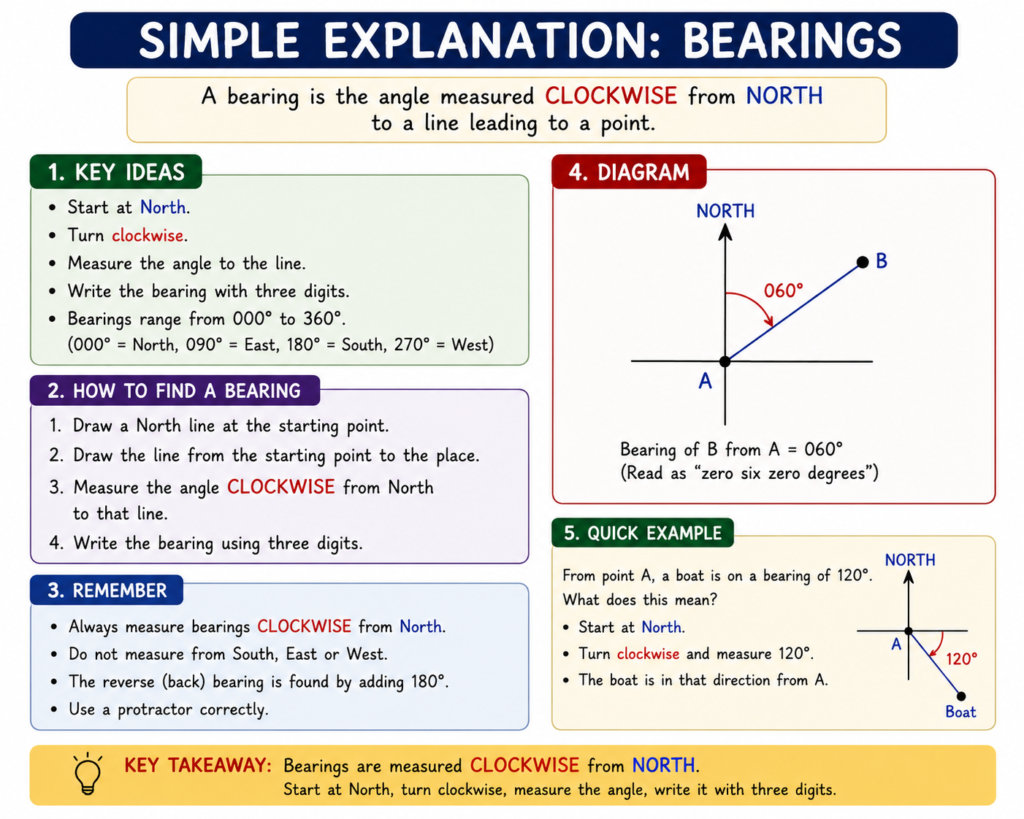
4. Simple Explanation
A bearing is a direction measured as an angle from North, moving clockwise. It is written using three digits. Bearing = angle measured clockwise from North
This means the learner should remember three classroom rules:
- Start from the North.
- Measure clockwise.
- Write the answer in three digits.
The Three-Digit Rule
A bearing must be written with three digits. This is why 45° becomes 045°. A bearing of 9° becomes 009°. A bearing of 120° is already three digits, so it remains 120°.
| Ordinary angle | Bearing form |
| 5° | 005° |
| 35° | 035° |
| 90° | 090° |
| 180° | 180° |
| 270° | 270° |
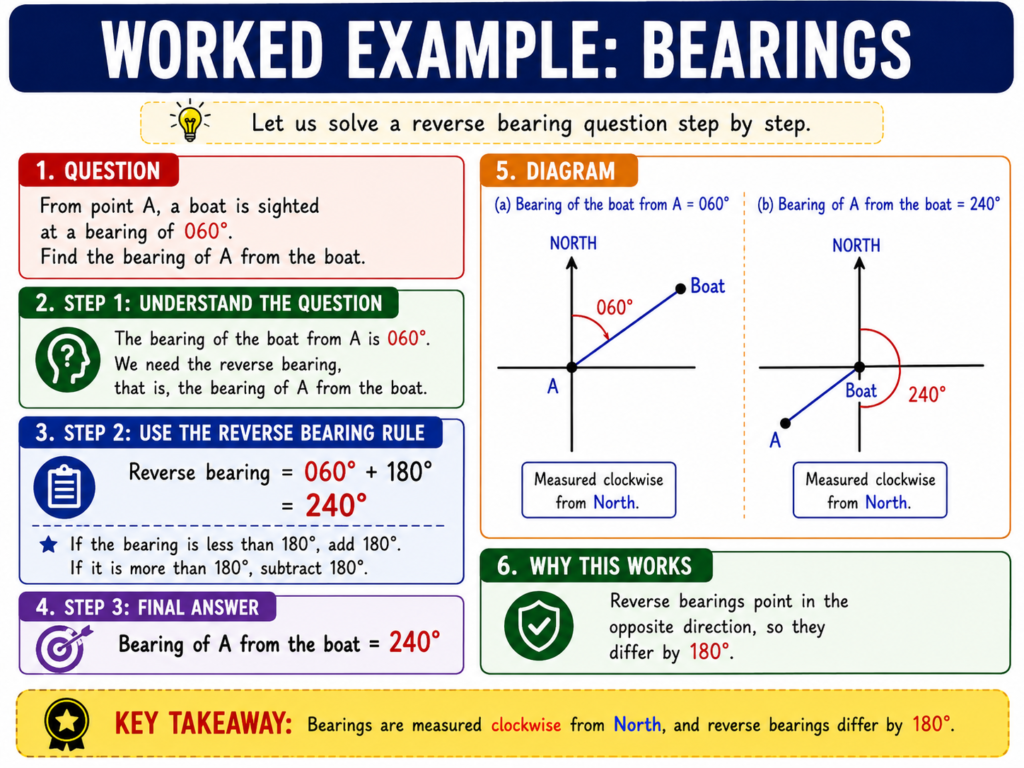
5. Worked Example
Example 1: Reading a Simple Bearing
The bearing of B from A is 060°. Explain what this means and sketch the direction.
Step 1: Understand the word “from.”
The phrase “B from A” means to stand at A and look towards B. So point A is the starting point.
Step 2: Draw the North line at A
At point A, draw a vertical line pointing upwards and label it North.
Step 3: Measure clockwise from North
From the North line at A, measure 060° clockwise. The line you draw after measuring 060° points towards B.
Final Meaning
The bearing 060° means B is located 60° clockwise from North when viewed from A.
Example 2: Finding the Reverse Bearing
The bearing of B from A is 060°. Find the bearing of A from B.
Step 1: Know what is changing
The first bearing tells us the direction from A to B. The question now asks for the reverse direction, from B back to A.
Step 2: Add or subtract 180°
Reverse bearings differ by 180° because the two directions are opposite.
Since 060° is less than 180°, add 180°:
060° + 180° = 240°
Final Answer
Bearing of A from B = 240°
So the bearing of A from B is 240°.
Example 3: WASSCE-Style Direction Question
A boy walks from point P to point Q on a bearing of 070°. He then walks from Q to point R on a bearing of 140°. What angle does he turn through at Q?
Step 1: Understand the first direction
From P to Q, the bearing is 070°. That means the direction P to Q is 70° clockwise from North at P.
Step 2: Find the direction of P from Q
At Q, the boy has arrived from P. So we need the reverse bearing of 070°.
070° + 180° = 250°
Therefore, the direction from Q back to P is 250°.
Step 3: Compare the directions of QP and QR
At Q, the direction back to P is 250°. The direction from Q to R is 140°.
250° – 140° = 110°
Final Answer
The boy turns through 110° at Q.
Angle turned = 110°
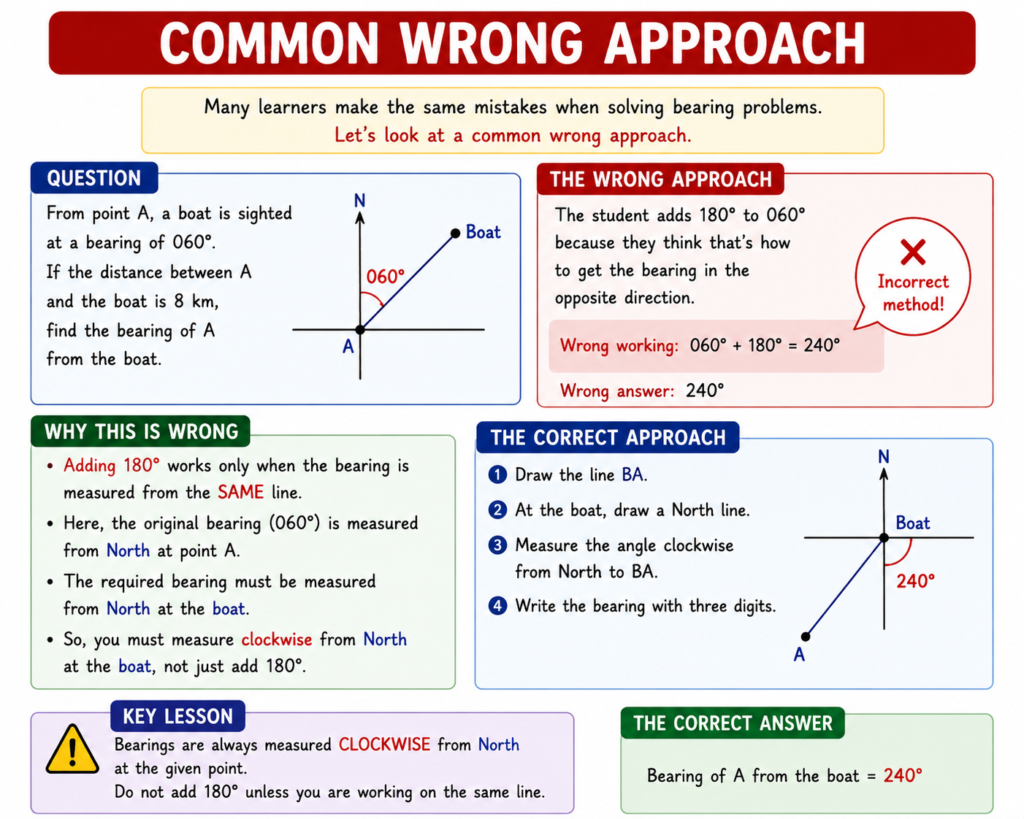
Common Wrong Approach
A common wrong approach is to treat the two bearings in Example 3 as if they are ordinary angles and subtract them directly:
140° – 070° = 070°
This answer is wrong because the learner has ignored the change of position. The first bearing was measured at P, but the turn happens at Q. You cannot subtract bearings from different points without first converting the first direction to the reverse direction at Q.
Why This Mistake Is Dangerous
The wrong method looks neat, and the subtraction is correct arithmetically. But the reasoning is wrong. This is one reason learners can get answers that look convincing but still lose marks.
In bearings, correct calculation must follow correct direction reading. If the direction is wrong, the work will not save the answer.
Correct Method
Use this method anytime you meet a bearing question.
Tip 1: Let “from” Tell You Where to Stand
If the question says “bearing of B from A,” stand at A. If it says “bearing of A from B,” stand at B. The word “from” is the starting point.
Tip 2: Draw North at the Starting Point
Do not draw North anyhow. Draw the North line at the point you are standing on. If the question changes the point, draw another North line at the new point.
Tip 3: Measure Clockwise, Not Anticlockwise
Bearings always move clockwise from North. This one rule alone can save many marks.
H3: Tip 4: Use Three Digits Always
Write 040°, not 40°. Write 005°, not 5°. WAEC expects bearings in proper three-figure form.
Tip 5: Use Reverse Bearing Carefully
If you need to turn the direction around, add or subtract 180°.
If bearing < 180°, add 180°. If bearing > 180°, subtract 180°
If bearing > 180°, subtract 180°
For example:
| Given bearing | Reverse bearing |
| 030° | 030° + 180° = 210° |
| 115° | 115° + 180° = 295° |
| 225° | 225° – 180° = 045° |
| 310° | 310° – 180° = 130° |
Tip 6: Mark the Angle You Are Looking For
Do not decorate the diagram with many angles. Mark only the angle the question is asking for, then use angle facts to find it.
Tip 7: Check Whether the Answer Makes Sense
A bearing must fall between 000° and 360°. If your answer is negative or more than 360°, check your work. If the question asks for a bearing and your answer is 45°, rewrite it as 045°.
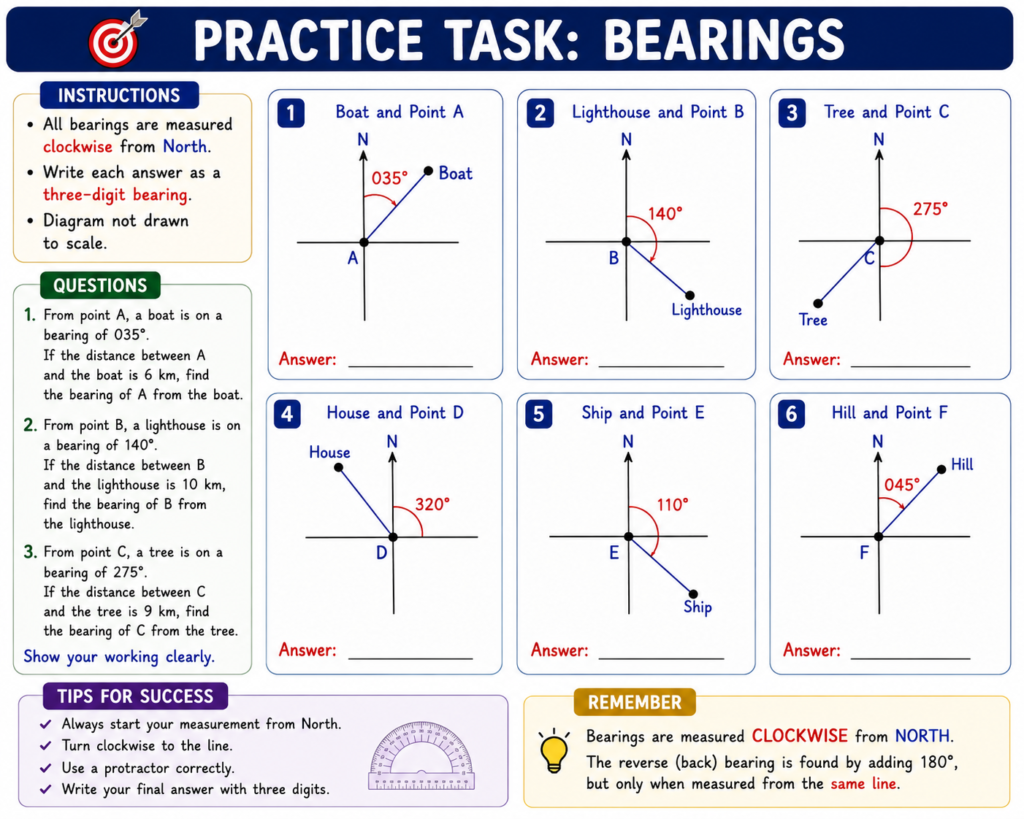
Practice Task
Try these questions before checking the solutions. Do not rush. For each one, ask yourself, “Where am I standing?” Where is North? Am I measuring clockwise?
Practice Questions
- Write 35° as a three-figure bearing.
- The bearing of B from A is 080°. Find the bearing of A from B.
- The bearing of Y from X is 230°. Find the bearing of X from Y.
- A student walks from A to B on a bearing of 050°. He then walks from B to C on a bearing of 130°. Find the angle he turns through at B.
- A town Q is on a bearing of 120° from town P. Explain in words what this means.
Practice Solutions
Solution 1
35°, written as a three-figure bearing, is 035°.
35° = 035°
Solution 2
The bearing of B from A is 080°. To find the reverse bearing, add 180° because 080° is less than 180°.
080° + 180° = 260°
So the bearing of A from B is 260°.
Solution 3
The bearing of Y from X is 230°. To find the reverse bearing, subtract 180° because 230° is greater than 180°.
230° – 180° = 050°
So the bearing of X from Y is 050°.
Solution 4
From A to B, the bearing is 050°. At B, the reverse direction back to A is:
050° + 180° = 230°
From B to C, the bearing is 130°. The angle turned at B is
230° – 130° = 100°
So the student turns through 100° at B.
Solution 5
Town Q is on a bearing of 120° from town P, which means stand at P, face North, then turn 120° clockwise. That direction points towards Q.
If you got some of the practice questions wrong, do not say, “I am bad at bearings.” The mistake is giving us information. It may mean you need help with direction reading, angle facts, reverse bearing, or careful interpretation of “from” and “to.”
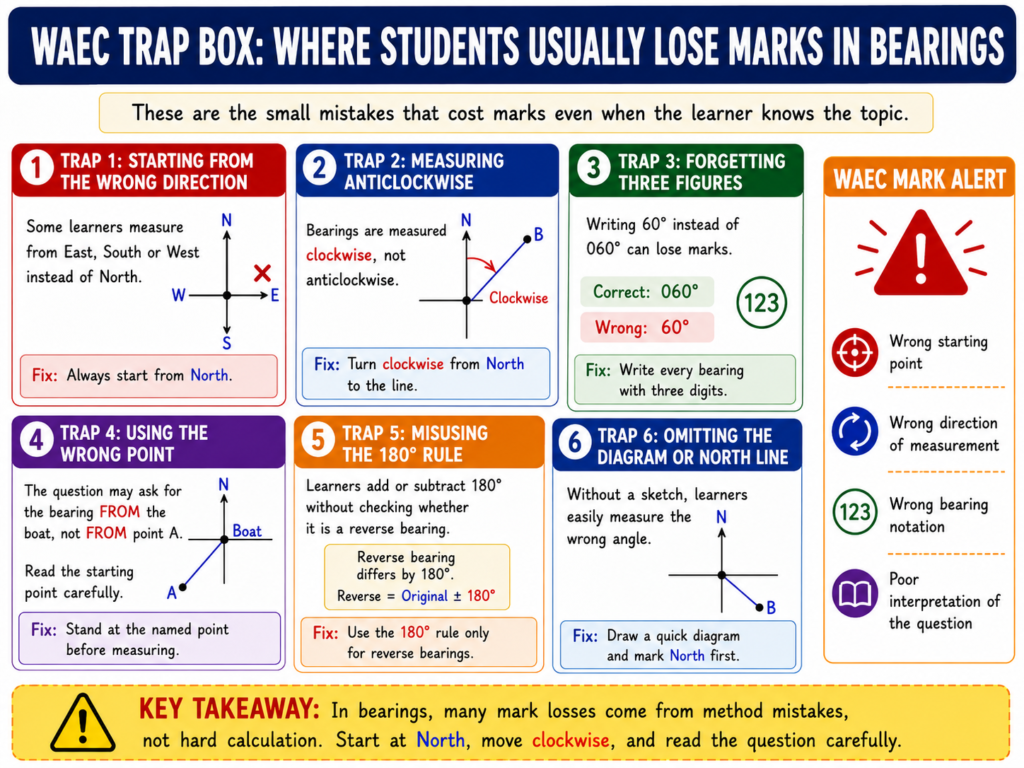
WAEC Trap Box: Where Students Usually Lose Marks in Bearings
| Common error | Why it happened | How to fix it |
| Starting from the wrong point | The word “from” was ignored. | Underline “from” and stand at that point. |
| Measuring anticlockwise | The learner treated it as an ordinary angle measurement. | Always measure clockwise from North. |
| Writing 45° instead of 045° | The three-figure rule was forgotten. | Use three digits for all bearings. |
| Wrong reverse bearing | The learner added or subtracted 180° wrongly. | If less than 180°, add 180°. If greater than 180°, subtract 180°. |
| Wrong angle turned | The learner subtracted bearings from different points directly. | Convert the incoming direction to its reverse at the turning point first. |
FAQ: Bearings in Core Maths
What is a bearing in Core Maths?
A bearing is a direction measured clockwise from North and written using three digits.
Why must bearings be written in three digits?
Three digits make the direction clear and standard. For example, 045° is clearer as a bearing than 45°.
What does “bearing of B from A” mean?
It means stand at A and look towards B. The word “from” tells you the starting point.
How do I find a reverse bearing?
Add 180° if the given bearing is less than 180°. Subtract 180° if the given bearing is more than 180°.
Why do students fail bearings even after learning the rule?
Many students memorize the rule but do not apply it correctly to the diagram. They may start at the wrong point, measure in the wrong direction, or forget to draw North at the correct place.
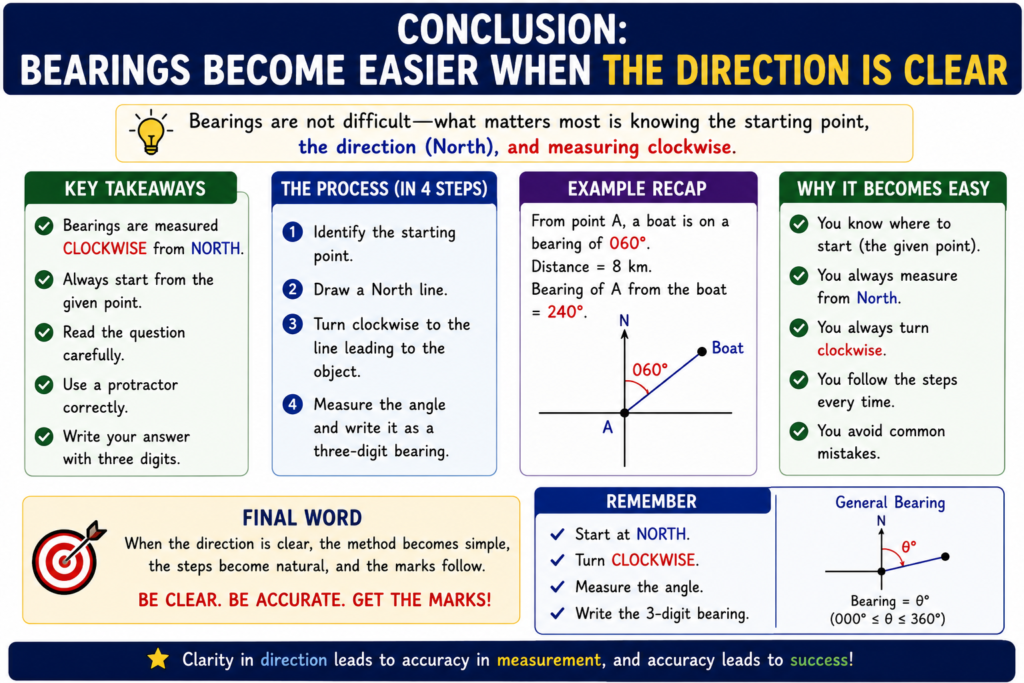
Conclusion: Bearings Become Easier When the Direction Is Clear
In the classroom, bearings can look difficult because the diagram may confuse the learner. But once the learner understands where to stand, where North is, and how to measure clockwise, the topic becomes friendlier.
Do not attack a bearing question by guessing. Stand at the correct point. Draw North. Measure clockwise. Use three digits. Check whether you need a reverse bearing. Then solve calmly.
That is how The Maths Clinic wants learners to approach mathematics: not by fear, not by guessing, but by finding the hidden gap and fixing it step by step.
So the next time you see bearings in Core Maths, remember this simple clinic rule:
Direction first. Calculation second. Answer last.