Struggling with WASSCE Maths? Stop guessing. Let’s fix the gap step by step.
How to Diagnose Your Mathematics Weaknesses

If you want to diagnose your mathematics weaknesses properly, do not start by saying, “I am bad at maths.” That statement is too wide. It is like going to the hospital and telling the nurse, “I am sick,” but refusing to explain where the pain is.
In many Ghanaian SHS classrooms, a learner can say, “Sir, Core Maths is worrying me.” But when the teacher asks, “Which part is worrying you?” the learner becomes quiet. That silence is important. It tells us that the learner has not yet identified the exact maths learning gaps behind the struggle.
At The Maths Clinic, we do not treat a wrong answer as the end of the story. We treat it as evidence. Every wrong answer can show whether the problem is reading, formula selection, substitution, signs, units, calculator use, poor exam habits, or a weak foundation.
This post will help Ghana SHS students preparing for WASSCE Core Maths to self-assess, identify weak areas, and follow a structured recovery plan. You will learn how to diagnose your mathematics weaknesses, understand your Core Maths mistakes, and practice with purpose instead of guessing your way through questions.

1. The Learner’s Problem
The learner’s problem is not always that he or she does not know anything. In many cases, the learner knows some formulas, remembers some class examples, and can even solve a few questions when the teacher is guiding the class. The real problem is that the learner cannot identify the exact weak area when the question changes.
Many students describe their struggle like this:
- “I do not understand maths.”
- “Core Maths is hard.”
- “I know the formula, but I still fail.”
- “When I see word problems, my mind goes blank.”
- “I understand in class, but I cannot do it alone.”
- “I always make small mistakes.”
These statements show pain, but they do not diagnose the weakness. A serious learner must move from a general complaint to a clear weakness statement.
Maths Clinic Diagnosis Question
Do not only ask, “Am I weak in math?” Ask: “Which skill breaks down when I try to solve the question?”
For example, when a learner fails a percentage question, the weakness may be any of these:
- The learner cannot identify the original amount.
- The learner cannot change a percentage to a fraction or decimal.
- The learner uses the new amount instead of the original amount.
- The learner subtracts incorrectly.
- The learner does not understand increase, decrease, profit, loss, discount, or interest.
- The learner knows the formula but cannot interpret the sentence.
So one wrong answer can hide many possible mathematical weaknesses. That is why diagnosis must come before serious WASSCE Maths practice.
2. Why Did the Mistake Happen?
A mistake becomes dangerous when the learner does not know why it happened. If the cause is not found, the same mistake will return in class exercises, mock exams, Nov/Dec, and WASSCE.
Most Core Maths mistakes come from seven common weak areas.
Reason 1: Foundation Gap
This happens when an earlier skill was not properly understood. A learner who is weak in fractions may struggle with percentages, ratios, probability, algebraic fractions, statistics, and many word problems.
Reason 2: Language Gap
This happens when the learner can calculate but cannot understand the English in the question. In WASSCE Core Maths, words like “increase,” “decrease,” “remaining,” “at least,” “more than,” “less than,” “difference,” “total,” and “product” carry mathematical meaning.
Reason 3: Concept Gap
This happens when the learner knows the formula but does not understand the idea behind it. For example, the learner may know perimeter formulas but still confuse perimeter with area.
Reason 4: Procedure Gap
This happens when the learner knows part of the method but not the full order of steps. The learner jumps from the question to the answer without arranging the work.
Reason 5: Accuracy Gap
This happens when the learner understands the idea but loses marks through signs, brackets, units, decimal points, substitution errors, calculator errors, or careless copying.
Reason 6: Exam Habit Gap
This happens when the learner does not manage time well, does not check answers, skips working, ignores units, or panics when a familiar topic is asked in an unfamiliar way.
Reason 7: Practice Gap
This happens when the learner practices randomly instead of practicing the exact weak skill. The learner may solve many questions, but the hidden gap remains untreated.
To diagnose your mathematics weaknesses, do not only mark the answer wrong. Ask why the answer became wrong.

3. What WAEC or the Curriculum Reveals
WASSCE Core Maths not only tests memorized formulas. It tests whether the learner can read, reason, select a method, substitute correctly, calculate accurately, and present work clearly. This is why a learner can know the formula and still lose marks.
The curriculum also pushes learners toward understanding, problem-solving, reasoning, communication, and application. That means a learner must do more than copy steps from the board. The learner must understand what the steps mean and when to use them.
In practical classroom terms, WAEC-style questions often expose these weak areas:
- Poor interpretation of word problems.
- Weak handling of fractions, decimals, percentages, and ratios.
- Wrong substitution into formulas.
- Sign errors when expanding brackets or solving equations.
- Wrong scale choice and poor plotting in graphs.
- Forgetting units in mensuration, bearings, and financial mathematics.
- Skipping working, making it difficult to earn method marks.
- Using a formula without understanding what each value represents.
WAEC Trap Box
- A learner may lose marks even when the formula is correct if the values are wrongly chosen.
- A learner may lose marks even when the final answer is close if the working is unclear.
- A learner may lose marks even when the topic is familiar if the question is not read carefully.
- A learner may lose marks even after solving many past questions if the same maths learning gaps are not corrected.
4. Simple Explanation
To diagnose your mathematics weaknesses, treat every wrong answer like evidence. Do not throw it away. Study it. The wrong answer is not only a failure. It is a message. It tells you where your reading, thinking, method, calculation, or presentation broke down.
Use this simple diagnosis path after every mistake:
- What topic is the question from?
- What was the question asking me to find?
- Which information did I use correctly?
- Which information did I ignore or misunderstand?
- Which step first became wrong?
- Was the problem reading, formula, substitution, calculation, signs, units, or presentation?
- What small skill must I revise before trying similar questions again?
This is how a learner moves from guessing to understanding. This is also how SHS Maths help becomes practical: the learner receives support for the exact weakness, not just general advice.
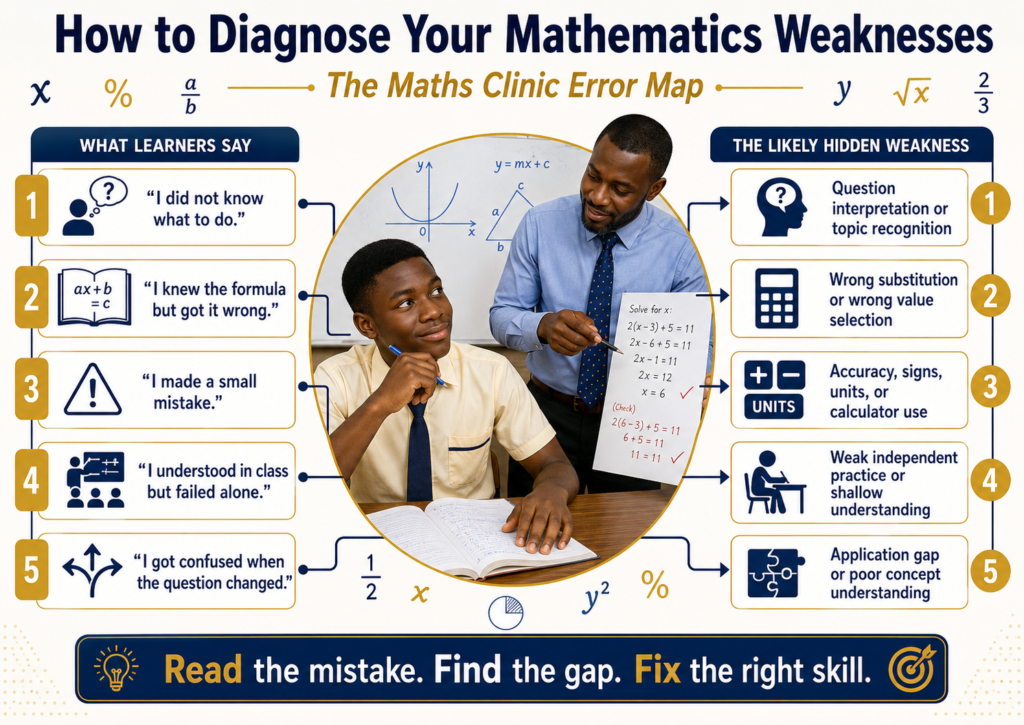
The Maths Clinic Error Map
| If the learner says… | Possible hidden weakness | Structured recovery action |
| “I did not know what to do.” | Question interpretation or topic recognition | Classify the topic, underline the command word, and solve three guided examples. |
| “I knew the formula but got it wrong.” | Wrong substitution or wrong value selection | Write the formula, list the given values, then substitute slowly before calculating. |
| “I made a small mistake.” | Accuracy, signs, units, or calculator use | Redo the same question and check each sign, bracket, unit, and calculator entry. |
| “I understood in class but failed alone.” | Weak independent practice or shallow understanding | Try one similar question without notes, then compare your working with the model solution. |
| “I got confused when the question changed.” | Application gap or poor concept understanding | Practise questions with the same concept but different wording. |
| “I do not know where to start.” | No problem-solving routine | Use the READ-LIST-PLAN-SOLVE-CHECK routine for every WASSCE Maths practice question. |
5. Worked Example
Example Question
A trader bought a calculator for GH₵80 and sold it at a profit of 25%. Find the selling price.
Step 1: Identify the Topic
This is a percentage profit question under financial mathematics.
Step 2: Identify What the Question Is Asking For
The question is asking for the selling price, not the profit only.
Step 3: Identify the Given Values
- Cost price = GH₵80
- Percentage profit = 25%
- Selling price = unknown
Step 4: Find the Profit
Profit = 25% of GH₵80
Profit = (25/100) × 80
Profit = GH₵20
Step 5: Find the Selling Price
Selling Price = Cost Price + Profit
Selling Price = 80 + 20
Selling Price = GH₵100
Final Answer
Selling Price = GH₵100
Diagnosis from the Example
- If a learner got GH₵20 as the final answer, the weakness is interpretation. GH₵20 is the profit, not the selling price.
- If a learner calculated 25/80 × 100, the weakness is formula confusion.
- If a learner wrote 80 – 20, the weakness is misunderstanding profit as a decrease instead of an increase.
- If a learner knew all the steps but wrote GH₵100 without clear working, the weakness is presentation and method-marking habits.
6. Common Wrong Approach
A common wrong approach is to stop after finding the profit.
25% of 80 = 20
Then the learner writes: Answer = GH₵20
This answer is wrong because the question asked for the selling price. The GH₵20 is only the profit.
Why the Wrong Approach Looks Attractive
The learner sees 25% and GH₵80, performs a correct calculation, and feels the work is finished. But mathematics is not only about calculation. It is also about answering the exact question asked.
What the Wrong Approach Reveals
This mistake reveals an interpretation weakness. The learner can calculate the percentage of a quantity, but the learner has not connected the result to the meaning of profit and selling price.
7. Correct Method
The correct method is to diagnose the question before solving it. Use the seven checks below. These checks help learners identify weak areas and build structured recovery instead of repeating the same Core Maths mistakes.
Check 1: Name the Topic
Ask: Is this algebra, percentage, graph, mensuration, probability, bearing, statistics, or financial mathematics?
Check 2: Underline What You Are Asked to Find
Do not assume. If the question asks for the selling price, do not stop at profit. If it asks for area, do not give perimeter.
Check 3: List the Given Information
Write the values down clearly before using them. This reduces substitution errors.
Check 4: Choose the Correct Formula or Method
Do not choose a formula because it looks familiar. Choose it because it matches the question.
Check 5: Substitute Slowly
Many WASSCE marks are lost at the substitution stage. Put the correct value in the correct position.
Check 6: Calculate Carefully
Check signs, brackets, decimal points, units, and calculator entries.
Check 7: Compare Your Answer with the Question
Ask: Have I answered exactly what the question asked? Does the unit make sense? Is the answer reasonable?
The Simple Diagnosis Rule
Wrong answer + no diagnosis = repeated mistake.
Wrong answer + clear diagnosis = improvement.
8. Practice Task
Use these tasks to diagnose your mathematics weaknesses. Do not only look for the final answer. After each question, identify the type of mistake you nearly made.
Question 1
A student scored 18 out of 30 on a class test. Express the score as a percentage.
Question 2
Solve: 3x – 5 = 16.
Question 3
A rectangular field is 12 m long and 7 m wide. Find its perimeter.
Question 4
A bag contains 5 red balls and 3 blue balls. Find the probability of picking a blue ball at random.
Question 5
A trader bought an item for GH₵150 and sold it for GH₵180. Find the percentage profit.
Question 6
A line graph uses a scale of 2 cm to 5 units on the vertical axis. A student plots 20 units at 6 cm. What weakness does this show?
Practice Task Solutions and Diagnosis
Solution 1
Percentage = (18/30) × 100% = 60%. Diagnosis: If you divided 30 by 18, your weakness is knowing which number is the part and which is the whole.
Solution 2
3x – 5 = 16; 3x = 16 + 5; 3x = 21; x = 7. Diagnosis: If you wrote 3x = 16 – 5, your weakness is transposition or inverse operations.
Solution 3
Perimeter = 2(l + w) = 2(12 + 7) = 38 m. Diagnosis: If you calculated 12 × 7 = 84 m², your weakness is confusing perimeter with area.
Solution 4
Total balls = 5 + 3 = 8, so P(blue) = 3/8. Diagnosis: If you wrote 3/5, your weakness is identifying the total possible outcomes.
H3: Solution 5
Profit = 180 – 150 = GH₵30. Percentage Profit = (30/150) × 100% = 20%. Diagnosis: If you used 180 as the denominator, your weakness is knowing that the percentage profit is based on the cost price, not the selling price.
Solution 6
With a scale of 2 cm to 5 units, 20 units should be plotted at 8 cm because 5 units = 2 cm, 10 units = 4 cm, 15 units = 6 cm, and 20 units = 8 cm. Diagnosis: This shows a scale-reading weakness in graphs.
Quick Self-Assessment Checklist for Learners
Use this eight-item self-assessment checklist after every wrong answer. It will help you identify weak areas instead of feeling that the whole of mathematics is impossible.
- Did I understand what the question was asking?
- Did I identify the topic correctly?
- Did I choose the correct formula or method?
- Did I substitute the correct values?
- Did I handle signs, brackets, fractions, and units correctly?
- Did I answer the exact question asked?
- Did I show enough working to earn method marks?
- Did I check whether my answer makes sense?
How to Record Your Mathematics Weaknesses in an Exercise Book
A learner who wants real recovery must keep a weakness record. Do not only write corrections. Write the weakness behind the correction.
| Record Item | Example Entry |
| Topic | Percentages |
| Question type | Percentage profit |
| My mistake | I used selling price as the denominator. |
| Hidden weakness | I forgot that percentage profit is based on cost price. |
| Correction | Use (Profit/Cost Price) × 100%. |
| Recovery task | Solve five percentage profit questions before moving on. |
| Review date | Check the same skill again after three days. |
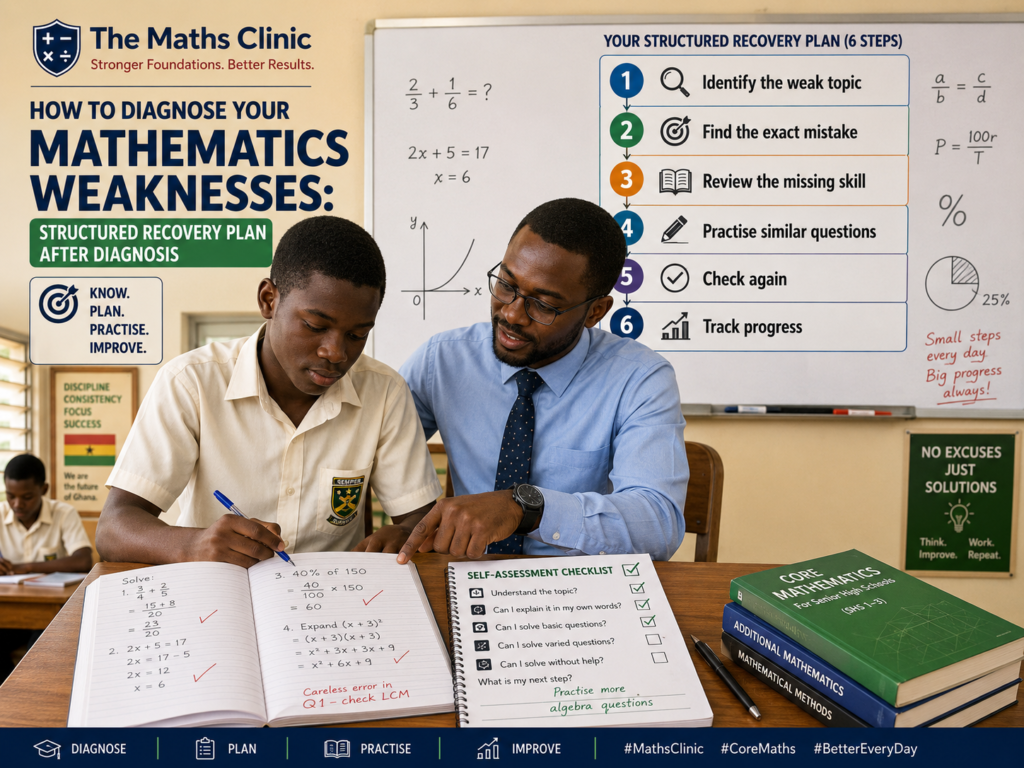
Structured Recovery Plan After Diagnosis
Diagnosis alone is not enough. After you identify weak areas, follow a structured recovery plan. This prevents blind practice and helps the learner rebuild confidence step by step.
Day 1: Name the Weakness
Choose one weak area from your corrections. Do not choose five topics at once. Write the exact problem, such as “I confuse area and perimeter” or “I use the wrong denominator in percentage profit.”
Day 2: Revise the Small Skill
Go back to the foundation skill. If the problem is percentage profit, revise profit, cost price, selling price, fractions, and percentages before solving harder WASSCE questions.
Day 3: Solve Three Guided Examples
Use worked examples where the method is clear. Compare each line of your work with the model solution.
Day 4: Solve Five Independent Questions
Try questions without looking at the solution. Mark them and write the mistake type beside each wrong answer.
Day 5: Mix the Skill with Word Problems
WASSCE Core Maths often hides simple skills inside word problems. Practice the same skill when the wording changes.
Day 6: Do a Short-Timed Practice
Set a small time limit. This trains exam habits, speed, and accuracy.
Day 7: Review and Decide
If you score well and can explain your steps, move to the next weak area. If the same mistake returns, repeat the recovery cycle.
FAQ: Diagnosing Mathematics Weaknesses
1. What does it mean to diagnose my mathematics weakness?
It means finding the exact reason behind your wrong answers. Instead of saying “I am bad at maths,” you identify whether the problem is reading, formula, substitution, calculation, signs, units, or exam habit.
2. Should I keep solving past questions if I keep failing them?
Yes, but do not solve them blindly. Use each wrong answer to find the hidden gap. Then revise that small skill before trying more questions.
3. Can one small weakness affect many topics?
Yes. Weak fractions can affect percentages, ratios, probability, algebraic fractions, statistics, and many word problems. That is why small gaps must be treated early.
4. How can a teacher help learners diagnose weaknesses?
A teacher can study the learner’s wrong work, ask where the thinking changed, and group the mistake under reading, concept, formula, substitution, calculation, or presentation.
5. What should I do after finding my weakness?
Practice that exact skill. Do not jump to harder questions until the foundation skill becomes clear.
H3: 6. How does The Maths Clinic help with diagnosis?
The Maths Clinic helps learners connect wrong answers to hidden maths learning gaps, then directs them to targeted SHS Maths help and WASSCE Maths practice.
Conclusion: Do Not Just Practise Hard; Practise the Right Weakness
In Core Mathematics, hard work is important, but blind hard work can waste time. If a learner keeps practicing without diagnosing the weakness, the same mistake can follow the learner from class exercises to mock exams and finally to WASSCE.
That is why The Maths Clinic teaches learners to slow down and read their mistakes. Every wrong answer has a story. It may be telling you that your fractions are weak, your signs are careless, your formula is mixed up, your interpretation is poor, or your exam habits need correction.
So do not say, “I am weak in maths,” and stop there. That statement is too general. Say, “My weakness is in translating word problems,” or “My weakness is choosing the correct denominator in percentages,” or “My weakness is solving equations with negative signs.”
Once you can name the weakness, you can treat it. Once you treat it, your confidence can start growing again. Mathematics improves when the hidden gap is found and fixed step by step.
Stop guessing. Start diagnosing. Start understanding.