Struggling with WASSCE Maths? Stop guessing. Let’s fix the gap step by step.

8 Clear Signs You Are Guessing Instead of Understanding Mathematics

The Maths Clinic Diagnosis This post helps a struggling SHS learner know the difference between real understanding and dangerous guessing before WASSCE. The aim is not to shame the learner. The aim is to expose the hidden gap, correct it, and help Core Maths make better sense.
Guessing instead of understanding mathematics is one hidden reason many Ghanaian SHS learners struggle in Core Maths, even when they look serious in class.
In many SHS classrooms, some learners copy notes, nod their heads, follow the teacher on the board, and sometimes even get answers correct during class exercises. From the outside, it looks as if everything is fine.
But when the same learner sits alone with a WASSCE-style question, the confidence disappears. The learner begins to try any formula that comes to mind, cancel numbers anyhow, change signs without reason, or choose answers by feeling.
That is not understanding. That is guessing.
Guessing in mathematics is dangerous because it can hide behind classroom activity. A learner may be busy, but the marks may not improve. The exercise book may be full, but the thinking may still be weak.
This post answers one important question: How does this help a struggling SHS learner understand Core Maths better?
It helps the learner see the exact difference between copying, guessing, and understanding. Once the learner identifies the guessing habit clearly, the learner can stop using blind methods and start building real mathematical thinking before WASSCE.
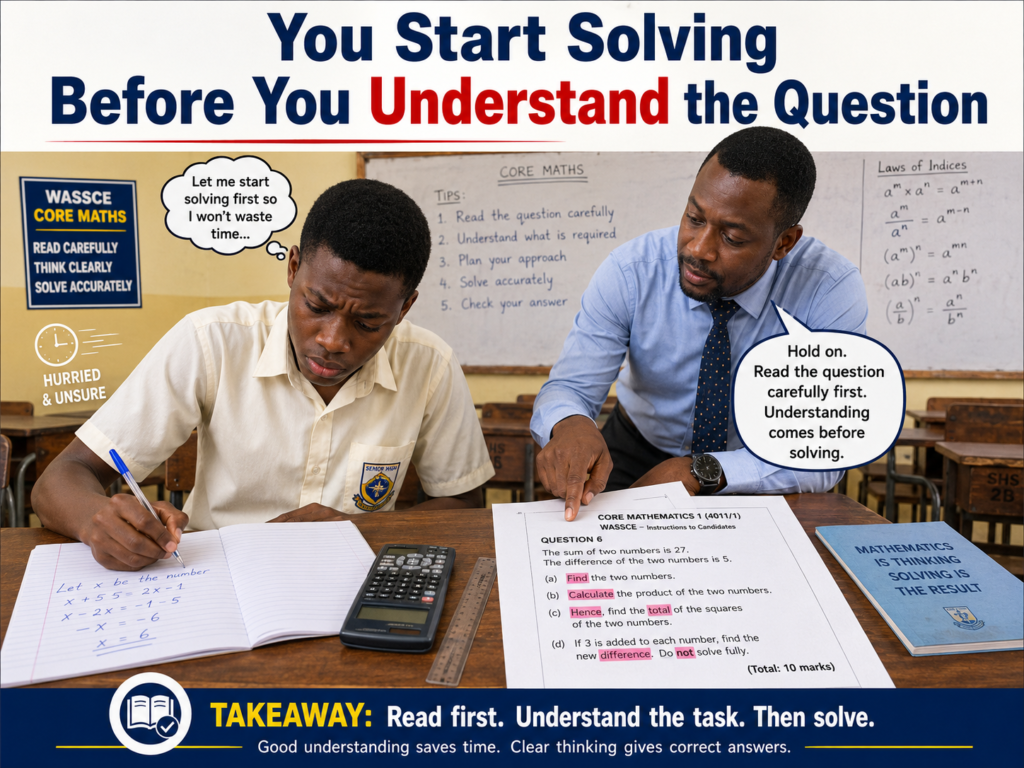
1. You Start Solving Before You Understand the Question
The first clear sign that you are guessing is that you start solving immediately after reading only part of the question.
You see numbers and quickly begin to add, subtract, multiply, divide, or apply a formula. But you have not yet understood what the question is really asking.
For example, a learner sees “20% discount” and quickly finds 20% of the selling price, even though the question may be asking for the original price.
Why This Happens
This happens because the learner is afraid of the question and wants to start doing something quickly. But in Core Maths, speed without understanding can send you in the wrong direction.
How This Helps You Understand Mathematics Better
This sign teaches you that reading is part of solving. Before you calculate, pause and ask:
- What is the question asking me to find?
- What information has been given?
- What topic is hiding inside the question?
- Is the answer expected to be a number, a percentage, a length, an angle, or a statement?
When you understand the question first, your method becomes more accurate.
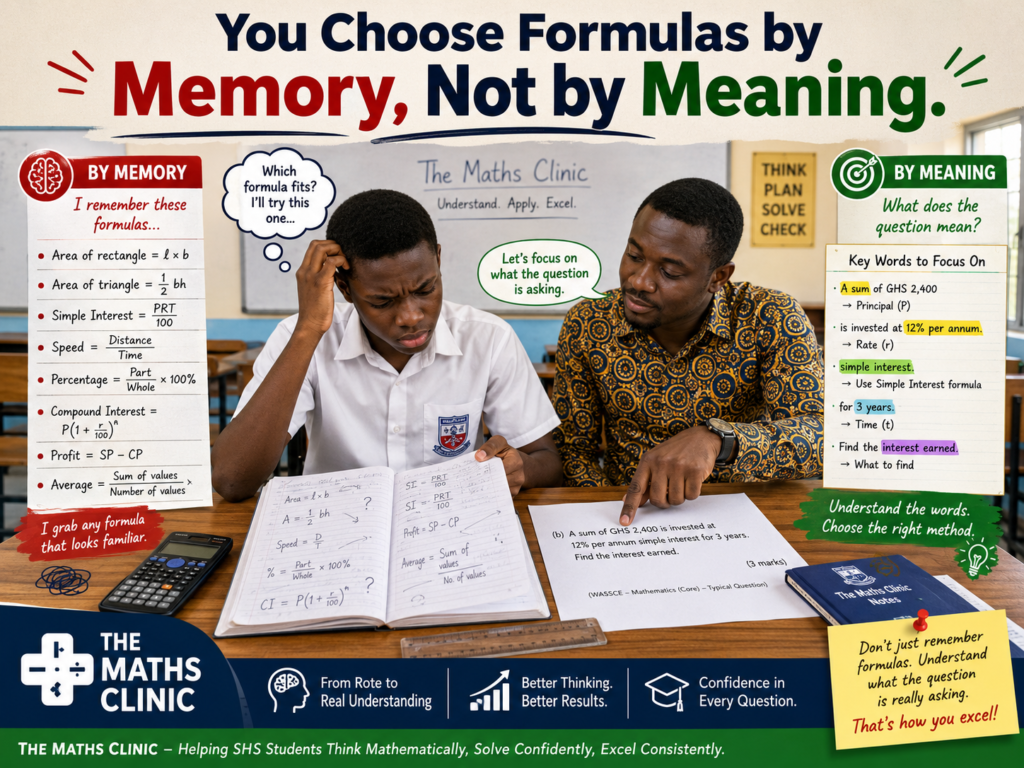
2. You Choose Formulas by Memory, Not by Meaning
Another sign of guessing is when you choose a formula only because you remember seeing it before.
You may see simple interest and write SI = PRT/100, even when the question is asking for the amount. You may see a shape and choose an area formula, even when the question is asking for perimeter.
Why This Happens
This happens when formulas are crammed like songs. The learner knows the letters, but not the meaning behind them.
For example, in simple interest, P is not just a letter. It is the principal, the original money invested or borrowed. R is the rate per annum. T is the time, usually in years.
How This Helps You Understand Mathematics Better
This sign helps the learner stop treating formulas like magic keys. A formula must match the situation in the question.
Before using any formula, ask:
- What does each letter mean?
- Does the question give those values?
- Is the question asking for the same thing the formula gives?
- Are the units correct?
When you know why a formula works, you can use it properly even when WASSCE changes the wording.
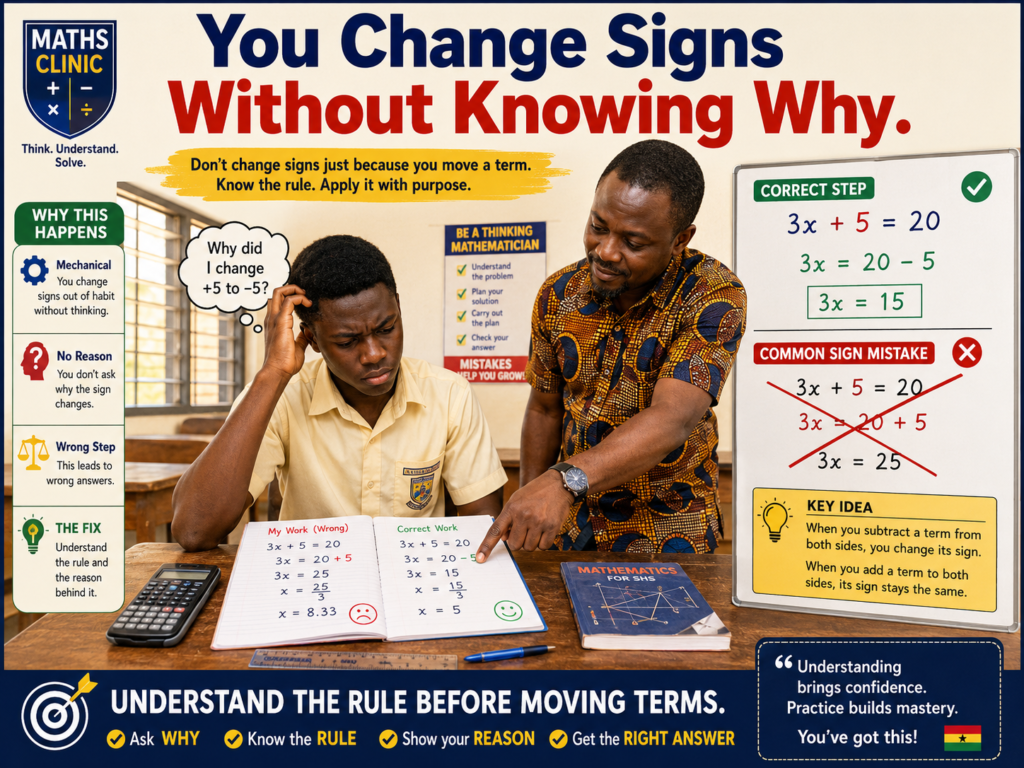
3. You Change Signs Without Knowing Why
If you often move numbers from one side of an equation to another side without understanding what happens to the sign, you may be guessing in algebra.
For example:
| Algebra check: Solve 2x – 5 = 13. A guessing learner may write the following: 2x = 13 – 5 But the correct move is 2x = 13 + 5 |
The learner may know that something must move but does not understand inverse operations.
Why This Happens
Many learners are taught to “send it to the other side” without deeply understanding balance. So they move terms by habit instead of reasoning.
How This Helps You Understand Mathematics Better
This sign teaches you that equations are about balance.
If 5 is subtracted from 2x, you remove it by adding 5 to both sides. The goal is not to move numbers anyhow. The goal is to keep the equation balanced while isolating the unknown.
Once you understand balance, algebra becomes less frightening.
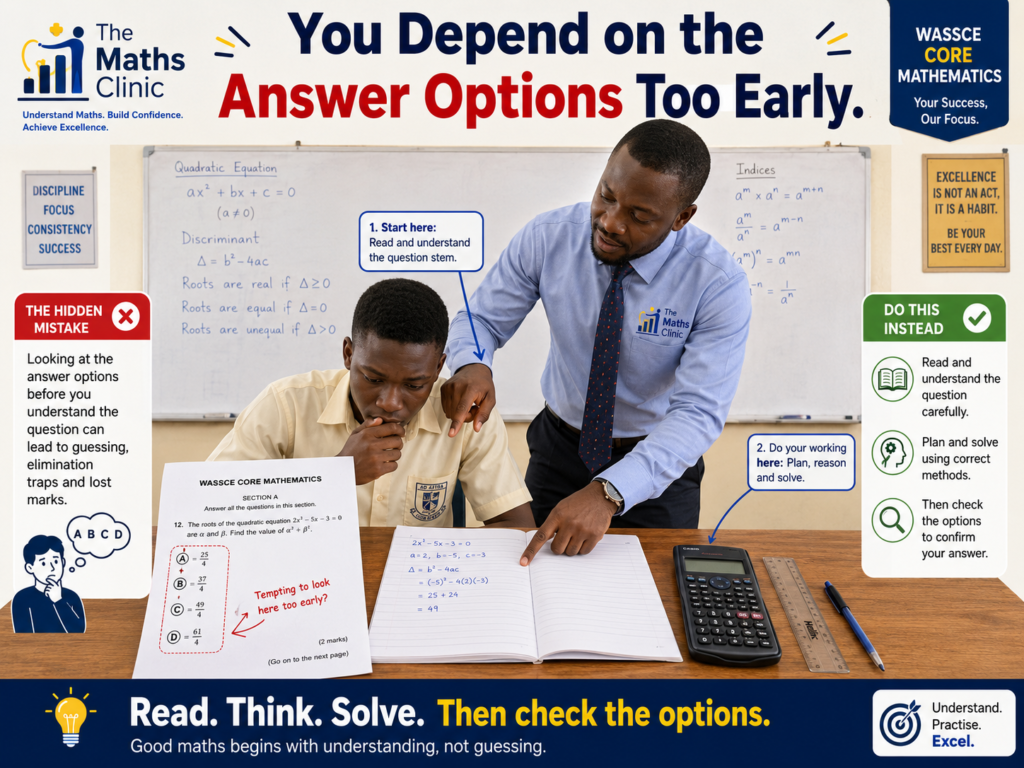
4. You Depend on the Answer Options Too Early
Some learners do not solve the question first. They rush to the multiple-choice options and try to guess which one “looks correct.”
This may work once or twice by chance, but it cannot build strong understanding.
Why This Happens
This happens when the learner does not trust the method. The options become a hiding place. Instead of solving, the learner tests answers randomly or chooses the one that looks familiar.
How This Helps You Understand Mathematics Better
Answer options can help you check, but they should not replace your work.
Train yourself to solve first. After solving, use the options to confirm your answer. That way, you are building method, not luck.
In WASSCE, your working habit matters because some mistakes are designed to appear among the options.
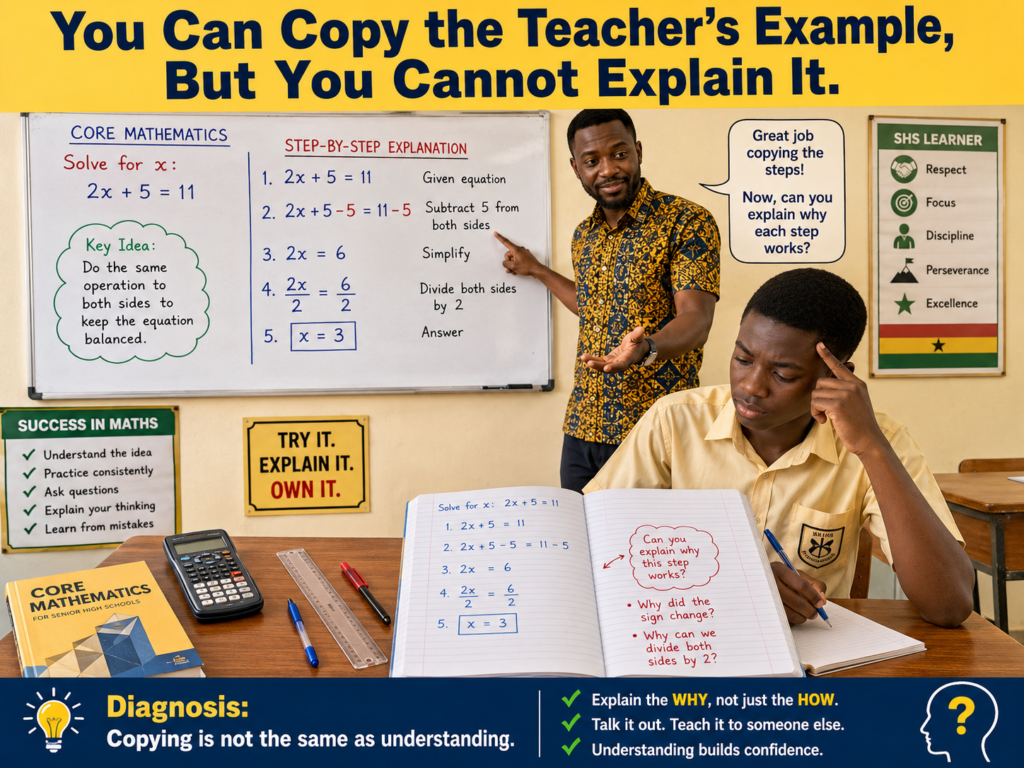
5. You Can Copy the Teacher’s Example, But You Cannot Explain It
This is one of the most common signs of guessing. The learner can copy the board work very well but cannot explain why the teacher took each step.
The exercise book looks neat, but the understanding is weak.
Why This Happens
Copying is easier than thinking. In class, the teacher carries the reasoning. The learner only records the result.
Later, when the learner meets a similar question alone, there is no teacher to guide the thinking.
How This Helps You Understand Mathematics Better
After every example, ask yourself:
- Why did the teacher choose this method?
- Why did this number move?
- Why was this formula used?
- What would change if the numbers changed?
- Can I explain the solution to a weaker friend?
If you cannot explain it, you have found your learning gap. Go back and learn the reason behind the steps.
6. You Get the Right Answer Sometimes, But You Cannot Repeat the Method
Sometimes, guessing can produce a correct answer. That is why it is dangerous.
A learner may get one answer correct by trying different operations. But when a similar question appears again, the learner cannot repeat the same method.
Why This Happens
This happens because the answer came by trial and error, not by understanding. The learner did not follow a clear mathematical path.
How This Helps You Understand Mathematics Better
A correct answer is not enough. You must know the path that produced it.
After solving, ask:
- Can I solve this again tomorrow?
- Can I explain the method without looking at the solution?
- Can I solve a similar question with different numbers?
- Did I use a rule or did I just try my luck?
Real understanding is repeatable. Guessing is not.
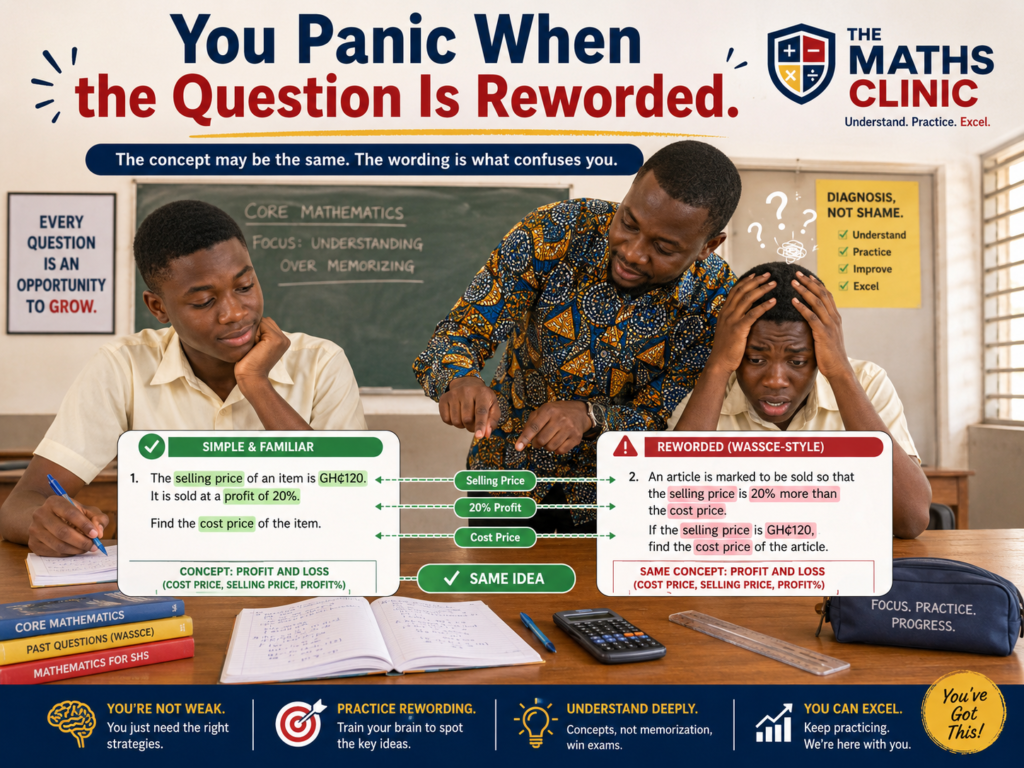
7. You Panic When the Question Is Reworded
Another clear sign of guessing is panic when the question is written differently from the classroom example.
For example, you can solve “Find 15% of 200,” but you struggle when the question says, “A student scored 15% more than his previous mark of 200.”
The topic may still be percentages, but the presentation has changed.
Why This Happens
This happens when the learner memorizes question patterns instead of understanding the idea.
WASSCE does not always repeat classroom language. It may test the same idea through a story, table, diagram, graph, or real-life situation.
How This Helps You Understand Mathematics Better
This sign teaches you to learn concepts, not only examples.
For percentages, understand part, whole, increase, decrease, discount, profit, loss, and original value. For graphs, understand coordinates, scale, gradient, and relationship. For algebra, understand unknowns, operations, and balance.
When the concept is clear, a change in wording will not defeat you easily.
8. You Cannot Identify Where Your Mistake Happened
If you get a question wrong and all you can say is “I made a mistake,” then diagnosis is weak.
A learner who understands the topic can often point to the exact place where the error entered.
Why This Happens
Many learners only look at the final answer. They do not study the steps. So when the answer is wrong, they do not know whether the problem was reading, formula, substitution, signs, calculation, or units.
How This Helps You Understand Mathematics Better
This sign teaches you to treat every wrong answer as evidence.
Do not erase wrong work too quickly. Compare your work with the correct solution and locate the first wrong step. That first wrong step is the gap you must fix.
| Maths clinic reminder: A wrong answer is not useless. It can show you exactly where your understanding broke down. |
Worked Example: Guessing Versus Understanding
Question
Solve: 3x + 4 = 19
Common Guessing Approach
| Wrong method: 3x + 4 = 19 3x = 19 + 4 3x = 23 x = 23/3 |
The learner moved +4 wrongly. The learner may know that a number must move but does not know the opposite operation needed to keep the equation balanced.
Correct Understanding
| The correct method is 3x + 4 = 19. Subtract 4 from both sides. 3x = 19 – 4 3x = 15 x = 5 |
What This Reveals
The weakness is not the whole of algebra. The real weakness is inverse operations and balancing equations.
This is why diagnosis matters. Once the learner sees the exact weakness, practice becomes focused.
Common Wrong Approach
A common wrong approach is to revise mathematics by only reading solved examples.
Reading examples may help, but it is not enough. If you do not solve questions on your own, explain your steps, and check your mistakes, you may still be guessing.
Another wrong approach is jumping from one topic to another without fixing the exact error. The learner says, “Let me learn more topics,” but the old mistake follows him into every new topic.
Correct Method: How to Move from Guessing to Understanding
Use this simple Maths Clinic method:
- Read the question twice before solving.
- Underline the key words and values.
- Identify the topic hiding inside the question.
- Choose the method because it matches the question, not because you remember it vaguely.
- Write each step clearly.
- Explain why each step was done.
- Check the answer against the question asked.
- Study any mistake and name the exact weakness.
This method trains your brain to think before calculating. That is how understanding grows.
Practice Task: Check Whether You Are Guessing
Try these questions. After each one, do not only check the answer. Ask yourself whether you understood the method or guessed your way through.
1. Algebra
Solve: 5x – 6 = 24
Diagnosis question: Did you know why -6 became +6?
2. Percentages
A bag is sold for GH₵240 after a discount of 20%. Find the original price.
Diagnosis question: Did you identify the original amount as the correct base?
3. Simple Interest
Find the simple interest on GH₵900 at 10% per annum for 6 months.
Diagnosis question: Did you change 6 months to half a year?
4. Graphs
Find the gradient of the line joining (2, 5) and (6, 13).
Diagnosis question: Did you subtract y-values and x-values correctly?
5. Word Problem
The sum of two numbers is 40. One number is 8 more than the other. Find the two numbers.
Diagnosis question: Did you translate the words into an equation correctly?
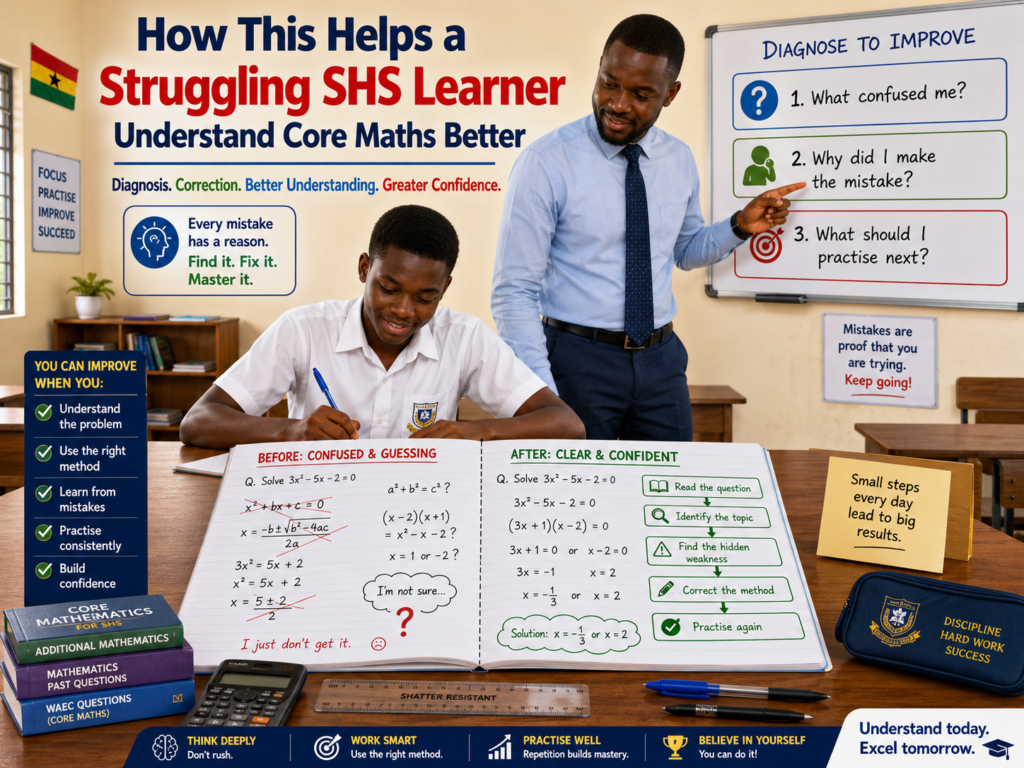
How This Helps a Struggling SHS Learner Understand Core Maths Better
This lesson helps a struggling learner understand Core Maths better because it separates guessing from real understanding.
Many learners think they are bad at mathematics, but the real problem is that they have been using guessing habits for too long. Once those habits are exposed, the learner can begin to build proper methods.
The learner begins to understand that
- Reading the question is part of solving.
- Formulas must be understood, not only memorized.
- Signs in algebra follow rules.
- Correct answers must come from clear methods.
- Wrong answers can reveal hidden gaps.
- WASSCE-style questions test understanding, not only memory.
This gives the learner a better way to revise. Instead of saying, “I do not understand Maths,” the learner can now say, “I am guessing when I use formulas,” or “I am guessing when signs change in algebra.”
That is more useful because a named weakness can be corrected.
Final Advice Before WASSCE
If you notice that you are guessing in mathematics, do not feel ashamed. Many learners do it without knowing.
But once you notice it, do not continue.
Start fixing it early. Choose one topic. Solve questions slowly. Explain each step. Check your mistakes. Practice again.
Understanding mathematics is not about rushing to get answers. It is about knowing why the answer is correct.
At The Maths Clinic, we believe a struggling learner can improve when the real gap is found and corrected. Guessing may give you one lucky answer, but understanding gives you confidence for many questions.
Before WASSCE, stop guessing. Start understanding.