Struggling with WASSCE Maths? Stop guessing. Let’s fix the gap step by step.
WASSCE Core Mathematics: 7 Hidden Reasons Students Struggle

WASSCE Core Mathematics is not hard for many Ghanaian SHS students because they are lazy or empty-headed. Very often, the real problem is that a small learning gap has been hiding under a bigger topic for too long.
In class, a learner may copy every example correctly, nod when the teacher explains, and even help a friend during group work. But when WAEC changes the wording of the question, adds a diagram, or hides the same idea inside a word problem, the learner begins to guess.
That is why a wrong answer should not be treated like the full story. A wrong answer is like a symptom. It may point to weak fractions, poor sign control, poor question reading, weak algebra, poor graph scale, missing units, or low confidence.
At The Maths Clinic, we do not insult the learner because of one wrong answer. We diagnose the mistake, find the hidden gap, explain the simple idea, and give guided WASSCE Maths practice until the learner can see the path clearly.
This pillar post explains seven hidden reasons SHS students struggle with WASSCE Core Mathematics and how each one can be corrected in a simple, Ghanaian classroom-friendly way.
Hidden Reason 1: Weak Foundation in Fractions, Percentages, and Basic Operations
1. The learner’s problem
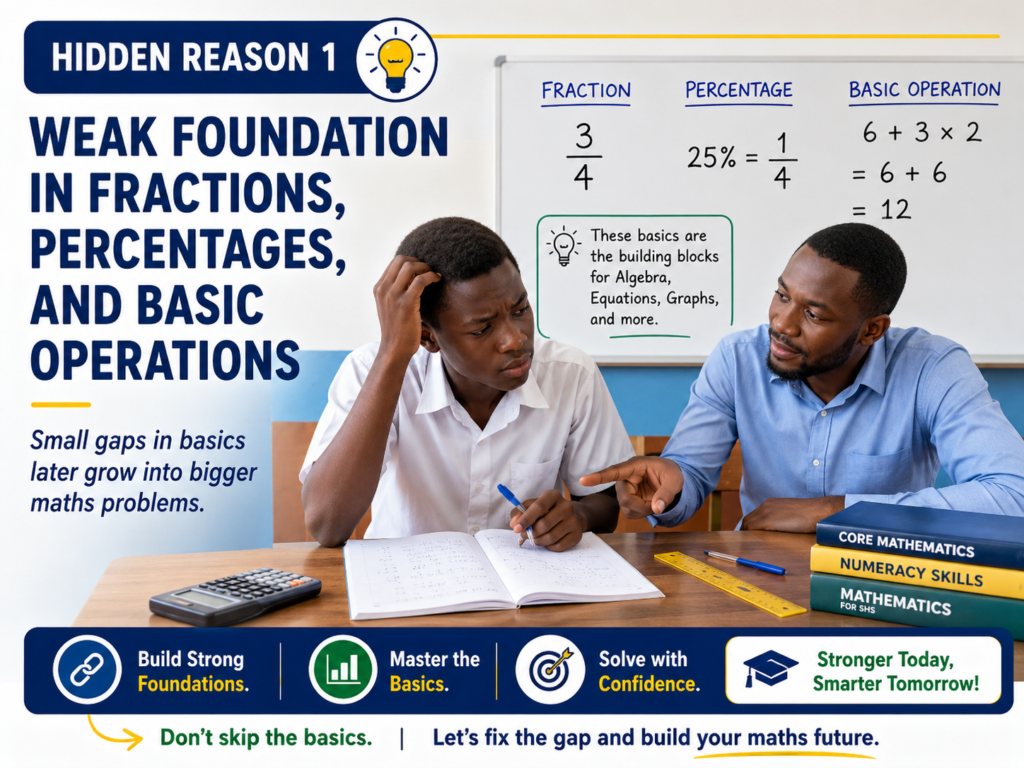
The learner can follow the teacher’s work on the board, but once the question contains fractions, percentages, decimals, negative signs, or mixed operations, the learner starts guessing. The same weakness later appears in profit and loss, probability, ratio, algebraic fractions, statistics, indices, mensuration, and even geometry.
2. Why did the mistake happen
Mathematics is built like blocks. If the lower blocks are weak, the upper blocks cannot stand well. A learner who does not understand what a fraction means may memorize a percentage formula and still fail when the question asks for percentage profit, percentage loss, depreciation, simple interest, or probability.
3. What WAEC or the curriculum reveals
WAEC-style questions often combine basic number skills with application. The new classroom direction also expects learners to reason, explain, apply, and connect ideas. So the learner must not only know a formula. The learner must understand the number idea behind the formula.
4. Simple explanation
A percentage is a fraction out of 100. So 25% means 25 out of 100. In fraction form, 25% = 25/100 = 1/4. If a learner does not see this connection, percentage questions begin to look like magic.
5. Worked example
During vacation, Ama bought a school bag at Kejetia for GH₵80 and sold it to a friend for GH₵100. Find the percentage profit.
Cost price = GH₵80
Selling price = GH₵100
Profit = 100 – 80 = GH₵20
Percentage profit = (Profit / Cost price) x 100%
Percentage profit = (20 / 80) x 100% = 25%
Final answer: 25%
6. Common wrong approach
Some learners divide the profit by the selling price: (20 / 100) x 100% = 20%. This is a WAEC Maths mistake because percentage profit is measured against the cost price, not the selling price.
7. Correct method
1. Identify the cost price first.
2. Identify the selling price.
3. Subtract to find the profit.
4. Divide the profit by the cost price.
5. Multiply by 100% and write the final answer clearly.
8. Practice task
A student bought a scientific calculator for GH₵120 and sold it for GH₵150. Find the percentage profit. Try WASSCE maths practice questions on percentages.
Hidden Reason 2: Memorizing Steps Without Understanding the Meaning
1. The learner’s problem
The learner can solve a question when it looks exactly like the teacher’s example. But when the figures change, or when the sentence is written differently, the learner gets stuck and says, “Sir, I know the formula, but I do not know how to start.”
2. Why did the mistake happen
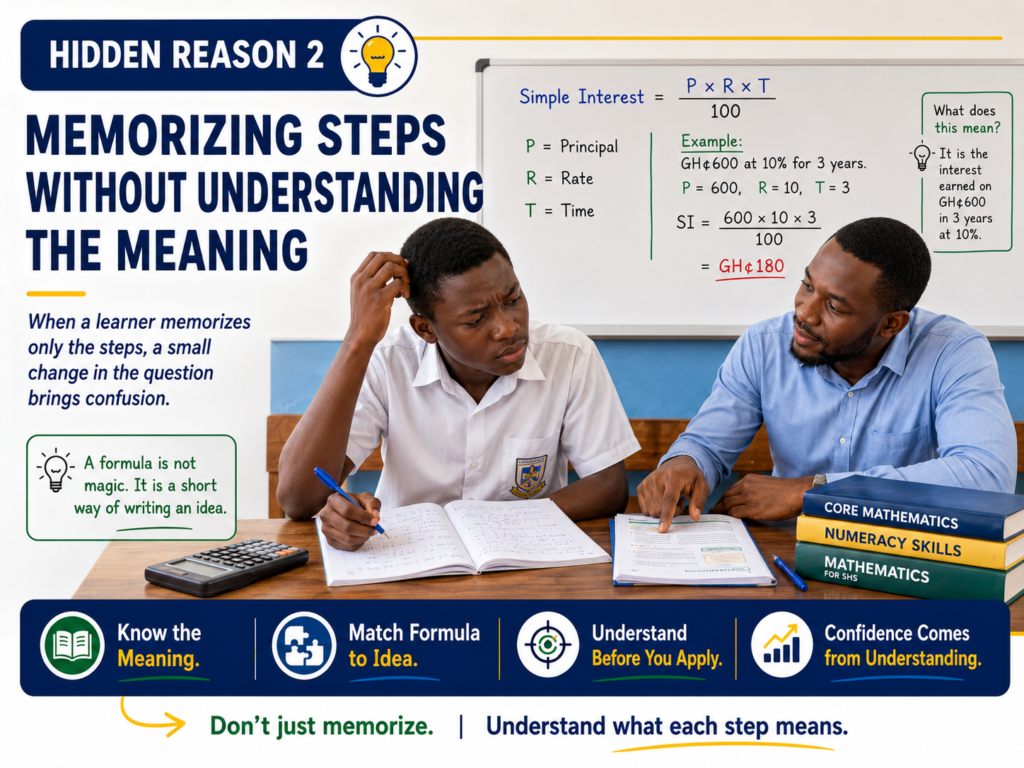
The learner memorized the movement of the hand, not the meaning of the mathematics. This is why formula-based topics can become dangerous. The formula is in the head, but the idea behind the formula is not yet strong.
3. What WAEC or the curriculum reveals
WAEC does not always repeat questions word for word. The same idea can appear inside a school-fees question, a savings question, a loan question, a farming question, or a business question. The curriculum also values understanding, application, and problem-solving.
4. Simple explanation
A formula is not a charm. It is a short way of writing an idea. If the learner does not understand the idea, the formula may be applied in the wrong place.
5. Worked example
Kofi saves GH₵600 in a credit union account for 3 years at 10% simple interest per annum. Find the simple interest.
Simple Interest = (Principal x Rate x Time) / 100
Principal = 600, Rate = 10, Time = 3
Simple Interest = (600 x 10 x 3) / 100
Simple Interest = GH₵180
Final answer: GH₵180
6. Common wrong approach
Some learners write (600 + 10 + 3) / 100. This shows that the learner remembers the topic name but does not understand what the formula means.
7. Correct method
1. Write what each value represents.
2. Substitute carefully into the formula.
3. Use multiplication where the formula demands multiplication.
4. Calculate step by step.
5. State the answer with the correct currency or unit.
8. Practice task
Find the simple interest on GH₵1,200 for 2 years at 5% per annum. Fix Memorizing Without Understanding in Core Maths.
Hidden Reason 3: Poor Question Reading and Word Problem Interpretation
1. The learner’s problem
The learner knows some mathematics but loses marks because the question is read too quickly. Important words such as “difference,” “total,” “at least,” “not more than,” “perimeter,” “area,” “nearest,” “hence,” and “estimate” are ignored.
2. Why did the mistake happen
Many learners see numbers before they see meaning. Once they spot numbers in a question, they begin to add, subtract, multiply, or divide without first understanding the situation.
3. What WAEC or the curriculum reveals
WASSCE Core Mathematics rewards correct interpretation. A learner may know the calculation and still lose marks because the question was not translated properly. This is one of the common core maths learning gaps among weak and struggling learners.
4. Simple explanation
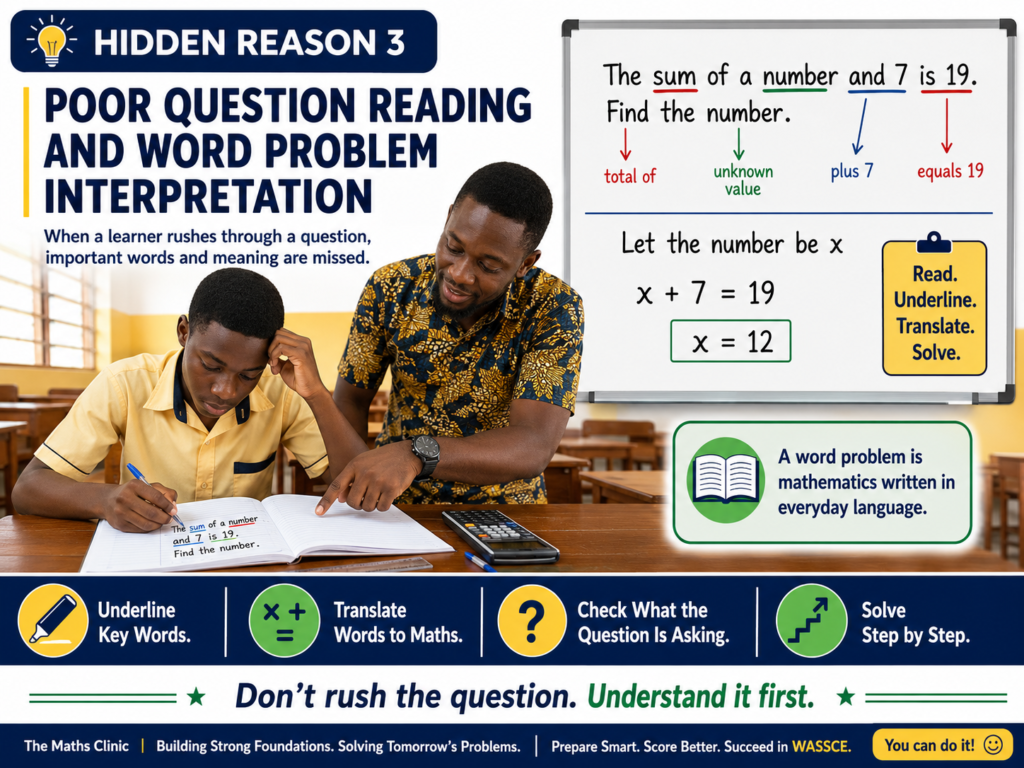
A word problem is not just English. It is mathematics written in ordinary language. The learner must translate the sentence into mathematical statements before calculating.
5. Worked example
The sum of a number and 7 is 19. Find the number.
Let the number be x.
x + 7 = 19
x = 19 – 7
x = 12
Final answer: 12
6. Common wrong approach
Some learners write 7x = 19. This is wrong because “the sum of a number and 7” means add 7 to the number, not multiply the number by 7.
7. Correct method
1. Read the question twice.
2. Underline the action words.
3. Represent the unknown with a letter.
4. Translate the sentence into an equation.
5. Solve and check whether the answer fits the original sentence.
8. Practice task
Five more than twice a number is 21. Find the number. Practice WASSCE Maths Word Problems Step by Step.
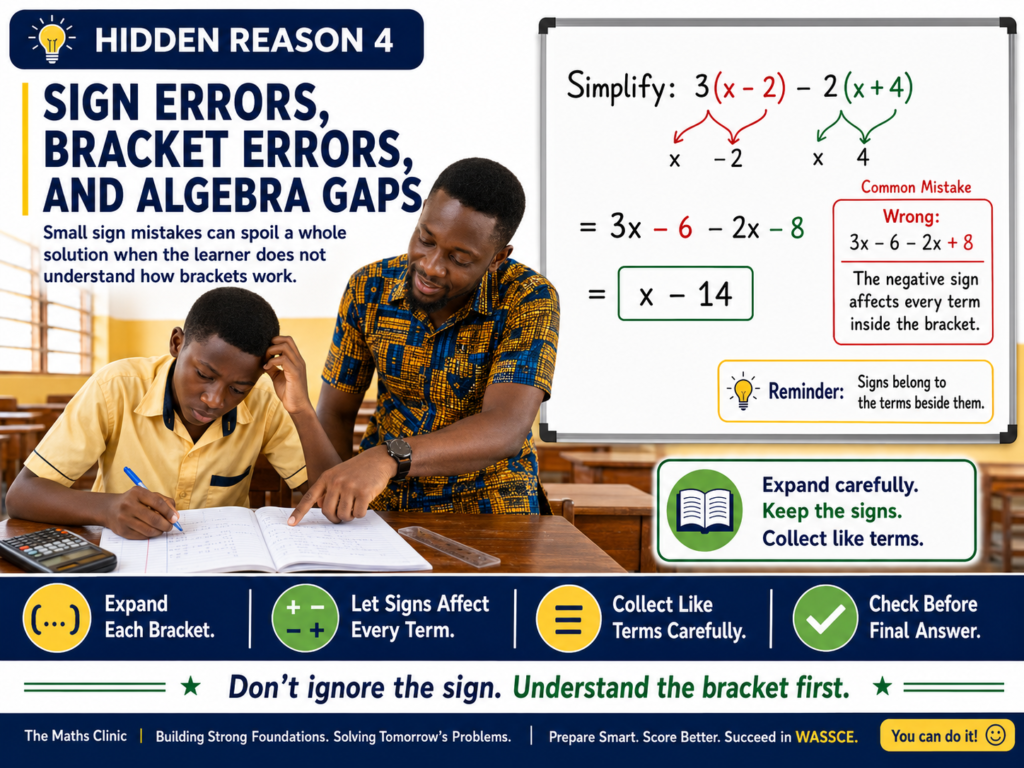
Hidden Reason 4: Sign Errors, Bracket Errors, and Algebra Gaps
1. The learner’s problem
The learner can start algebra questions but makes mistakes with negative signs, brackets, collecting like terms, transposition, and substitution. A small sign error can spoil a full solution.
2. Why did the mistake happen
The learner may not understand that signs belong to the terms beside them. When a negative sign is placed before a bracket, it affects every term inside the bracket. Some learners also move terms across the equal sign without changing signs correctly.
3. What WAEC or the curriculum reveals
Algebra appears in many areas of WASSCE Core Mathematics. It supports equations, graphs, functions, variation, mensuration, trigonometry, and coordinate geometry. A weak algebra foundation can therefore disturb many topics.
4. Simple explanation
In algebra, the sign is part of the term. In 3x – 5, the second term is -5, not just 5. If the sign is ignored, the answer changes.
5. Worked example
Simplify: 3(x – 2) – 2(x + 4)
3(x – 2) – 2(x + 4)
= 3x – 6 – 2x – 8
= x – 14
Final answer: x – 14
6. Common wrong approach
A common wrong solution is 3x – 6 – 2x + 8 = x + 2. The mistake is that the learner did not allow the negative sign before 2 to affect +4. Since -2 multiplies +4, the result is -8, not +8.
7. Correct method
1. Expand each bracket slowly.
2. Allow the sign outside the bracket to affect every term inside.
3. Collect like terms carefully.
4. Keep the sign attached to each term.
5. Check the final expression before moving on.
8. Practice task
Simplify: 4(a – 3) – 2(a + 5).
Fix Algebra Sign Errors Before WASSCE.
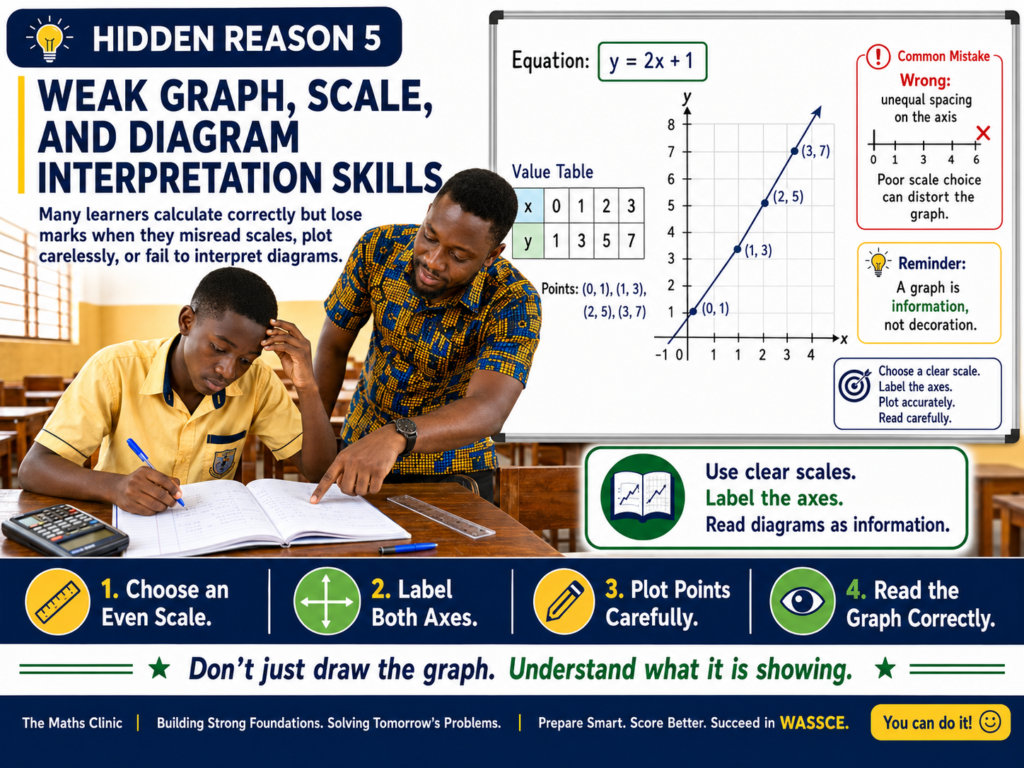
Hidden Reason 5: Weak Graph, Scale, and Diagram Interpretation Skills
1. The learner’s problem
The learner may calculate values correctly but struggles to draw, read, or interpret graphs and diagrams. This affects linear graphs, cumulative frequency curves, histograms, transformations, bearings, construction, and geometry.
2. Why did the mistake happen
Many learners treat diagrams as decoration instead of information. They do not check the scale, labels, units, axes, angles, or shape. In graph work, some learners plot points without checking whether the axis markings are even.
3. What WAEC or the curriculum reveals
WAEC often awards marks for correct scale, accurate plotting, smooth curves, labeled axes, and correct interpretation. A learner can lose marks even when the calculations are correct if the graph is poorly presented.
4. Simple explanation
A graph is a picture of numbers. If the scale is wrong, the picture gives wrong information. If the axes are not labelled, the examiner may not know what the learner is showing.
5. Worked example
Complete the table for y = 2x + 1 when x = 0, 1, 2, 3.
When x = 0, y = 2(0) + 1 = 1
When x = 1, y = 2(1) + 1 = 3
When x = 2, y = 2(2) + 1 = 5
When x = 3, y = 2(3) + 1 = 7
Ordered pairs: (0,1), (1,3), (2,5), (3,7)
6. Common wrong approach
Some learners calculate correctly but plot carelessly or use an uneven scale, such as 0, 1, 3, and 6 in equal spaces. That distorts the graph and causes avoidable mark loss.
7. Correct method
1. Choose a clear and even scale.
2. Label the x-axis and y-axis.
3. Plot each point accurately.
4. Use a ruler for straight-line graphs.
5. Read values from the graph carefully and write the units where necessary.
8. Practice task
For y = 3x – 2, find y when x = 0, 1, 2, and 3. Write the ordered pairs clearly.
Practice WASSCE Graph Questions with Feedback.
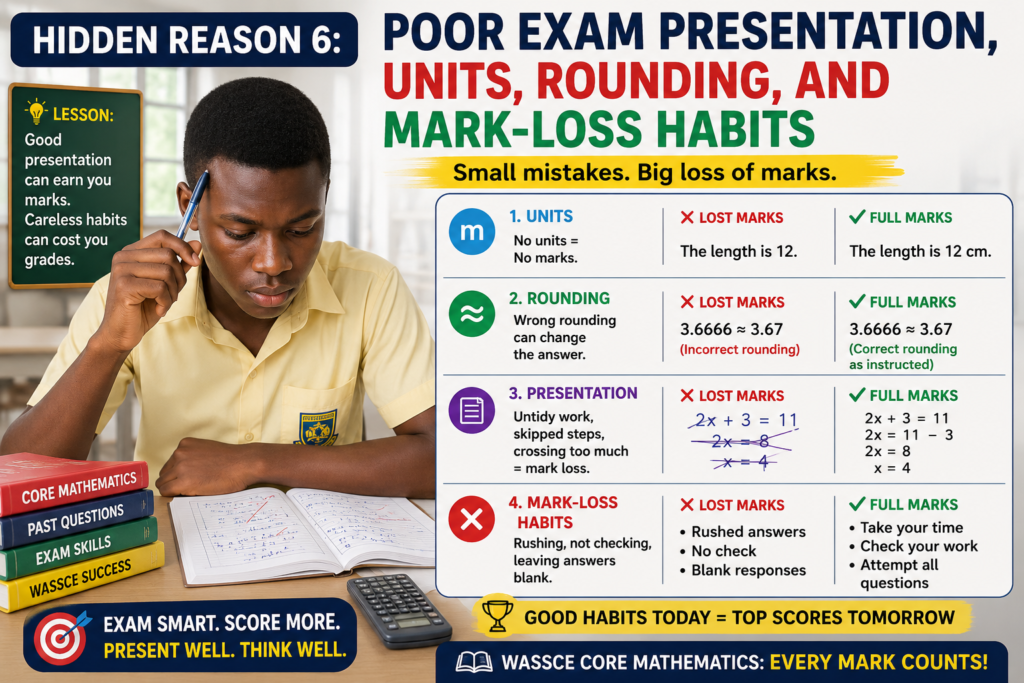
Hidden Reason 6: Poor Exam Presentation, Units, Rounding, and Mark-Loss Habits
1. The learner’s problem
The learner may understand the topic but still loses marks because the work is scattered, units are missing, rounding is careless, or the final answer is not clearly stated.
2. Why did the mistake happen
Some learners think the examiner checks only the final answer. Because of that, they do not arrange their work properly. Others skip important steps and later cannot trace their own mistakes.
3. What WAEC or the curriculum reveals
In WASSCE, method matters. Even when the final answer is wrong, correct steps can earn marks. But when the work is unclear, the learner makes it difficult for the examiner to follow the thinking.
4. Simple explanation
Mathematics is not only about the answer. It is also about the path. If the path is clear, some marks can still be saved. If the path is confused, marks that could have been earned may disappear.
5. Worked example
Find the area of a classroom noticeboard of length 12 cm and breadth 8 cm.
Area of a rectangle = length x breadth
Area = 12 x 8
Area = 96 cm²
Final answer: 96 cm²
6. Common wrong approach
A learner may write only 12 x 8 = 96. This is not the best presentation because the formula and unit are missing. In a longer WASSCE question, this habit can cost marks.
7. Correct method
1. Write the formula.
2. Substitute the values clearly.
3. Calculate carefully.
4. Attach the correct unit.
5. Box or clearly state the final answer.
8. Practice task
Find the perimeter and area of a rectangle of length 15 cm and breadth 6 cm. Show your working clearly and include units.
Learn Common WAEC Maths Traps and How to Avoid Them.
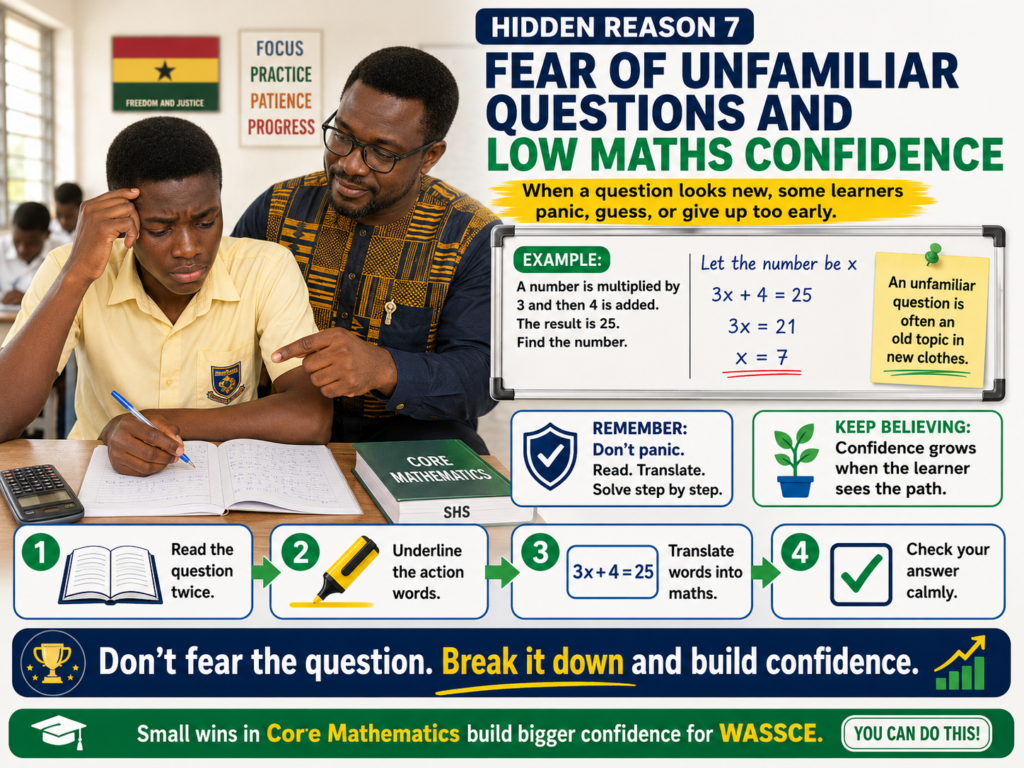
Hidden Reason 7: Fear of Unfamiliar Questions and Low Maths Confidence
1. The learner’s problem
The learner may know something, but once the question looks new, fear takes over. The learner stops thinking and begins guessing. This is common among students who have failed before or who have been called weak for a long time.
2. Why did the mistake happen
The learner has not been trained to attack unfamiliar questions step by step. Instead of looking for what is known, what is asked, and what method may help, the learner panics.
3. What WAEC or the curriculum reveals
WASSCE questions may look unfamiliar even when the topic is familiar. The curriculum expects learners to apply knowledge, not only repeat rehearsed examples. Confidence grows when learners practice different forms of the same idea and receive corrective feedback.
4. Simple explanation
An unfamiliar question is not always a new topic. Sometimes it is an old topic wearing new clothes. The learner must learn to remove the fear first, then identify the topic hiding inside the question.
5. Worked example
A number is multiplied by 3, and then 4 is added. The result is 25. Find the number.
Let the number be x.
3x + 4 = 25
3x = 25 – 4
3x = 21
x = 7
Final answer: 7
6. Common wrong approach
Some learners see the long sentence and start guessing random numbers without forming an equation. Guessing may work once in a while, but it is not reliable in an exam.
7. Correct method
1. Calm down and read the question twice.
2. Underline what is known and what is being asked.
3. Represent the unknown with a letter.
4. Translate the sentence into mathematics.
5. Solve step by step.
6. Check the answer in the original sentence.
8. Practice task
A number is divided by 5, and then 6 is added. The result is 10. Find the number.
Build confidence with guided WASSCE maths practice.
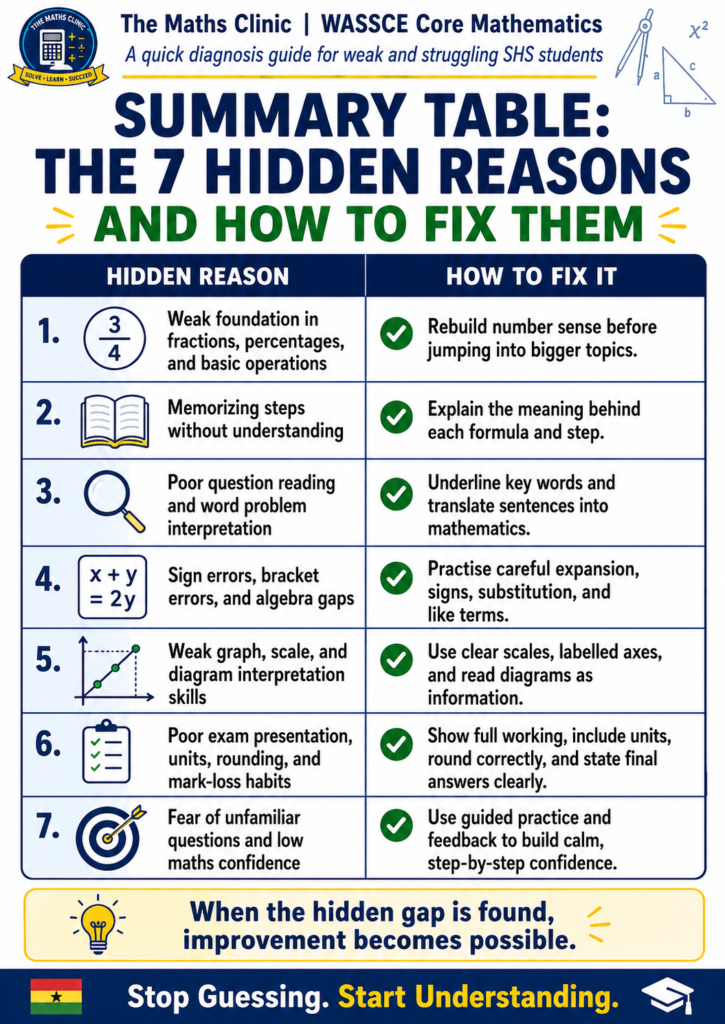
Summary Table: The 7 Hidden Reasons and How to Fix Them
| Hidden Reason | What It Looks Like in Class | Best Fix |
| Weak foundation | The learner struggles with fractions, percentages, signs, and basic operations. | Rebuild number sense before jumping into bigger topics. |
| Memorizing without understanding | The learner solves only examples that look familiar. | Explain the meaning behind each formula and step. |
| Poor question reading | The learner misses key words and instructions. | Train learners to translate words into mathematics. |
| Algebra and sign errors | The learner loses marks through brackets, signs, and like terms. | Practice slow expansion, substitution, and equation solving. |
| Weak graph and diagram skills | The learner misreads scales, axes, and diagrams. | Teach graphs as information, not decoration. |
| Poor exam presentation | The learner omits units, formulas, steps, or final answers. | Use clean working, units, and clear final statements. |
| Fear of unfamiliar questions | The learner panics when the question looks different. | Use guided practice and feedback to build confidence. |
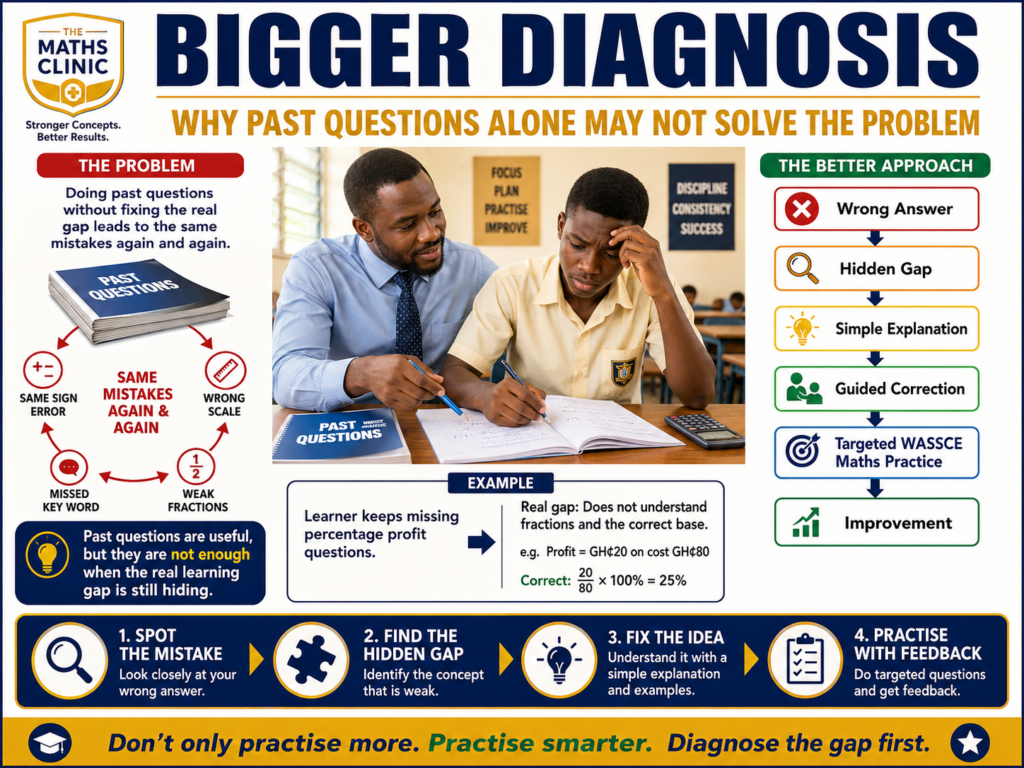
Bigger Diagnosis: Why Past Questions Alone May Not Solve the Problem
Past questions are useful, but they are not medicine by themselves. If a learner keeps solving past questions without diagnosing the mistake, the learner may repeat the same wrong habit many times.
For example, a student may solve ten percentage questions and still fail the eleventh one because the real gap is in fractions. Another learner may solve many graph questions but still lose marks because the real gap is scale selection.
The Maths Clinic approach is simple: do not only ask, “What is the answer?” Ask, “What learning gap produced this answer?”
This is why the Practice Zone and Intervention Hub must work together. The Practice Zone gives the learner questions. The Intervention Hub explains the hidden gap behind the wrong answer. Together, they make WASSCE Maths practice more useful for Ghanaian SHS learners and NOVDEC candidates.
FAQ Section
Why do many SHS students fail WASSCE Core Mathematics?
Many learners fail because of hidden gaps in fractions, algebra, percentages, signs, word problem interpretation, graphs, and exam presentation. The problem is often not laziness. It is usually an untreated foundation gap.
Can a weak SHS student improve in core mathematics before WASSCE?
Yes. A weak learner can improve when the exact gap is diagnosed and corrected. The learner must practice with feedback instead of only memorizing answers.
Are past questions enough for WASSCE Core Mathematics preparation?
Past questions are helpful, but they are not enough when the learner does not understand the topics behind the questions. Past questions work better when combined with gap diagnosis and guided correction.
What is the best way to fix core maths learning gaps?
The best way is to identify the topic behind each mistake, explain the simple idea, solve worked examples, correct the wrong approach, and give practice tasks with feedback.
How can The Maths Clinic help struggling SHS students?
The Maths Clinic helps by diagnosing common WAEC Maths mistakes, explaining the hidden Core Maths learning gaps, and guiding learners through practice that builds understanding step by step.
Conclusion: The Learner Is Not Finished; the Gap Must Be Found
In every Ghanaian classroom, some students become quiet during mathematics lessons, not because they do not care, but because they have carried the same hidden gap for too long.
Some are afraid of fractions. Some are confused by algebra. Some panic when they see word problems. Some know the answer but lose marks because they cannot present their work properly.
The solution is not to shame the learner. The solution is to diagnose the gap and fix it patiently.
At The Maths Clinic, we believe that when the hidden gap is treated, the learner begins to see WASSCE core mathematics differently. The fear reduces. The steps become clearer. The confidence grows gradually.
So if Core Maths has been difficult for you, do not conclude that you are bad at mathematics. Start by asking the right question: Where is my gap?
Once the gap is found, it can be fixed. And once it is fixed, improvement becomes possible. Start with the Practice Zone. Visit the Intervention Hub. Ask questions. Practice carefully. Mathematics improves when the learner stops guessing and starts understanding.