Struggling with WASSCE Maths? Stop guessing. Let’s fix the gap step by step.
7 Costly Learning Gaps Behind Repeated WASSCE Maths Failure

WASSCE Maths failure is painful, especially when a learner has written the paper before, joined extra classes, bought more notes, and still returned with the same result. Some Ghana SHS students do not fail because they are lazy. Many fail because the real core maths learning gaps were never found and repaired.
That is why repeated WASSCE Maths failure must not be treated as only an examination problem. It is often a foundation problem, a reading problem, a method problem, or a confidence problem hiding under the surface.
At The Maths Clinic, our Maths intervention approach is simple: stop guessing, diagnose the gap, fix the smaller weakness, and practice WASSCE Core Maths with understanding. A learner does not need to fight the whole of mathematics at once. The learner must first know exactly where the breakdown is happening.
This post answers one important question: How does knowing these learning gaps help a struggling SHS learner understand Core Maths better before WASSCE?
It helps because the learner stops saying, “I am bad at Maths.” The learner begins to say, “This is the exact Maths foundation gap I must repair.” That small change can save many months of blind revision.

1. Weak Number Sense
The first costly learning gap behind WASSCE Maths failure is weak number sense. Number sense means the learner understands how numbers behave before applying a formula.
A learner with weak number sense may struggle with fractions, decimals, negative numbers, approximations, ratios, percentages, and simple mental checks. The learner may calculate an answer and not notice that the answer does not make sense.
Why This Gap Causes Repeated Failure
Core Maths is built on numbers. Algebra uses numbers. Graphs use numbers. Mensuration uses numbers. Statistics uses numbers. Financial Maths uses numbers. So when the number foundation is weak, many topics become shaky.
For example, if a learner does not understand that 0.25 is the same as 25/100 or 1/4, percentages will continue to confuse him or her. If a learner does not understand directed numbers, algebra signs will continue to cause errors.
How This Helps the Learner Understand Core Maths Better
Once the learner sees that the problem is number sense, revision becomes more focused. The learner can go back and repair fractions, decimals, directed numbers, estimation, and basic operations before jumping into bigger WASSCE questions.
This is one of the most important core maths learning gaps to fix because it supports almost every topic in WASSCE Core Maths.
2. Poor Understanding of Mathematical Language
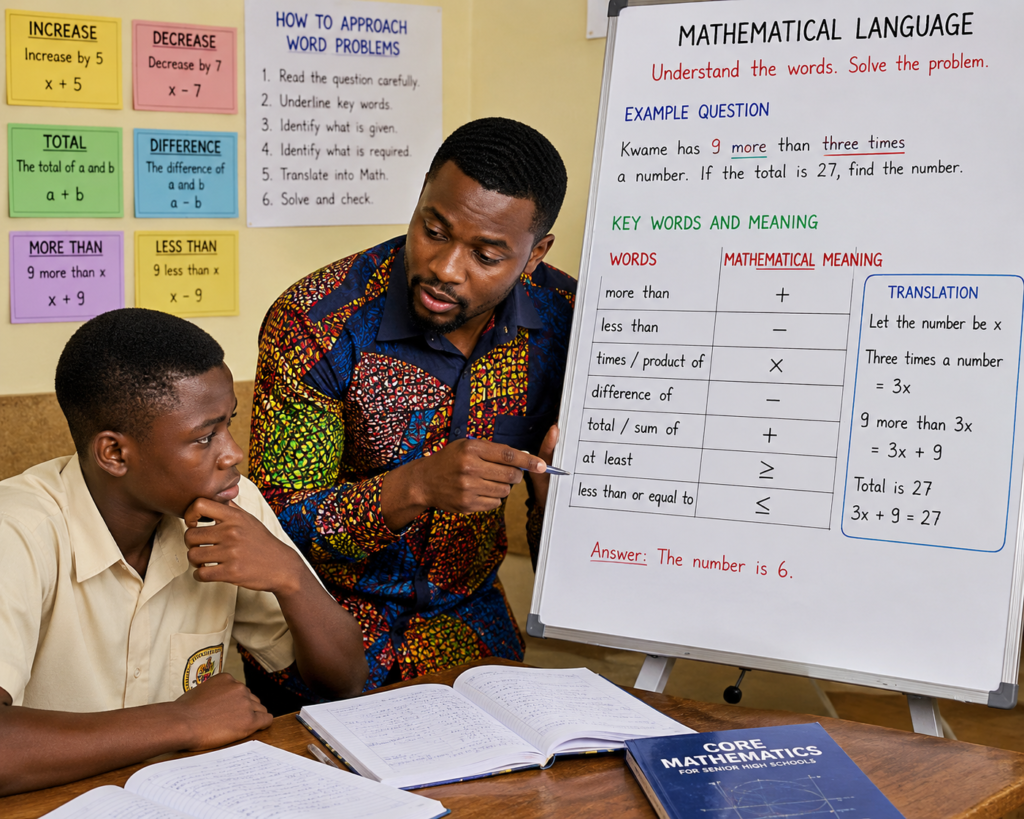
Many learners experience repeated WASSCE Maths failures because they cannot translate the language of the question into mathematical terms.
They see words like “increase,” “decrease,” “total,” “difference,” “product,” “at least,” “more than,” “less than,” “per annum,” “discount,” “marked price,” “probability,” “gradient,” “bearing,” “median,” and “estimate.” Still, they do not fully understand what action those words are demanding.
Why This Gap Causes Repeated Failure
WASSCE core maths questions are not always written like classroom drills. The exam may hide the topic inside a sentence. If the learner cannot decode the language, the correct method will not come to mind.
For example, “9 more than a number” means x + 9. Some learners write 9x because they see the number 9 and the unknown together. This is not only an algebra problem. It is a translation problem.
How This Helps the Learner Understand Core Maths Better
When the learner identifies mathematical language as the gap, word problems become less frightening. The learner begins to underline key words, identify what is given, identify what is required, and translate slowly before calculating.
This practically gives SHS Maths help because the learner now reads the question like a mathematician, not like someone rushing to pick a formula.
3. Weak Algebra Foundation
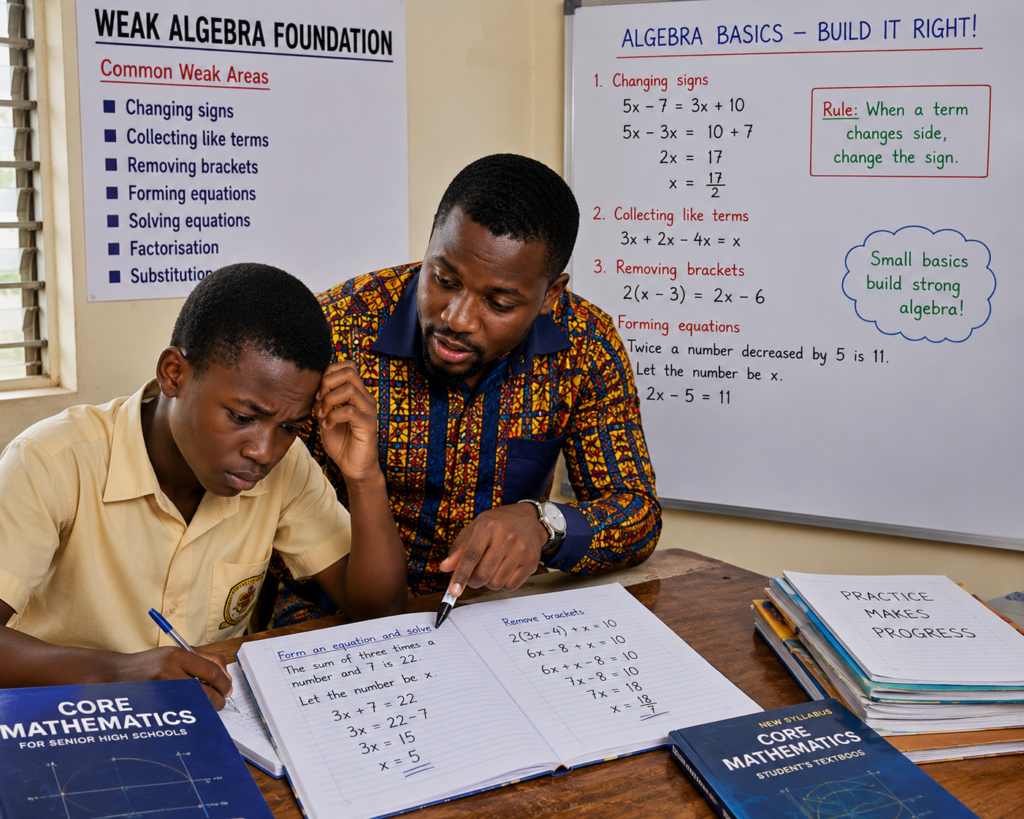
Algebra is one of the places where WASSCE Maths failure shows itself clearly. A learner may fear letters, brackets, signs, substitution, expansion, factorization, and equations.
But the real issue may not be the whole of algebra. The learner may be weak in one smaller skill, such as inverse operations, collecting like terms, changing signs, or removing brackets.
Why This Gap Causes Repeated Failure
Algebra appears directly and indirectly in equations, variation, graphs, functions, word problems, geometry, and financial Maths. If the learner cannot form and solve a simple equation, many WASSCE questions become difficult before the final calculation begins.
How This Helps the Learner Understand Core Maths Better
Once the algebra gap is diagnosed properly, the learner can stop saying, “I do not understand algebra.” Instead, the learner can say, “I struggle with changing signs,” or “I struggle with forming equations from words.”
That type of diagnosis is powerful because it points to the exact Maths foundation gaps that must be repaired before serious WASSCE Core Maths practice continues.
4. Formula Memorisation Without Meaning
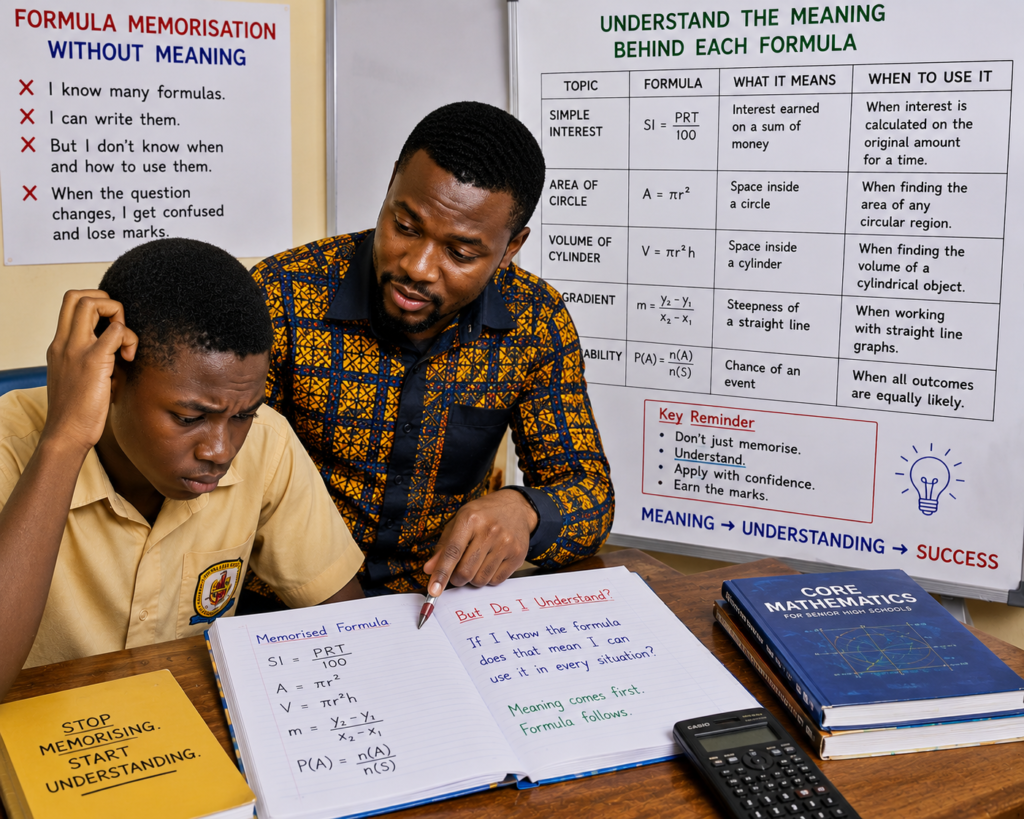
Another costly learning gap behind repeated WASSCE maths failures is learning formulas without understanding what they mean.
Some learners can recite many formulas, but when the question changes slightly, they do not know what to do. They know the formula for simple interest, area, volume, gradient, or probability, but they cannot tell when and how to use it.
Why This Gap Causes Repeated Failure
WASSCE does not always reward learners who only cram formulas. The exam often checks whether the learner understands the situation in the question.
For example, a learner may know SI = PRT/100. But if the question gives the amount instead of interest, or gives time in months, the learner may still fail because the meaning behind the formula is weak.
How This Helps the Learner Understand Core Maths Better
When the learner notices this gap, formula learning becomes meaningful. The learner begins to ask:
- What does each letter stand for?
- What unit should I use?
- Is the question asking for interest, amount, area, volume, gradient, or something else?
- Does the formula match the information given?
This changes formula work from cramming to understanding, which is the heart of effective Maths intervention for struggling learners.
5. Poor Error Correction Habit
Some learners repeat WASSCE Core Maths because they do not learn from their wrong answers. They solve, mark, feel bad, and move on. But they do not study why the answer was wrong.
That is a serious learning gap because a wrong answer is not useless. It is a report. It shows where the learner’s thinking went off track.
Why This Gap Causes Repeated Failure
If a learner keeps losing marks through wrong signs, wrong units, wrong substitutions, poor scales, or wrong interpretations but never records those mistakes, the same errors will appear again in the next test.
How This Helps the Learner Understand Core Maths Better
When the learner builds a correction habit, every mistake becomes a lesson. Instead of only writing the correct answer, the learner writes the reason for the mistake.
For example:
- Wrong sign when moving a term
- Used selling price as the original price
- Forgot to convert months into years
- Chose a poor graph scale
- Misread “more than” as multiplication
This kind of SHS Maths help fixes the thinking behind the mistake, not only the final answer.
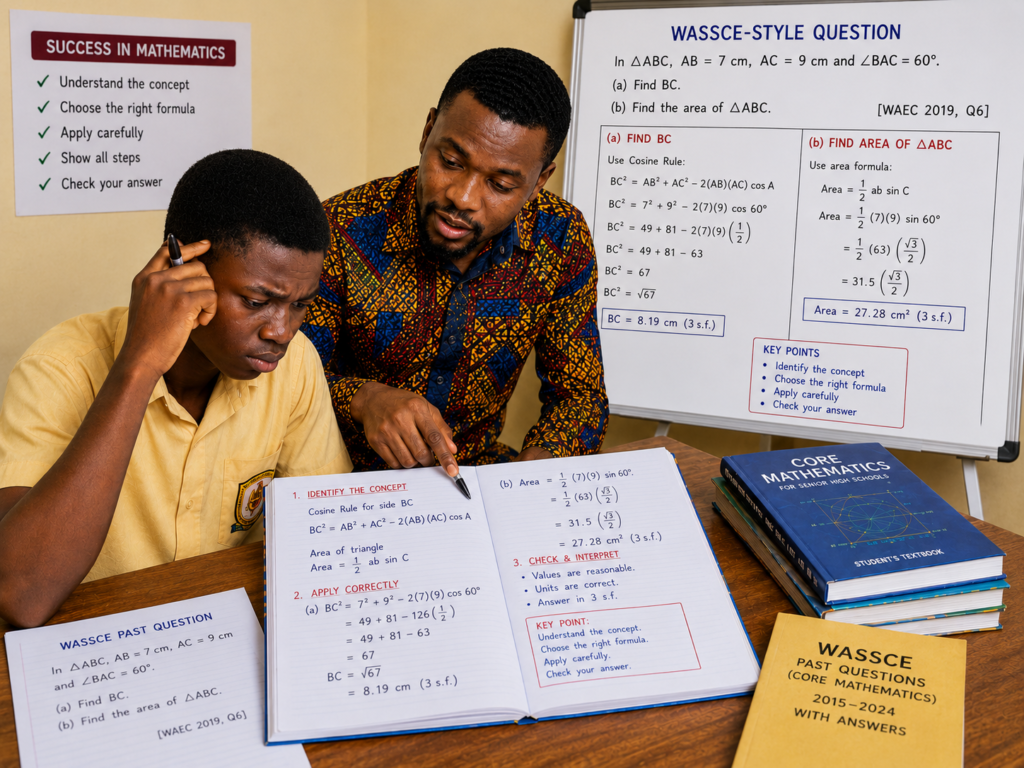
6. Weak Application of Concepts in WASSCE-Style Questions
Some Ghana SHS students can solve simple classroom examples but fail when the question looks like WASSCE. This shows a gap between basic practice and application.
The learner may know the topic but cannot use the idea in a mixed or unfamiliar situation.
Why This Gap Causes Repeated Failure
WASSCE questions may combine topics. A question may involve percentages and algebra. Another may involve geometry and trigonometry. Another may involve statistics and graph interpretation.
If the learner only practices direct questions, the learner becomes confused when the exam presents the idea in a different form.
How This Helps the Learner Understand Core Maths Better
When this gap is identified, the learner learns to move in stages: first, understand the basic skill; then, solve medium questions; then, practice WASSCE-style questions.
This helps the learner build flexibility. The learner begins to see that the same idea can appear in different clothes.
7. Lack of a Personal Maths Diagnosis Plan
The final costly learning gap is that many learners revise without a diagnosis plan. They say, “I am learning maths,” but they cannot say which topic they are fixing, which mistake they are correcting, or which skill they are rebuilding.
Why This Gap Causes Repeated Failure
Without diagnosis, revision becomes blind. The learner may spend time on familiar topics and avoid the painful ones. The learner may also jump from one topic to another without repairing the foundation.
This is why some learners work hard but still do not improve. Their effort is real, but it is not targeted.
How This Helps the Learner Understand Core Maths Better
A personal diagnosis plan helps the learner revise with direction. The learner can record weak topics, common mistakes, correction tasks, and practice scores.
For example, instead of saying, “I will learn Core Maths today,” the learner can say, “Today I will fix sign errors in linear equations and solve ten questions without help.”
That kind of revision is sharper and more useful. It turns general revision into focused Maths intervention.
Worked Example: How One Small Gap Can Cause Repeated Failure
Question
Solve: 5x – 8 = 27
Common Wrong Approach
5x = 27 – 8
5x = 19
x = 19/5
x = 3.8
The learner may conclude, “Algebra is hard.” But the whole of algebra is not the problem here. The hidden gap is smaller and easier to repair.
Correct Method
5x – 8 = 27
Add 8 to both sides:
5x = 27 + 8
5x = 35
Divide both sides by 5:
x = 7
What the Diagnosis Reveals
The real gap is the inverse operations. The learner did not understand that -8 must be removed by adding 8 to both sides. If this gap is not repaired, the learner will keep losing marks in many algebra questions. But once it is fixed, the learner can improve quickly.
Common Wrong Approach Among Repeat Candidates
Many repeat candidates prepare by doing only more questions. Practice is good, but practice without diagnosis can repeat the same mistakes.
If the learner keeps solving questions with the same weak method, the learner is not improving. The learner is only strengthening the bad habit.
Another wrong approach is reading notes without testing understanding. A learner can read a full notebook and still fail if he or she cannot solve questions independently.
Correct Method: The Maths Clinic Gap-Fixing Approach
Use this simple approach to repair Core Maths learning gaps before WASSCE:
- Pick one topic that often costs you marks.
- Solve five questions without checking the solution first.
- Mark the work carefully, including the steps.
- Write the exact mistake you made.
- Identify the smaller foundation skill behind the mistake.
- Revise that smaller skill.
- Practice again with WASSCE-style questions.
This approach helps the learner stop revising blindly. It turns every mistake into a diagnosis and every correction into treatment.
Practice Task: Find the Gap Behind the Mistake
Try these questions. After solving, do not only check the answer. Write the exact learning gap if you get any part wrong.
- Algebra: Solve 4x + 9 = 33. Diagnosis question: Did you use the opposite operation correctly?
- Percentage: A laptop was sold for GH₵2,400 after a discount of 20%. Find the original price. Diagnosis question: Did you identify the original price as the correct base?
- Simple Interest: Find the simple interest on GH₵1,500 at 12% per annum for 10 months. Diagnosis question: Did you change 10 months into years?
- Graphs: Find the gradient of the line joining (2, 5) and (6, 17). Diagnosis question: Did you subtract y-values and x-values in the same order?
- Word Problem: The sum of two numbers is 42. One number is 6 more than the other. Find the two numbers. Diagnosis question: Did you translate the words correctly into an equation?
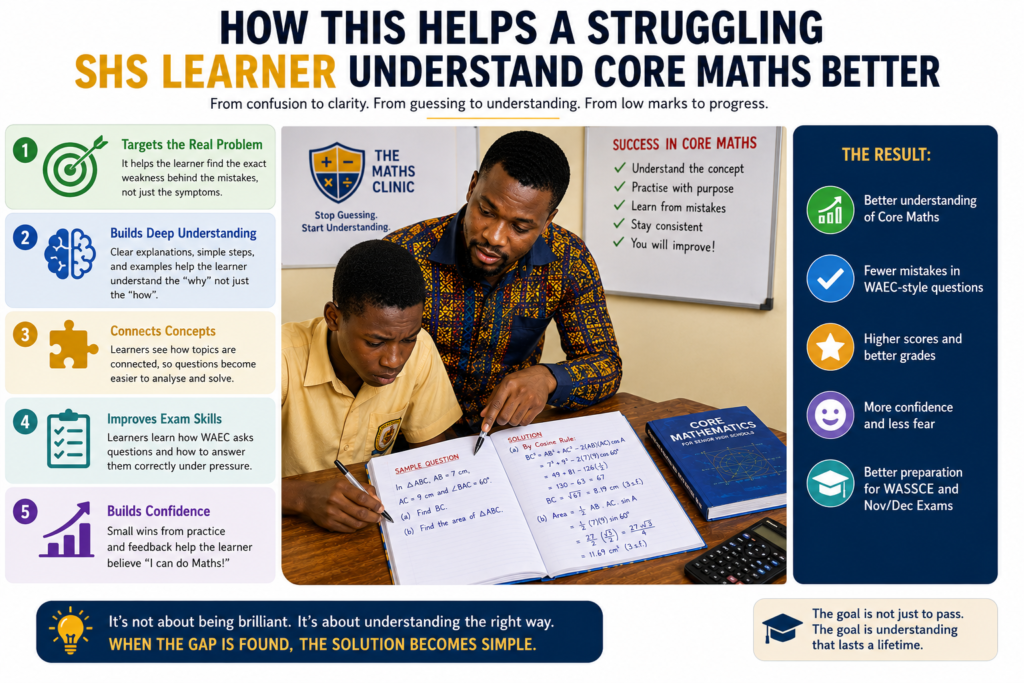
How This Helps a Struggling SHS Learner Understand Core Maths Better
This post helps a struggling SHS learner understand Core Maths better because it changes the way the learner sees failure.
Repeated WASSCE maths failures do not always mean the learner is hopeless. It may mean the learner has repeated the exam without repairing the Core Maths learning gaps that caused the first failure.
When the learner identifies the exact gap, learning becomes clearer. The learner no longer says, “I do not understand Maths.” The learner can say, “I need to fix percentages,” or “I need to work on word problem translation,” or “I need to correct sign errors in algebra.”
That is a better starting point. It also helps the learner revise with purpose. Instead of reading everything in panic, the learner focuses on the gaps that are costing marks.
Most importantly, it gives the learner hope. A learning gap can be repaired. A weak foundation can be rebuilt. A wrong method can be corrected. But the learner must first know what is wrong.
Final Advice Before WASSCE
If you have failed WASSCE Core Maths before, do not only ask for more notes. Ask for a diagnosis.
Do not only ask, “What is the answer?” Ask, “Why did I get it wrong?” Do not only revise topics. Repair the Maths foundation gaps under the topics.
At The Maths Clinic, we believe that repeated WASSCE Maths failure is not the final story. Sometimes, it is a signal that the learner needs a better method, a clearer explanation, and a proper foundation repair plan.
You can still improve. But start by finding the gap. Then fix it patiently. That is how Core Maths begins to make sense again.