Struggling with WASSCE Maths? Stop guessing. Let’s fix the gap step by step.

Mathematics Improvement: 9 Habits That Help SHS Students

Mathematics improvement is one of the things many weak and struggling Ghanaian SHS students desire, but many expect it to happen too quickly. A learner may fail one class test and hope that one long night of past questions will suddenly repair every gap. In real classroom life, it usually does not work that way.
Improvement in mathematics is normally gradual. A learner who used to score 18% may first move to 30%, then 42%, then 55%, and later become more confident. That progress may not look loud at first, but it is still serious progress.
At The Maths Clinic, we do not describe weak students as finished students. We look at the habits behind the performance. Sometimes the learner is not lazy. Sometimes the learner has practiced incorrectly for a long time. Sometimes the learner is trying, but the method is not helping.
This post explains the common habits of students who gradually improve in mathematics, especially Ghanaian SHS students preparing for WASSCE Core Mathematics, end-of-semester examinations, mock examinations, or Nov/Dec. The goal is simple: help the learner stop guessing, start understanding, and build steady confidence.
| The Maths Clinic diagnosis Wrong answer -> hidden gap -> simple correction -> guided practice -> steady confidence. When a learner makes a mistake, we do not stop at the wrong answer. We ask what learning gap produced that answer. |
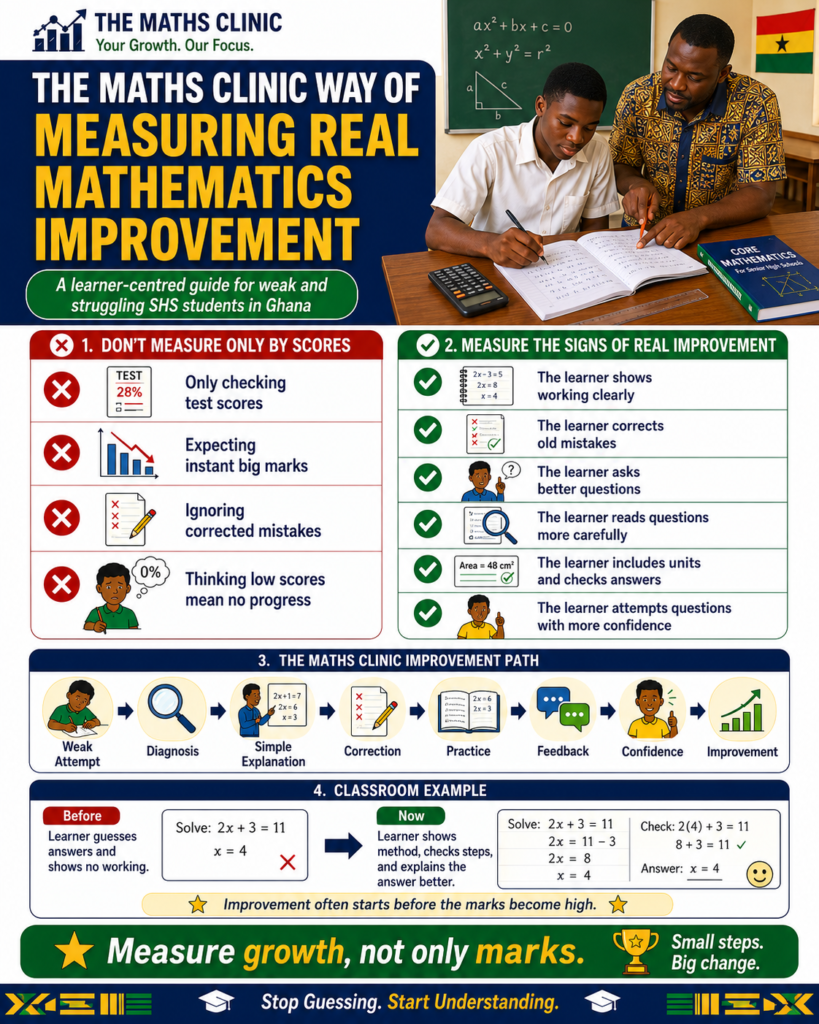
The Maths Clinic Way of Measuring Real Mathematics Improvement
A student does not improve in mathematics only because the student is naturally brilliant. Many learners improve by changing how they study, correcting mistakes, asking questions, and practicing with feedback.
This is important because some learners may begin improving before their examination scores become very high. A learner is improving when they now show their work, check units, ask better questions, read word problems slowly, and correct old mistakes instead of repeating them.
| What changes? | What it means for the learner |
| Old habit | The learner guesses, copies, hides mistakes, and waits for exam time. |
| Improving habit | The learner diagnoses the gap, practices small portions, corrects errors, and asks for help early. |
| Better classroom sign | The learner may still make mistakes, but the mistakes are now clearer and easier to correct. |
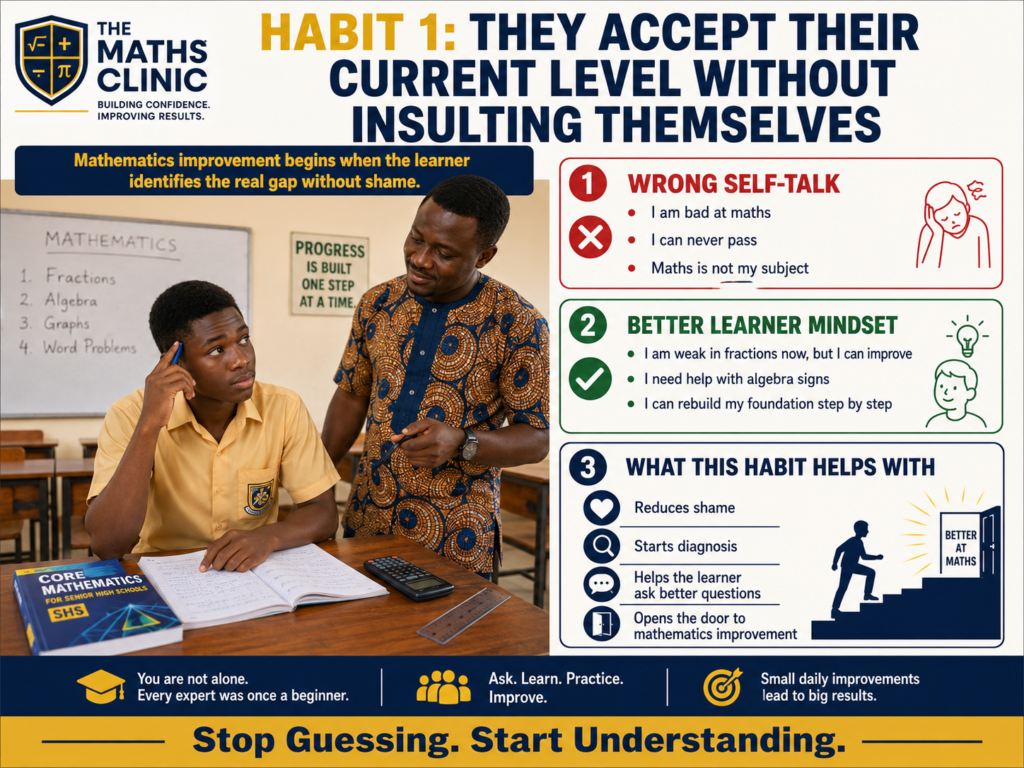
Habit 1: They Accept Their Current Level Without Insulting Themselves
The learner’s problem and hidden gap
Many weak students begin by attacking themselves. They say, “Sir, maths is not my subject,” or “I can never pass Core Maths.” This mindset makes the learner afraid before the question even starts.
Students who gradually improve do not pretend that everything is fine. They accept the exact place where they are weak, but they do not use that weakness to insult themselves.
A Ghanaian SHS learner may be in SHS 2 or SHS 3 and still struggle with fractions. That is not a reason to give up. It is a sign that the foundation must be rebuilt. The shame does not solve the fraction. The correction does.
Classroom example
I am weak in fractions now, but I can rebuild it. I make sign errors now, but I can practice them carefully.
Practice task
Write three exact Core Maths gaps disturbing you. Do not write “everything.” Be specific: fractions, algebra signs, word problems, graph scales, bearings, mensuration, or statistics.
Find and Fix My Maths Learning Gaps.
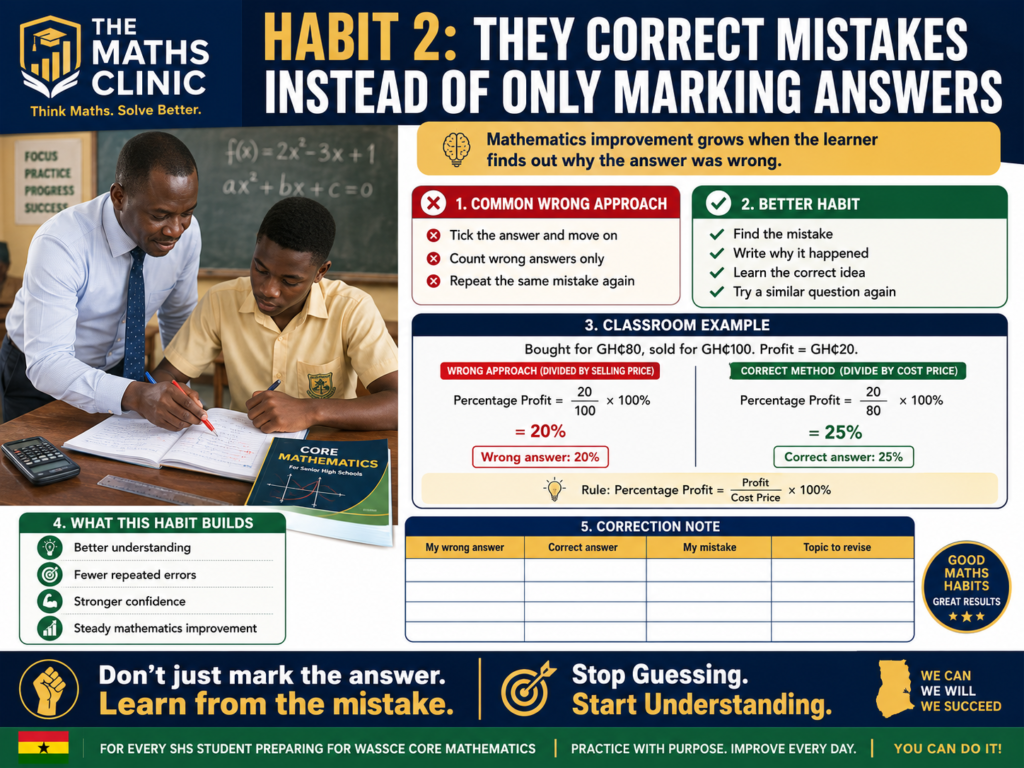
Habit 2: They Correct Mistakes Instead of Only Marking Answers
The learner’s problem and hidden gap
Some students solve questions, mark the answers, count the wrong ones, and close the book. That is not enough. If the learner does not know why the answer was wrong, the same mistake will return.
Students who gradually improve treat wrong answers like clues. A wrong answer is not only a failure. It is information showing where understanding broke down.
For example, if a learner keeps getting percentage profit wrong, the real issue may not be the formula. The hidden gap may be the base: percentage profit is compared to the cost price, not the selling price.
Classroom example
Bought for GH₵80 and sold for GH₵100. Profit = GH₵20. Percentage profit = 20/80 × 100% = 25%. The base is the cost price.
Practice task
Solve: A calculator was bought for GH₵150 and sold for GH₵180. Find the percentage profit and write one sentence explaining the base used.
Try WASSCE Maths practice questions with feedback.
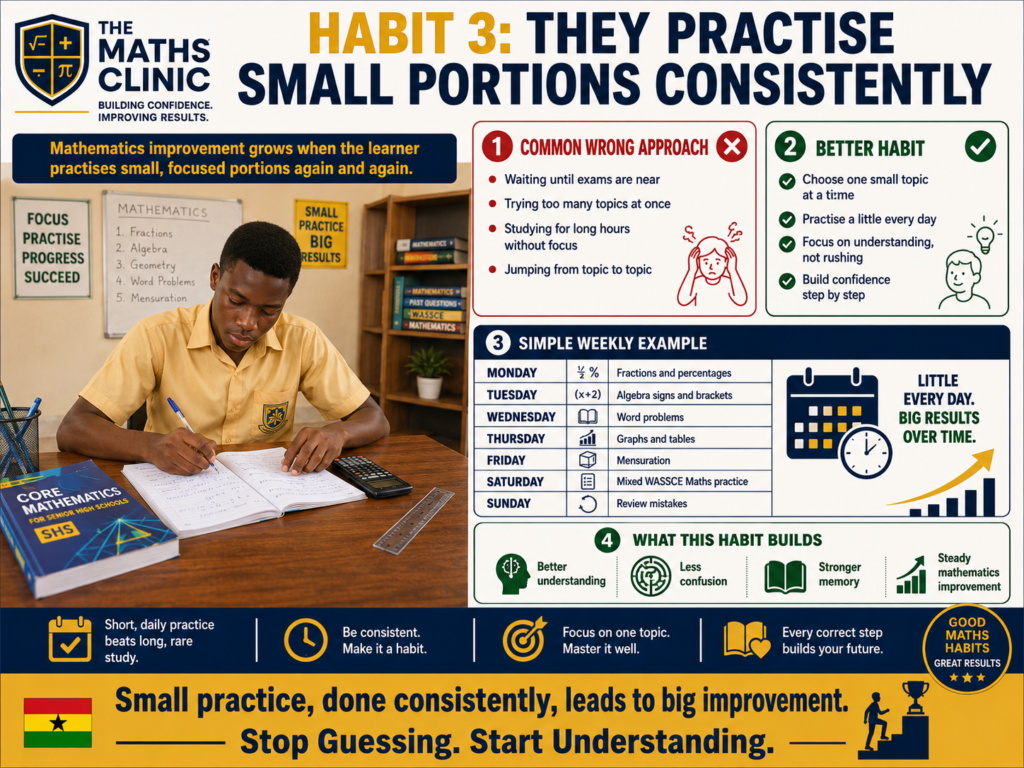
Habit 3: They Practise Small Portions Consistently
The learner’s problem and hidden gap
Some learners wait until examination week before they start serious practice. They try to learn fractions, algebra, graphs, mensuration, trigonometry, and statistics in one night. That creates pressure and confusion.
Students who gradually improve practice small portions often. For a struggling learner, 30 to 45 minutes of focused correction can be more useful than four confused hours once a week.
A simple weekly pattern can help: Monday for fractions and percentages, Tuesday for algebra signs, Wednesday for word problems, Thursday for graphs, Friday for mensuration, Saturday for mixed WASSCE Maths practice, and Sunday for review.
Classroom example
Today I will practice only percentage profit. Tomorrow I will correct only the bracket expansion. This is better than jumping through many topics without fixing any gaps.
Practice task
Choose one weak topic today and solve five questions from only that topic. After each question, write what confused you or what you understood.
Practice core maths, topic by topic.
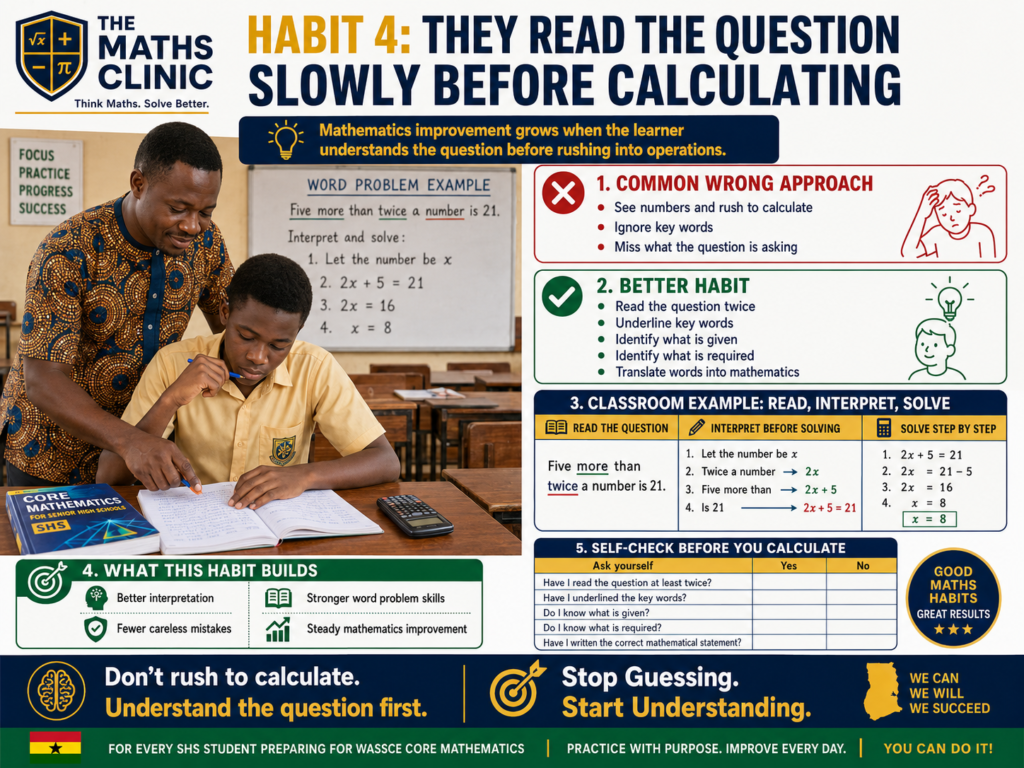
Habit 4: They Read the Question Slowly Before Calculating
The learner’s problem and hidden gap
Many students see numbers and start calculating immediately. They add, subtract, multiply, or divide before understanding the question.
Students who gradually improve read like mathematicians. They ask, “What is given?” What is required? What topic is hiding here? Which word is important? What unit should the final answer carry?
WASSCE Core Mathematics often tests interpretation before calculation. A learner can know the formula and still lose marks because the question was not read properly.
Classroom example
Five more than twice a number is 21. Let the number be x. Twice the number is 2x. Five more than that is 2x + 5. So 2x + 5 = 21 and x = 8.
Practice task
Translate this sentence into an equation before solving: Seven less than three times a number is 20.
Practice WASSCE word problems step by step.
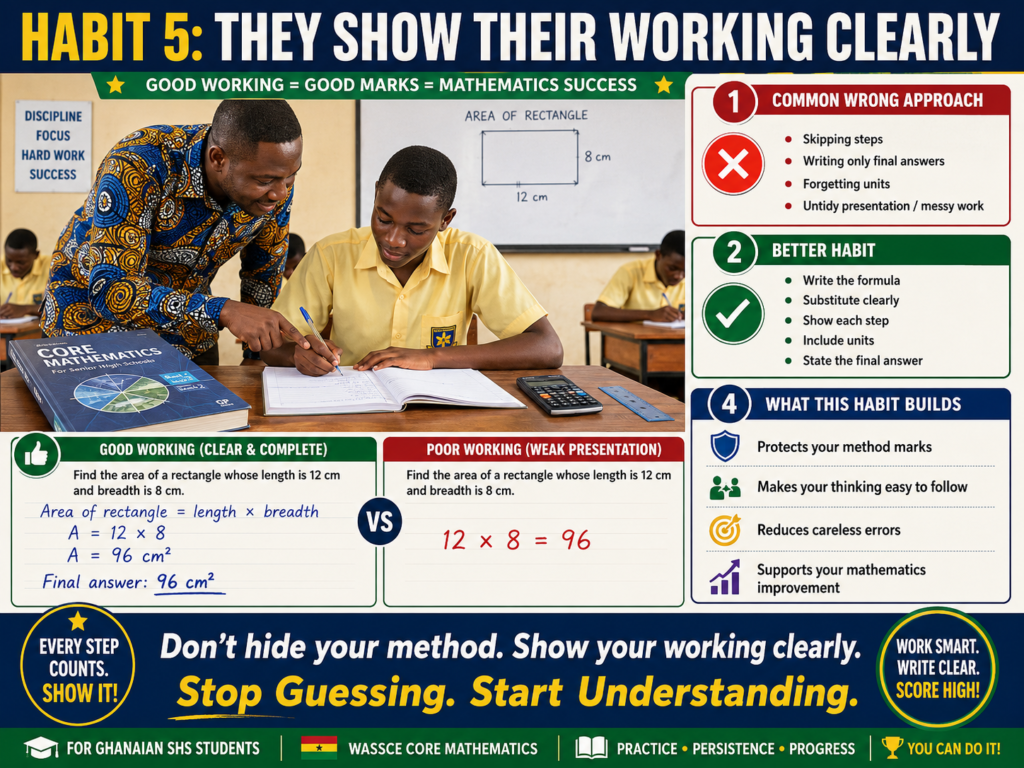
Habit 5: They Show Their Working Clearly
The learner’s problem and hidden gap
Some learners know part of the solution, but write their work anyhow. They skip steps, scatter numbers, omit units, and leave the final answer unclear.
Students who gradually improve understand that method matters. In WASSCE Core Mathematics, correct working can save marks even when the final answer has a small mistake.
A good presentation is not decoration. It helps the examiner follow the learner’s thinking. It also helps the learner trace mistakes during checking.
Classroom example
Area of a rectangle = length × breadth. If length = 12 cm and breadth = 8 cm, then area = 12 × 8 = 96 cm². The unit matters.
Practice task
Find the perimeter and area of a rectangle of length 15 cm and breadth 6 cm. Show formula, substitution, calculation, unit, and final answer.
Learn Common WAEC Maths Mistakes and How to Avoid Them.
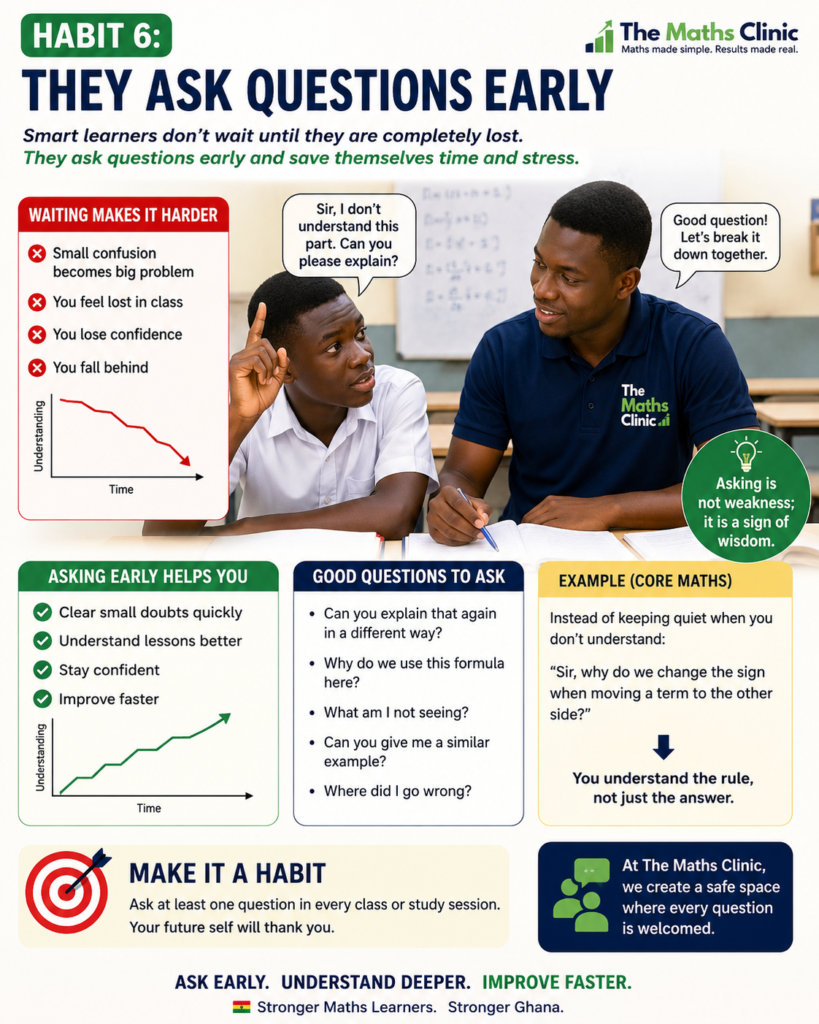
Habit 6: They Ask Questions Early
The learner’s problem and hidden gap
Some learners keep quiet when they do not understand. They fear that classmates will laugh or that the teacher will think the question is too simple.
Students who gradually improve ask questions before the confusion grows. Sometimes one small question can fix a serious learning gap.
For example, a learner who asks why -2(x + 4) becomes -2x – 8 is not wasting time. That question can correct a major algebra and bracket problem.
Classroom example
Good questions include: Why did the sign change? Why are we dividing by the cost price? Why is the unit cm² and not cm? Why did we choose that graph scale?
Practice task
Write one mathematics question you have been afraid to ask. Rewrite it clearly so a teacher or classmate can help you.
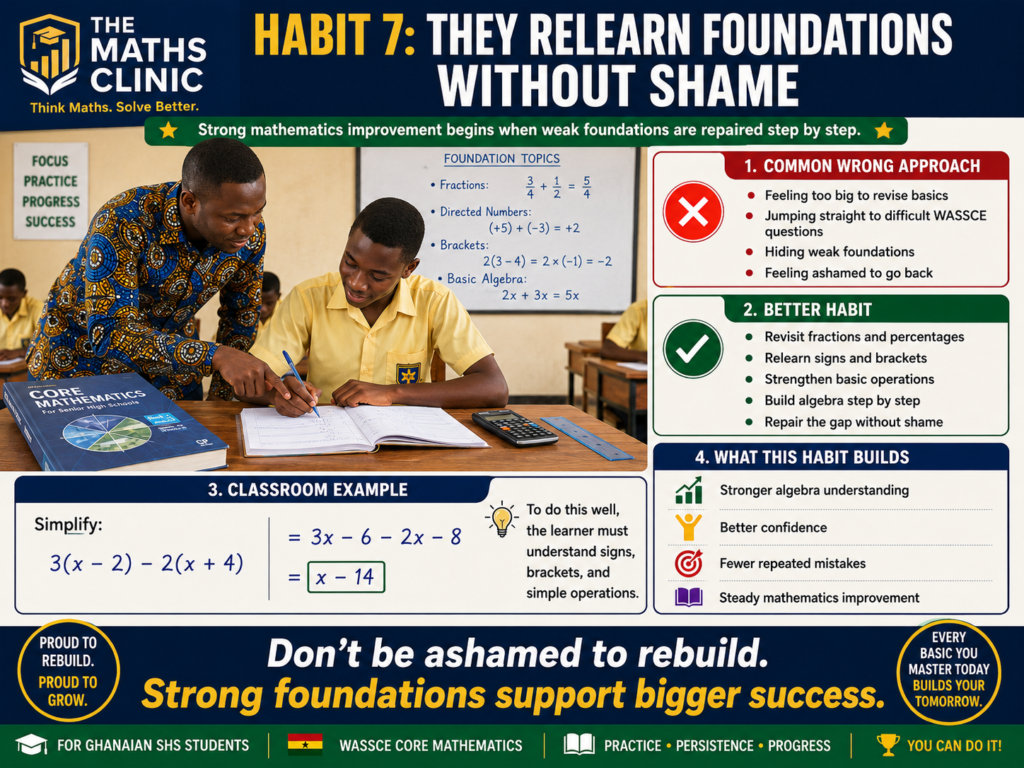
Habit 7: They Relearn Foundations Without Shame
The learner’s problem and hidden gap
Some SHS students feel too big to revise JHS-level mathematics. They want to jump straight into WASSCE past questions, even when fractions, directed numbers, and BODMAS are weak.
Students who gradually improve are not ashamed to go back and rebuild. Going back is not failure. It is repair work.
If fractions are weak, percentages will shake. If negative numbers are weak, algebra will shake. If substitution is weak, mensuration and equations will shake. If reading is weak, word problems will shake.
Classroom example
Simplify 3(x – 2) – 2(x + 4). Correct expansion gives 3x – 6 – 2x – 8 = x – 14. The negative sign affects every term inside the bracket.
Practice task
Simplify 4(a – 3) – 2(a + 5). Check whether the negative sign affected every term inside the second bracket.
Fix Core Maths Learning Gaps Step by Step.
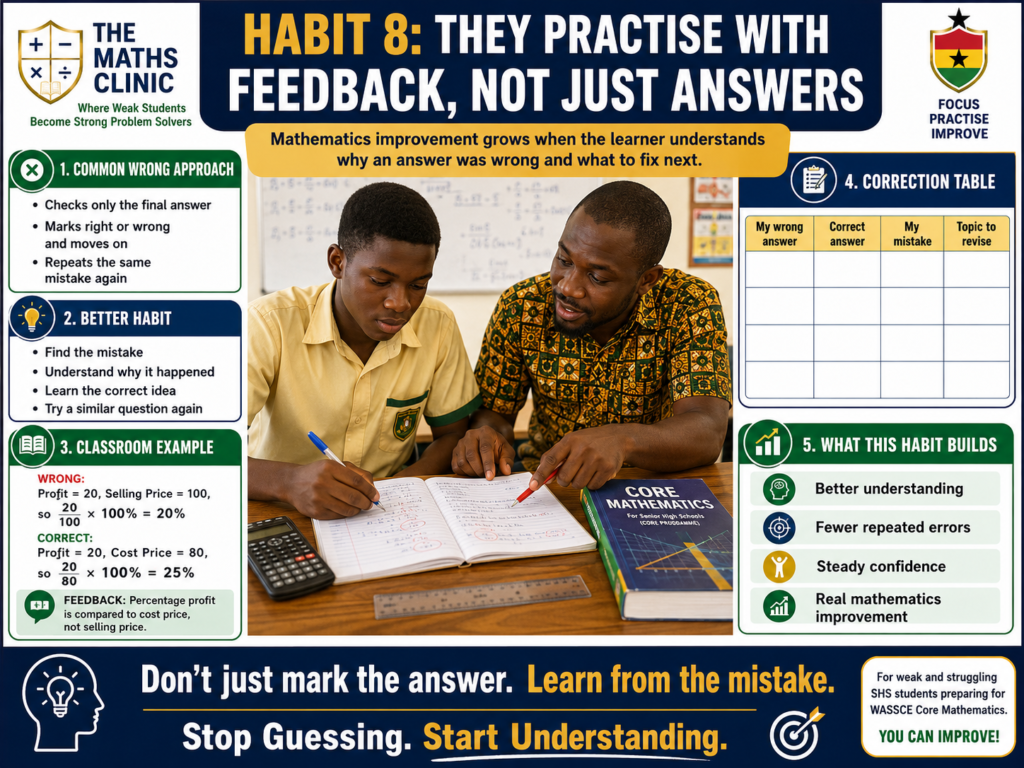
Habit 8: They practice with feedback, not just answers.
The learner’s problem and hidden gap
Some learners only want the final answer. Once they see A, B, C, or D, they move on. But the answer alone does not always teach the method.
Students who gradually improve want feedback. They ask why the answer is wrong, which step caused the mistake, which topic must be revised, and what similar questions should be tried again.
This is the difference between ordinary practice and guided WASSCE Maths practice. Feedback turns practice into correction.
Classroom example
If a learner chooses 20% instead of 25% in a percentage profit question, useful feedback says, “You divided by selling price.” The percentage profit must be compared to the cost price.
Practice task
After your next five Core Maths questions, create a correction table with the following: question, my wrong answer, correct answer, my mistake, and topic to revise. Try guided WASSCE maths practice.
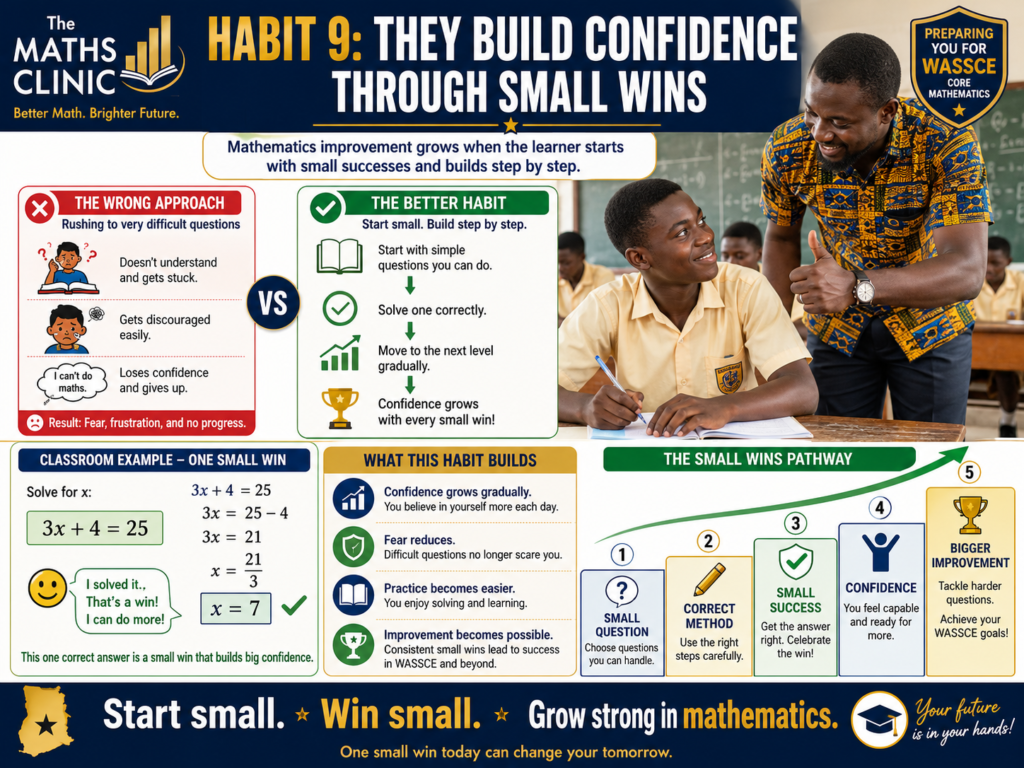
Habit 9: They Build Confidence Through Small Wins
The learner’s problem and hidden gap
Some students want confidence before they practice. But confidence usually grows after small successful steps, not before them.
Students who gradually improve build small wins. A small win can be solving one fraction correctly, reading one word problem properly, choosing a correct graph scale, adding the right unit, or correcting one sign error.
Small wins are not childish. These are the steps that rebuild maths confidence for weak students. The learner who keeps seeing little progress begins to believe that improvement is possible.
Classroom example
A number is multiplied by 3, and then 4 is added. The result is 25. Let the number be x. Then 3x + 4 = 25, so x = 7.
Practice task
Choose one topic you fear. Solve three simple questions under that topic slowly. Your goal is not speed. Your goal is understanding. Build Confidence in Core Mathematics.
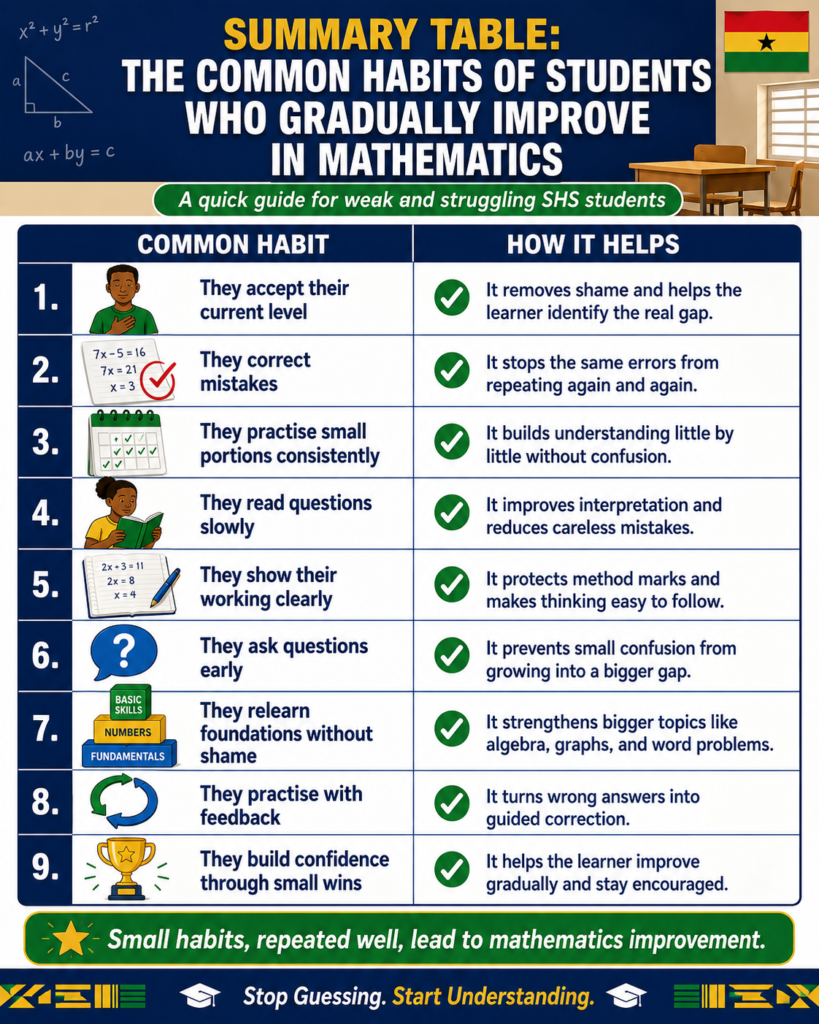
Summary Table: The Common Habits of Students Who Gradually Improve in Mathematics
| Habit | What it looks like | Why it helps |
| Accept their current level | They admit the exact topic disturbing them | It removes shame and starts diagnosis |
| Correct mistakes | They find why the answer was wrong | It prevents repeated errors |
| Practise small portions | They focus on one topic at a time | It reduces confusion |
| Read questions slowly | They underline key words before calculating | It improves interpretation |
| Show clear working | They write formulas, steps, units, and final answers | It protects method marks |
| Ask questions early | They speak up when confused | It stops small gaps from growing |
| Relearn foundations | They revise basics without shame | It strengthens bigger topics |
| Practise with feedback | They learn from each wrong answer | It turns practice into correction |
| Build small wins | They start with manageable questions | It grows confidence gradually |
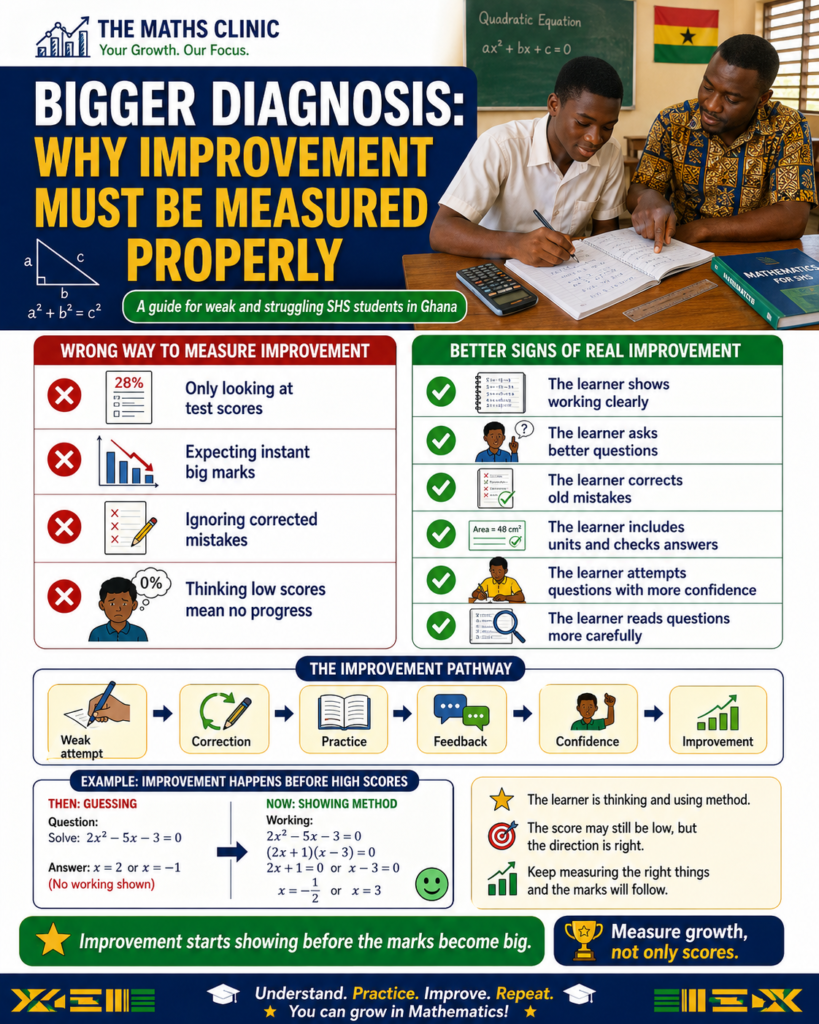
Bigger Diagnosis: Why Improvement Must Be Measured Properly
Sometimes parents, teachers, or learners expect mathematics improvement to show only as a high score. Scores are important, but for a weak learner, improvement can begin before the score becomes high.
A learner is improving when the learner now shows working instead of only writing answers, underlines key words in word problems, includes units in mensuration, checks signs before collecting like terms, asks questions instead of keeping quiet, corrects mistakes instead of tearing the page, and attempts questions that used to frighten him or her.
A student who moves from guessing blindly to showing a correct method is improving. A student who moves from avoiding mathematics to practicing three times a week is improving. A student who begins to identify personal mistakes is improving. These signs must be noticed and encouraged.
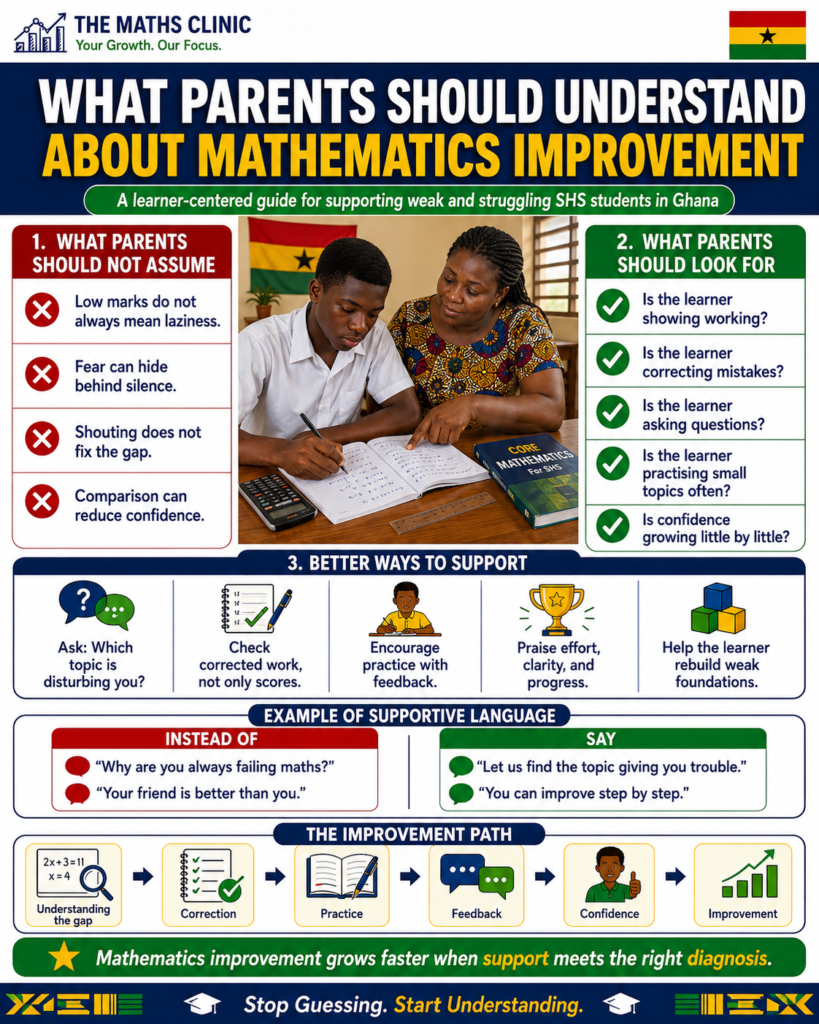
What Parents Should Understand About Mathematics Improvement
Parents play an important role, especially when the learner has struggled for a long time. A parent should avoid comparing the learner with siblings or classmates. Pressure without direction can make mathematics feel heavier.
| Less helpful pressure | More helpful support |
| Avoid the phrase “You are lazy.” | Try the following: “Which exact topic is disturbing you?” |
| Avoid: “Your brother was good in maths.” | Try the following: “Show me the mistake you keep making.” |
| Avoid the phrase “You will fail again.” | Try the following: “Have you corrected the wrong answers?” |
| Avoid only forcing more past questions | Try the following: “Are you practicing with feedback?” |
A struggling learner needs discipline, but discipline should come with a diagnosis. The aim is not to pamper the learner. The aim is to correct the gap properly so that practice can produce results.
What Teachers Should Watch For
In a Ghanaian SHS classroom, a teacher may have many learners and limited time. Still, some signs can help the teacher notice students who are beginning to improve.
- The learner starts attempting questions instead of leaving them blank.
- The learner shows work even when unsure.
- The learner asks clearer questions.
- The learner corrects old mistakes.
- The learner begins to explain the steps to another learner.
- The learner stops rushing through word problems.
- The learner checks units, rounding, signs, and scale.
Such learners may still be scoring low, but they are no longer learning the same way. That change should be encouraged.
What Students Should Stop Doing
- Stop copying solutions without understanding them.
- Stop memorizing formulas without knowing what the letters mean.
- Stop waiting until exams are close before practicing.
- Stop hiding your mistakes.
- Stop saying “I am bad at maths” every time you meet a difficult question.
- Stop jumping from topic to topic without fixing the old gap.
- Stop using past questions only as a guessing game.
- Stop ignoring units, signs, scales, and instructions.
You do not have to stop all these habits in one day. But you must start correcting them one by one.
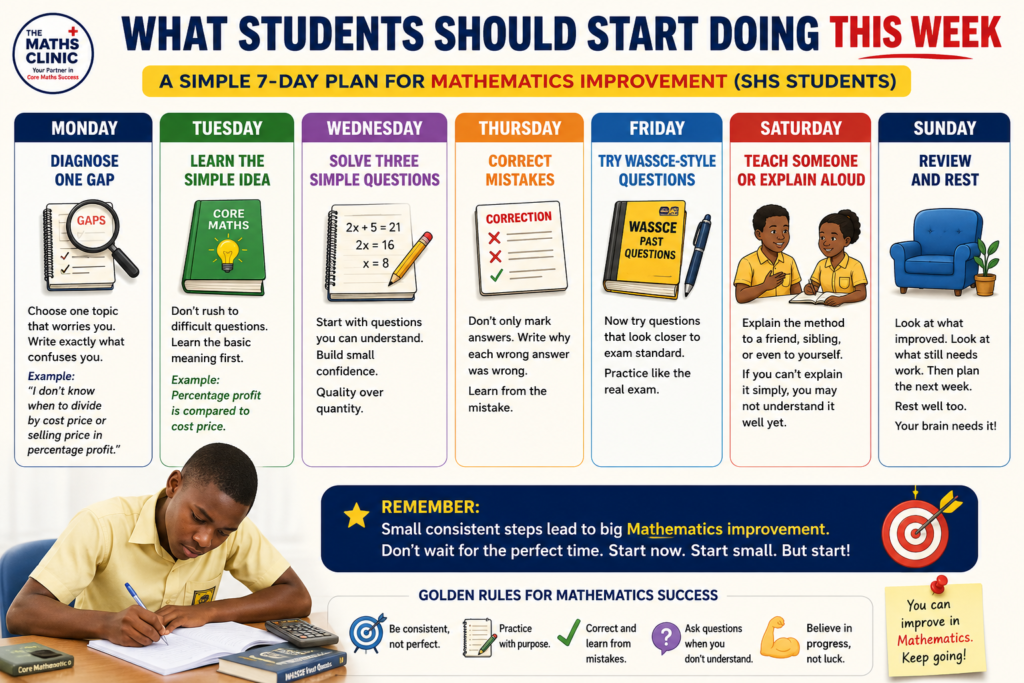
What Students Should Start Doing This Week
- Monday: Diagnose one gap: Choose one topic that worries you and write exactly what confuses you.
- Tuesday: Learn the simple idea: Do not rush to difficult questions. Learn the basic meaning first.
- Wednesday: Solve three simple questions: Start with questions you can understand. Build small confidence.
- Thursday: Correct mistakes: Do not only mark answers. Write why each wrong answer was wrong.
- Friday: Try WASSCE-style questions: Now try questions that look closer to the examination standard.
- Saturday: Explain the method aloud: Explain the method to a friend, sibling, classmate, or yourself.
- Sunday: Review and plan: Look at what improved and what still needs work. Then plan the next week.
FAQ: The Common Habits of Students Who Improve in Mathematics
Can a weak SHS student improve in mathematics?
Yes. A weak SHS student can improve when the exact learning gaps are diagnosed and corrected. Mathematics improvement becomes easier when the learner practices consistently, asks questions, corrects mistakes, and rebuilds weak foundations.
Is solving past questions enough to improve in WASSCE Core Mathematics?
Past questions are useful, but they are not enough if the learner keeps repeating the same mistakes. Past questions work better when they are combined with correction, explanation, and targeted practice.
How many hours should a struggling student study mathematics?
A struggling student does not always need very long hours at first. The learner needs focused practice. Even 30 to 45 minutes of serious mathematics practice daily can help when mistakes are corrected properly.
Why do some students understand in class but fail in exams?
Some students understand examples when the teacher is guiding them, but struggle when the question changes. This may happen because they memorized steps without understanding the meaning or because they have weak question-reading habits.
What is the best habit for improving in mathematics?
One of the best habits is correcting mistakes properly. The learner should not only ask, “What is the correct answer?” The learner should also ask, “Why did I get it wrong?”
How can The Maths Clinic help struggling SHS students?
The Maths Clinic helps struggling Ghanaian SHS students by diagnosing core maths learning gaps, explaining mistakes in simple language, and guiding learners through targeted WASSCE Maths practice.
Conclusion: Mathematics Improvement Is Built One Correct Habit at a Time
The student who improves in mathematics is not always the student who started as the best in class. Sometimes it is the student who becomes honest about the gap, corrects mistakes, practices small portions consistently, asks questions early, and learns foundations again without shame.
So if you are struggling with WASSCE Core Mathematics, do not conclude that your case is finished. Start with one habit. Read the question slowly. Show your working. Correct one mistake. Revise one weak foundation. Ask one honest question. Practice one small topic today.
Mathematics improvement does not always arrive loudly. Sometimes it starts quietly, inside one corrected mistake.
At The Maths Clinic, we believe that when the hidden gap is found and treated step by step, the learner can improve. You may be struggling now, but you are not finished. Stop guessing. Start understanding.