Struggling with WASSCE Maths? Stop guessing. Let’s fix the gap step by step.

8 Signs Your Maths Confidence Is Low Because of Hidden Gaps

Many SHS students think they have low maths confidence because they are not naturally good at mathematics.
But in many Ghanaian classrooms, that is not the real story. A learner can lose confidence simply because small hidden gaps have stayed too long without correction.
Maybe the learner missed fractions in JHS. Maybe negative numbers were never clear. Maybe algebra signs became confusing from SHS 1. Maybe word problems have always looked like English comprehension instead of mathematics.
So when WASSCE questions come, the learner is not only fighting the new topic. The learner is also fighting old gaps that were never repaired.
That is why this post matters.
It answers one important question:
How does this help a struggling SHS learner understand Core Maths better?
It helps because the learner begins to see that low confidence is not always the main problem. Sometimes, low confidence is a signal. It is pointing to a hidden gap that needs diagnosis, correction, and practice.
When the hidden gap is found, the learner stops saying, “I am bad at Maths.” The learner begins to say, “This is the exact part I must fix.” That is where real improvement begins.
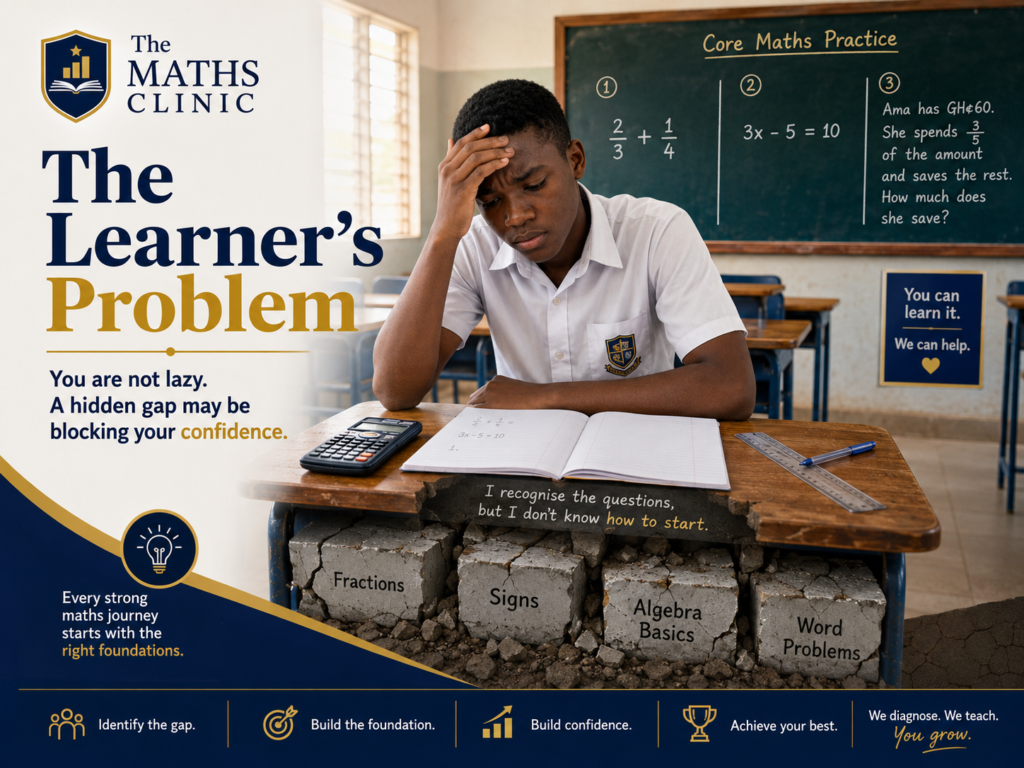
The Learner’s Problem
A learner may sit in a Core Maths class and feel afraid even before the teacher finishes writing the question on the board. The learner may avoid answering questions, hide the exercise book, or copy from friends just to escape embarrassment.
Outside the classroom, people may call that learner lazy. But a teacher who diagnoses properly will ask a better question:
What is making this learner lose confidence?
Very often, the answer is a hidden gap. The learner is not empty. The learner is carrying missing pieces.
Core Maths is connected. If fractions are weak, percentages suffer. If integers are weak, algebra becomes painful. If reading is weak, word problems become frightening. If coordinates are weak, graphs become confusing.
So the work is not to shame the learner. The work is to find the missing piece and repair it.
Why Low Maths Confidence Happens
Low maths confidence usually grows slowly. It may start with one topic the learner did not understand. Then another topic depends on that first topic. Before long, the learner feels the whole subject is difficult.
For example, a learner who does not understand negative numbers may struggle with algebraic equations. When equations keep going wrong, the learner may start avoiding algebra. When algebra appears in graphs, functions, and word problems, the fear spreads.
This is why hidden gaps are dangerous. They do not stay in one corner. They follow the learner into many topics.
Now let us look at eight signs that your maths confidence may be low because of hidden gaps.

1. You Feel Afraid Before You Even Try the Question
One clear sign of low maths confidence is fear before the work even begins. The teacher writes a question, and before you read it properly, your mind has already said, “I cannot do this.”
Why this happens
This often happens when the learner has failed similar questions many times. The brain remembers the embarrassment and tries to protect the learner by avoiding the question.
The hidden gap
The hidden gap may be a poor understanding of the basic idea behind the topic. For example, a learner may fear percentages because fractions and decimals are weak. The fear is not really about percentages alone. It is about the foundation underneath percentages.
How this helps a struggling learner understand Core Maths better
This helps the learner understand Core Maths better because it teaches the learner to pause and locate the fear. Instead of running away, ask: “Which part of this question is frightening me?” If the fear is from fractions, fix fractions. If it is from algebraic signs, fix signs. Confidence grows when the learner repairs the exact missing skill.
2. You Understand When the Teacher Solves, But You Cannot Start Alone
Another sign is that everything looks simple when the teacher is solving, but when you are alone, you cannot start.
Why this happens
In class, the teacher provides the direction. The teacher knows the topic, chooses the formula, arranges the steps, and corrects mistakes quickly. So the learner feels comfortable while watching.
The hidden gap
The hidden gap may be weak independent thinking. The learner may know how to follow steps but may not know how to decide the first step alone.
How this helps a struggling learner understand Core Maths better
This helps the learner by separating watching from understanding. After each worked example, close your book and try one question on your own. If you cannot start, your gap may be topic recognition or first-step thinking. Fixing that gap helps Core Maths become less dependent on the teacher.
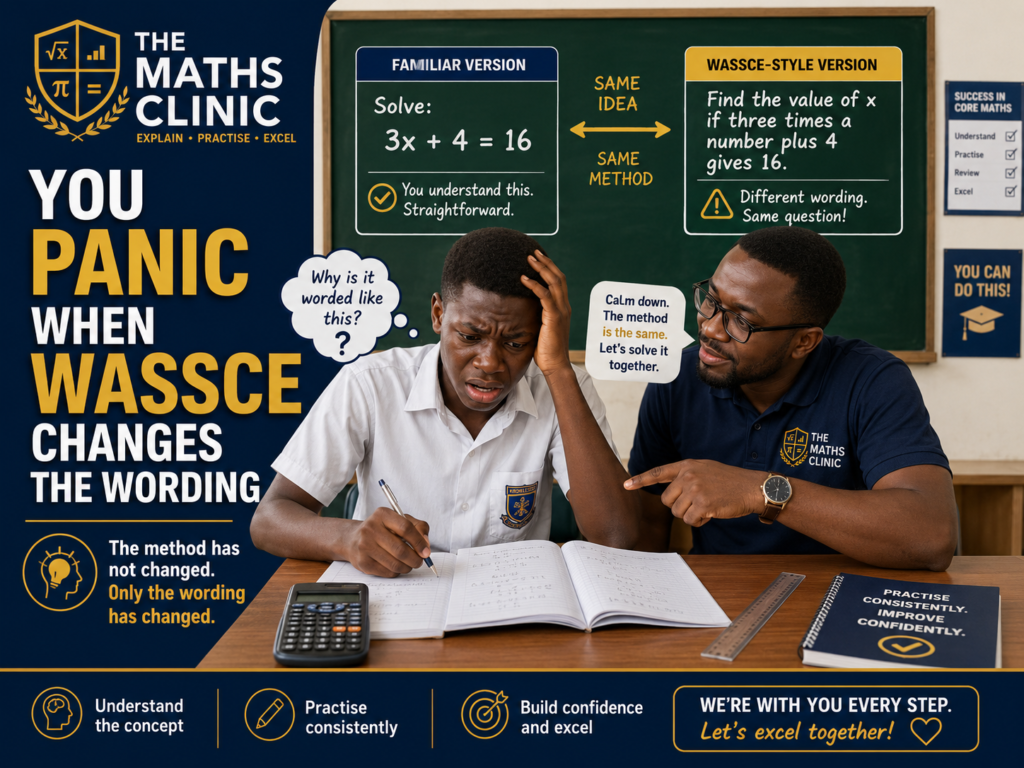
3. You Panic When WASSCE Changes the Wording
Some learners can solve a question when it looks exactly like the class example. But when WASSCE changes the wording, they panic.
Why this happens
This happens when the learner memorizes patterns instead of understanding concepts. The learner is not reading the meaning of the question. The learner is looking for something familiar to copy.
The hidden gap
The hidden gap may be a weak interpretation. For example, “decrease by 20%,” “discount of 20%,” and “20% loss” are connected ideas, but the wording may confuse a learner who only memorized one example.
How this helps a struggling learner understand Core Maths better
This helps the learner understand Core Maths better because it shows that the problem is not always calculation. Sometimes the problem is reading and interpretation. To fix it, underline key words, identify the topic, and explain what the question is asking before solving.
4. You Keep Saying “I Know It,” But Your Marks Do Not Improve
This is a painful sign. A learner may say, “I know this topic,” but the test score does not show improvement.
Why this happens
This happens because seeing a topic before is not the same as mastering it. Familiarity can deceive a learner. You may recognize the topic but still make the same errors inside it.
The hidden gap
The hidden gap may be a repeated small error. It may be wrong signs, poor substitution, wrong units, wrong formula choice, or weak checking.
How this helps a struggling learner understand Core Maths better
This helps the learner because it teaches honesty in revision. Do not only ask, “Have I learnt this topic?” Ask, “Can I solve WASSCE-style questions correctly without help?” When the answer is no, the topic needs more diagnosis.
5. You Avoid Certain Topics Completely
Many learners have topics they quietly avoid. Some avoid graphs. Some avoid bearings. Some avoid word problems. Some avoid indices. Some avoid statistics.
Why this happens
Avoidance usually begins from confusion. The learner tries the topic, gets lost, feels embarrassed, and then starts skipping it. Over time, the gap becomes bigger.
The hidden gap
The hidden gap may not be the whole topic. For graphs, the real gap may be scale or coordinates. For bearings, the real gap may be in the clockwise direction from North. For statistics, the real gap may be cumulative frequency.
How this helps a struggling learner understand Core Maths better
This helps the learner understand Core Maths better because it turns avoidance into diagnosis. Instead of saying, “I hate graphs,” say, “I struggle with choosing scale.” That is a fixable problem.
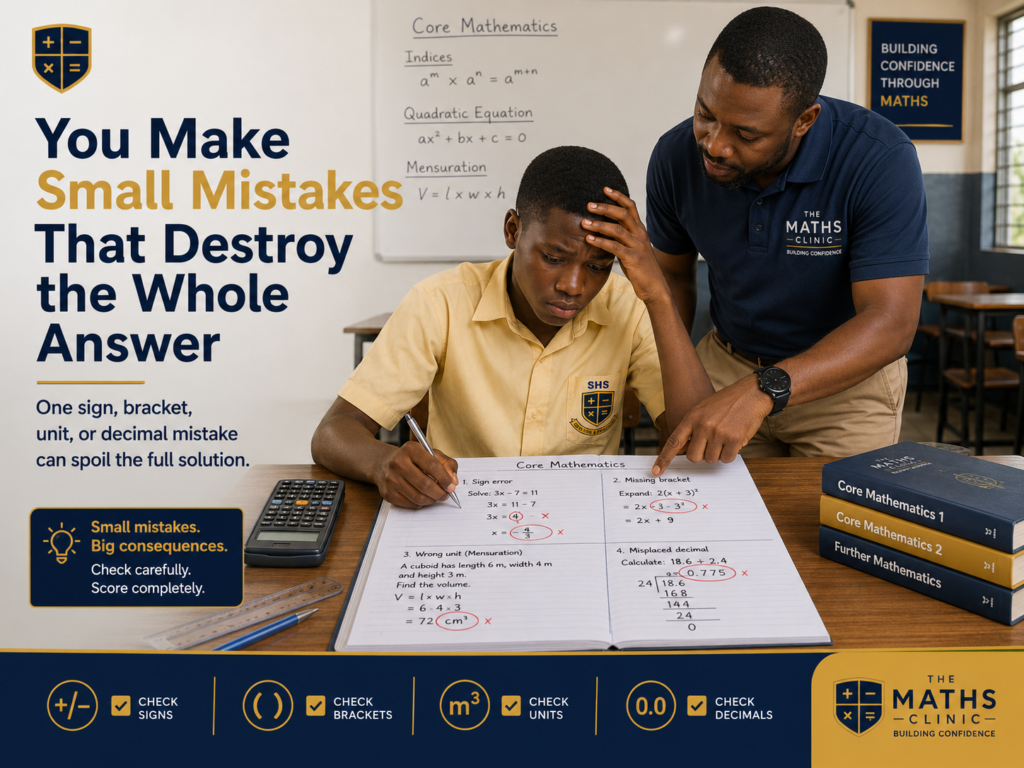
6. You Make Small Mistakes That Destroy the Whole Answer
Some learners understand the general method but lose marks because of small mistakes. They copy the question wrongly, change signs wrongly, forget units, round too early, or use the wrong value from a table.
Why this happens
This happens when the learner does not have a strong checking habit. It can also happen when basic skills are not automatic. The learner uses too much energy on simple steps and loses focus on the main idea.
The hidden gap
The hidden gap may be arithmetic weakness, sign weakness, poor organization, or weak exam discipline.
How this helps a struggling learner understand Core Maths better
This helps the learner because it shows that confidence is not built only by learning new topics. It is also built by reducing avoidable mistakes. After solving, check signs, units, substitution, and final answer. Small corrections can protect many WASSCE marks.
7. You Feel Fine With Direct Questions But Struggle With Word Problems
A learner may solve “Find 25% of 80” but struggle when the same idea is placed inside a story about profit, loss, discount, or interest.
Why this happens
This happens because word problems require translation. The learner must turn English into mathematics before calculation can begin.
The hidden gap
The hidden gap may be a weak reading of mathematical language. Words like “of,” “per annum,” “less than,” “more than,” “remaining,” “discount,” and “total amount” carry mathematical meaning.
How this helps a struggling learner understand Core Maths better
This helps the learner understand Core Maths better because it teaches the learner to slow down. First, understand the story. Second, identify what is given. Third, identify what is being asked. Fourth, choose the topic. Then solve.
8. You Give Up Quickly After One Wrong Attempt
A learner with low maths confidence may stop after one wrong attempt. The learner says, “I knew I could not do it,” and closes the book.
Why this happens
This happens when wrong answers are seen as proof of failure instead of evidence for diagnosis. The learner does not know how to learn from mistakes.
The hidden gap
The hidden gap may be a lack of a correction strategy. The learner may not know how to compare the wrong method with the correct method.
How this helps a struggling learner understand Core Maths better
This helps the learner because it changes the meaning of mistakes. A wrong answer is not the end. It is a clue. It can show whether the gap is a formula, signs, interpretation, substitution, or calculation. Once the gap is named, the learner can practice the exact skill again.
What WAEC-Style Questions Reveal
WASSCE Core Maths does not only test whether a learner can remember a formula. It often tests whether the learner can read carefully, choose the correct method, apply the method, and avoid common traps.
That is why hidden gaps show quickly in WASSCE-style questions. A learner may know the formula for simple interest, but if the learner does not change months to years, the answer will be wrong. A learner may know how to draw a graph, but if the scale is poor, the graph will not communicate properly.
This is why The Maths Clinic focuses on diagnosis. When a learner sees where marks are being lost, the learner can repair the foundation before the final examination.
Worked Example: How a Hidden Gap Can Affect Confidence
Question
Solve: 5x – 4 = 21
A learner with low confidence may look at this and say, “I do not understand algebra.” But let us diagnose the real issue.
Common wrong approach
5x – 4 = 21
5x = 21 – 4
5x = 17
x = 17/5
The learner may feel bad because the answer does not look neat. But the mistake is not the whole of algebra.
Correct method
5x – 4 = 21
Add 4 to both sides:
5x = 21 + 4
5x = 25
Divide both sides by 5:
x = 5
Diagnosis
The hidden gap is inverse operations. The learner did not understand that -4 must be removed by adding 4 to both sides.
Once this gap is fixed, many similar algebra questions become easier. The learner’s confidence improves because the learner now knows the real problem and how to correct it.
Common Wrong Approach to Low Maths Confidence
Many learners handle low maths confidence in the wrong way. They say, “I will just read more.”
Reading more is not bad, but reading without diagnosis may not solve the problem. If the weakness is signs, reading the whole chapter again may not fix it. If the weakness is word interpretation, copying more examples may not fix it.
Another wrong approach is avoiding practice because mistakes feel painful. But without practice, the hidden gap remains hidden.
The correct approach is to use mistakes as evidence. Every wrong answer should tell you something about your foundation.
Correct Method: Rebuild Confidence by Fixing the Hidden Gap
Use this simple Maths Clinic method:
- Step 1: Choose one weak topic, not the whole of mathematics.
- Step 2: Solve five questions without looking at the solution.
- Step 3: Mark your work and circle where the mistake entered.
- Step 4: Name the mistake clearly: sign error, formula error, interpretation error, substitution error, unit error, or calculation error.
- Step 5: Revise the small foundation skill behind that mistake.
- Step 6: Try another WASSCE-style question to test whether the gap is closing.
This method builds confidence slowly but properly. The learner no longer depends on hope. The learner can see progress in the exact area that used to cause fear.
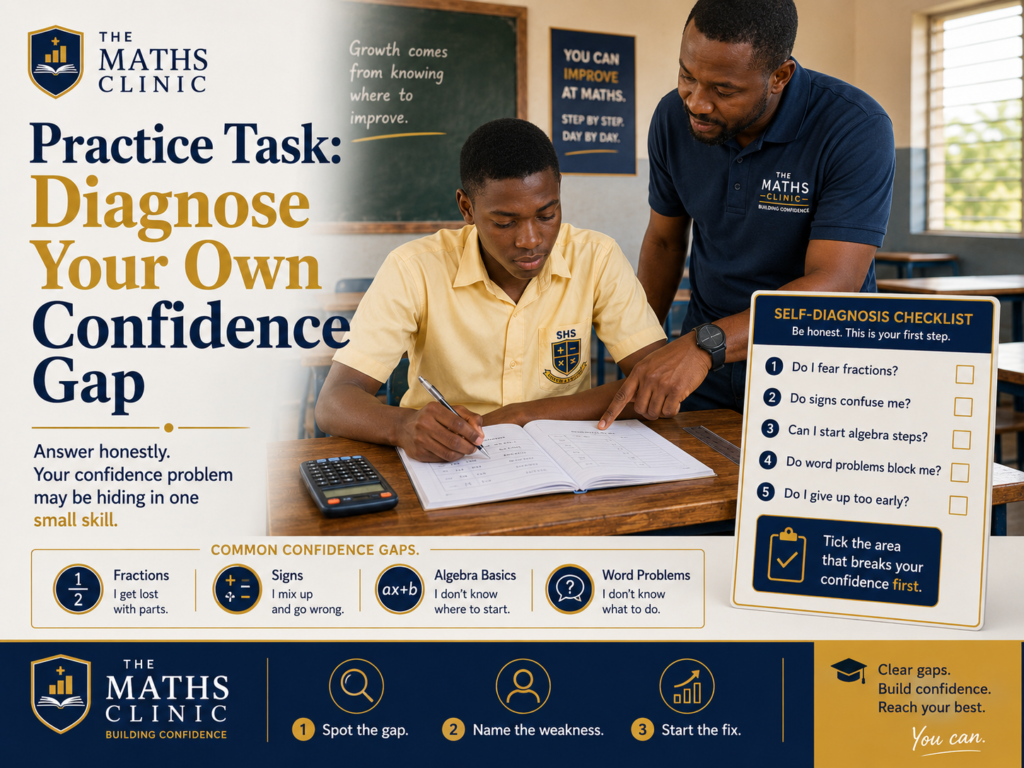
Practice Task: Diagnose Your Own Confidence Gap
Try these questions. After each one, do not only check whether the answer is right. Write down the gap if you make a mistake.
Algebra
Solve: 4x + 6 = 30
Diagnosis question: Did you handle the operation affecting x correctly?
Percentages
A student scored 36 marks out of 60. Express the score as a percentage.
Diagnosis question: Did you compare the part to the correct whole?
Simple Interest
Find the simple interest on GH₵900 at 10% per annum for 6 months.
Diagnosis question: Did you change 6 months into years?
Graphs
Find the gradient of the line joining (2, 5) and (6, 13).
Diagnosis question: Did you subtract the coordinates in the correct order?
Word Problem
The sum of two numbers is 42. One number is 8 more than the other. Find the numbers.
Diagnosis question: Did you translate the words into an equation?
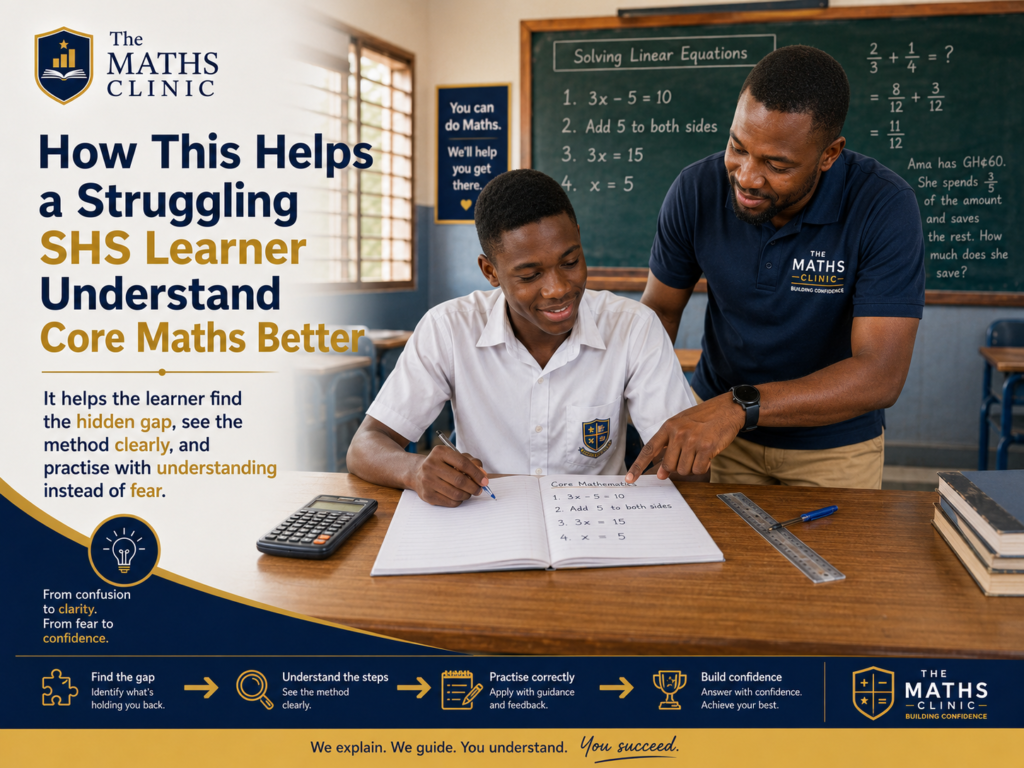
How This Helps a Struggling SHS Learner Understand Core Maths Better
This post helps a struggling SHS learner understand Core Maths better because it separates confidence from foundation.
A learner may think, “I cannot do Maths,” when the real issue is one hidden gap. Once that gap is found, the learner can repair it and begin again with more clarity.
It also helps the learner stop revising blindly. Instead of reading all topics in fear, the learner can focus on the exact mistake that keeps reducing marks.
Most importantly, it teaches the learner that wrong answers can be useful. A wrong answer can show the teacher and the learner where the foundation is weak.
That is how Core Maths becomes clearer. Not by shame. Not by fear. Not by guessing. But by diagnosis, correction, and steady practice.
Final Advice Before WASSCE
If your maths confidence is low, do not conclude that you are finished.
Low confidence may be a signal that your foundation needs attention. The earlier you diagnose the hidden gap, the earlier you can fix it.
Start with one topic. Solve a few questions. Check your mistakes. Name the weakness. Fix the missing skill. Practice again.
This is how confidence returns.
At The Maths Clinic, we believe that a weak learner is not a useless learner. A weak learner may only need the right diagnosis, the right correction, and the right practice.
You do not need to guess your way through WASSCE Core Maths. You need to find the gap, fix the gap, and build your confidence one step at a time.
Related Post