Struggling with WASSCE Maths? Stop guessing. Let’s fix the gap step by step.
Number Skills Clinic
Rebuild the number skills under every WASSCE topic: negatives, fractions, order of operations, indices, standard form and surds.
Many learners who “can’t do” algebra, percentages or graphs are actually stuck one level lower: on negatives, fractions, decimals, powers or order of operations. Those number skills sit under almost every WASSCE Mathematics question, and when one of them is shaky, a correct method still produces a wrong answer.
The Number Skills Clinic rebuilds them one at a time. Each lesson names one skill, shows the mistake examiners see most, explains the idea behind it, and gives you practice with answers so you can check yourself.
What you’ll be able to do by the end
- Handle negatives, fractions and decimals without fear
- Use order of operations to read any expression correctly
- Apply the laws of indices, including zero, negative and fraction powers
- Write and read numbers in standard form, and tell decimal places from significant figures
- Simplify surds and rationalise denominators
- Estimate first, so you can tell when an answer is wrong
Number skills in one page
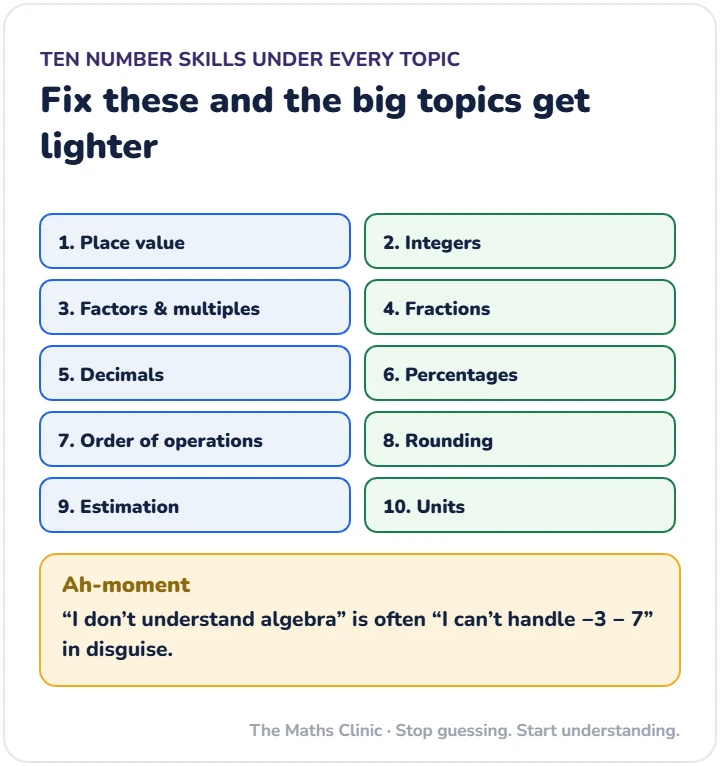
1. Place value and the number foundation
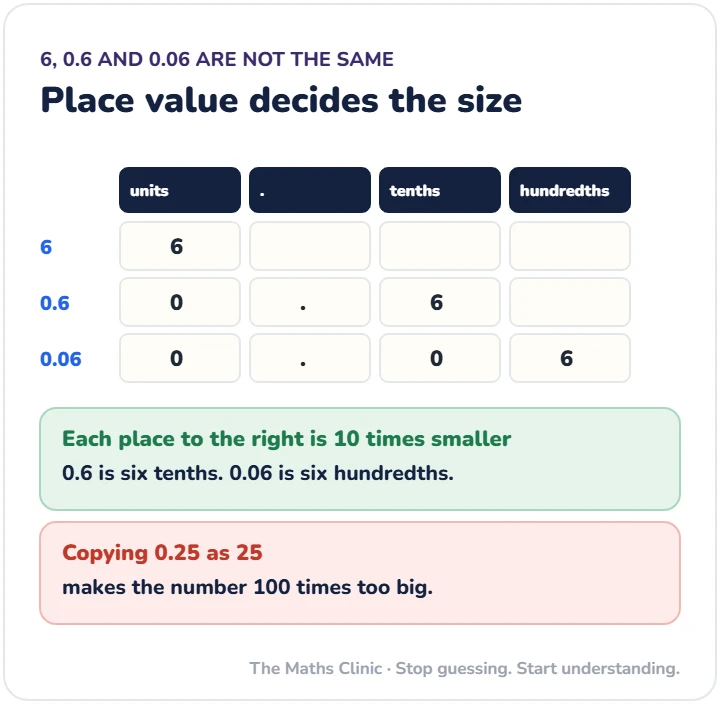
Know how big a number is before you do anything with it. Each place to the right is ten times smaller, so 0.6 and 0.06 are very different numbers.
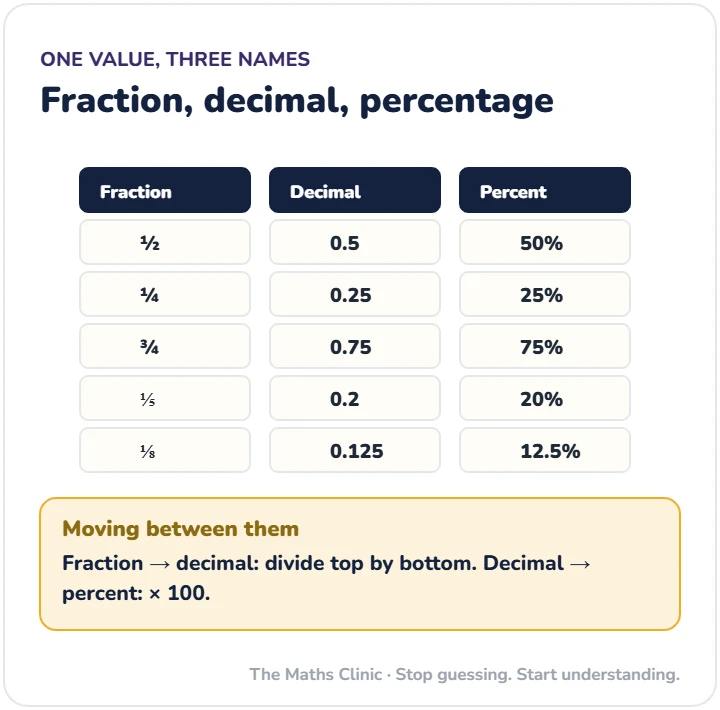
2. Fractions, decimals and percentages
These are three names for the same value. Only same-sized pieces can be added, and “of” means multiply.
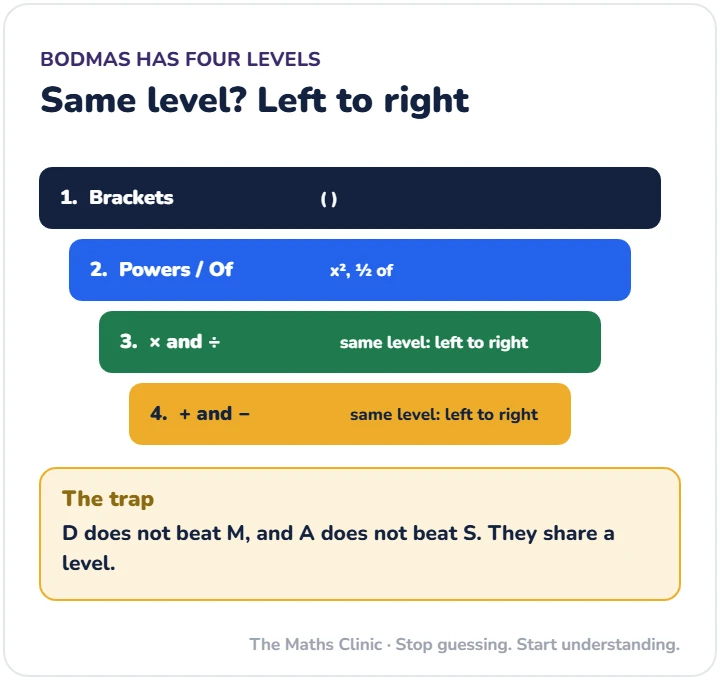
3. Order of operations
Brackets, then powers, then × and ÷ from left to right, then + and − from left to right. Division does not always come before multiplication: they share a level.
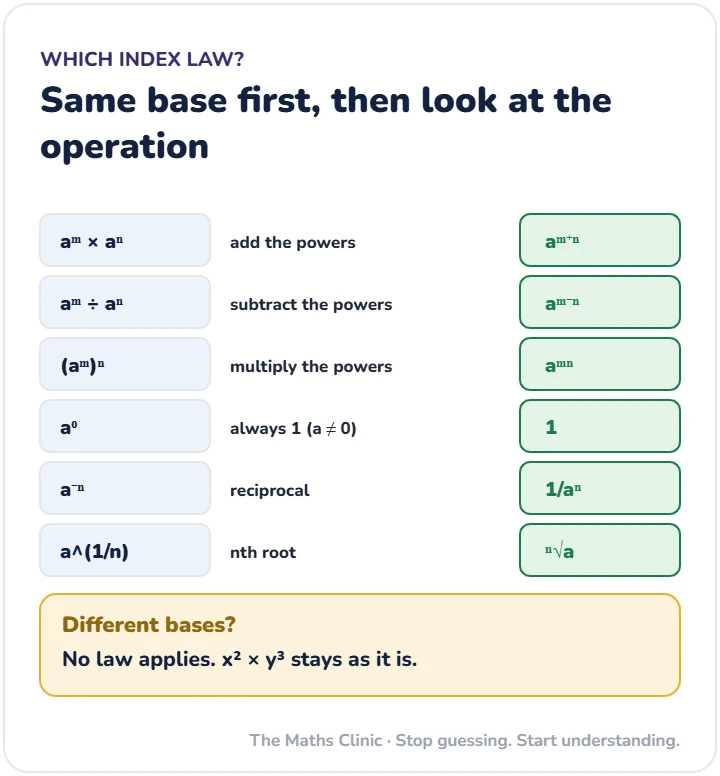
4. Indices
Check the base first, then let the operation choose the law. A negative power means reciprocal, never a negative answer.
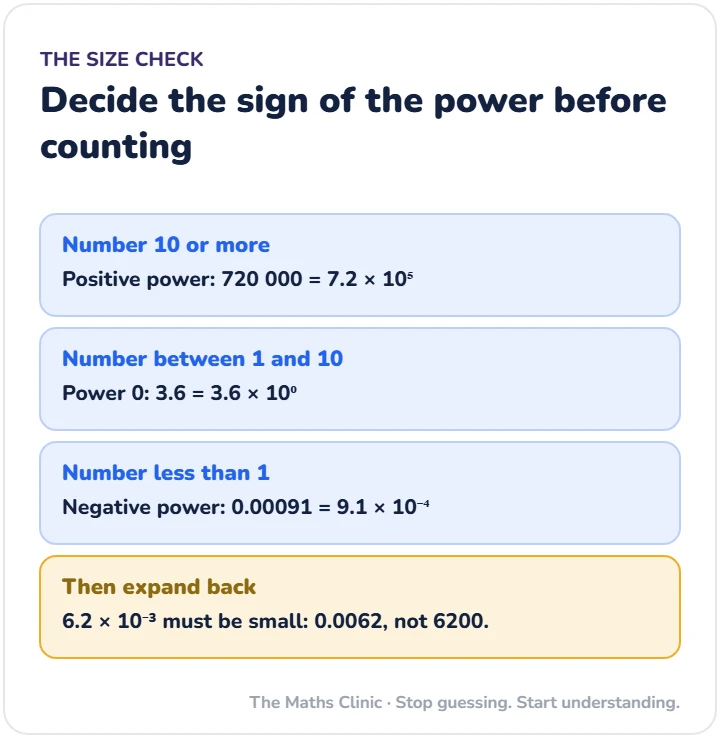
5. Standard form and powers of ten
The first number sits between 1 and 10; the power carries the size. Decide whether the number is big or small before you count the hops.
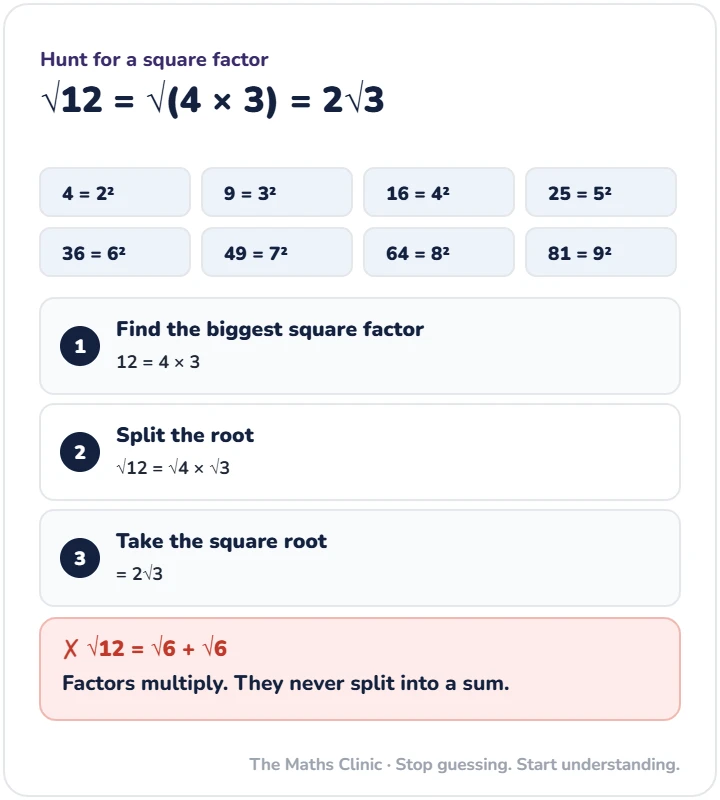
6. Surds
Find the biggest square factor, simplify, and combine only like surds. To rationalise, multiply by a form of 1.
The lessons
The first Number Skills lessons go live on 14 December, one a day.
Practise as you go
After each lesson, try mixed questions in the Practice Zone. Not sure which skill is weak? Start with Find Your Maths Gap.
The number mistakes examiners see most
| Mistake | Fix |
|---|---|
| 3 + 4 × 2 = 14 | Multiply before adding: 11 |
| ½ + ⅓ = 2/5 | Same-sized pieces first: 5/6 |
| 2⁻³ = −8 | Negative power means reciprocal: 1/8 |
| 56 × 10³ called standard form | First number must be 1 to 10: 5.6 × 10⁴ |
| √9 + √16 = √25 | Roots do not add inside: 3 + 4 = 7 |
| Rounding halfway through | Round once, at the end |
Questions learners often ask
Is it too late to fix number skills in SHS 3?
No. Each skill can be repaired in days if you practise that exact skill and check your answers.
Which lesson should I start with?
If you are unsure, start with the number skills overview and the number foundation check. They show which skill to fix first.
Can I use a calculator?
Yes, to confirm your work. Estimate first and work the method yourself, then let the calculator check it.
This clinic is part of How to Pass WASSCE and NOVDEC Core Maths.
Sources and further reading
These lessons are built on what WAEC examiners report year after year, matched to Ghana’s SHS curriculum.
- WAEC Chief Examiner’s Reports: the yearly reports on where candidates lose marks
- NaCCA SHS curriculum: the official Ghana Senior High School curriculum
- Ghana curriculum resources: official teaching and learning resources

Written by
Dickson Sarpong
NTC-certified SHS Mathematics teacher in Ghana with WAEC marking experience, and author of The Bridge Series textbooks. Every lesson here is built around the mistakes WAEC examiners keep reporting.
About DicksonStuck? Ask a question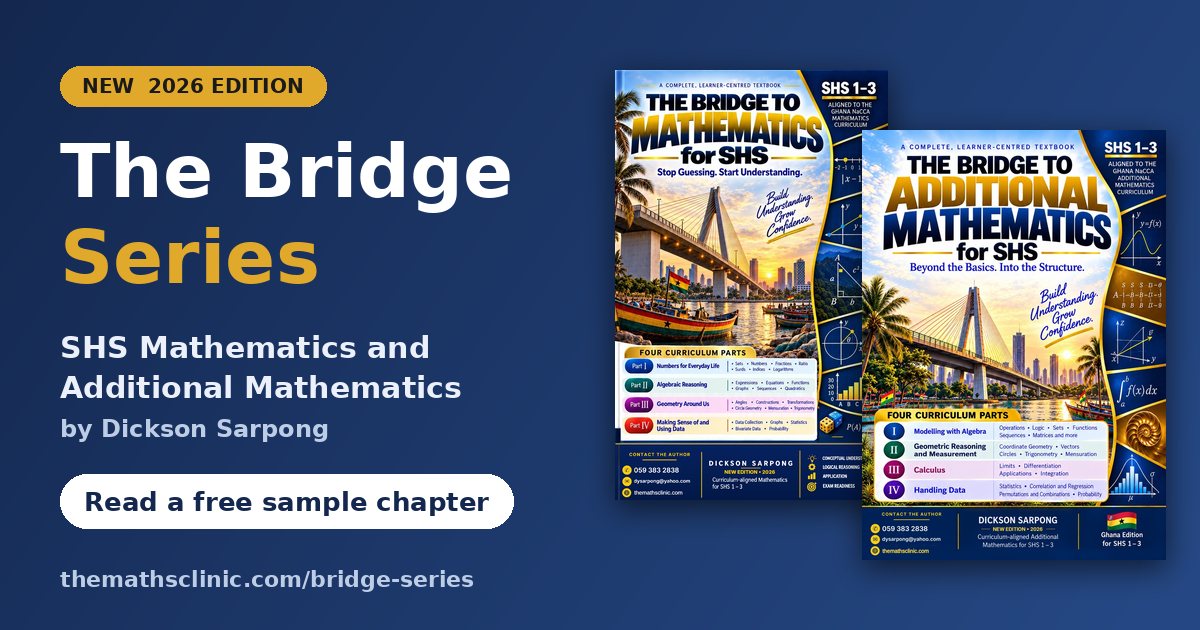
Want the whole topic, step by step? My textbooks, The Bridge to Mathematics and The Bridge to Additional Mathematics for SHS, follow the new curriculum and rebuild the basics as you go.
Read a free chapter →