Struggling with WASSCE Maths? Stop guessing. Let’s fix the gap step by step.

Percentages in Core Maths: 6 Common Mistakes to Avoid

Percentages in Core Maths are treated like one of the “easy” topics in many Ghanaian SHS classrooms. The teacher writes a few examples on the board, the class follows, and many learners feel comfortable.
But when WASSCE brings percentages inside profit and loss, simple interest, depreciation, statistics, probability, graphs, or word problems, the same learners begin to lose marks. The issue is not always that the learner does not know the formula. Often, the learner does not know what the percentage is being compared to.
That is the hidden trap in percentages. A percentage is never standing alone. It is always a part compared to a whole. Once the learner chooses the wrong whole, the answer becomes wrong even if the calculation looks neat.
This Maths Clinic post will help learners diagnose six common percentage mistakes, understand why those mistakes happen, and correct them step by step before WASSCE.
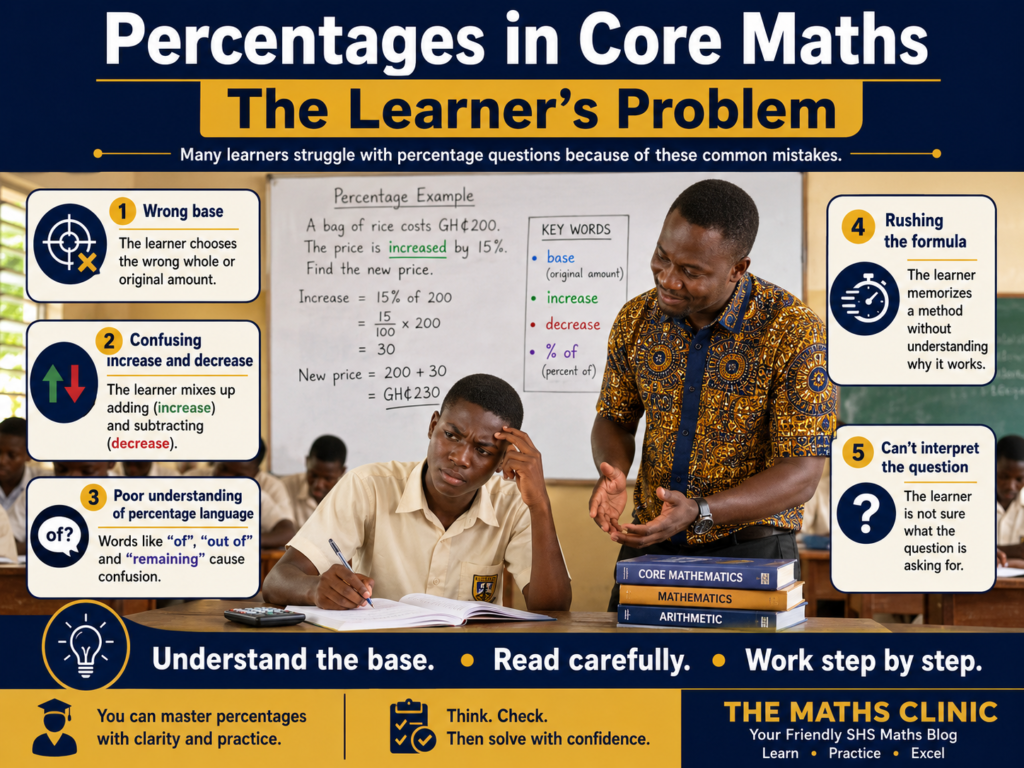
1. The Learner’s Problem
The learner may know that “percentage” means “out of 100,” but the problem starts when the question is no longer direct.
- The learner can change 25% to 25/100 but cannot use it correctly in a word problem.
- The learner knows the formula for percentage profit, but uses the selling price instead of the cost price.
- The learner can calculate 10% of a number, but becomes confused when the question says “increased by 10%.”
- The learner subtracts percentages directly, even when the bases are different.
- The learner rounds too early and loses accuracy.
- The learner sees percentage, fraction, decimal, ratio, and money in one question and starts guessing.
In simple words, the learner knows some percentage facts but does not yet understand percentage thinking.
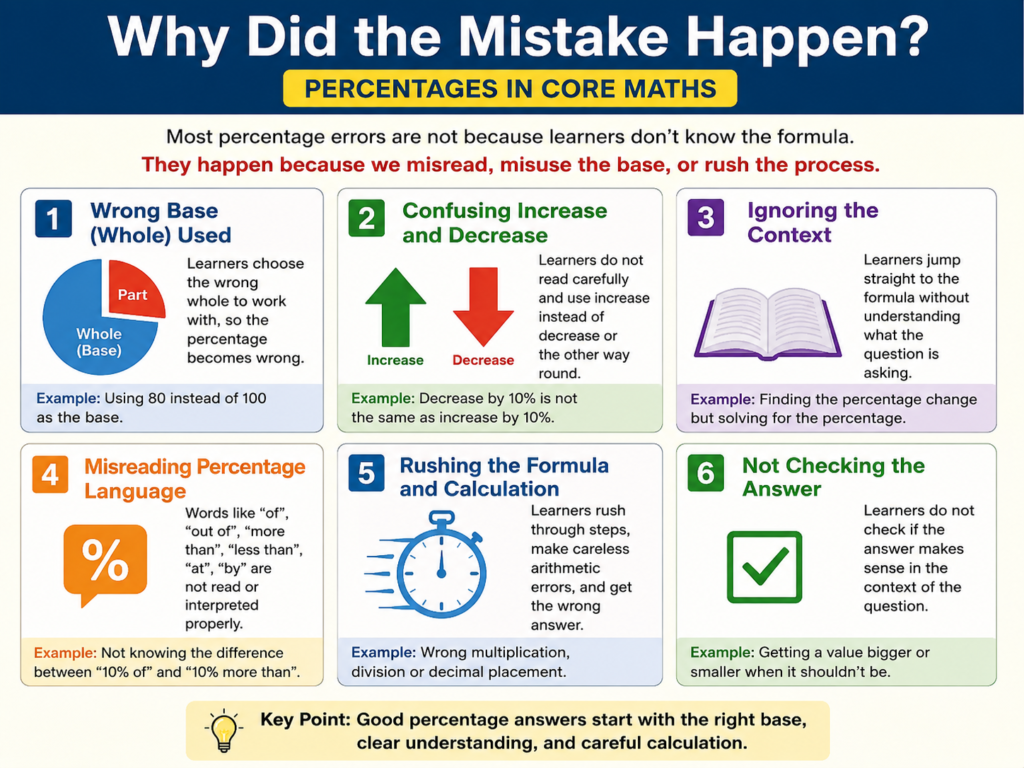
2. Why Did the Mistake Happen?
Most percentage mistakes happen because the learner has not been trained to ask one important question:
“Percentage of what?”
This question is very important. In percentage work, the word “of” points to the base or original quantity. If the base is wrong, the whole answer becomes wrong.
The Hidden Gap
- Weak fraction understanding: The learner does not see that 35% means 35/100.
- Weak decimal understanding: The learner cannot easily connect 0.35 to 35%.
- Weak reading skill: The learner misses words like “increase,” “decrease,” “profit,” “loss,” “original,” “new,” and “remaining.”
- Weak algebra skills: The learner struggles when the original amount is unknown.
- Poor exam habit: The learner rushes to multiply or divide before identifying the base.
3. What WAEC or the Curriculum Reveals
WASSCE Core Mathematics does not test percentages only as a separate topic. It often hides percentage thinking inside other topics.
Where Percentages Commonly Appear
- Profit and loss
- Simple interest and compound interest
- Discount and commission
- Depreciation and appreciation
- Statistics and data interpretation
- Probability
- Ratios and proportions
- Graphs and real-life applications
- Word problems involving money, population, marks, and measurements
The curriculum direction also expects learners to reason, interpret, apply, and explain. So the learner must go beyond memorizing “percentage equals something over something times 100.” The learner must know what each value means in the question.
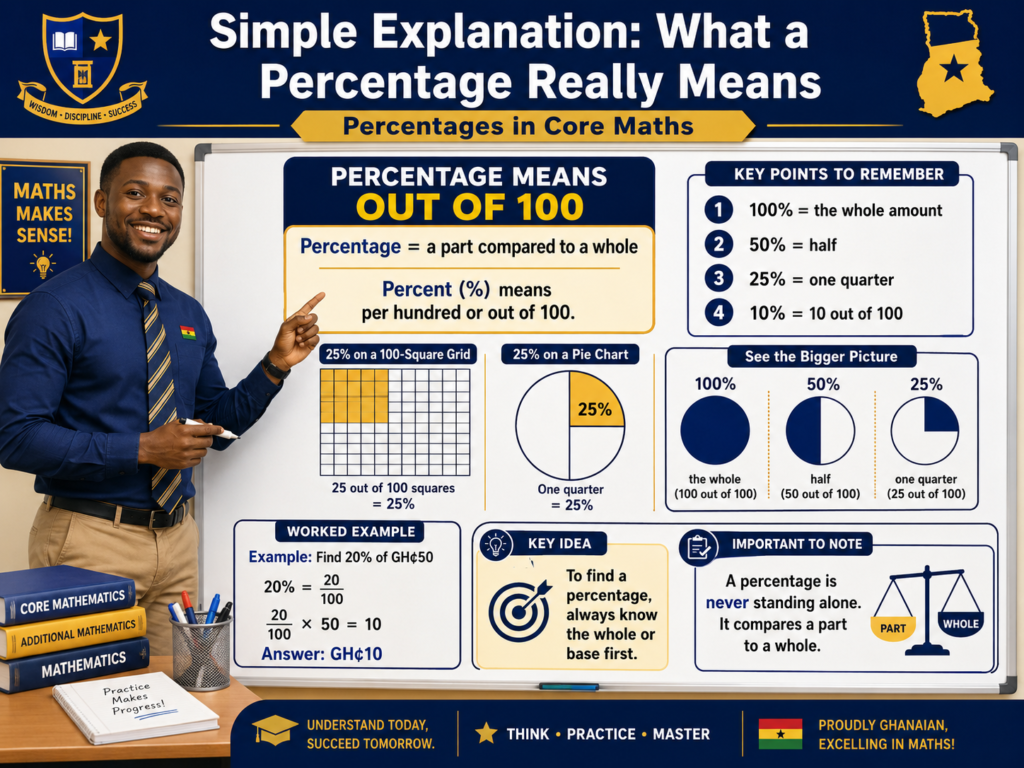
4. Simple Explanation: What a Percentage Really Means
A percentage is a way of comparing a part to a whole using 100 as the standard whole.
Percentage = (Part / Whole) × 100%
This means the whole is the base. The base is the quantity you are comparing against.
Simple Ghanaian Classroom Example
Suppose 12 students out of 40 students passed a short test.
Percentage passed = (12 / 40) × 100%
= 30%
Here, 40 is the whole class. That is why 40 is the denominator. If a learner uses 12 as the denominator, the thinking is already wrong.
5. Worked Example
Example: Percentage Increase
The price of a scientific calculator increased from GH₵80 to GH₵100. Find the percentage increase.
Step 1: Identify the Original Amount
The original price is GH₵80. This is the base because the increase is compared to the starting price.
Original amount = GH₵80
Step 2: Find the Increase
Increase = New amount – Original amount
Increase = 100 – 80 = GH₵20
Step 3: Use the Percentage Increase Formula
Percentage increase = (Increase / Original amount) × 100%
= (20 / 80) × 100%
= 25%
Final Answer
Percentage increase = 25%
6. Common Wrong Approach
A common wrong approach is to divide the increase by the new price instead of the original price.
Wrong method: (20 / 100) × 100% = 20%
This answer is wrong because the increase did not start from GH₵100. The calculator first cost GH₵80. So the increase must be compared to GH₵80, not GH₵100.
The Mark-Loss Reason
The learner used the wrong base. In percentage increase, the base is the original amount.
7. Correct Method
The correct method is to read the question slowly and identify the base before calculating.
- Ask: What is the original amount?
- Find the change. To increase, subtract the old amount from the new amount.
- Place the change over the original amount.
- Multiply by 100%.
- Check whether your answer makes sense.
Percentage increase = (Increase / Original amount) × 100%
Percentage decrease = (Decrease / Original amount) × 100%
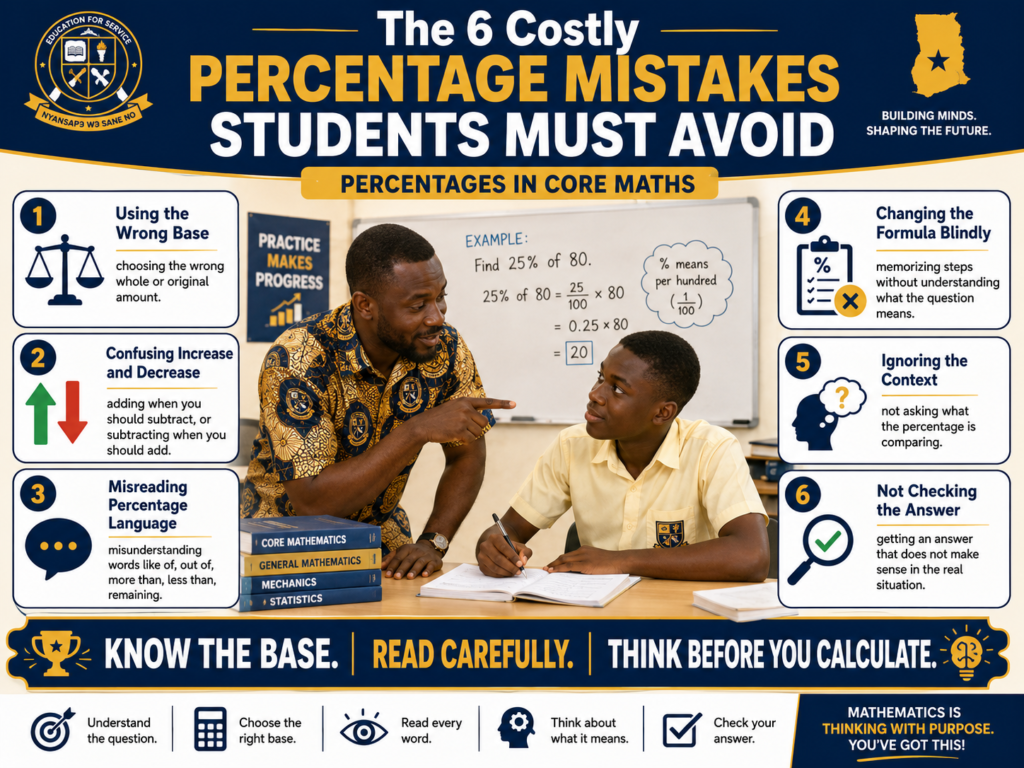
8. The 6 Costly Percentage Mistakes Students Must Avoid
Mistake 1: Using the Wrong Base
Why it happens: This happens when the learner uses the final amount instead of the original amount. It is common in percentage increase, percentage decrease, profit, and loss.
How to correct it: Always ask: “Compared to what?” The answer to that question is usually the base.
Mistake 2: Confusing Percentage Increase with Percentage of a Number
Why it happens: Finding 20% of GH₵500 is not the same as increasing GH₵500 by 20%.
How to correct it: First, find the percentage amount, then add it to the original amount when the question says “increase by.”
Mistake 3: Confusing Percentage Decrease with Subtraction of Percentages
Why it happens: If a price is reduced by 15%, the new price is not simply “15.” You must find 15% of the original amount and subtract it.
How to correct it: “Decrease” means removing that percentage value from the original amount.
Mistake 4: Using Profit or Loss Formula Without Understanding the Terms
Why it happens: Some learners know the formula but cannot identify the cost price, the selling price, profit, and loss from the question.
How to correct it: Profit is the selling price minus the cost price. Loss is the cost price minus the selling price. The percentage profit or loss is compared to the cost price.
Mistake 5: Rounding Too Early
Why it happens: Some learners round values in the middle of the work and get a final answer that is slightly wrong.
How to correct it: Keep enough decimal places during calculation. Round only at the final stage unless the question gives a specific instruction.
Mistake 6: Ignoring Units and Context
Why it happens: A learner may calculate correctly but fail to attach the percentage sign or misread money, marks, population, or measurements.
How to correct it: Write the unit clearly where needed, and remember that percentage answers must carry the percent sign.
9. Practice Task
Try these questions before checking the solutions. Do not rush. First, identify the base.
- A textbook costs GH₵60. Its price has increased by 20%. Find the new price.
- A school bag was bought for GH₵150 and sold for GH₵180. Find the percentage profit.
- A class has 45 students. If 18 are girls, what percentage of the class are girls?
- The population of a town decreased from 8,000 to 7,200. Find the percentage decrease.
- A phone originally costs GH₵1,500. It is sold at a discount of 12%. Find the selling price.
Practice Task Solutions
Solution 1
Original price: GH₵60
Increase: 20% of 60 = 0.20 × 60 = GH₵12
New price: 60 + 12 = GH₵72
Final answer: GH₵72
Solution 2
Cost price: GH₵150
Selling price: GH₵180
Profit: 180 – 150 = GH₵30
Percentage profit: (30 / 150) × 100% = 20%
Final answer: 20%
Solution 3
Girls: 18
Total class: 45
Percentage of girls: (18 / 45) × 100% = 40%
Final answer: 40%
Solution 4
Original population: 8,000
New population: 7,200
Decrease: 8,000 – 7,200 = 800
Percentage decrease: (800 / 8,000) × 100% = 10%
Final answer: 10%
Solution 5
Original price: GH₵1,500
Discount: 12% of 1,500 = 0.12 × 1,500 = GH₵180
Selling price: 1,500 – 180 = GH₵1,320
Final answer: GH₵1,320
10. Link to Practice Zone or Intervention Hub
If you missed any of the practice questions, do not just mark yourself wrong and move on. Look at the type of mistake you made.
- If you used the wrong denominator, visit the Practice Zone for percentage-based questions.
- If you are confused about increasing and decreasing, go to the Intervention Hub and revise the percentage change.
- If you struggled with the wording, practice word problems under WASSCE Maths Practice.
- If you made a profit and loss error, revise the cost price, the selling price, the profit, and the loss before attempting more questions.
FAQ: Percentages in Core Maths
Why do students fail percentage questions in WASSCE Core Maths?
Many students fail because they use the wrong base, misread increase and decrease, confuse profit and loss, or rush into calculation without understanding the question.
What is the most important rule in percentages?
The most important rule is to identify the whole or original amount. A percentage always compares a part to a whole.
Why is the cost price used in percentage profit?
Cost price is used because profit is measured against the amount used to buy the item. The selling price is not the basis for the percentage profit.
How can weak students improve in percentages?
They should practice fractions, decimals, percentages of a number, percentage increases, percentage decreases, and word problems step-by-step. They should also write full works instead of guessing.
Conclusion: Percentages Become Easier When the Base Is Clear
Percentages in Core Maths are not difficult because the topic is too big. Many learners struggle because they do not identify the correct base before calculating.
In the classroom, when a learner asks, “Sir, should I divide by the old one or the new one?” that question is a sign that the learner is close to understanding the real issue. The answer depends on what the question is comparing.
For percentage increase, percentage decrease, profit, loss, discount, and interest, do not rush. Read the question. Identify the original amount. Find the change or required part. Then use the correct formula.
Once the base is clear, the percentage question becomes lighter. The learner stops guessing and starts understanding. That is the Maths Clinic way.