Struggling with WASSCE Maths? Stop guessing. Let’s fix the gap step by step.

What Teachers Notice About Weak Mathematics Students

In many Ghanaian SHS classrooms, a mathematics teacher can notice a struggling learner even before the test results come. It may not be because the learner is noisy, lazy, or unwilling to learn. Sometimes, the learner is quiet, respectful, punctual, and even writes neatly. But the way the learner opens the exercise book, copies from the board, avoids questions, hides the answer, or waits for others to solve first tells the teacher that something is wrong.
At The Maths Clinic, the phrase “weak mathematics students” is not used to insult learners. It is used to describe a learning condition that needs attention. A weak mathematics student is not a finished student. It simply means there are gaps, habits, fears, or misunderstandings blocking progress.
Many weak mathematics students are not refusing to learn. Some are avoiding embarrassment. Some have failed so many times that they now protect themselves by staying silent. Others have carried small gaps from JHS into SHS, and those gaps now appear in algebra, word problems, graphs, mensuration, statistics, and WASSCE Core Mathematics questions.
This post explains what teachers usually notice about weak mathematics students in Ghanaian SHS classrooms. The aim is not to shame learners. The aim is to help teachers, parents, and students identify the warning signs early and correct them patiently.
The Learner’s Problem: Present in Class, but Not Fully Learning
A struggling learner may attend class, sit quietly, and copy everything from the board. From a distance, the student looks serious. But when the teacher checks closely, the real problem appears.
The learner may not be following the explanation. The learner may not know why the steps are moving that way. The learner may be copying symbols without understanding their meaning. The learner may be waiting for the final answer so that it can be written neatly in the exercise book.
This is one reason some Ghanaian SHS students look prepared during lessons but perform poorly during class exercises, end-of-semester exams, mock exams, and WASSCE Core Mathematics. The learner is not always absent from class. Sometimes, the learner is absent from understanding.
Why the Mistake Happens: Many Students Hide Their Confusion
In mathematics, confusion can be embarrassing. A learner may feel that everybody else understands the topic. Because of that, the learner may pretend to understand instead of asking for help.
This is common in topics such as fractions, percentages, algebra, simultaneous equations, bearings, graphs, and word problems. The teacher may ask, “Do you understand?” and the whole class will answer, “Yes, sir.” But deep down, some students are lost.
Some learners hide their confusion because they fear being laughed at. Some do not want the teacher to call them weak. Some have asked questions before and were embarrassed. Some do not even know how to explain what they do not understand. Some believe maths is only for brilliant students. Some have failed for so long that they now expect failure before trying.
This is why classroom habits matter. A teacher who understands the signs can diagnose the learner before the learner completely gives up.
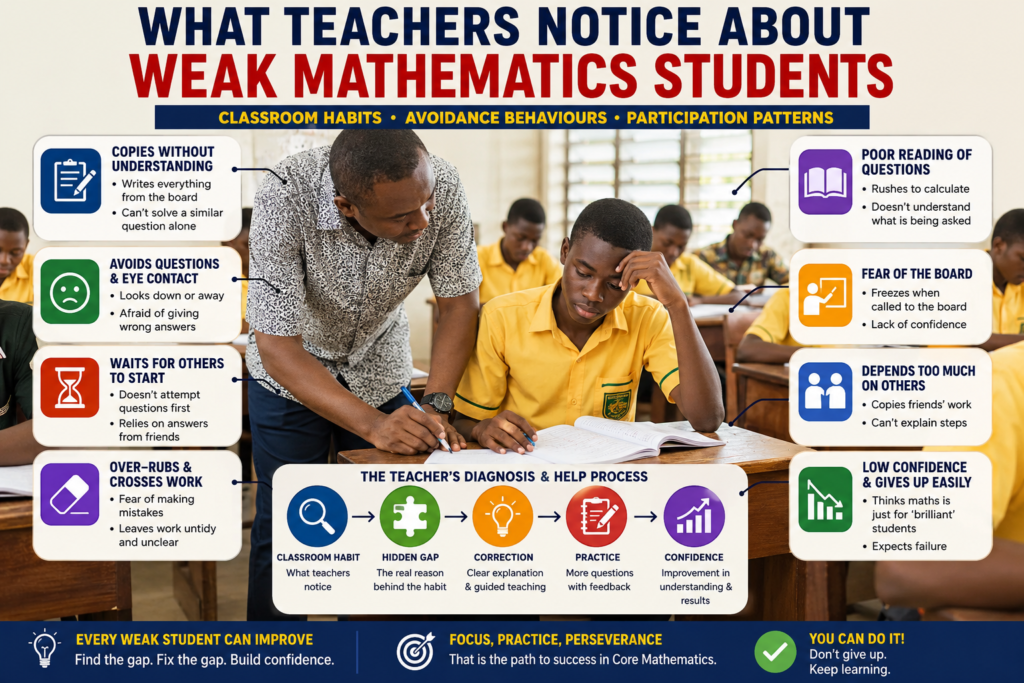
What Teachers Notice About Weak Mathematics Students
1. Copying Without Thinking
One common habit teachers notice among weak mathematics students is copying without thinking. The learner writes everything on the board. The notes may even look neat. But if the teacher changes the example slightly and asks the learner to solve, the learner becomes stuck.
For example, the teacher solves 3x + 4 = 19. Then the teacher asks the learner to solve 5x – 7 = 18. The learner may not know what to do because the learner copied the movement of the solution but did not understand the reason behind each step.
This habit often reveals memorizing without understanding. To help, the teacher should pause after each major step and ask, “What did we do here?” “Why did the sign change?” “What does this number represent?” “What will happen if the question changes?” This moves the learner from copying to understanding.
2. Avoiding Eye Contact During Questions
In many classrooms, when the teacher starts asking questions, some students suddenly become very busy. They look into their books. They sharpen pencils. They pretend to search for a pen. They look down. They avoid eye contact.
This is not always disrespect. Sometimes it is fear. The learner is thinking, “Please do not call me.” The learner may know part of the answer but is afraid of saying it wrong. Over time, this behavior becomes a habit. The student learns how to hide instead of learning how to try.
A better approach is low-pressure questioning. Instead of calling the learner suddenly to solve a full question, the teacher can ask for a small part: “What is the first thing we must find?” “Which formula may help us?” “What is the cost price in this question?” Small questions can help weak mathematics students participate without panic.
3. Waiting for Others to Start
Some struggling SHS maths students do not begin class exercises immediately. They wait for the teacher to solve the first one. They wait for a friend to write something. They wait for the class prefect to begin. They wait for the answer to move around the room.
This waiting habit is dangerous because mathematics improves through personal attempts. A learner who always waits for others may never discover the exact gap in his or her own understanding.
For example, if the question says, “A bag was bought for GH₵80 and sold for GH₵100. Find the percentage profit.” A confident learner may begin by finding the profit. A struggling learner may sit and wait because the learner is not sure whether to divide by GH₵80 or GH₵100. That small hesitation tells the teacher that the real gap may be understanding the base value in percentage profit.
4. Over-Rubbing and Cancelling Work Too Early
Some learners rub their work too often. They write one line, cancel it, write another, cancel again, and finally leave the page almost empty. This may look like carelessness, but sometimes it is fear of being wrong.
In mathematics, wrong working is useful because it shows the teacher where the learner’s thinking went off. But many weak mathematics students do not know this. They think a wrong attempt is shameful, so they hide the evidence.
A helpful classroom statement is “Do not hide the mistake. Let us see it so we can fix it.” This simple message can reduce fear and help learners become more open during correction.
5. Poor Participation in Mental Maths and Oral Questions
During mental maths or quick oral questions, weak learners often keep quiet. Some smile. Some look away. Some whisper to friends. Some say “I don’t know” before thinking. This is common when the class is dealing with multiplication facts, fractions, directed numbers, percentages, and simple algebra.
A learner who struggles with basic operations may find bigger topics very difficult. For example, if a learner still struggles with -3 + 7, then simplifying 3(x – 2) – 2(x + 4) will not be easy. The real issue is not only algebra. The hidden gap may be directed numbers and signs.
Teachers should not assume that SHS students have mastered all JHS basics. Sometimes, the best intervention is to rebuild the basics briefly before entering the main topic. A five-minute foundation drill can save a full lesson.
6. Choosing Only Easy Questions
Weak mathematics students often choose questions that look familiar. When given several practice questions, they may do the first one or two and avoid the ones with long sentences, diagrams, graphs, or unfamiliar wording.
This habit becomes a problem during WASSCE because the examination does not ask only comfortable questions. A learner must be trained to face unfamiliar questions calmly.
The better method is simple: read the question twice, underline key words, write what is given, write what is required, identify the topic, choose a method, and start with the part you understand. This helps learners stop guessing and start thinking.
7. Poor Question Reading
Many weak mathematics students start calculating before understanding the question. They see numbers and quickly add, subtract, multiply, or divide. But word problems in WASSCE Core Mathematics are not solved by rushing to use numbers. The learner must first understand the situation.
For example, the question says, “The sum of a number and 7 is 19. Find the number.” Some learners may write 7x = 19. This is wrong because “the sum of a number and 7” means x + 7, not 7x. The learner did not fail because of algebra only. The learner failed because of an interpretation.
Teachers should train students to translate words into mathematics. “Sum” may mean addition. “Difference” may mean subtraction. “Product” may mean multiplication. “Quotient” may mean division. “At least” and “not more than” also need careful inequality thinking.
8. Good Behaviour but Weak Independent Work
Some weak mathematics students are not troublesome. They are respectful, quiet, and punctual. But when they are asked to solve independently, they struggle.
This is why teachers must be careful. Good behavior is not the same as understanding. In Ghanaian classrooms, quiet students can easily be missed because attention often goes to noisy students. But some of the quiet learners are silently drowning.
Teachers can check understanding through short individual tasks. A two-minute question, such as “Find 15% of GH₵200” or “Write an equation for twice a number is 18,” can reveal a lot.
9. Fear of the Board
Many weak mathematics students fear going to the board. Once they are called, they may freeze. Some begin well but stop halfway. Others say, “Sir, I can’t,” before trying.
The board can feel like a public judgment space. Every mistake is visible. Every pause feels long. Every wrong answer can attract laughter. This fear can reduce participation and keep the learner weak for a long time.
Teachers can make board work more supportive by allowing partial answers, using pair work, praising correct steps, correcting calmly, and stopping classmates from laughing at wrong attempts. Board work should be diagnosis, not punishment.
10. Depending Too Much on Friends
Peer support is good, but over-dependence is dangerous. Some learners always sit near a stronger friend. During exercises, they copy quietly. During group work, they allow others to lead everything. During homework, they submit correct answers but cannot explain the method.
This creates false progress. The book looks correct, but the learner’s mind is not yet trained. Teachers can ask learners to explain one step from their own work: “Why did you divide by 100 here?” “Why did you subtract 4 from both sides?” “Why is the unit cm² and not cm?”
11. Poor Use of Mathematical Language
Weak mathematics students often use vague expressions such as “I did plus,” “I carried it there,” “I cancelled it,” or “That is how we do it.” These statements show that the learner may be following movement without understanding meaning.
Mathematics has language. Learners should gradually learn to say, “I subtracted the cost price from the selling price,” “I expanded the bracket,” “I collected like terms,” or “I used the scale 2 cm to 5 units.” The better the learner’s mathematical language becomes, the clearer the thinking becomes.
12. Poor Presentation and Mark-Loss Habits
Some learners understand part of the question but lose marks because of poor presentation. They do not write formulas. They skip steps. They omit units. They round wrongly. They scatter their work. They do not state the final answer clearly.
In WASSCE Core Mathematics, method matters. A learner can earn marks from correct steps even when the final answer is not perfect. But if the work is unclear, the examiner may not see the learner’s thinking.
For example, if a question asks for the area of a rectangle of length 12 cm and breadth 8 cm, writing only 12 × 8 = 96 is not the best presentation. A clearer solution is Area of rectangle = length × breadth; Area = 12 × 8; Area = 96 cm². Final answer = 96 cm².
13. Low Confidence After Repeated Failure
Some weak mathematics students have failed so many times that they no longer trust their own thinking. Even when they are right, they ask, “Sir, is it correct?” or “Madam, should I continue?” This shows a confidence gap.
Confidence is not built by motivation alone. It is built on repeated small successes. A learner who finally understands percentage profit may become more willing to try simple interest. A learner who understands sign rules may stop fearing algebra. Confidence grows when the learner sees the path.
14. Attendance Without Consistency
Some struggling learners attend school, but not consistently enough to build understanding. They may miss lessons because of sickness, distance, family duties, financial pressure, lateness, or other personal issues.
In mathematics, missing one lesson can affect the next three lessons. If a learner misses the expansion of brackets, solving linear equations becomes harder. If the learner misses percentages, profit and loss become harder. If the learner misses scale drawing, graphs, and bearings may suffer.
Teachers should avoid quick judgment. Instead of saying, “You are lazy,” it may be better to ask, “Which lesson did you miss?” “Which part did you not understand?” “Do you have the previous notes?”
15. Strong Effort but Wrong Strategy
Not every weak mathematics student is unserious. Some work hard but use the wrong method. They solve many past questions without correcting their mistakes. They memorize answers instead of understanding topics. They watch videos without practicing. They copy solutions without attempting first.
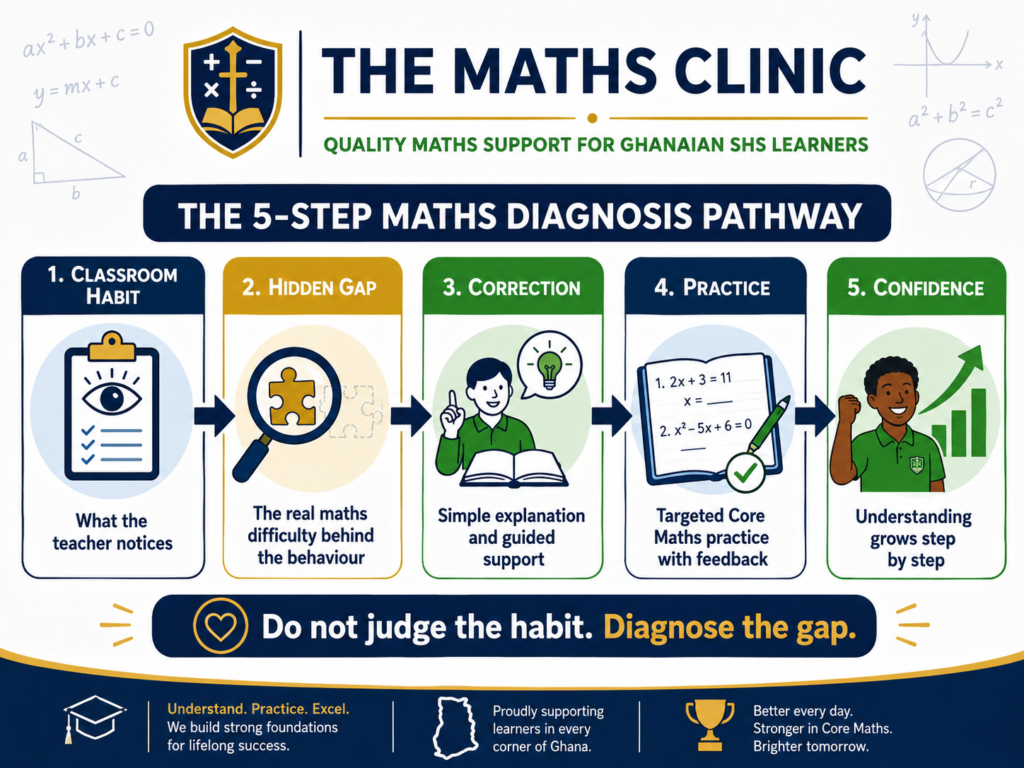
Past questions are useful, but past questions alone may not solve the problem if the learner keeps repeating the same Core Maths mistakes. The Maths Clinic approach is a wrong answer, hidden gap, simple explanation, correct method, guided practice, feedback, and improvement.
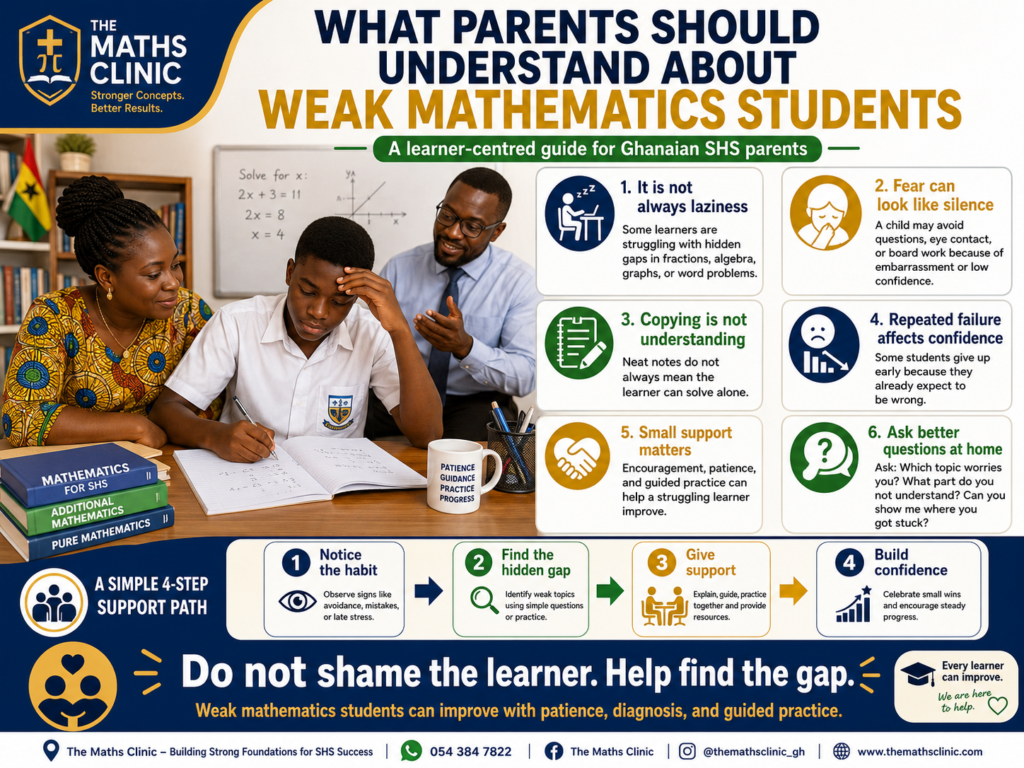
What Parents Should Understand About Weak Mathematics Students
Parents sometimes see poor mathematics results and conclude that the child is careless, lazy, or not serious. Sometimes that may be part of the issue, but it is not always the full story.
A learner may be struggling because of a weak foundation from JHS, fear of embarrassment, poor reading of questions, lack of confidence, missed lessons, language difficulty, poor study strategy, lack of guided practice, or repeated failure without proper correction.
Parents can help by asking better questions. Instead of asking only, “Why did you fail?” ask, “Which topics worry you most?” “Do you understand the corrections?” “Can you explain one mistake you made?” “Are you practicing with feedback?” This kind of support makes the learner more honest and less defensive.
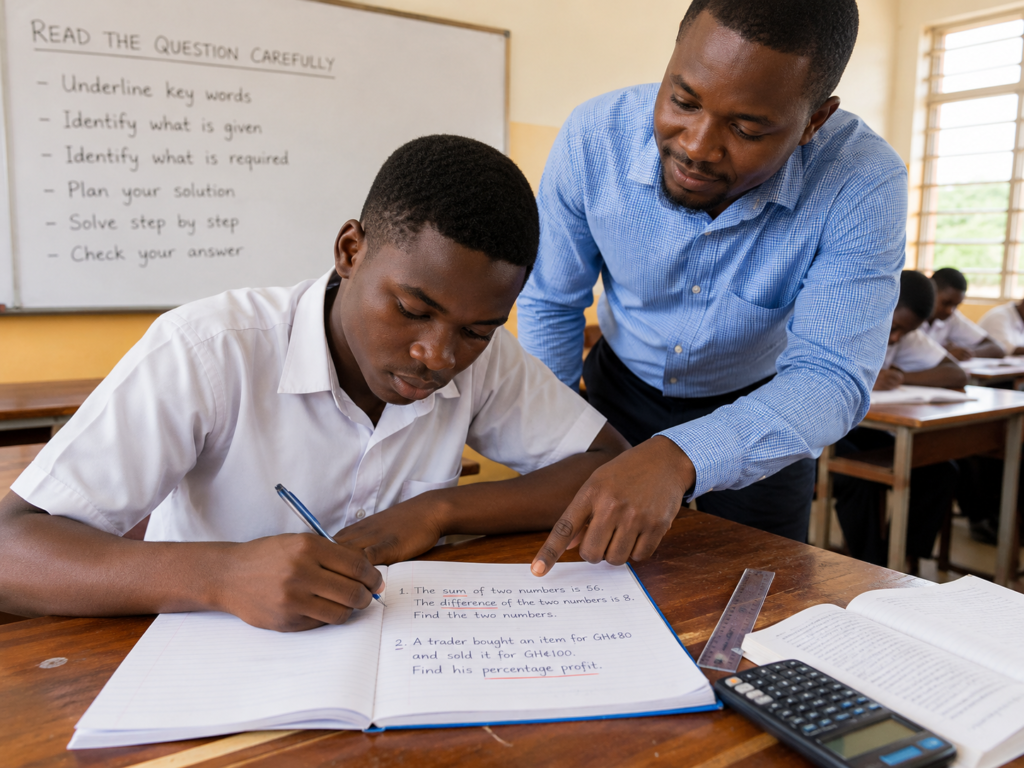
What Teachers Can Do Differently
A teacher cannot solve every problem in one lesson, but a teacher can create a classroom where weak learners are easier to diagnose and support. The goal is not to lower standards. The goal is to help learners climb properly.
Teachers can use short diagnostic questions before teaching a new topic, check foundations before assuming learners remember, ask learners to explain steps in simple language, praise correct reasoning and not only correct answers, correct mistakes without public shame, and give practice tasks from easy to moderate to exam-style.
The teacher should also separate careless mistakes from deep maths learning gaps. A learner who forgets a unit once may need a reminder. A learner who always omits units, formulas, and steps needs training in exam presentation.
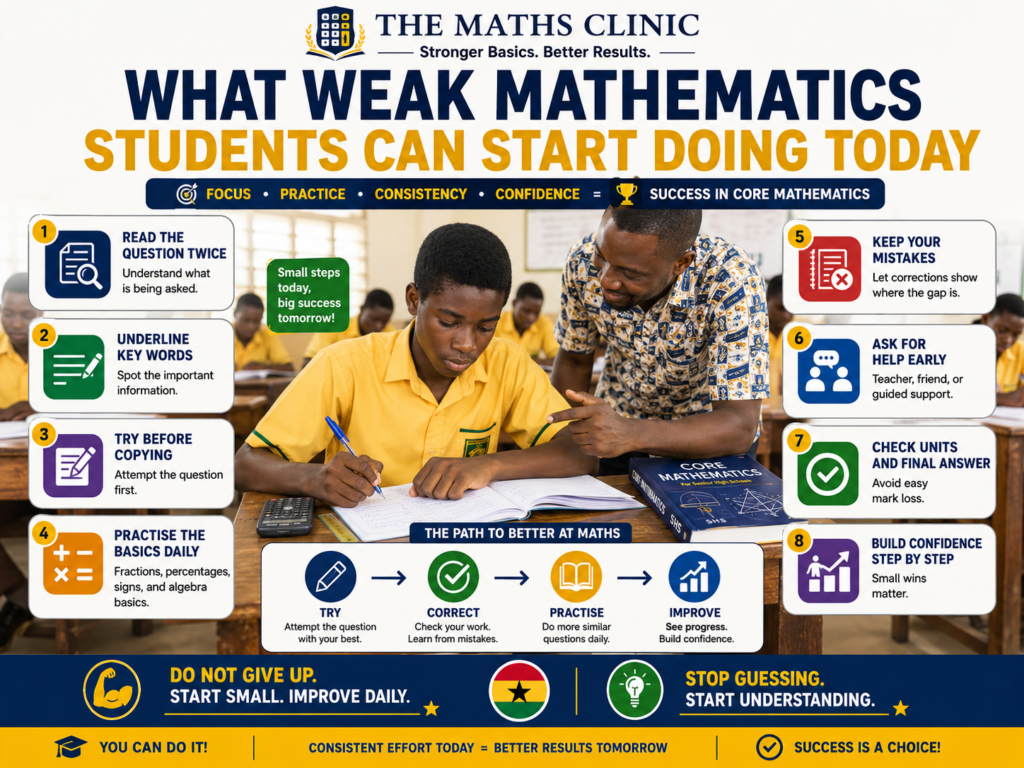
What Weak Mathematics Students Can Start Doing Today
If you are a Ghanaian SHS student struggling with mathematics, do not conclude that you are finished. Start by changing how you learn.
Do not only copy. Ask yourself what each step means. Do not hide your mistakes. Let the teacher see them. Do not wait for your friend to start. Try something first. Do not fear simple topics. Fractions, signs, and percentages are building blocks. Do not rush word problems. Read, underline, translate, then solve.
A weak student can improve when the right gap is found and treated. The learner is not finished. The gap must be found.
Summary Table: What Teachers Notice and What It May Mean
| What the teacher notices | What it may mean | How to help |
| The learner copies everything but cannot solve alone | Memorizing without understanding | Ask the learner to explain each step |
| The learner avoids eye contact | Fear of being called or embarrassed | Use smaller, safer questions |
| The learner waits for others to start | Low confidence or poor starting strategy | Check the learner’s first attempt |
| The learner rubs work often | Fear of mistakes | Treat wrong work as a diagnosis. |
| The learner avoids word problems | Poor question interpretation | Teach reading and translation skills |
| The learner fears the board | Public embarrassment | Use supportive board work |
| The learner omits units and steps | Poor exam presentation | Train clear working and final answers |
| The learner depends too much on friends | Copying without ownership | Ask for explanation of one step |
| The learner gives up quickly | Low maths confidence | Build small wins through guided practice |
FAQ: What Teachers Notice About Weak Mathematics Students
1. Are weak mathematics students lazy?
Not always. Some learners may not put in enough effort, but many are struggling because of hidden learning gaps, fear, poor confidence, weak foundations, or wrong study methods. A good teacher looks beyond the wrong answer to find the real cause.
2. Why do some students copy notes well but fail tests?
Copying notes is not the same as understanding. Some learners copy the teacher’s steps without knowing why each step works. When the question changes, they become confused.
3. Why do weak students avoid answering questions in class?
Many avoid questions because they fear embarrassment. Some have been laughed at before. Others do not know how to explain their confusion. A safe classroom helps them participate more.
4. Can weak mathematics students improve in WASSCE Core Mathematics?
Yes. Improvement is possible when the learner’s exact gaps are diagnosed and corrected. The learner needs guided practice, patient correction, and regular feedback.
5. What is the best way to help struggling SHS maths students?
The best way is to identify the hidden gap behind each mistake, explain the idea simply, solve examples step by step, allow practice, and give feedback without shame.
Conclusion: The Habit Is the Signal, Not the Final Judgment
What teachers notice about weak mathematics students should not be used to condemn them. It should be used to help them.
The quiet learner, the learner who avoids eye contact, the learner who copies without understanding, the learner who fears the board, and the learner who keeps making the same mistake may all be showing signs of hidden gaps.
A weak mathematics student is not a useless student. A weak mathematics student is a learner whose gaps have stayed untreated for too long.
The solution is diagnosis. Find the habit. Trace the gap. Explain the idea. Correct the method. Practice with feedback. Build confidence slowly.
At The Maths Clinic, we believe that when learners stop hiding their mistakes, teachers can start treating the real problem. And when the real problem is treated, WASSCE Core Mathematics becomes less frightening and more possible.
The learner is not finished. The gap must be found. Once the gap is found, it can be fixed.