Struggling with WASSCE Maths? Stop guessing. Let’s fix the gap step by step.

Why Is Trigonometry Hard? It Isn’t: Sketching Is
If you think you are “not a trigonometry person”, the WAEC reports suggest otherwise. One narrow, fixable step is costing you the marks.

📚 Part of the Trigonometry Clinic: every lesson on trigonometry, elevation, depression and bearings, in one place.
Quick answer: why is trigonometry hard?
For most SHS learners it is not the trigonometry. The WAEC Chief Examiners’ reports show that sin, cos and tan are usually handled well once a correct diagram exists. The step that breaks is turning the words of the question into that diagram. Practise that one step and the topic stops feeling hard.
If you have ever said “I’m just not a trigonometry person” after another bad mock, you have told yourself a story that feels true but usually is not. We know this because we looked for the answer in the WAEC Chief Examiners’ reports, not in a hunch.
Two stories, side by side
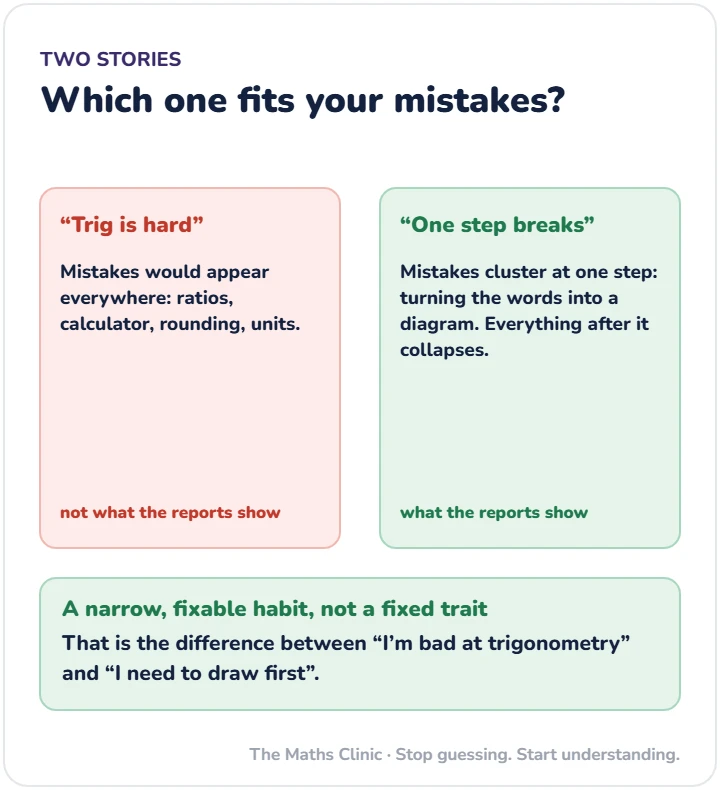
If trigonometry were simply too hard for you, your mistakes would be scattered across every stage: recalling ratios, using the calculator, rounding. What the reports describe is narrower. One step breaks, and everything after it collapses with it.
A one-line proof
From a point P on level ground, the angle of elevation of the top of a pole 18 m high is 34°. Find the distance from P to the foot of the pole.
- Draw the ground as a horizontal line and the pole as a vertical line, 18 m. Mark the right angle at the foot.
- Put P on the ground, away from the pole, and draw the line of sight from P to the top.
- Write 34° at P, between the ground and the line of sight. The unknown distance along the ground is d.
- Now label from the angle: 18 m is opposite, d is adjacent. Opposite and adjacent means tan.

tan 34° = 18 ÷ d. Multiply both sides by d: d × tan 34° = 18. Divide by tan 34°: d = 18 ÷ 0.6745.
d=\dfrac{18}{\tan 34^\circ}=26.7\text{ m}Nothing about that last line is difficult. The thinking happened in the three lines before it: horizontal at P, line of sight to the top, angle between them.
Check. The angle is less than 45°, so the distance should be longer than the height (at 45° they would be equal). 26.7 m is longer than 18 m. ✔
The wrong way. Putting the 34° at the top of the pole. Then 18 m becomes adjacent to the angle and the answer comes out as 12.1 m.
Worked example 2: an angle of depression
Question. From the top of a building 50 m high, the angle of depression of a car on the road is 32°. How far is the car from the foot of the building?
Step 1: sketch. Building vertical, 50 m. At the top, draw a horizontal line. Draw the line of sight down to the car. The 32° goes between the horizontal and the line of sight.
Step 2: move the angle. The horizontal at the top is parallel to the ground, so the angle of elevation of the top from the car is also 32° (alternate angles).
Step 3: calculate. From the car: 50 m is opposite, the distance d is adjacent. tan 32° = 50 ÷ d, so d = 50 ÷ 0.6249 = 80.0 m.
Check. 32° is less than 45°, so the distance should be more than 50 m. ✔
Why this matters
“I’m weak in trigonometry” is big and vague, so the natural reaction is to avoid trig questions, which keeps the gap open. “I struggle to turn the question into a diagram” is small and specific. It has an obvious starting point, and it can improve in weeks.

How to close the gap in two weeks
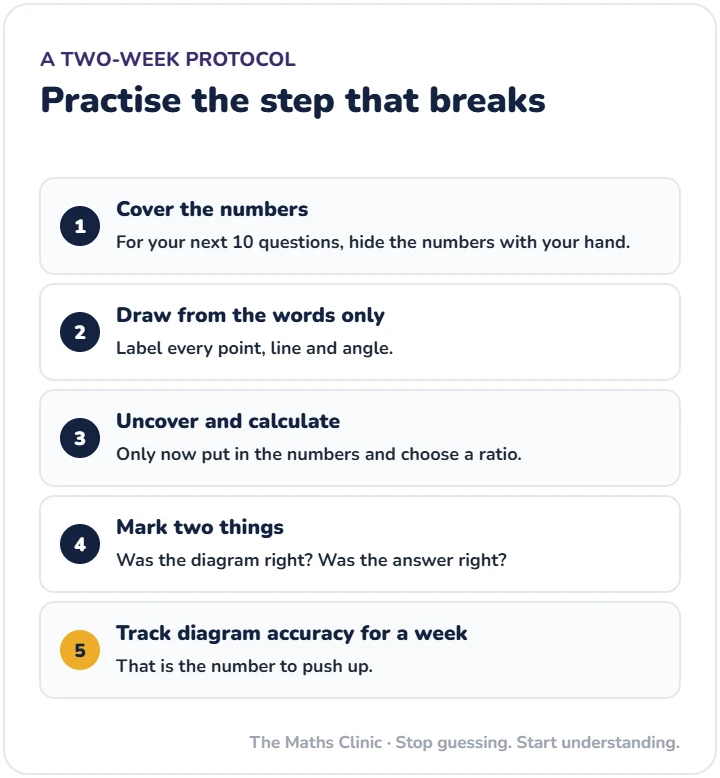
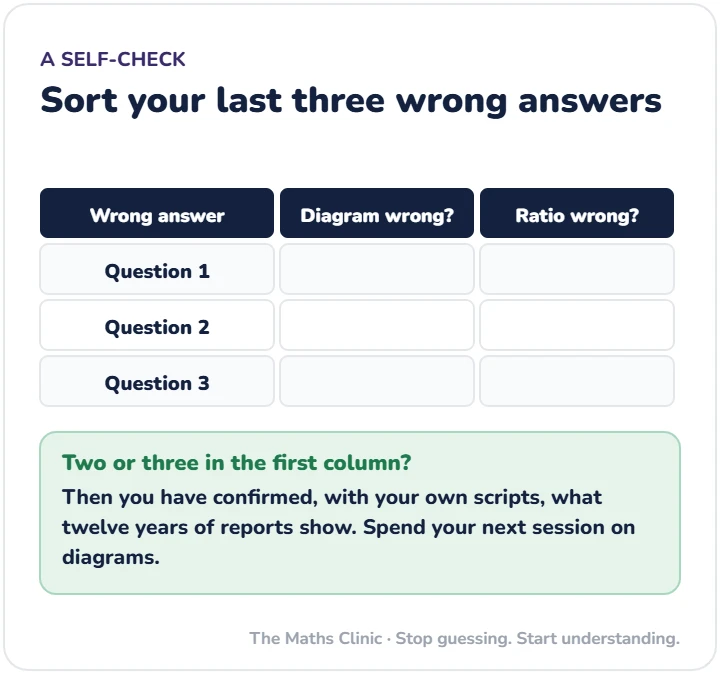
A self-check
The encouraging part
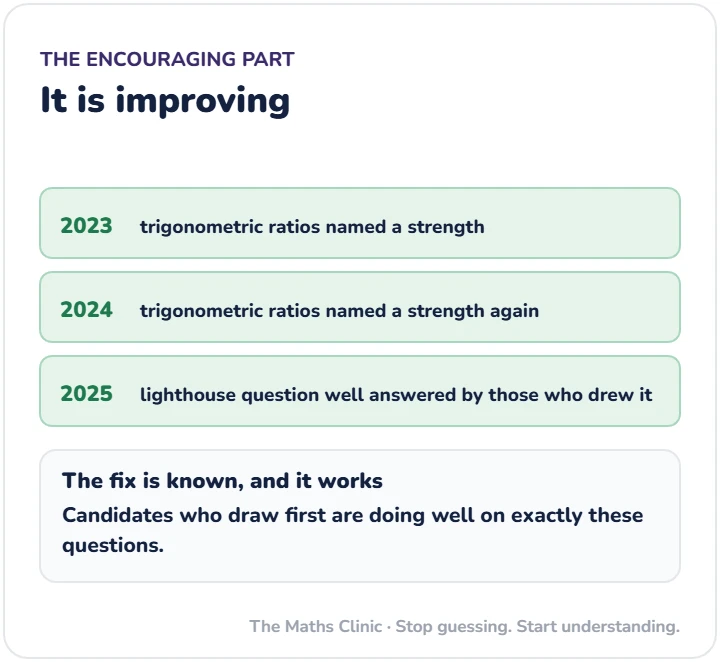
Do not over-celebrate: diagram questions were still poorly answered in 2025. But the direction is clear. This is not a topic where nobody succeeds. It is a topic where the fix is known.
📋 What the WAEC Chief Examiner reported
- 2012 and 2018: candidates skipped or stalled on elevation questions because they could not sketch them.
- 2017: many could not deduce the correct ratio from the given diagram.
- 2023 and 2024: trigonometric ratios were named a strength.
- 2025: the diagram-based mast question was poorly answered; the lighthouse question was well answered by those who drew it.
What WAEC recommends
The Chief Examiner advised in 2021: “Teachers should be encouraged to have time for weak students and teach them the basic principles and skills in the topic that they are weak in.” For trigonometry, the skill the reports keep naming is the diagram. That is the one this page asks you to practise.
How to win these marks back
- Draw the diagram before you think about ratios.
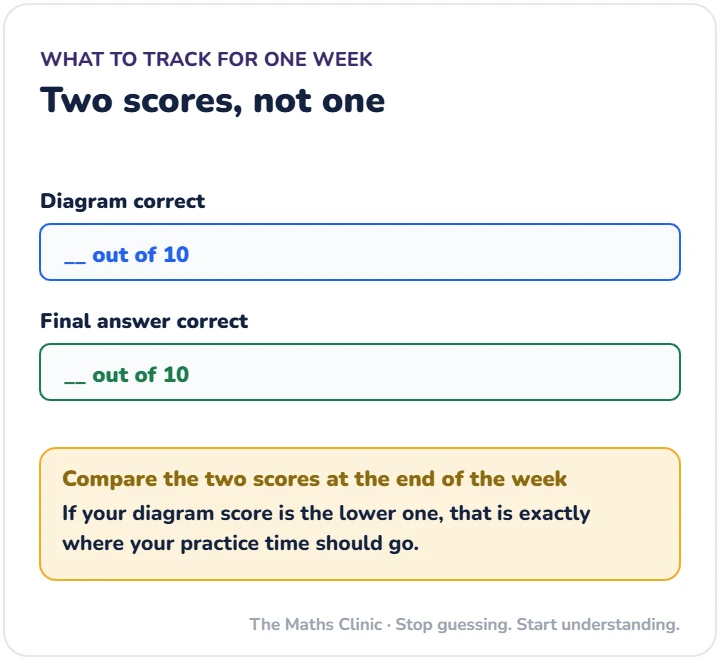
- Mark your practice on two things: the diagram and the answer.
- Practise diagrams on purpose, not only full questions.
- Use the Trigonometry Clinic lesson that matches your weak step.
Source: WAEC Chief Examiners’ Reports, WASSCE (SC) 2025, Ghana: Mathematics (Core); WAEC Chief Examiners’ Reports, Mathematics (Core), 2012, 2017, 2018, 2023, 2024
Try it now
For every question, draw the diagram from the words first, with no numbers. Then add the numbers and calculate.
Question 1
From a point 30 m from the foot of a tree, the angle of elevation of the top is 25°. Find the height of the tree.
Question 2
From the top of a building 50 m high, the angle of depression of a car is 32°. How far is the car from the building?
Question 3
A kite string is 60 m long and makes an angle of 40° with the level ground. How high is the kite?
Question 4
A ladder 8 m long leans against a wall with its foot 3 m from the wall. Find the angle the ladder makes with the ground.
Question 5 (WASSCE style)
From two points on the same side of a tower and 20 m apart, the angles of elevation of the top are 30° and 45°. Find the height of the tower.
Question 6 (real life)
A boy whose eyes are 1.5 m above the ground sees the top of a 12 m pole at an angle of elevation of 35°. How far is he from the pole?
Solutions
Solution 1
Sketch: tree vertical, ground horizontal, 25° at the observer. Height is opposite, 30 m is adjacent: tan. Height = 30 × tan 25° = 30 × 0.4663 = 13.99 m.
Solution 2
Sketch as in Worked example 2. Distance = 50 ÷ tan 32° = 50 ÷ 0.6249 = 80.0 m.
Solution 3
Sketch: string from the ground to the kite, 60 m, 40° at the ground. The height is opposite the angle and the string is the hypotenuse: sin. Height = 60 × sin 40° = 60 × 0.6428 = 38.57 m.
Solution 4
Sketch: wall vertical, ground horizontal, ladder 8 m as the hypotenuse, foot 3 m from the wall. 3 m is adjacent to the angle at the ground: cos. cos θ = 3 ÷ 8 = 0.375, so θ = cos⁻¹(0.375) = 68.0°.
Solution 5
Let x = distance from the nearer point (45°). Then h = x × tan 45° = x. From the further point: h = (x + 20) × tan 30° = (x + 20) ÷ √3. So x = (x + 20) ÷ √3. Multiply by √3: x√3 = x + 20. So x(√3 − 1) = 20, and x = 20 ÷ 0.7321 = 27.32. Height = 27.32 m.
Solution 6
Sketch: the horizontal line is at his eyes, 1.5 m up. The part of the pole above eye level is 12 − 1.5 = 10.5 m. tan 35° = 10.5 ÷ d, so d = 10.5 ÷ 0.7002 = 15.0 m.
📘 New SHS curriculum link
These skills sit in Year 1 of the new SHS Mathematics curriculum (1.3.2.LO.2: the three primary trigonometric ratios) and Year 2 (2.3.2.LO.2: angles of elevation and depression in everyday situations).
For parents
If your child says “I am not good at trigonometry”, ask them to draw the diagram for one question while you read it aloud, without doing any calculation. If the drawing is right, tell them so: the hard part is done. That small win changes how they see the topic.
Frequently asked questions
Is trigonometry hard for everyone?
No. The 2023 and 2024 reports name trigonometric ratios as a strength. What remains hard for many candidates is drawing the diagram, and that is a skill, not a talent.
Where should I start?
With “Illustrate the Information in a Diagram”, then the lesson for the question type you lose most: elevation and depression, or bearings.
Keep learning
- Trigonometry Questions and Answers: What WAEC Chief Examiners Report
- “Illustrate the Information in a Diagram”
- Why Do I Understand Maths in Class but Fail Tests?
📚 See every lesson in the Trigonometry Clinic
✏️ Practise trigonometry in the Practice Zone

Written by
Dickson Sarpong
NTC-certified SHS Mathematics teacher in Ghana with WAEC marking experience, and author of The Bridge Series textbooks. Every lesson here is built around the mistakes WAEC examiners keep reporting.
About DicksonStuck? Ask a question
Want the whole topic, step by step? My textbooks, The Bridge to Mathematics and The Bridge to Additional Mathematics for SHS, follow the new curriculum and rebuild the basics as you go.
Read a free chapter →