Struggling with WASSCE Maths? Stop guessing. Let’s fix the gap step by step.
Trigonometry Questions and Answers: What WAEC Chief Examiners Report (2011–2025)
Twelve WAEC Chief Examiners’ reports, one pattern: candidates know the ratios but lose marks in the diagram. The timeline, the fix, and questions with answers.

📚 Part of the Trigonometry Clinic: every lesson on trigonometry, elevation, depression and bearings, in one place.
Quick answer: what do WAEC Chief Examiners say about trigonometry?
Across the reports we hold for 2011 to 2025, the trigonometric ratios themselves are usually handled well, and were named a strength in 2023 and 2024. Marks are lost one step earlier: candidates cannot turn the words of the question into the right diagram. That shows up in elevation and depression questions, in bearings journeys, and in choosing the wrong ratio from a diagram.
Most trigonometry advice is general. This page is built from evidence: the WAEC Chief Examiners’ reports for WASSCE Mathematics (Core) that we have for 2011 to 2025. We read what they said about trigonometry year by year. The pattern is specific, and it is fixable.
📋 What the WAEC Chief Examiner reported
- 2020: solving problems on angles of elevation and depression was named as a weakness.
- 2017: many could not deduce the correct trigonometric ratios from the given diagram.
- Drawing the diagram from words is named as a weakness every year from 2023 to 2025. 2023: “illustrating a given information correctly on a diagram”. 2024: “representing mathematical illustrations in a diagram”. 2025: “representing mathematical information in a diagram”.
- 2023 and 2024: trigonometric ratios were named as a strength.
What WAEC recommends
The Chief Examiner advised in 2021: “Teachers should be encouraged to have time for weak students and teach them the basic principles and skills in the topic that they are weak in.” In trigonometry, the basic skill the reports point to again and again is drawing the diagram from the words. This page sends you to the lesson that teaches each skill.
How to win these marks back
- Draw the diagram before choosing a ratio.
- Put a horizontal at every observer and a north line at every point.
- Label opposite, adjacent and hypotenuse from the angle.
- Practise the three question types WAEC sets almost every year.
Source: WAEC Chief Examiners’ Reports, WASSCE (SC) 2025, Ghana: Mathematics (Core); WAEC Chief Examiners’ Reports, Mathematics (Core), 2011–2024
Twelve years of trigonometry, one timeline

Two cautions when reading this. A topic can only appear as a weakness in a year it was examined. And the short summary at the top of a report sometimes disagrees with the question-by-question comments. In 2023 and 2024, bearings were listed as a strength, yet on the bearings question in the same reports most candidates could not draw the diagram. We trust the question comments, because they describe real scripts.
Where trigonometry marks are really lost
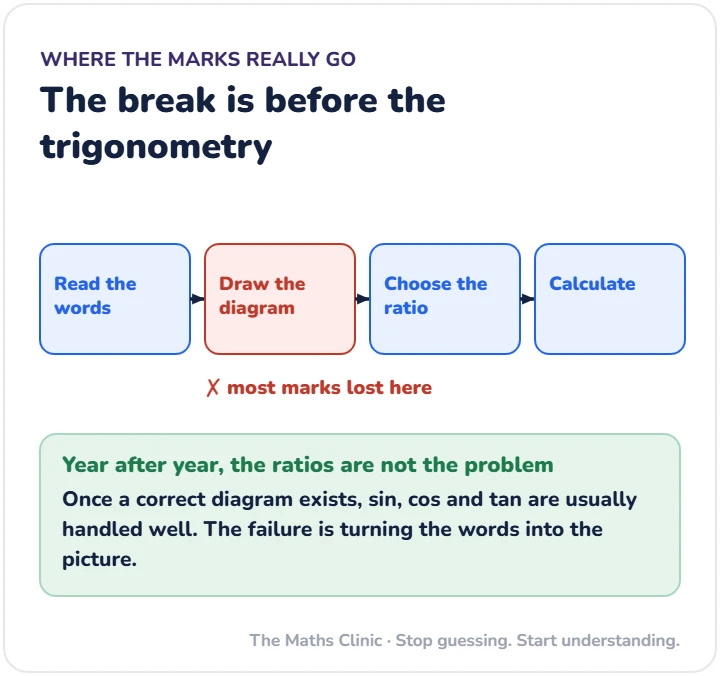
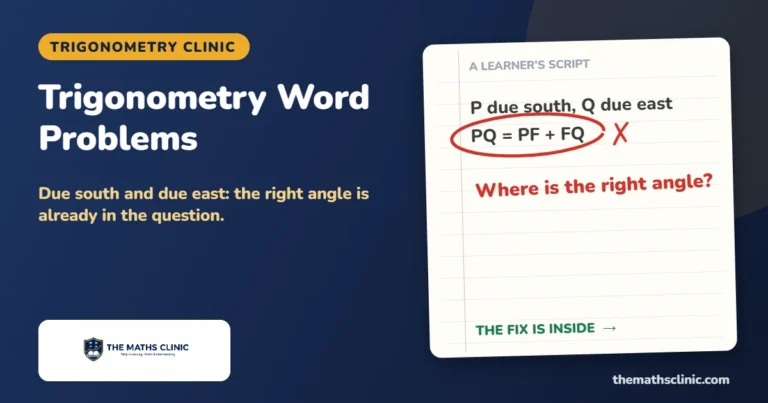
The same failure appears in different forms: candidates skipping elevation questions because they could not sketch them (2012, 2018), choosing the wrong ratio after misreading the diagram (2017), and building the bearings diagram wrongly from the start (2016, 2021).
The one fix

Seeing it work: a bearings question
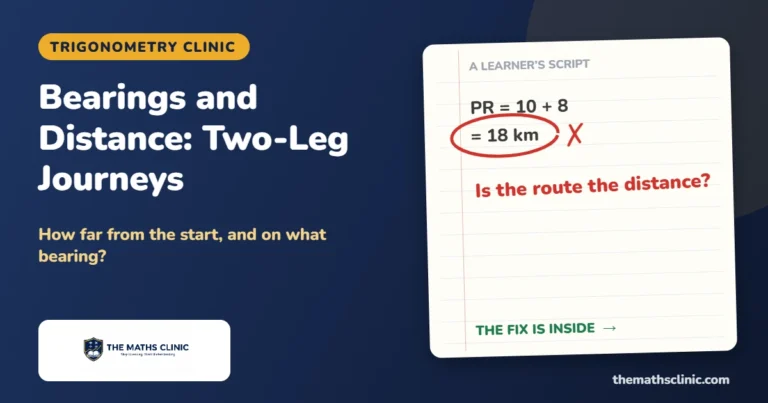
A cyclist rides from P on a bearing of 048° for 12 km to Q, then on a bearing of 138° for 7 km to R. Find the distance PR and the bearing of R from P.
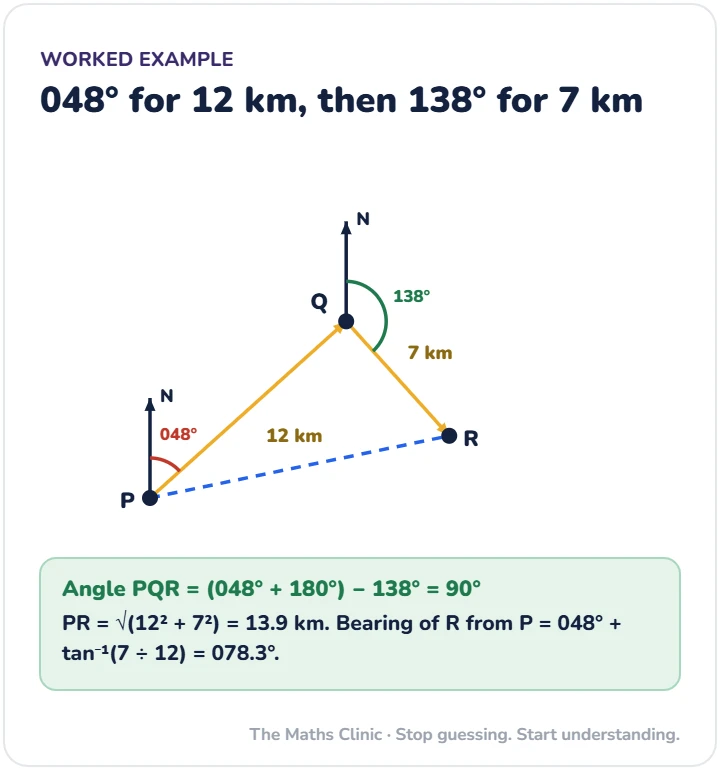
Step 1: draw. North line at P, turn 48° clockwise, draw PQ = 12 km. New north line at Q, turn 138° clockwise, draw QR = 7 km.
Step 2: the angle at Q. The bearing of P from Q is 048° + 180° = 228°. The angle between the legs is 228° − 138° = 90°.
Step 3: distance. PR² = 12² + 7² = 144 + 49 = 193, so PR = √193 = 13.9 km.
PR=\sqrt{12^2+7^2}=13.9\text{ km}Step 4: bearing. tan(∠QPR) = 7 ÷ 12 = 0.583, so ∠QPR = 30.3°. The cyclist turned clockwise at Q, so add it to the first bearing.
048^\circ+\tan^{-1}\tfrac{7}{12}=078.3^\circCheck. R should be a little north of due east of P (Q is north-east, R is south-east of Q). 078.3° is just north of east. ✔
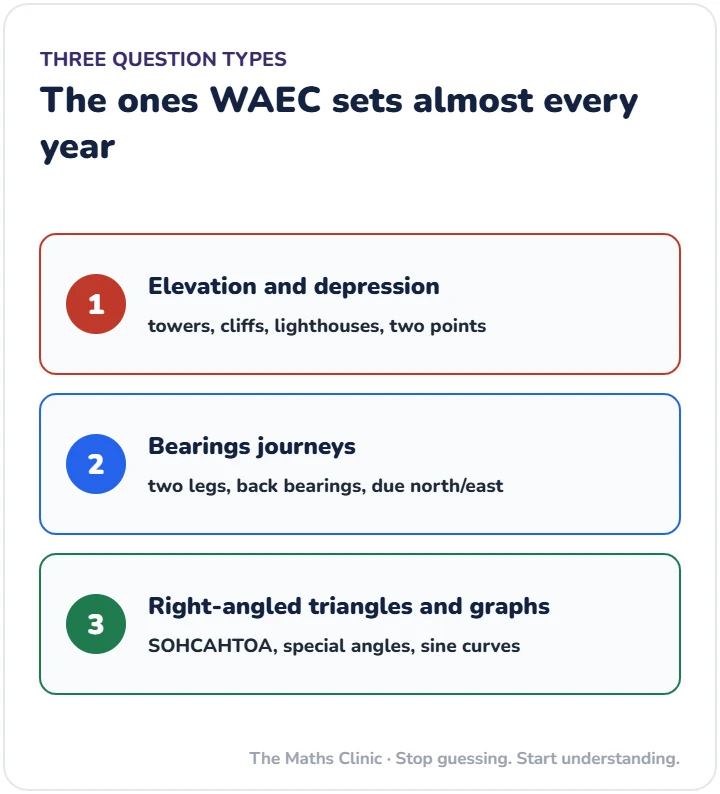
The three question types WAEC sets almost every year
Trigonometry questions and answers
Try each question before opening the answer. Every answer links to the lesson that teaches it.
1. In a right-angled triangle, the hypotenuse is 20 cm and one angle is 40°. Find the side opposite the 40°.
Show the answer
Label from the 40° angle: the hypotenuse is 20 cm and we want the opposite side. Opposite and hypotenuse means sine (SOH). sin 40° = opposite ÷ 20, so opposite = 20 × sin 40° = 20 × 0.6428 = 12.86 cm.
2. The sides opposite and adjacent to an angle θ are 7 cm and 10 cm. Find θ.
Show the answer
Opposite and adjacent means tangent (TOA). tan θ = 7 ÷ 10 = 0.7. Use the inverse: θ = tan⁻¹(0.7) = 35.0°.
3. Without a calculator, evaluate sin 30° + cos 60°.
Show the answer
sin 30° = 1/2 and cos 60° = 1/2 (from half an equilateral triangle). 1/2 + 1/2 = 1.
4. From a point 45 m from the foot of a tower, the angle of elevation of the top is 35°. How tall is the tower?
Show the answer
Sketch: the tower is vertical, the ground horizontal, the angle 35° is at the observer. The tower is opposite the angle and 45 m is adjacent, so use tan. tan 35° = height ÷ 45, so height = 45 × tan 35° = 45 × 0.7002 = 31.51 m.
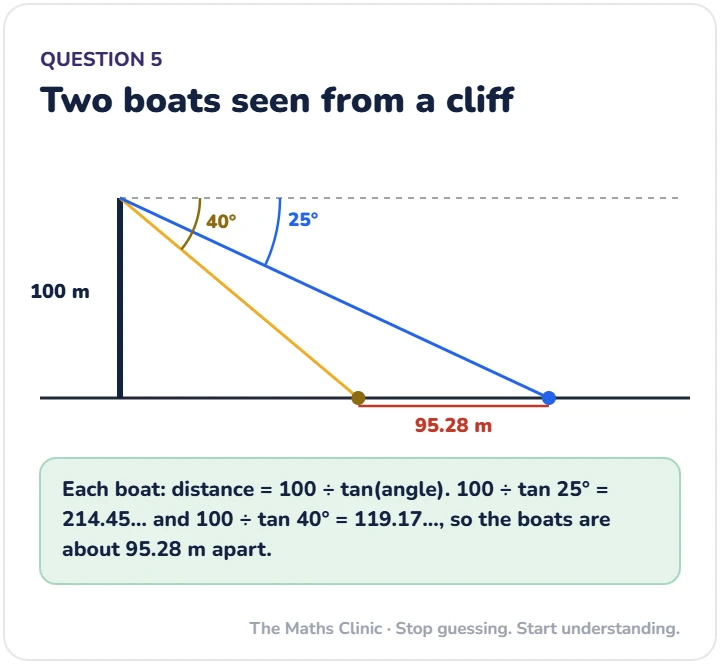
5. From the top of a cliff 100 m high, the angles of depression of two boats on the same side are 40° and 25°. How far apart are the boats?
Show the answer
Each angle of depression equals the angle of elevation from that boat. Far boat (25°): distance = 100 ÷ tan 25° = 100 ÷ 0.4663 = 214.45 m. Near boat (40°): distance = 100 ÷ tan 40° = 100 ÷ 0.8391 = 119.18 m. Same side, so subtract: 214.45 − 119.18 = 95.27 m (95.28 m using unrounded values).
Lesson: Angle of Elevation and Depression Questions With Solutions
6. The bearing of B from A is 315°. What is the bearing of A from B?
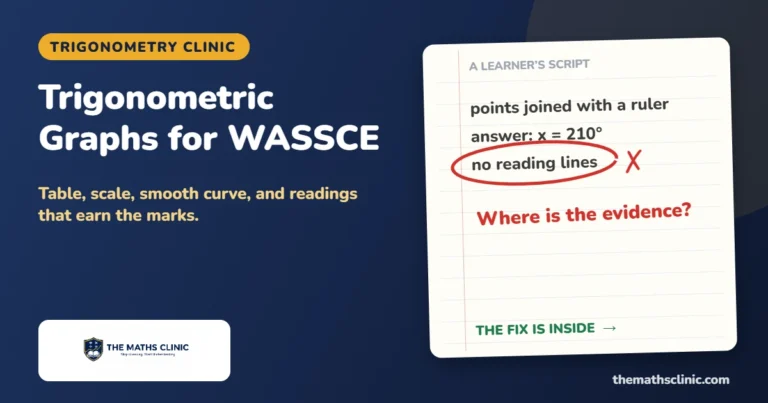
7. Solve 2 sin x + 1 = 0 for 0° ≤ x ≤ 360°.
Show the answer
Rearrange: 2 sin x = −1, so sin x = −0.5. The reference angle is 30°. Sine is negative in the third and fourth quarters: x = 180° + 30° = 210° or 360° − 30° = 330°.
Lesson: Trigonometric Graphs
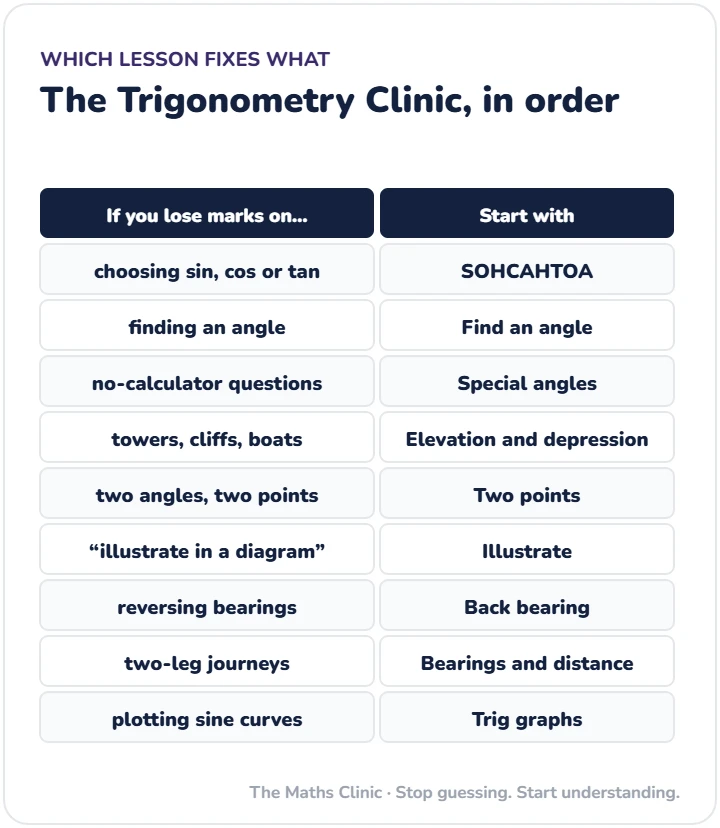
Which lesson fixes what
📘 New SHS curriculum link
Trigonometry runs through all three years of the new SHS Mathematics curriculum: Year 1 (1.3.2.LO.2: the primary ratios and special angles), Year 2 (2.3.2.LO.2: angles of elevation and depression, distances and heights) and Year 3 (3.3.2.LO.1: trigonometric graphs).
For parents
Ask your child to bring their last trigonometry test and sort the wrong answers into two piles: “my diagram was wrong” and “my diagram was right but the ratio was wrong”. The bigger pile tells you both which lesson on this page to start with.
✏️ Try it yourself
Pull out your last three wrong trigonometry answers. For each one, ask only: was my diagram wrong, or was my diagram right and my ratio wrong?
Tap to see the answer
If most come back “diagram wrong”, you have confirmed, with your own evidence, what twelve years of reports show. Spend your next study session drawing diagrams, not memorising ratios.
Frequently asked questions
Is trigonometry in the new SHS curriculum?
Yes: the primary ratios and bearings in SHS 1, elevation and depression in SHS 2, and trigonometric graphs in SHS 3. The sine and cosine rules and latitude and longitude were not found in the 2023 curriculum.
Are trigonometry questions getting better answered?
The ratios were named a strength in 2023 and 2024, which is encouraging. But diagram questions were still poorly answered in 2025, so the improvement is real but not complete.
Keep learning
- “Illustrate the Information in a Diagram”
- WAEC Chief Examiner’s Report 2025 for Mathematics
- What WAEC Examiners Report: 12 Years of Mathematics
📚 See every lesson in the Trigonometry Clinic
✏️ Practise trigonometry in the Practice Zone

Written by
Dickson Sarpong
NTC-certified SHS Mathematics teacher in Ghana with WAEC marking experience, and author of The Bridge Series textbooks. Every lesson here is built around the mistakes WAEC examiners keep reporting.
About DicksonStuck? Ask a question
Want the whole topic, step by step? My textbooks, The Bridge to Mathematics and The Bridge to Additional Mathematics for SHS, follow the new curriculum and rebuild the basics as you go.
Read a free chapter →