Struggling with WASSCE Maths? Stop guessing. Let’s fix the gap step by step.

Angle of Elevation and Depression Questions With Solutions
Six WASSCE-style angle of elevation and depression questions, each solved step by step from a correct diagram, plus practice questions with answers.

📚 Part of the Trigonometry Clinic: every lesson on trigonometry, elevation, depression and bearings, in one place.
Quick answer: how do you solve angle of elevation and depression questions?
Draw the horizontal at the observer, draw the line of sight, and mark the angle between them. Move an angle of depression down to the object (alternate angles). Then label opposite, adjacent and hypotenuse, and use \tan when the height and the ground distance are involved, or \sin and \cos when a sloping length is involved.
This page is all practice. Each question is the kind WAEC sets, solved the way an examiner wants to see it: diagram first, then one clear line of trigonometry, then the answer to the accuracy asked for. If the ideas themselves are new, start with Angle of Elevation and Depression: Meaning, Diagrams and the Difference.
📋 What the WAEC Chief Examiner reported
- 2025, Question 4: angles of depression from a lighthouse to two boats on the same side. Well answered by most candidates who drew the diagram.
- 2025, Question 9: a mast and a pillar seen from the point midway between them. Poorly answered: many could not draw the diagram, so the follow-up parts failed.
- 2020: elevation and depression problems named as a weakness. 2023 to 2025: “representing information in a diagram” named every year.
How to win these marks back
- Draw and label the diagram before any calculation, even when the question does not ask for one.
- Write each angle at the point it is measured from.
- Find shared lengths first (such as a distance used by two triangles), and keep four decimal places until the end.
- Read the question again: same side or opposite sides changes add to subtract.
Source: WAEC Chief Examiners’ Reports, WASSCE (SC) 2025, Ghana: Mathematics (Core); WAEC Chief Examiners’ Reports, Mathematics (Core), 2020, 2023, 2024
Question 1: height of a flagpole (angle of elevation)
From a point on level ground 25 m from the foot of a flagpole, the angle of elevation of the top of the flagpole is 52°. Find the height of the flagpole, correct to one decimal place.
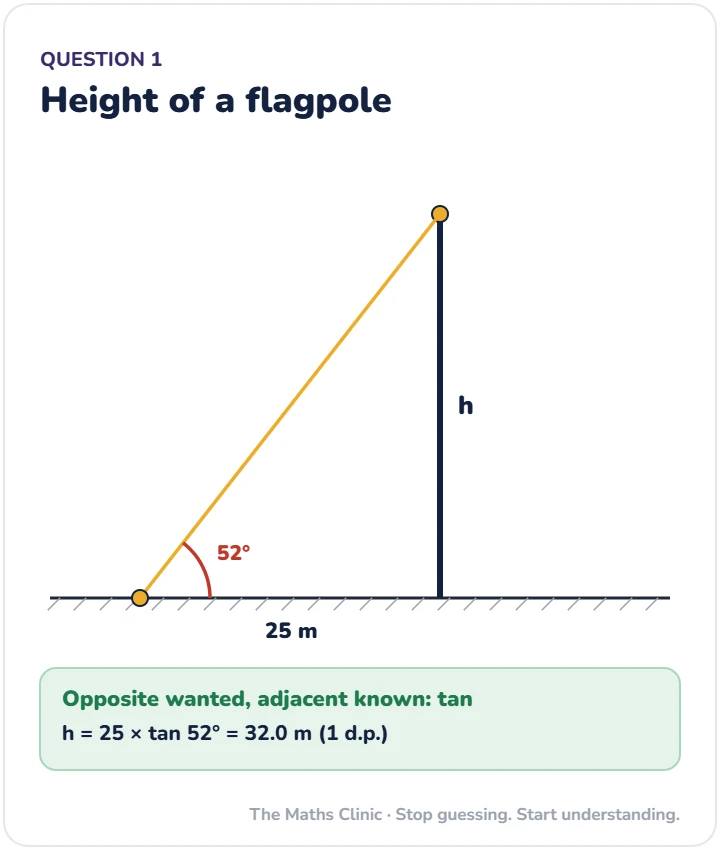
h=25\tan 52^\circ=32.0\text{ m}Question 2: distance from a building (angle of depression)
From the top of a building 42 m high, the angle of depression of a point P on the level ground is 28°. How far is P from the foot of the building?
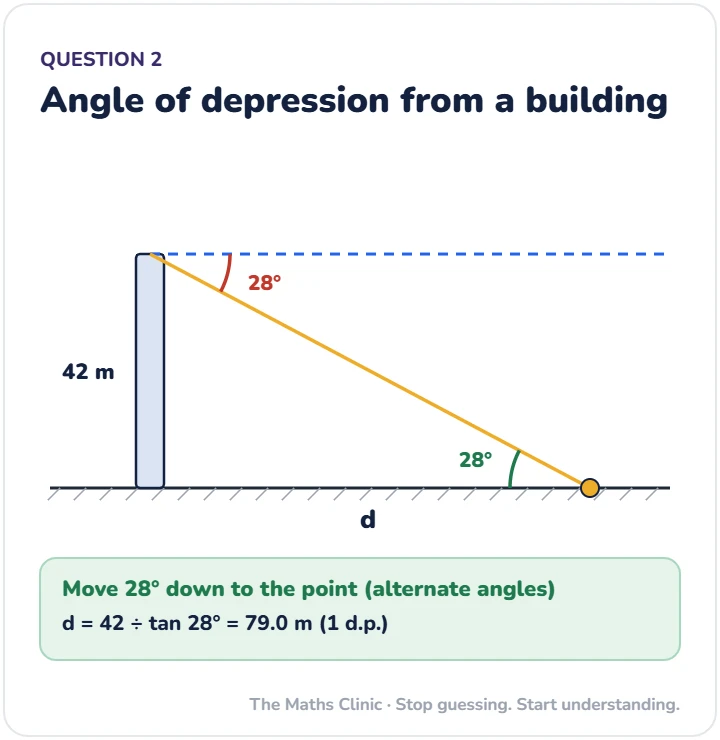
d=\dfrac{42}{\tan 28^\circ}=79.0\text{ m}Question 3: a lighthouse and two boats
From the top of a lighthouse 120 m high, the angles of depression of two boats A and B are 50° and 32°. The boats are on the same side of the lighthouse and in line with its foot. Find the distance AB, to the nearest metre.
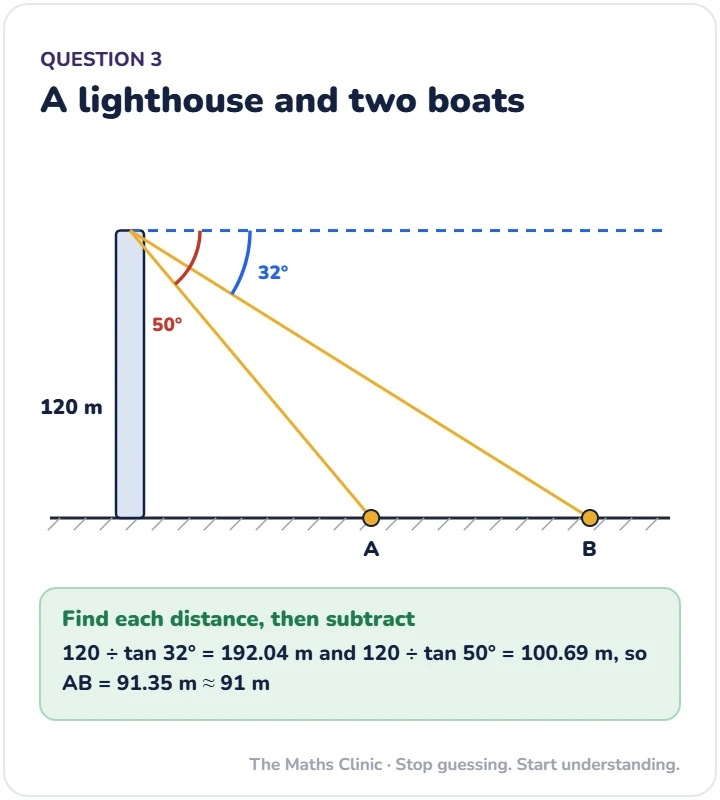
OB=\dfrac{120}{\tan 32^\circ}=192.04\text{ m}OA=\dfrac{120}{\tan 50^\circ}=100.69\text{ m}AB=192.04-100.69=91\text{ m}If the boats were on opposite sides, you would add the two distances instead. This is exactly why the diagram matters.
Question 4: two angles of elevation from two points
From a point A on level ground, the angle of elevation of the top of a tower is 30°. From a point B, 40 m nearer the tower, the angle of elevation is 45°. Find the height of the tower, correct to one decimal place.
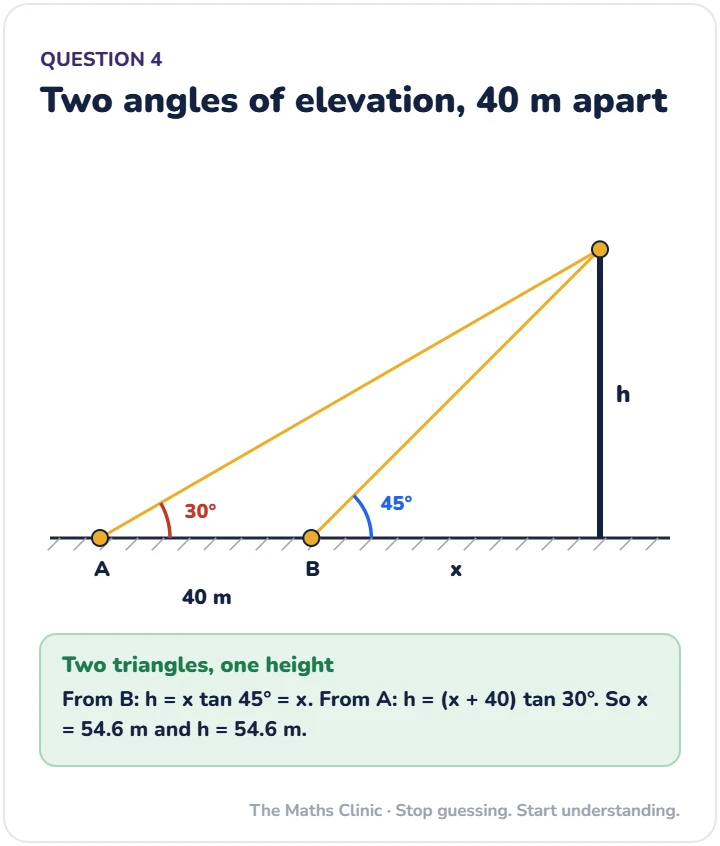
Let x be the distance from B to the foot. From B, h=x\tan 45^\circ=x. From A, h=(x+40)\tan 30^\circ.
x=\dfrac{x+40}{\sqrt{3}}x(\sqrt{3}-1)=40x=\dfrac{40}{\sqrt{3}-1}=54.6\text{ m}So the tower is 54.6 m high.
Question 5: a pillar, a mast and the midpoint
A pillar 12 m high and a mast stand on the same level ground. From O, the point midway between their feet, the angle of elevation of the top of the pillar (H) is 30° and the angle of elevation of the top of the mast (G) is 65°. Find the height of the mast and the distance HG, to one decimal place.
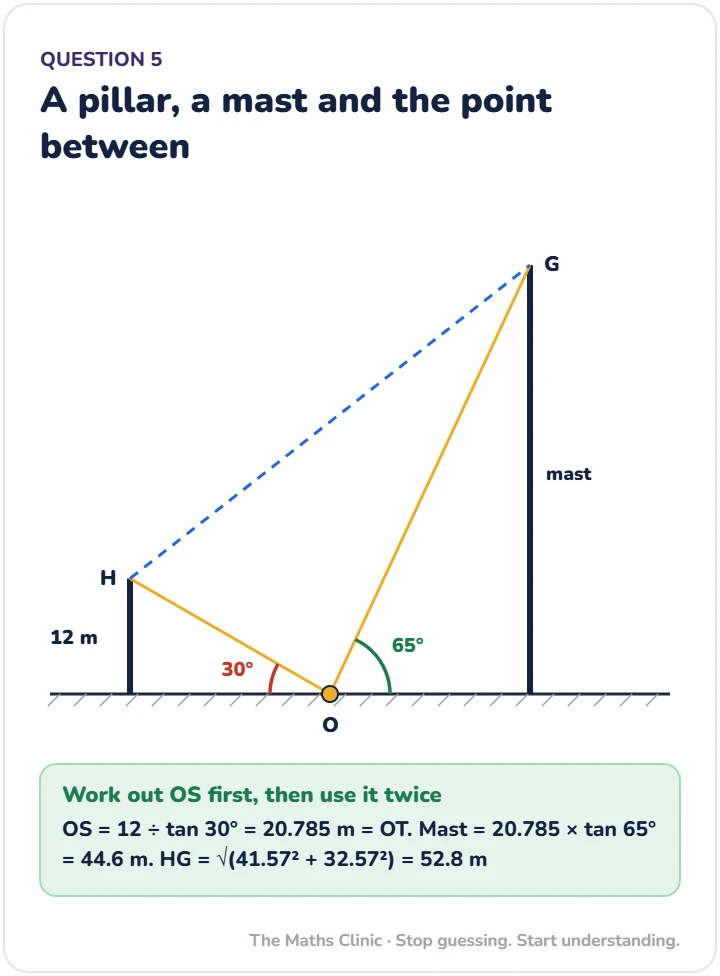
OS=\dfrac{12}{\tan 30^\circ}=20.785\text{ m}\text{mast}=20.785\tan 65^\circ=44.6\text{ m}HG=\sqrt{41.57^2+32.57^2}=52.8\text{ m}HG is the hypotenuse of a right-angled triangle whose horizontal side is the full distance between the feet (2 × 20.785 m) and whose vertical side is the difference in heights (44.57 − 12 m).
Question 6: looking up and down from one point
From the top of a building 30 m high, the angle of elevation of the top of a taller building is 20° and the angle of depression of its foot is 35°. Find the height of the taller building.
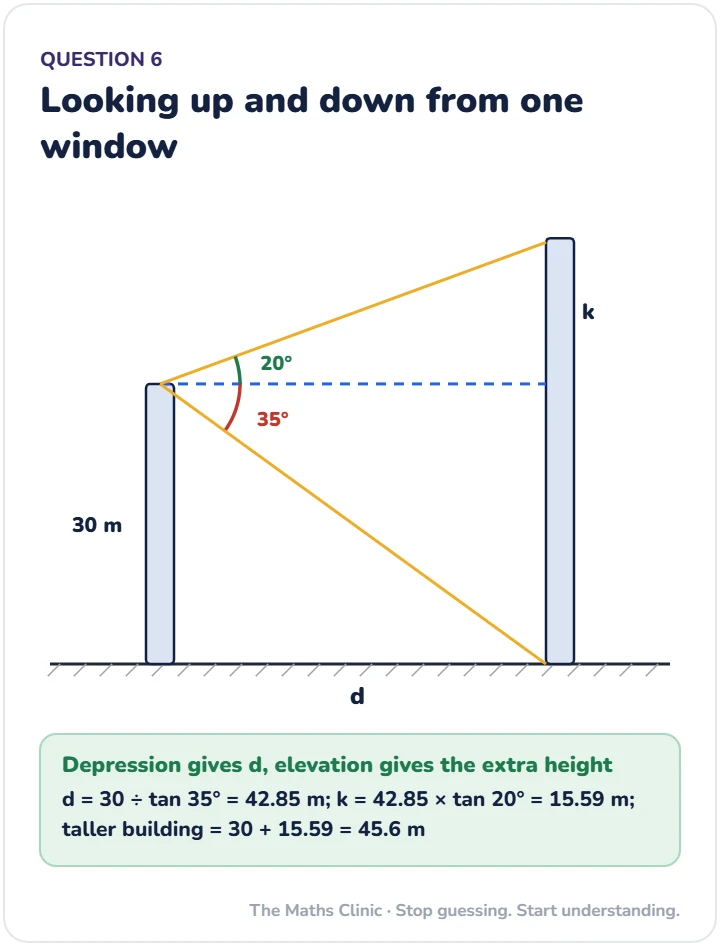
d=\dfrac{30}{\tan 35^\circ}=42.85\text{ m}k=42.85\tan 20^\circ=15.59\text{ m}\text{height}=30+15.59=45.6\text{ m}What these six questions have in common
- Every one starts with a horizontal line at the observer.
- Every angle sits at the point it is measured from.
- Whenever two triangles appear, one length is shared: find it first.
- The trigonometry is one or two lines. The marks are won in the diagram.
More practice questions
- From the top of a cliff 65 m high, the angle of depression of a ship is 15°. How far is the ship from the foot of the cliff?
- A ladder 8 m long leans against a vertical wall and makes an angle of 70° with the level ground. How far up the wall does it reach?
- From a point 60 m from the foot of a tower, the angle of elevation of the top of the tower is 35° and the angle of elevation of the top of a flagpole standing on the tower is 40°. Find the length of the flagpole.
Show the answers
1. \dfrac{65}{\tan 15^\circ} = 242.6 m
2. The ladder is the hypotenuse: 8\sin 70^\circ = 7.52 m
3. 60(\tan 40^\circ-\tan 35^\circ) = 8.33 m
✏️ Try it yourself
From a window 12 m above the ground, the angle of elevation of the top of a building across the road is 38° and the angle of depression of its foot is 24°. Draw the diagram, then find the height of the building.
Tap to see the answer
Distance across: \dfrac{12}{\tan 24^\circ} = 26.95 m. Extra height: 26.95 × tan 38° = 21.06 m. Height = 12 + 21.06 = 33.1 m.
Frequently asked questions
Which ratio do I use for elevation and depression questions?
Look at the two sides involved. Height and ground distance: \tan. A sloping length (a ladder, a string, a line of sight) with the height: \sin. A sloping length with the ground distance: \cos.
How do I know whether to add or subtract distances?
From the diagram. Two objects on the same side of a tower: subtract. On opposite sides: add. Never decide without drawing it.
How accurate should my answer be?
Exactly as the question says, usually one decimal place or the nearest whole number. Keep at least four decimal places in your working and round only at the end.
Keep learning
- Angle of Elevation and Depression: Meaning, Diagrams and the Difference
- Bearings in Mathematics: Questions and Answers With Diagrams
- Word Problems in WASSCE Mathematics: Questions and Answers
📚 See every lesson in the Trigonometry Clinic
✏️ Practise trigonometry in the Practice Zone

Written by
Dickson Sarpong
NTC-certified SHS Mathematics teacher in Ghana with WAEC marking experience, and author of The Bridge Series textbooks. Every lesson here is built around the mistakes WAEC examiners keep reporting.
About DicksonStuck? Ask a question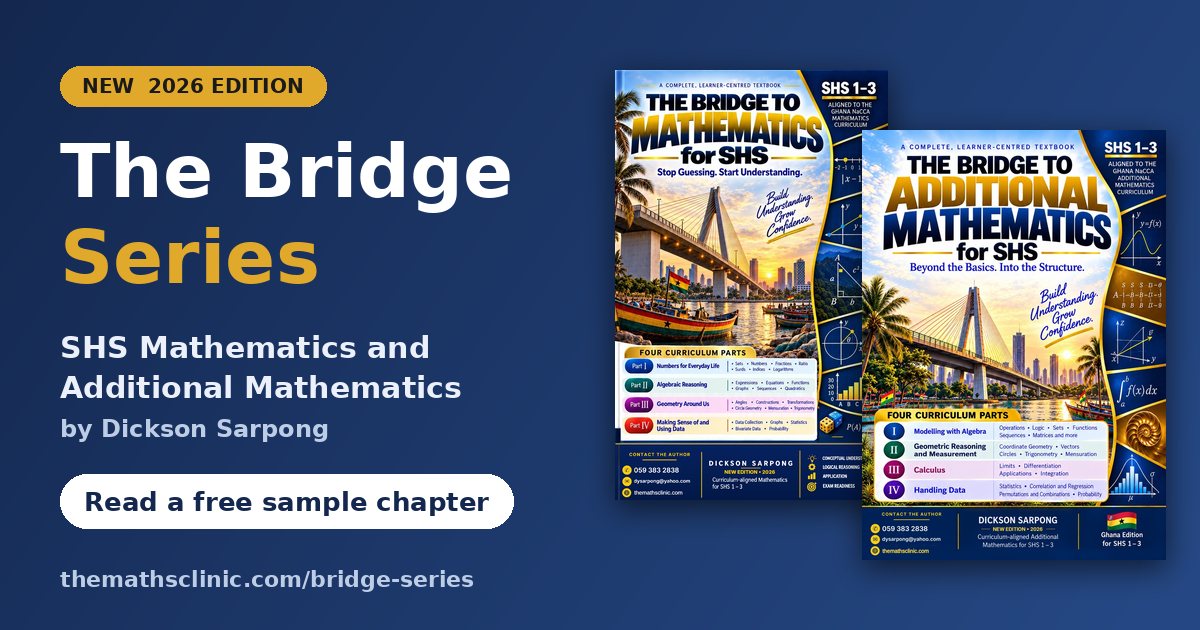
Want the whole topic, step by step? My textbooks, The Bridge to Mathematics and The Bridge to Additional Mathematics for SHS, follow the new curriculum and rebuild the basics as you go.
Read a free chapter →