Struggling with WASSCE Maths? Stop guessing. Let’s fix the gap step by step.

How to Find an Angle in a Right-Angled Triangle (Using Two Sides)
Find any angle in a right-angled triangle from two known sides: choose the ratio, use the inverse key, and check the size makes sense.

📚 Part of the Trigonometry Clinic: every lesson on trigonometry, elevation, depression and bearings, in one place.
Quick answer: how do you find an angle in a right-angled triangle from two sides?
Name the two sides you know (opposite, adjacent or hypotenuse) from the angle. Choose the ratio that uses those two sides, work out the fraction, then use the inverse key: \theta=\tan^{-1}\!\left(\tfrac{\text{opp}}{\text{adj}}\right), \sin^{-1}\!\left(\tfrac{\text{opp}}{\text{hyp}}\right) or \cos^{-1}\!\left(\tfrac{\text{adj}}{\text{hyp}}\right).
Finding a side is SOHCAHTOA forwards. Finding an angle is SOHCAHTOA backwards: you already know the ratio, and you need the angle that gives it. That backwards step is where many WASSCE candidates slip, writing a ratio such as 0.58 as if it were an angle.
📋 What the WAEC Chief Examiner reported
- 2018: some candidates treated a trigonometric value as an angle and wrote equations such as θ + 25° = 5.145.
- 2017: many could not deduce the correct trigonometric ratio from the given diagram.
- 2023 and 2024: trigonometric ratios were named as a strength, so these marks are within reach.
How to win these marks back
- Write the ratio in words first (for example tan θ = opp ÷ adj).
- Use the inverse key to turn the ratio into an angle.
- Give the angle to the accuracy asked, usually one decimal place.
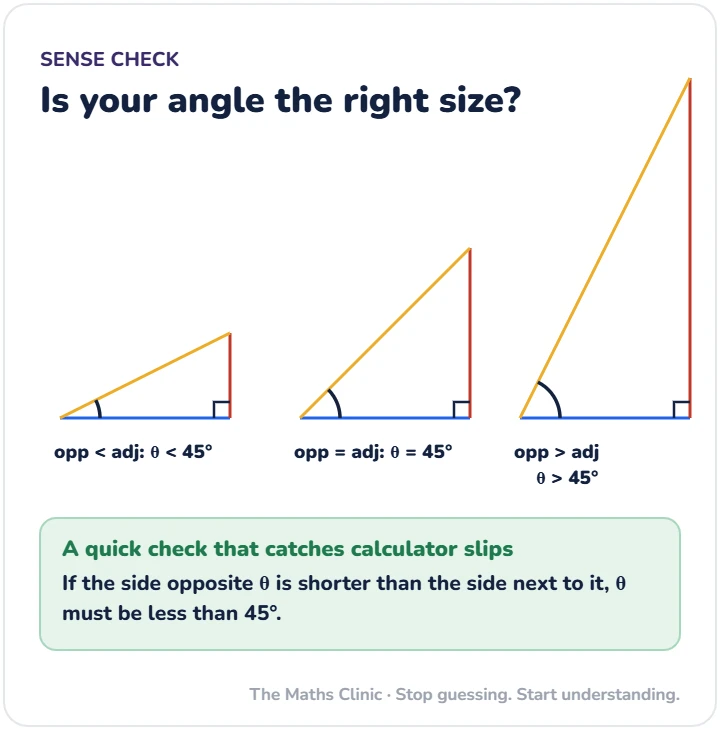
- Check the size: shorter opposite side means a smaller angle.
Source: WAEC Chief Examiners’ Reports, Mathematics (Core), 2017, 2018, 2023, 2024
The five-step method
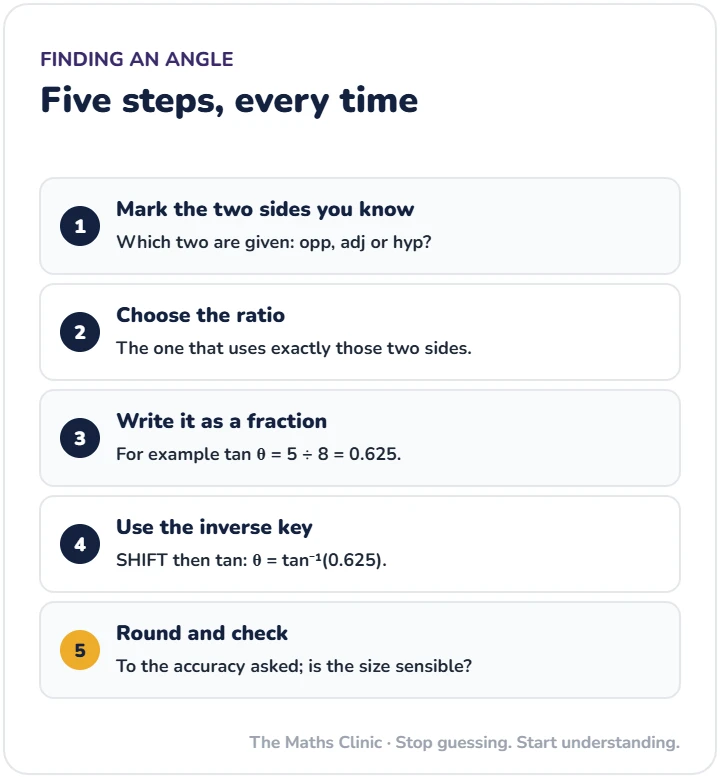
Example 1: using inverse tan
In a right-angled triangle, the side opposite θ is 5 cm and the side adjacent to θ is 8 cm. Find θ.
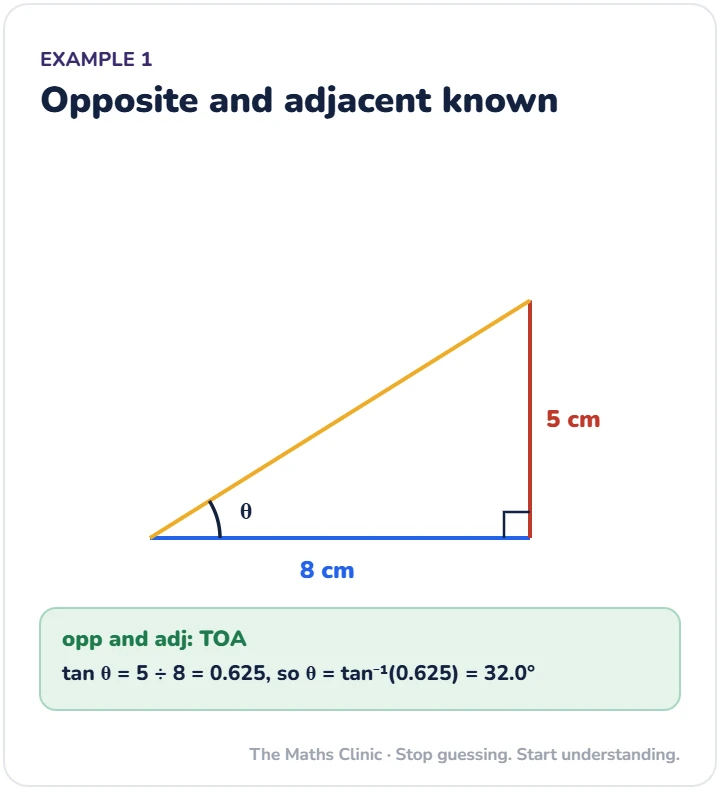
\tan\theta=\dfrac{5}{8}=0.625\theta=\tan^{-1}(0.625)=32.0^\circExample 2: using inverse sin
The side opposite θ is 7 m and the hypotenuse is 12 m. Find θ.
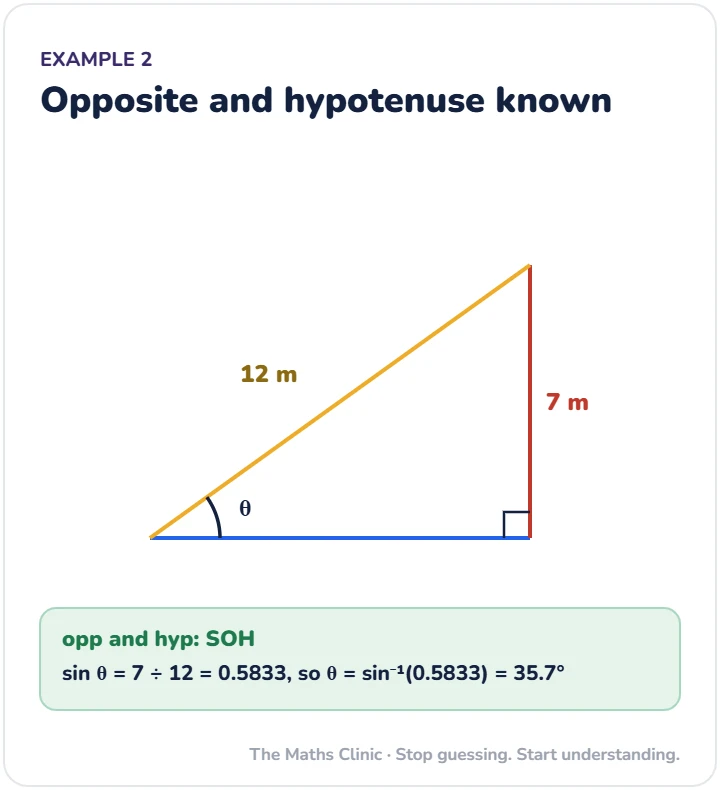
\sin\theta=\dfrac{7}{12}=0.5833\theta=\sin^{-1}(0.5833)=35.7^\circExample 3: using inverse cos
The side adjacent to θ is 9 cm and the hypotenuse is 15 cm. Find θ.
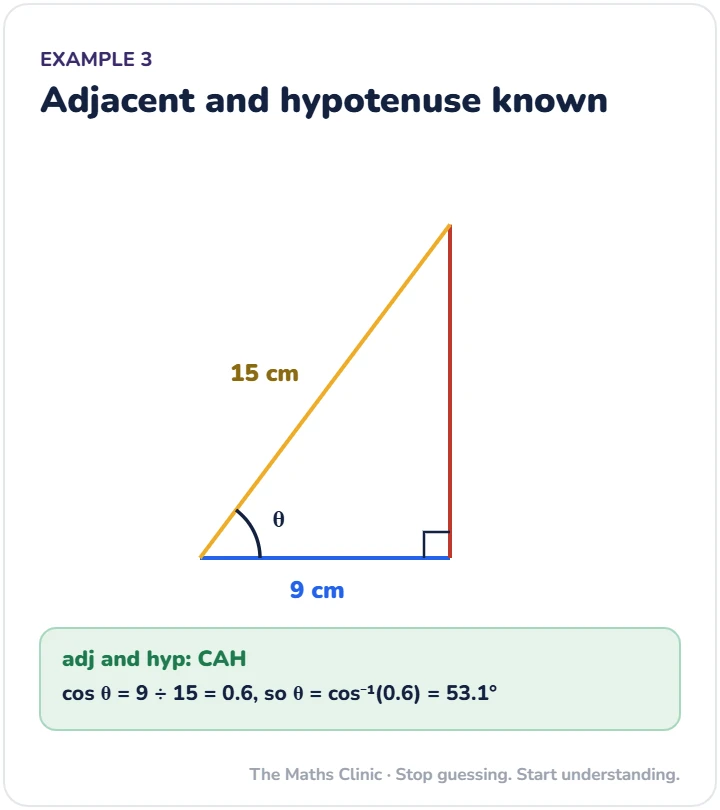
\cos\theta=\dfrac{9}{15}=0.6\theta=\cos^{-1}(0.6)=53.1^\circWhat sin⁻¹, cos⁻¹ and tan⁻¹ mean
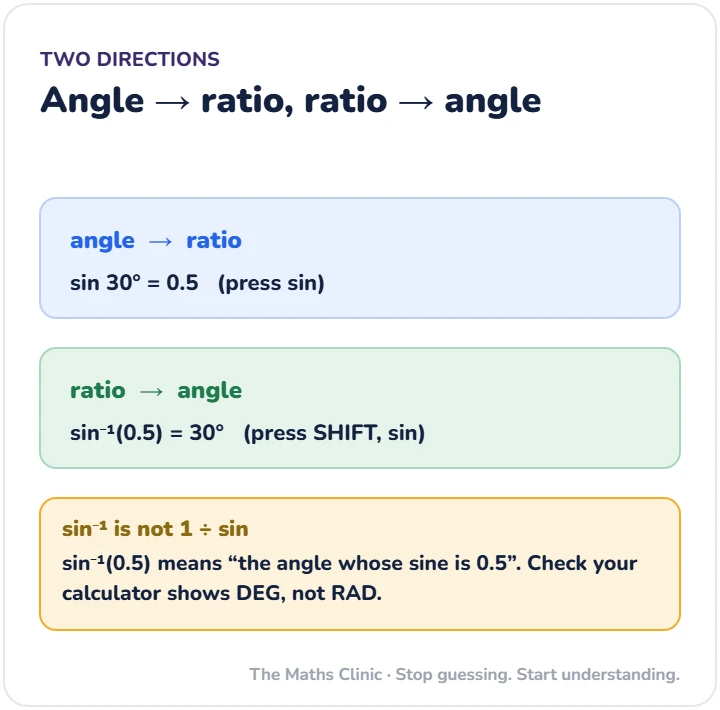
On most scientific calculators you press SHIFT (or 2nd F) and then sin, cos or tan. Make sure the screen shows D or DEG. In radian mode every answer will be wrong.
Check that your angle makes sense
The mistake that costs the marks
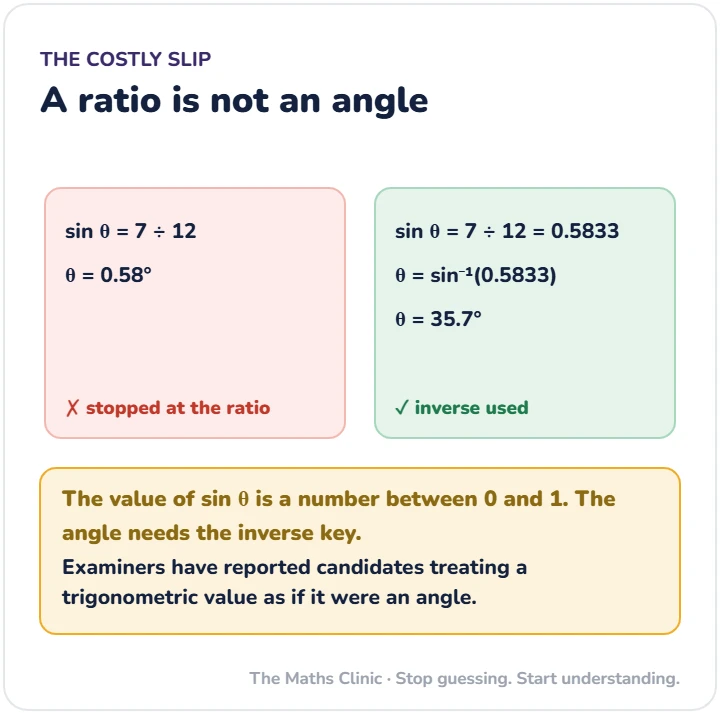
- Stopping at \sin\theta=0.58 and calling 0.58 the angle.
- Typing \sin^{-1}(7)\div 12 instead of \sin^{-1}(7\div 12). Use brackets or work out the fraction first.
- Rounding the fraction too early. Keep four decimal places.
- Using the wrong pair of sides because θ was not marked first.
Practice questions with answers
- The side opposite θ is 4 cm and the side adjacent to θ is 9 cm. Find θ to one decimal place.
- The side opposite θ is 11 m and the hypotenuse is 20 m. Find θ.
- A ladder 6 m long leans against a wall with its foot 2 m from the wall. Find the angle the ladder makes with the ground.
Show the answers
1. \tan^{-1}(4\div 9) = 24.0°
2. \sin^{-1}(11\div 20) = 33.4°
3. The 2 m is adjacent and the ladder is the hypotenuse: \cos^{-1}(2\div 6) = 70.5°
✏️ Try it yourself
A vertical pole 15 m high casts a shadow 9 m long on level ground. Find the angle of elevation of the sun. Draw the triangle first.
Tap to see the answer
The pole is opposite and the shadow is adjacent, so \theta=\tan^{-1}(15\div 9) = 59.0°.
Frequently asked questions
What is the formula to find an angle of a right triangle?
Use one of \theta=\sin^{-1}\!\left(\tfrac{\text{opp}}{\text{hyp}}\right), \theta=\cos^{-1}\!\left(\tfrac{\text{adj}}{\text{hyp}}\right) or \theta=\tan^{-1}\!\left(\tfrac{\text{opp}}{\text{adj}}\right), depending on which two sides you know.
Can I find the third angle without trigonometry?
Yes. The angles of a triangle add up to 180°, and one angle is 90°, so the other two add up to 90°. Once you have θ, the third angle is 90° − θ.
Why does my calculator give a strange answer?
It is probably in radian mode, or the fraction was not in brackets. Set it to degrees (DEG) and work out the fraction first.
Keep learning
- SOHCAHTOA: Meaning, Formula and Examples
- Angle of Elevation and Depression: Meaning, Diagrams and the Difference
- Angle of Elevation and Depression Questions With Solutions
📚 See every lesson in the Trigonometry Clinic
✏️ Practise trigonometry in the Practice Zone

Written by
Dickson Sarpong
NTC-certified SHS Mathematics teacher in Ghana with WAEC marking experience, and author of The Bridge Series textbooks. Every lesson here is built around the mistakes WAEC examiners keep reporting.
About DicksonStuck? Ask a question
Want the whole topic, step by step? My textbooks, The Bridge to Mathematics and The Bridge to Additional Mathematics for SHS, follow the new curriculum and rebuild the basics as you go.
Read a free chapter →