Struggling with WASSCE Maths? Stop guessing. Let’s fix the gap step by step.

Back Bearing: How to Find the Bearing of A From B
If the bearing of B from A is known, the bearing of A from B is 180° away. Here is the rule, why it works, and the slips that cost marks.

📚 Part of the Trigonometry Clinic: every lesson on trigonometry, elevation, depression and bearings, in one place.
Quick answer: how do you find a back bearing?
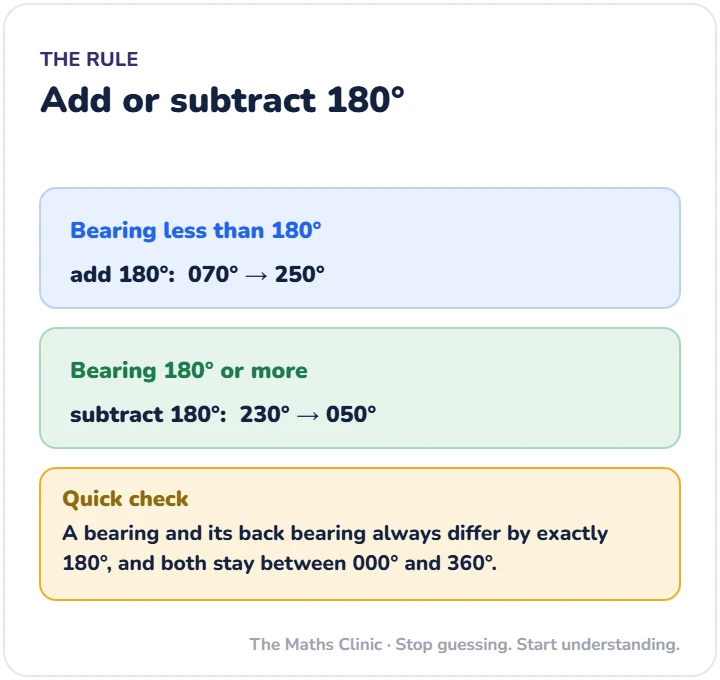
The back bearing is the original bearing plus or minus 180°. If the bearing is less than 180°, add 180°; if it is 180° or more, subtract 180°. For example, if the bearing of B from A is 070°, the bearing of A from B is 250°; if it is 230°, the back bearing is 050°.
Many bearings questions ask for “the bearing of A from B” when you were given “the bearing of B from A”. The two are on the same line but point in opposite directions. Getting this one step right protects every later part of the question.
The question gives the bearing of B from A, then asks for the bearing of A from B. Many candidates copy the same number, or subtract it from 360°. Both are wrong. Below, the rule is built step by step, so you know why it works and can check it with a sketch.
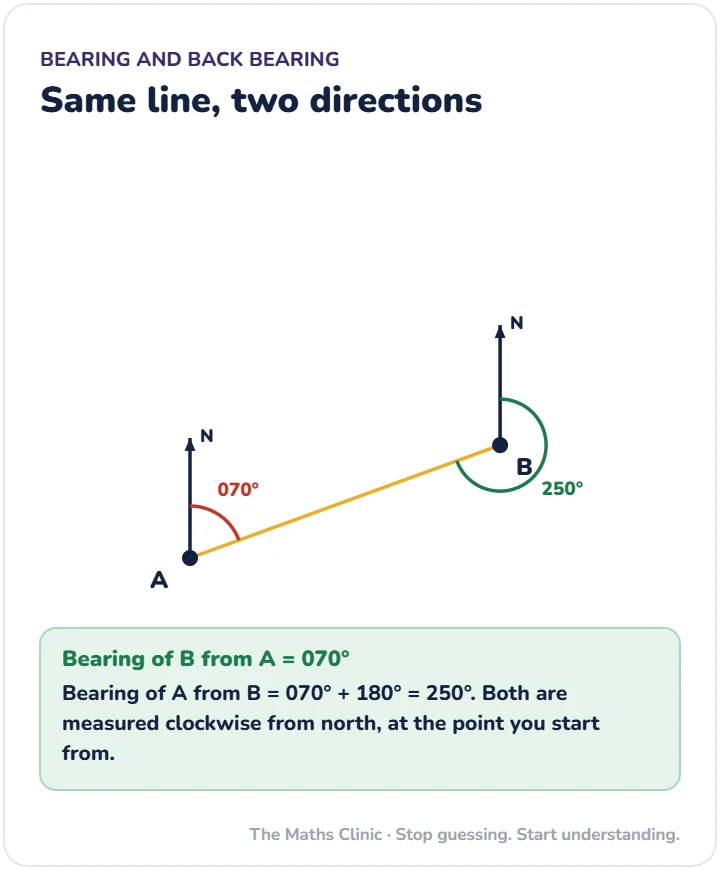
Bearing and back bearing on one line
The back bearing rule
| Bearing of B from A | Back bearing (A from B) |
|---|---|
| 035° | 215° |
| 070° | 250° |
| 125° | 305° |
| 230° | 050° |
| 300° | 120° |
Example: a bearing of more than 180°
The bearing of Q from P is 230°. Find the bearing of P from Q.
Step 1: is the bearing more or less than 180°? 230° is more than 180°.
Step 2: subtract 180°. (Adding would give 410°, which is more than a full turn.)

230^\circ-180^\circ=050^\circ
Step 3: write three figures. 50° is written 050°.
Check. Sketch it: 230° from P points south-west, so Q is south-west of P. Standing at Q and looking back at P, you face north-east, and 050° is north-east. ✔
Example 2: a bearing of less than 180°
Question. The bearing of a borehole from a school is 070°. Find the bearing of the school from the borehole.
Step 1. 070° is less than 180°, so add 180°.
Step 2. 070° + 180° = 250°.
Check. 070° points east-north-east, so 250° should point west-south-west: the opposite direction. ✔
The wrong way. 360° − 070° = 290°. That reflects the direction instead of reversing it.
Why the rule works

Because north is the same direction everywhere on the diagram, the north lines at A and B are parallel. The line AB cuts both, so the angle it makes with north at A equals the angle it makes with south at B (alternate angles). Going round from north at B to that line therefore takes 180° plus the original angle.
Compass bearings to three-figure bearings
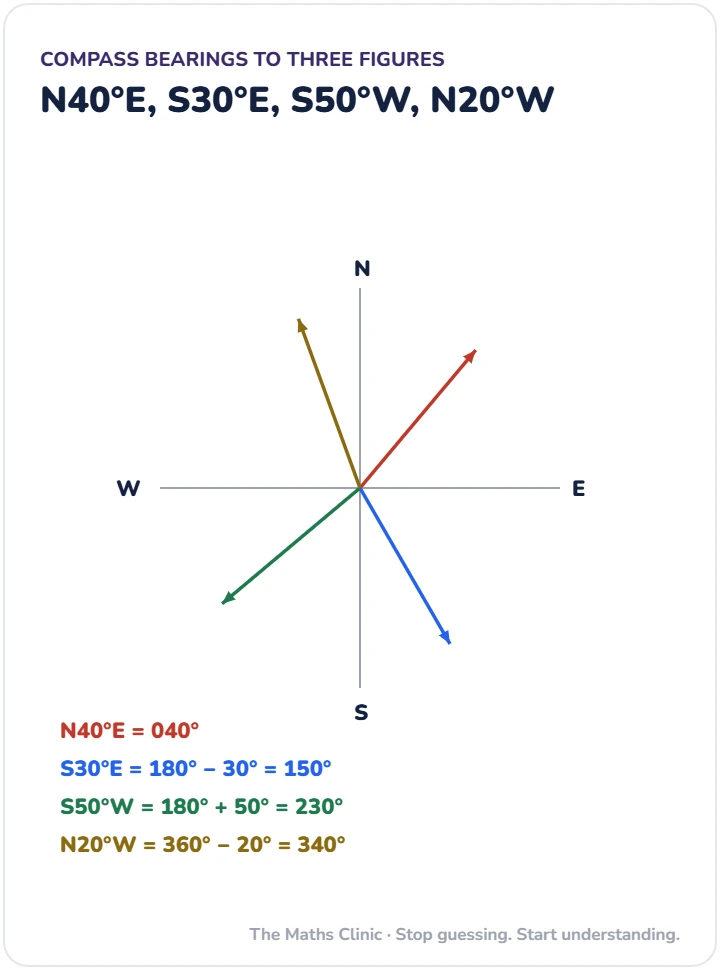
WAEC questions sometimes give compass bearings such as N40°E or S50°W. Convert them to three-figure bearings first, then reverse them in the usual way. The back bearing of N40°E (040°) is 220°, which is S40°W.
Example 3: from a compass bearing
Question. The bearing of Y from X is S50°W. Find the three-figure bearing of X from Y.
Step 1: convert. S50°W means face south (180°), then turn 50° towards west. Turning from south towards west is clockwise, so add: 180° + 50° = 230°.
Step 2: reverse. 230° is more than 180°, so subtract: 230° − 180° = 050°.
Check. The reverse of south-west is north-east, and 050° (N50°E) is north-east. ✔
The mistakes that cost marks
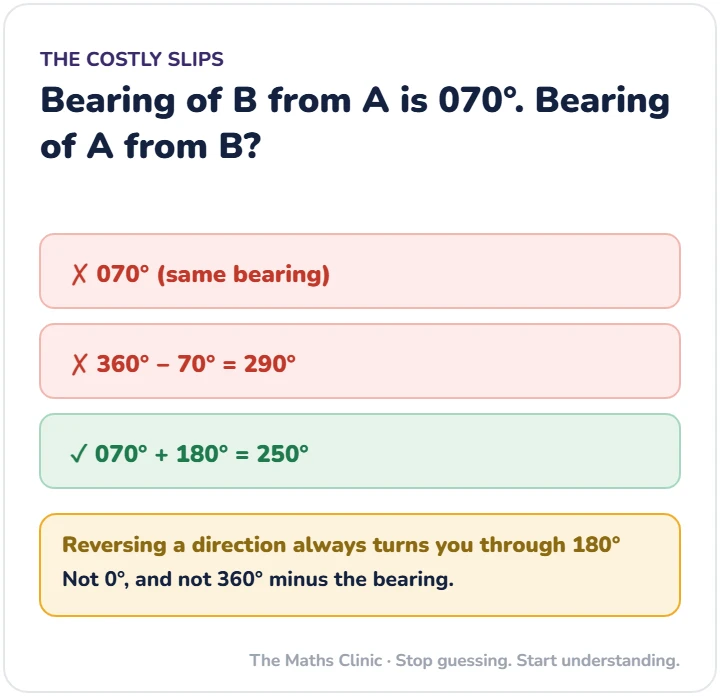
- Giving the same bearing back (070° instead of 250°).
- Using 360° minus the bearing.
- Measuring anticlockwise or from the east.
- Writing 50° instead of 050°.
📋 What the WAEC Chief Examiner reported
- 2016: a bearings question was poorly done because candidates could not analyse it.
- 2021: in a two-leg journey question, illustrating the journey was not correctly answered by most candidates.
- 2023 and 2024: bearings were named a strength in the summaries, but in the same reports most candidates could not draw the bearings diagram.
What WAEC recommends
In 2021 the Chief Examiner advised: “Candidates should be advised to read carefully and understand the demands of questions before attempting them.” In bearings, the most important word to read carefully is “from”: it tells you where to stand and draw your north line.
How to win these marks back
- Read “from” carefully: the bearing is measured at the point after “from”.
- Draw a north line at both points.
- Add 180° if the bearing is less than 180°; otherwise subtract 180°.
- Always write bearings with three figures, such as 050°.
Source: WAEC Chief Examiners’ Reports, Mathematics (Core), 2016, 2021, 2023, 2024
Try it now
Cover the solutions. For each one, decide “more or less than 180°?” before you add or subtract, and sketch a quick check.
Question 1
The bearing of Q from P is 125°. Find the bearing of P from Q.
Question 2
The bearing of X from Y is 300°. Find the bearing of Y from X.
Question 3
Write N35°W as a three-figure bearing, then give its back bearing.
Question 4
The bearing of B from A is 180°. Find the bearing of A from B.
Question 5 (WASSCE style)
A ship sails from A to B on a bearing of 060°, then from B to C on a bearing of 150°. Find (a) the bearing of A from B, (b) the bearing of B from C, (c) the angle ABC.
Question 6 (real life)
The bearing of a school from a church is 112°. What is the bearing of the church from the school?
Solutions
Solution 1
125° is less than 180°, so add: 125° + 180° = 305°.
Solution 2
300° is more than 180°, so subtract: 300° − 180° = 120°.
Solution 3
N35°W: face north (000° or 360°) and turn 35° towards west, which is anticlockwise, so 360° − 35° = 325°. 325° is more than 180°, so the back bearing is 325° − 180° = 145°.
Solution 4
180° is not less than 180°, so subtract: 180° − 180° = 000°. B is due south of A, so A is due north of B. ✔
Solution 5
(a) 060° is less than 180°, so the bearing of A from B = 060° + 180° = 240°. (b) 150° is less than 180°, so the bearing of B from C = 150° + 180° = 330°. (c) At B, the direction back to A is 240° and the direction on to C is 150°. The angle between them is 240° − 150° = 90°.
Solution 6
112° is less than 180°, so add: 112° + 180° = 292°.
📘 New SHS curriculum link
Bearings use the angle facts in Year 1 of the new SHS Mathematics curriculum (1.3.1.LO.1): parallel lines and transversals. The north lines at two points are parallel, which is exactly why the back bearing rule works.
For parents
Stand with your child facing north outside, and point to a building. Ask: “What direction is that building from us, and what direction are we from the building?” If they say the two directions are opposite, 180° apart, they understand back bearings.
Frequently asked questions
What is the difference between a bearing and a back bearing?
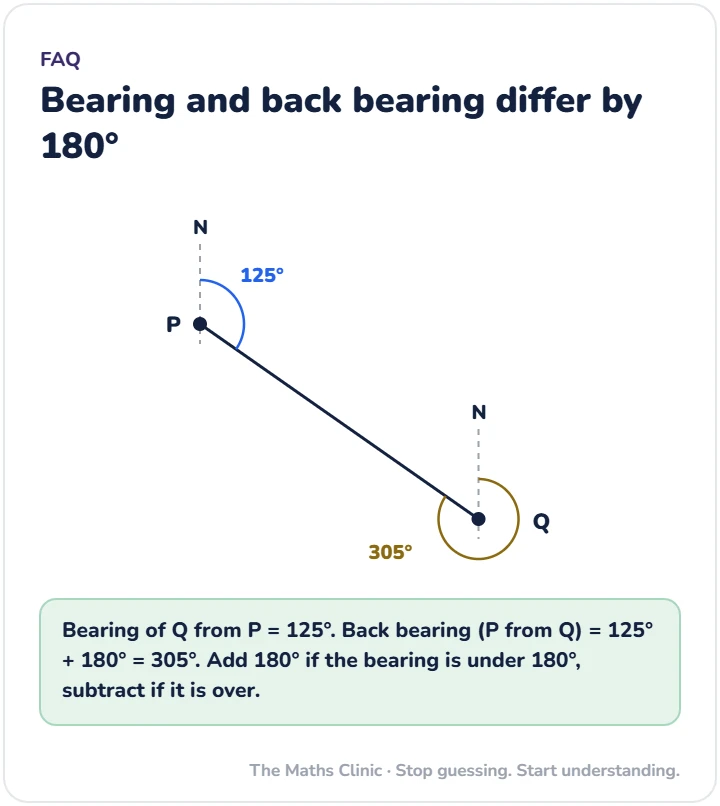
A bearing gives the direction from one point to another. The back bearing gives the direction for the return journey, so the two always differ by 180°.
Is the bearing of A from B the same as the bearing of B from A?
No. They point in opposite directions along the same line, so they differ by 180°.
Why do bearings have three figures?
So that there is no confusion when they are read or written: 050° cannot be misread as 500° or as an incomplete number.
What to do next
Use back bearings inside full journey questions in “Illustrate the Information in a Diagram”, then practise in the Practice Zone.
Keep learning
- Bearings in Mathematics: Questions and Answers With Diagrams
- “Illustrate the Information in a Diagram”: How to Draw WASSCE Diagrams
- Angle of Elevation From Two Points
📚 See every lesson in the Trigonometry Clinic
✏️ Practise trigonometry in the Practice Zone

Written by
Dickson Sarpong
NTC-certified SHS Mathematics teacher in Ghana with WAEC marking experience, and author of The Bridge Series textbooks. Every lesson here is built around the mistakes WAEC examiners keep reporting.
About DicksonStuck? Ask a question
Want the whole topic, step by step? My textbooks, The Bridge to Mathematics and The Bridge to Additional Mathematics for SHS, follow the new curriculum and rebuild the basics as you go.
Read a free chapter →