Struggling with WASSCE Maths? Stop guessing. Let’s fix the gap step by step.

Angle of Elevation From Two Points: How to Solve It Step by Step
Two angles of elevation, one height: how to write two equations, make them equal and solve, with the same-side and opposite-side cases.

📚 Part of the Trigonometry Clinic: every lesson on trigonometry, elevation, depression and bearings, in one place.
Quick answer: how do you solve angle of elevation questions from two points?
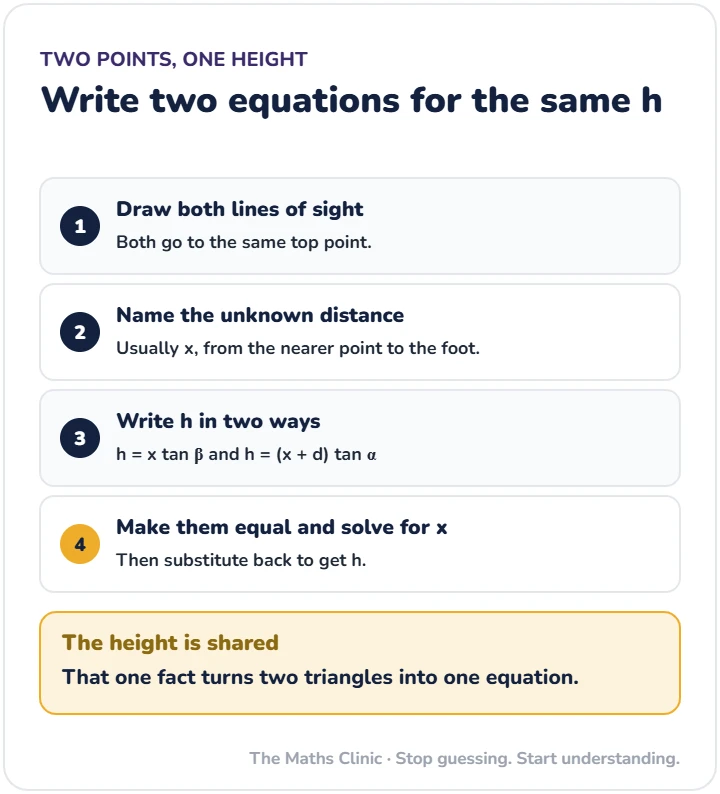
The two lines of sight meet at the same top, so the height h is shared. Write h twice, once from each point, for example h=x\tan\beta and h=(x+d)\tan\alpha. Set the two expressions equal, solve for x, then substitute back to find h.
This is one of the question types WAEC returns to again and again: two points, two angles of elevation, one tower or building. It looks hard because there are two triangles. It becomes easy when you notice they share the same height.
Many candidates read “from a point 50 m nearer” and freeze, because there are two triangles and one unknown height. Others write one equation and stop. The trick is a single idea: both triangles share the same height. Below, every step is written out, including the algebra in the middle that most solutions skip.
The method in four steps
- Sketch the diagram: the ground as a horizontal line, the tower as a vertical line, and a line of sight from each point to the top. Mark the right angle at the foot.
- Choose one unknown distance, usually x from the nearer point to the foot, and write the other distance in terms of x.
- Write h twice, once from each triangle, using tan = opposite ÷ adjacent.
- Set the two expressions for h equal, solve for x, then find h.
Example 1: two points on the same side
From a point A on level ground, the angle of elevation of the top of a building is 25°. From a point B, 50 m nearer the building, the angle of elevation is 40°. Find the height of the building to one decimal place.
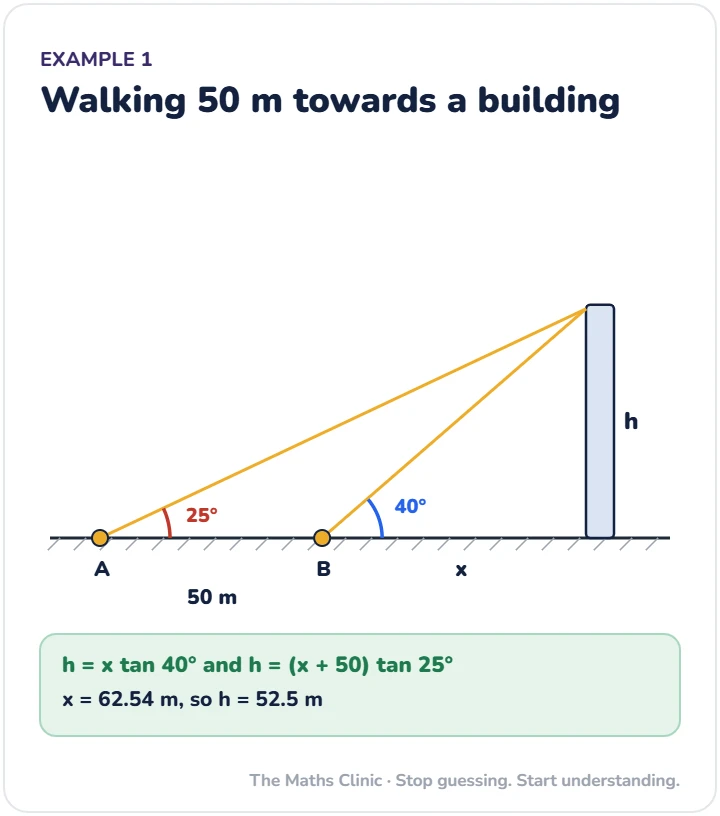
Step 1: name the unknown. Let x be the distance from B to the foot of the building. A is 50 m further away, so A is (x + 50) m from the foot.
Step 2: triangle at B. tan 40° = h ÷ x. Multiply both sides by x:
h=x\tan 40^\circ
Step 3: triangle at A. tan 25° = h ÷ (x + 50). Multiply both sides by (x + 50):
h=(x+50)\tan 25^\circ
Step 4: set them equal. Both are h, so x tan 40° = (x + 50) tan 25°.
Step 5: expand the bracket. x tan 40° = x tan 25° + 50 tan 25°.
Step 6: collect the x terms. Take x tan 25° from both sides: x tan 40° − x tan 25° = 50 tan 25°. Factorise: x(tan 40° − tan 25°) = 50 tan 25°.
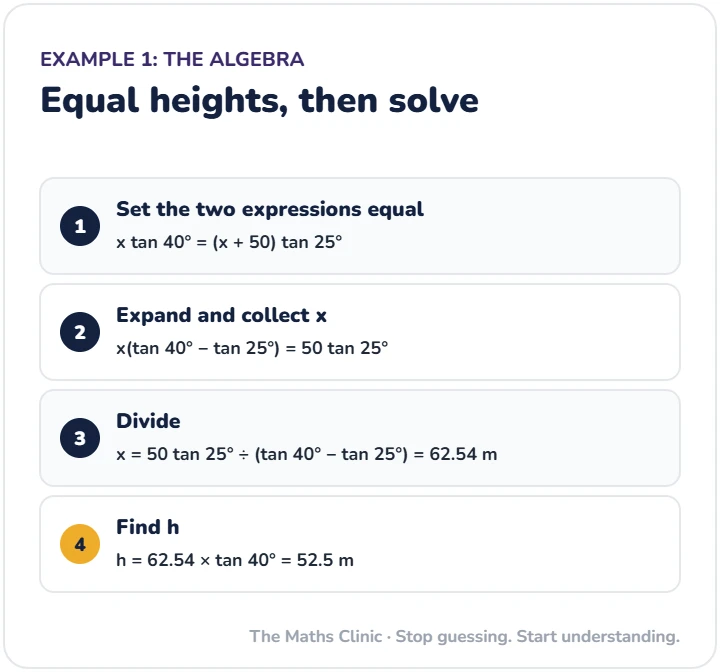
Step 7: put in the values (4 d.p.). tan 40° = 0.8391 and tan 25° = 0.4663. So x = (50 × 0.4663) ÷ (0.8391 − 0.4663) = 23.315 ÷ 0.3728 = 62.54 m.
x=\dfrac{50\tan 25^\circ}{\tan 40^\circ-\tan 25^\circ}=62.54\text{ m}Step 8: find h. h = 62.54 × 0.8391 = 52.48, so the building is 52.5 m high (1 d.p.).
h=62.54\tan 40^\circ=52.5\text{ m}Check. From A: (62.54 + 50) × tan 25° = 112.54 × 0.4663 = 52.48 m. Both triangles give the same height. ✔
The wrong way. Using 50 m as the distance from A to the foot. 50 m is only the gap between A and B.
Example 2: two points on opposite sides
P and Q are on opposite sides of a vertical tower and 60 m apart, in line with its foot. The angles of elevation of the top of the tower from P and Q are 35° and 50°. Find the height of the tower.
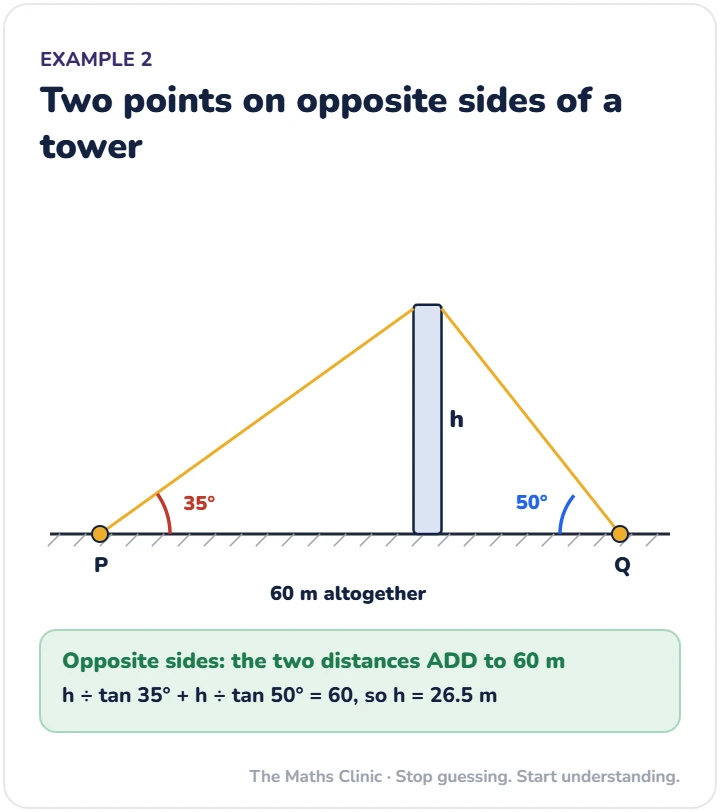
Step 1: each distance in terms of h. From P: tan 35° = h ÷ (distance from P), so distance from P = h ÷ tan 35°. In the same way, distance from Q = h ÷ tan 50°.
Step 2: the two distances add up to 60 m, because P and Q are on opposite sides of the tower:
\dfrac{h}{\tan 35^\circ}+\dfrac{h}{\tan 50^\circ}=60Step 3: work out each fraction’s number. 1 ÷ tan 35° = 1.4281 and 1 ÷ tan 50° = 0.8391. So h × 1.4281 + h × 0.8391 = 60, which is h × 2.2672 = 60.
Step 4: divide. h = 60 ÷ 2.2672 = 26.46 m.
h=26.5\text{ m}Check. Distance from P = 26.46 × 1.4281 = 37.79 m; from Q = 26.46 × 0.8391 = 22.20 m. 37.79 + 22.20 = 59.99 ≈ 60 m. ✔
The wrong way. Subtracting the distances. On opposite sides they add; on the same side they differ.
Example 3: when the observer has a height
A girl whose eyes are 1.5 m above the ground stands 20 m from a tree. The angle of elevation of the top of the tree from her eyes is 30°. Find the height of the tree.

Step 1: draw the eye-level line. The angle is measured from her eyes, 1.5 m above the ground. So the triangle sits on a horizontal line at eye level, not on the ground.
Step 2: the part above eye level. Call it k. tan 30° = k ÷ 20, so k = 20 × tan 30° = 20 × 0.5774 = 11.55 m.
k=20\tan 30^\circ=11.55\text{ m}Step 3: add the eye height.
\text{tree}=1.5+11.55=13.05\text{ m}The wrong way. Giving 11.55 m as the height of the tree. That is only the part above her eyes.
The mistake examiners keep seeing
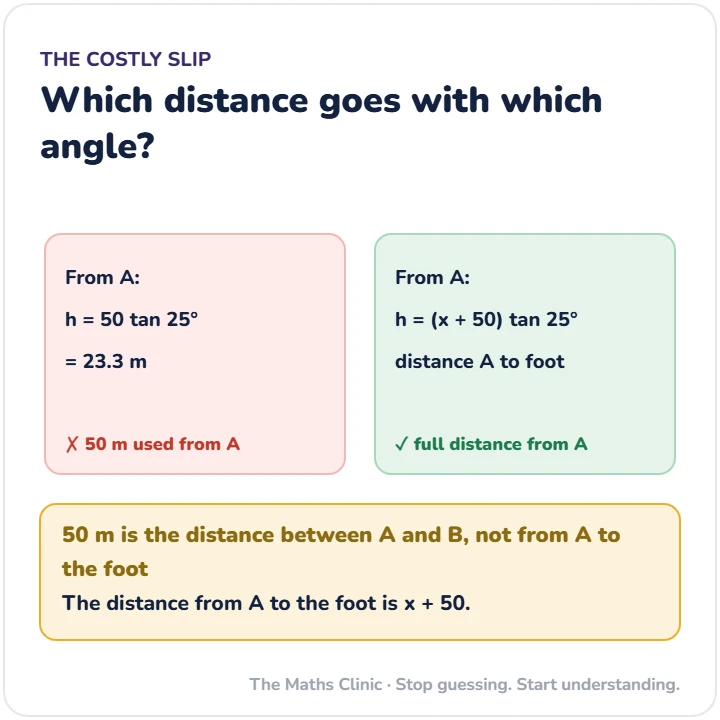
- Using the gap between the two points as the distance from the far point to the foot.
- Adding distances when the points are on the same side (or subtracting when they are on opposite sides).
- Forgetting the observer’s eye height.
- Rounding \tan 25^\circ to 0.47 too early: the final answer drifts.
📋 What the WAEC Chief Examiner reported
- 2012: an elevation question involving two poles needed a sketch first, and most candidates never got that far.
- 2020: solving problems on angles of elevation and depression was named as a weakness.
- 2025, Question 9: a two-object elevation question (mast and pillar) was poorly answered because many could not draw the diagram.
What WAEC recommends
In 2021 the Chief Examiner advised: “Candidates should be advised to read carefully and understand the demands of questions before attempting them.” In elevation questions, reading carefully means turning every sentence into a mark on your sketch before you calculate. This lesson shows you how.
How to win these marks back
- Draw both lines of sight to the same top point.
- Name one unknown distance, usually from the nearer point to the foot.
- Write the shared height in two ways and set them equal.
- Keep four decimal places for the tan values until the final answer.
Source: WAEC Chief Examiners’ Reports, WASSCE (SC) 2025, Ghana: Mathematics (Core); WAEC Chief Examiners’ Reports, Mathematics (Core), 2012, 2020
Try it now
Cover the solutions. Sketch first, mark the right angle, then write h twice. Give answers to 2 decimal places unless the question says otherwise.
Question 1
From a point A, the angle of elevation of the top of a tower is 30°. From B, 40 m nearer the tower, it is 60°. Find the height of the tower.
Question 2
Two points on opposite sides of a pole are 100 m apart. The angles of elevation of the top of the pole from them are 45° and 30°. Find the height of the pole.
Question 3
A man whose eyes are 1.7 m above the ground stands 15 m from a flagpole. The angle of elevation of the top of the flagpole from his eyes is 42°. Find the height of the flagpole.
Question 4
From the top of a building 20 m high, the angle of elevation of the top of a tower is 25°. From the foot of the building, the angle of elevation of the top of the tower is 40°. Find the height of the tower to 1 decimal place.
Question 5 (WASSCE style)
From the top of a cliff 80 m high, the angles of depression of two boats in line with the foot of the cliff, on the same side, are 45° and 30°. Find the distance between the boats.
Question 6 (real life)
A student whose eyes are 1.6 m above the ground stands 25 m from a classroom block. The angle of elevation of the top of the block is 28°. Find the height of the block to 1 decimal place.
Solutions
Solution 1
Let x = distance from B to the foot. From B: h = x tan 60° = x√3. From A: h = (x + 40) tan 30° = (x + 40) ÷ √3. Set equal: x√3 = (x + 40) ÷ √3. Multiply both sides by √3: 3x = x + 40. So 2x = 40 and x = 20. h = 20√3 = 34.64 m. Check from A: 60 × tan 30° = 60 × 0.5774 = 34.64 ✔
Solution 2
Distance from the 45° point = h ÷ tan 45° = h. Distance from the 30° point = h ÷ tan 30° = h√3. Opposite sides, so h + h√3 = 100. Factorise: h(1 + √3) = 100, so h = 100 ÷ 2.7321 = 36.60 m. Check: 36.60 + 63.40 = 100 ✔
Solution 3
Part above eye level = 15 × tan 42° = 15 × 0.9004 = 13.51 m. Add the eye height: 13.51 + 1.7 = 15.21 m.
Solution 4
Let d = distance between the building and the tower, H = height of the tower. From the foot: H = d tan 40°. From the top (20 m up): H − 20 = d tan 25°. Subtract the second from the first: 20 = d(tan 40° − tan 25°) = d × 0.3728, so d = 53.65 m. H = 53.65 × 0.8391 = 45.02, so H = 45.0 m. Check: H − 20 = 25.02 and 53.65 × 0.4663 = 25.02 ✔
Solution 5
The angle of depression from the top equals the angle of elevation from the boat (alternate angles). Near boat: distance = 80 ÷ tan 45° = 80 m. Far boat: distance = 80 ÷ tan 30° = 80√3 = 138.56 m. Same side, so subtract: 138.56 − 80 = 58.56 m.
Solution 6
Part above eye level = 25 × tan 28° = 25 × 0.5317 = 13.29 m. Add 1.6 m: 14.89 m, so the block is 14.9 m high.
📘 New SHS curriculum link
This is Year 2 of the new SHS Mathematics curriculum (2.3.2.LO.2): calculate angles of elevation and depression in everyday life situations and apply the knowledge to calculate distances and heights.
For parents
Read Question 6 aloud and ask your child to sketch it before doing any working: the ground, the block, the student, and the line of sight. If the sketch shows the 1.6 m eye height and the 25 m distance in the right places, the hardest part is already done.
Frequently asked questions
Why do I get a negative distance?
Usually the angles are swapped. The larger angle of elevation always belongs to the nearer point.

Can I use the sine rule instead?
It works, but the sine rule was not found in the 2023 SHS curriculum. The two-equation method uses only tan and is what this lesson recommends.
What to do next
If drawing the diagram from the words is where you get stuck, start with Angle of Elevation and Depression: Meaning, Diagrams and the Difference. Then practise in the Practice Zone.
Keep learning
- Angle of Elevation and Depression Questions With Solutions
- SOHCAHTOA: Meaning, Formula and Examples
- WAEC Chief Examiner’s Report 2025 for Mathematics
📚 See every lesson in the Trigonometry Clinic
✏️ Practise trigonometry in the Practice Zone

Written by
Dickson Sarpong
NTC-certified SHS Mathematics teacher in Ghana with WAEC marking experience, and author of The Bridge Series textbooks. Every lesson here is built around the mistakes WAEC examiners keep reporting.
About DicksonStuck? Ask a question
Want the whole topic, step by step? My textbooks, The Bridge to Mathematics and The Bridge to Additional Mathematics for SHS, follow the new curriculum and rebuild the basics as you go.
Read a free chapter →